Thursday, February 26, 2026
Home Blog Page 594

Lettuce Eat Local: What a soup-er idea

0

Amanda Miller
Columnist
Lettuce Eat Local


“Soup.” “Um, soup!” “Mac and cheese with hot dogs.” “…prob’ly soup.”

It was a Wednesday evening at our weekly kids’ program, and we were going around the circle with our little group of kindergarteners and first-graders, naming favorite things in a few categories. I had noticed in the “favorite candy” round that Sour Patch Kids got very popular after Brian mentioned them, yet I was willing to give the kids the benefit of the doubt. 

When I started “favorite food” off, however, by saying that I like basically any kind of soup best, it seemed a bit too much of a coincidence that all these six- and seven-year-olds would also vote for soup. I think we often underestimate children and our own expectations can put them in a culinary box, but also, there’s no way their parents would corroborate this particular spoken preference. 

The uncomfortable looks on the kids’ faces when I suggested I could just bring soup for our next Bonus Snack confirmed my suspicions. 

Even though I know their stated stance on favorite foods won’t go with them when they leave our classroom, I think it’s adorable — or should I say, soup-er — that they wanted to match me. And I really do love essentially everything that fits in the category of soup, so I’m more than happy to be a role model for a few minutes. 

I can, and do, eat all kinds of soup in all kinds of meteorological conditions, but these days of chill and clouds truly are Soup Weather. Just as the plunging temperatures and turning leaves awaken an almost desperate desire for baked goods like I talked about last week, so does the changing of seasons usher in a particular deep-seated eagerness for pulling out the big kettles and ladling up cozy bowls of steaming liquid. I consider stews, chowder, chilis, et cetera, all within the extremely broad classification of “soup,” and I consider them all appropriate. It can be brothy or creamy, chunky or smooth, light or hearty, even hot or cold: if it’s a soup, I’ll probably like it. 

I’m not sure what it is that appeals to me so much about eating runny food with a spoon…and when I say it like that, I really don’t know what it is, but it’s there. And it’s not just because I’m pregnant. This is a lifelong dedication to the finer things in life; i.e., soup. 

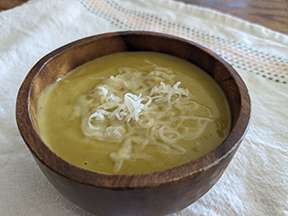
Brian does not share my affinity, and while there are certain soups he definitely enjoys, many of my favorites he categorizes as “not a meal,” meaning it fundamentally needs more girth or substance or something. So when his being gone this weekend coincided with me wearing a sweatshirt for the first time this season, I knew it was a sign for soup. I went all for it and made a big pot of broccoli cheese soup, which even I will readily admit always smells bad and usually looks bad. To make matters worse, I incorporated some vegan ideas (again, he was gone, so it was the time), so my broccoli-cheese is awkwardly light on the cheese. 

Tell you what, though, a giant bowl of this, piping hot and luxuriously smooth, was a superb addition to a windy and dreary day. And I know I’ll get to enjoy the leftovers all by myself!

Unless, of course, I bring it along to share with my kindergartners. 


Not-As-Cheesy Broccoli Soup

As I mentioned, the recipe I jumpstarted from was vegan, but hello I live on a dairy farm, so I couldn’t make it without ANY cheese. And I clearly don’t have anything against cheese, but I just like trying something different, and often feel that regular broccoli cheese soup is missing something — something the smoked paprika and nutritional yeast bring here. Unfortunately, the color does not improve with those additions, especially when blended; but fortunately, the flavor is worth it. 

Prep tips: the hard part at the end of a block of Parmesan (the rind) imparts such a lovely richness, and should blend up just fine if you have a good blender. Any strong/funky cheese will do, though, and of course it doesn’t have to be a rind part; this is just a good place to use it. Nutritional yeast sounds like a niche ingredient but it’s actually easy to find at most groceries. 

a glug of any oil/butter

a large sweet onion, diced

2 carrots, chopped

2-4 gold potatoes, cubed

1 teaspoon smoked paprika 

½ cup cashews

4 cups good chicken broth 

1 parmesan rind/a couple ounces sharp cheese

4-6 cups broccoli pieces (stems included)

¼ cup nutritional yeast

Heat oil in a soup-y pot. Add onion and saute until golden; toss in carrots and potatoes and cook a couple minutes, then stir in paprika, cashews, and broth. Bring to a boil and simmer until veg are just tender, then add in cheese and broccoli. Cover and cook until broccoli is tender but not mushy. Transfer (carefully) to a high-powered blender along with the nutritional yeast, and blend to utter creaminess (you could reserve some broccoli florets to pulse in afterwards for some texture). Season to taste, and serve with a good handful of shredded cheese to get all melty on top.

2024 Medicare Open Enrollment Begins October 15th

0

More than 572,000 Kansas residents receive health coverage through Medicare, and the time to review benefits is only days away. The program’s Fall Open Enrollment period, when you can make changes that take effect January 1 of the following year, occurs each year from October 15 through December 7.

“It’s important that Medicare beneficiaries make sure their current providers are still participating in their plan for 2024 and that the cost of any medications they need hasn’t increased,” KDADS Director of Medicare Programs Emily Blanch said. “Medicare beneficiaries can make changes to several aspects of their coverage, so it’s important to look at all the options again before you lock yourself in for another year. We encourage people to always take advantage of open enrollment because all of us have health care needs that change over time and Medicare plans change as well.”

By shopping available plans and comparing costs, beneficiaries may be able to find a Medicare health or drug plan with better coverage or a lower premium in 2024. Help is out there:

  • The Medicare Plan Finder, an online tool that helps people compare pricing between Original Medicare, Medicare prescription drug plans, Medicare Advantage plans, and Medicare Supplement Insurance (Medigap) policies, will be updated with 2024 information by October 1, 2023.
  • 1-800-MEDICARE is available 24 hours a day, seven days a week, to provide help in English and Spanish as well as more than 200 additional languages.
  • Senior Health Insurance Counseling for Kansas is a free program that offers Kansans unbiased assistance with questions about Medicare and other insurance issues. SHICK has counselors throughout the state to educate and assist the public in making informed decisions for each individual situation. This counseling services is free at l-800-860-5260.

During open enrollment, those currently enrolled may:

  • Switch from original Medicare to a Medicare Advantage plan, or vice versa
  • Switch from one Medicare Advantage plan to another, or from one Medicare Part D prescription drug plan to another
  • If you didn’t enroll in a Medicare Part D plan when you were first eligible, you can do so during open enrollment, although a late enrollment penalty may apply

If you want to enroll in a Medicare Advantage plan, you must meet some basic criteria:

  • You must be enrolled in Medicare Parts A and B
  • You must live in the plan’s service area

If you’re already enrolled in a Medicare Part D prescription plan or a Medicare Advantage Plan and you don’t want to make changes to your coverage for 2024, you don’t need to do anything during open enrollment, assuming your current plan will still be available in 2024. If your plan is being discontinued and isn’t eligible for renewal, you will receive a non-renewal notice from your carrier prior to open enrollment.

Each year, there’s a Medicare Advantage Open Enrollment Period from January 1 through March 31. During this time, if you’re in a Medicare Advantage plan and want to change your health plan, you can switch to a different Medicare Advantage Plan with or without drug coverage or go back to original Medicare and, if needed, also join a Medicare Prescription Drug Plan.

Changes to be aware of for 2024 include:

  • 21 Medicare prescription drug plans will be available with premiums varying from $0.50 to $106.70
  • 77.81 percent of people with a stand-alone Medicare prescription drug plan have access to a plan with a lower premium than what they paid in 2023
  • 92 Medicare Advantage plans are available in 2024, compared to 90 plans in 2023
  • 100 percent of people with Medicare have access to a Medicare Advantage plan
  • The average monthly Medicare Advantage plan premium changed from $7.42 in 2023 to $9.90 in 2024, representing a $2.48 change in average premium
  • Through the Inflation Reduction Act, people with Medicare prescription drug coverage who fall into the catastrophic phase of the prescription drug benefit won’t have to pay anything out of pocket during that phase for covered Medicare prescription drugs
  • There will be expanded eligibility for full benefits under the Extra Help program, meaning all Extra Help enrollees will pay no deductible, no premium, and benefit from fixed lower copayments for certain medications. Learn more about the Extra Help program, including eligibility criteria and how to apply

To help with Medicare costs, low-income seniors and adults with disabilities may qualify to receive financial assistance from a Medicare Savings Programs (MSPs). MSPs help millions of Americans access high-quality health care at a reduced cost, yet only about half of eligible people are enrolled. MSPs cover Medicare premiums and may also cover Medicare deductibles, coinsurance, and copayments if individuals meet the eligibility requirements in their state. Enrolling in an MSP offers relief from these Medicare costs, allowing people to spend money on other necessities like food, housing, or transportation.

The Low-Income Subsidy Program, also called Extra Help, is a Medicare program that helps qualifying individuals pay Part D premiums, deductibles, coinsurance, and other costs. Enrollees can save nearly $300 per year on average according to estimates. Up to three million seniors and people with disabilities could benefit from the Extra Help program but aren’t currently enrolled. Individuals who enroll in MSPs automatically qualify for help affording prescription drugs through the Extra Help program.

State-by-State Fact Sheets are available at https://www.cms.gov/files/document/2024-ma-part-d-landscape-state-state.pdf (Kansas’s Fact Sheet are found on pages 49-51).

KU News: Scroll depicting rat wedding banquet provides important insight about cooking in medieval Japan

0

From the Office of Public Affairs | http://www.news.ku.edu

Headlines

Contact: Jon Niccum, KU News Service, 785-864-7633, [email protected]
Scroll depicting rat wedding banquet provides important insight about cooking in medieval Japan
LAWRENCE — Rats in the kitchen.
Typically that implies issues with cleanliness and safety. But in medieval Japan, having rats in the kitchen could suggest an entirely different meaning.
Such is the case with “The Illustrated Rat’s Tale” (Nezumi no sōshi emaki), an anonymous Japanese picture scroll created between 1550-1650 that depicts a rat wedding banquet.
“There were quite a few stories written in medieval and early modern Japan about rats, and many of these became picture scrolls combining illustrations with text,” said Eric Rath, professor of history at the University of Kansas. “But what sets this example apart are the detailed scenes of cooking. There is only one other picture scroll that depicts cooking scenes for this period, so as a food historian, I wanted to see what I could learn from this rat story.”
The result is his article “What Rats Reveal about Cooking in Late Medieval Japan.” It examines how this artwork supplies an important source for understanding the staff and procedures for food preparation during this era and how the gendered and status-conscious division of labor reflected how food played a powerful role in the representation of authority. It appears as the cover story for the fall 2023 edition of Gastronomica: The Journal for Food Studies.
The creators of “The Illustrated Rat’s Tale” show the rodents taking on human roles, so the scroll can also be read as a representation of Japanese society.
“In other words, the way the artists depicted rats preparing for a banquet offers insights into the division of labor and workflow of kitchens in elite households in the 16th century, an age with very few other visual sources. We learn that specially trained male (rat) chefs handled prestigious tasks like carving meats and female workers performed manual labor such as milling the rice outside,” Rath said.
The professor first learned there was a copy of this scroll in the New York Public Library. He then secured a grant from the Culinary Historians of New York that allowed him to study the item in person.
In addition to general commentaries on class and society, the scroll makes some specific ones as well.
“One of the leading cultural influencers of the late 1500s was the tea master Sen no Rikyu, whom many claimed invented Japan’s traditions of the tea ceremony. He makes a cameo appearance as a rat in the picture scroll. Also it seems that rats were big fans of sake drinking as much as humans,” Rath said.
There’s no specific connection between rats and cooking in modern Japan, he said.
“No one likes to see a rat in the kitchen today, and the same was true in medieval Japan. Rats are consumers of food, and many of the stories about them are about their appetites. In the picture scroll I studied, some of the rat characters had names like Tobei the Bean-lover, Bad Taro the Glutton and Kuranojo the Rice-Chewer,” Rath said.
However, “The Illustrated Rat’s Tale” turns the idea of rats as consumers on its head by making them into producers because it is the story of a rat lord who wants to marry a human being. Thus he needs a fancy wedding banquet in the style of a shogun.
Rath said, “The wedding required an enormous and complex feast with specialty rat chefs, the medieval Japanese equivalent of the rat in the film ‘Ratatouille.’”
A 22-year veteran of KU, Rath teaches a course on the history of sushi. His book “Oishii: The History of Sushi” (Reaktion Books/University of Chicago Press, 2021) offers the first comprehensive chronicle of sushi written in English. His previous article for Gastronomica titled “Sake Journal (Goshu no nikki): Japan’s Oldest Guide to Brewing” provides the first English translation of the earliest Japanese manual for brewing sake.
As for rats, this is the first time Rath has written about them. But he has enjoyed their company at home.
“My daughter received two ‘male’ rats from her fifth grade teacher, and we learned one of them was actually female, so we had a family of pet rats soon led by Mama-Razzi and Papa-Razzi. They proved to be good pets,” he said.
Besides the insights the scroll imparts regarding foodways in late medieval Japan, Rath’s article shows the interdisciplinary nature of food history.
He said, “It’s a discipline where scholars like me frequently poach ideas from other fields and use a range of sources in writing about the past.”
-30-
————————————————————————

KU News Service
1450 Jayhawk Blvd.
Lawrence KS 66045
Phone: 785-864-3256
Fax: 785-864-3339
[email protected]
http://www.news.ku.edu

Erinn Barcomb-Peterson, director of news and media relations, [email protected]

Today’s News is a free service from the Office of Public Affairs

KU News: Study shows testimonials can open acceptance to differing opinions on controversial topics

0

From the Office of Public Affairs | http://www.news.ku.edu

Headlines

Study shows testimonials can open acceptance to differing opinions on controversial topics
LAWRENCE — New research from the University of Kansas could help communicators reach people on important topics regarding health, life, death and other difficult-to-discuss issues. A study surveyed nearly 1,500 people on their attitudes about several controversial issues, including physician-assisted suicide. When participants then read a testimonial that gave a moving account of a person’s lived experience with the issue, they were more likely to be receptive to an attitude different than their own than those who read an informative article on the same topic.

KU Engineering’s annual Tiberti lecture to focus on sustainable leadership
LAWRENCE — The chairman, CEO and founder of the first African American employee stock ownership plan corporation in Missouri will deliver this year’s J.A. Tiberti Family Lecture at the University of Kansas School of Engineering. KU alumnus Anthony Thompson, CEO of Kwame Building Group Inc., will present “Sustainable Leadership” at 2:30 p.m. Oct. 12 in the Beren Auditorium in Slawson Hall.

Letters show religious side of avant-garde icon Georges Auric
LAWRENCE — A University of Kansas professor of music and biographer of 20th century French modernist composer Georges Auric has published a new article analyzing how the young musician wrestled with religion seriously, even as he was attracted to the iconoclastic and artistically earthshaking Paris dada and surrealist movements of the 1920s. “Part of the revelation of this project, to me, was the depth and the fervor of this kid in his late teens and early 20s, just passionately diving into really heavy and deep Catholic philosophy and finding connections between that and this music that is typically regarded as atheistic,” author Colin Roust said.

Full stories below.

————————————————————————

Contact: Mike Krings, KU News Service, 785-864-8860, [email protected], @MikeKrings
Study shows testimonials can open acceptance to differing opinions on controversial topics
LAWRENCE — It’s hard to change people’s minds, especially on a topic they feel strongly about. But a new study from the University of Kansas shows that testimonials about a person’s lived experience can open people to acceptance of attitudes different than their own on controversial topics. That could go a long way in helping communicators reach people on important topics regarding health, life, death and other difficult to discuss issues, researchers say.
A study surveyed nearly 1,500 people on their attitudes about several controversial issues, including if they were in favor of or opposed to physician-assisted suicide. When they then read a testimonial that gave a moving account of a person’s lived experience with the issue, they were more likely to be receptive to an attitude different than their own than those who read an informative article on the same topic.
“At their core, testimonials are essentially the story of someone’s lived experience. They can be evocative or emotional. But much of the research on narratives tends to focus on much bigger productions like movies, television or books rather than how testimonials or simpler forms of stories affect people, but not on how effective they can be in everyday life,” said Judy Watts, assistant professor of journalism & mass communications at KU and lead author of the study. “Physician-assisted suicide is a very polarizing issue that can elicit complex and mixed emotions. It hit all the areas we are interested in with researching communication processes and persuasion about issues that involve life and death.”
Participants in the study were randomly assigned either a testimonial or an informative article on the topic, so some received a testimonial or article that aligned with their previous beliefs, while others did not. They then answered another set of questions about how they felt on the topic afterward. Those who read testimonials on physician-assisted suicide, whether pro or con, were the most willing to accept or consider the value of opposing views.
“Regardless of baseline attitudes, they were a little more willing to accept the persuasive argument of the testimonial, even when it differed from their own,” Watts said.
Written with co-authors Michael Slater and Emily Moyer-Gusé of Ohio State University, the study was published in the journal Communication Research.
The findings can help communicators craft messages that are more likely to effectively reach their target audiences, especially if it involves a controversial or sensitive topic, the researchers wrote. During the COVID-19 pandemic, testimonials were used frequently to encourage people to take the vaccine, encourage their family members to do so and to take other protective measures. Those came at a time when there was much public debate about the vaccines, masking, business and school closures and other measures that elicited strong reactions.
While movies and larger productions have long known the influence of an engaging story on audiences, many communicators do not have the budgets or other resources to craft such an elaborate message. The findings also show that testimonials can be effective in eudaimonic situations, or when people are striving to do what is meaningful, even if it is difficult to achieve. In a media-saturated environment it is difficult to produce messages that reach people, and better understanding the effectiveness of certain types of communications can help, especially those with limited budgets and means, reach their target audiences, researchers said.
Watts, who conducts research on the influence of media on individuals’ emotional responses, said she hopes to continue studying the effects of testimonials on other topics, including those that might not be as controversial but are still emotionally fraught, such as end-of-life conversations about whether to resuscitate and end-of-life wishes.
“A thoughtful and emotional testimonial can help reach people. We’ll continue to study what happens when people encounter testimonials on topics that might not be easy to discuss but are nonetheless important for health-related decision making and behaviors,” Watts said.
-30-
————————————————————————
The official university Twitter account has changed to @UnivOfKansas.
Refollow @KUNews for KU News Service stories, discoveries and experts.


————————————————————————

Contact: Cody Howard, School of Engineering, 785-864-2936, [email protected], @kuengineering
KU Engineering’s annual Tiberti lecture to focus on sustainable leadership
LAWRENCE — The chairman, CEO and founder of the first African American employee stock ownership plan corporation in Missouri will deliver this year’s J.A. Tiberti Family Lecture at the University of Kansas School of Engineering.
Anthony Thompson, CEO of Kwame Building Group Inc., based in St. Louis, will deliver this year’s lecture at 2:30 p.m. Oct. 12 in the Beren Auditorium in Slawson Hall. Thompson’s lecture is titled “Sustainable Leadership.”
“I hope the students discover that leadership is learned and not taught. In order to have longevity in this industry, leadership must be sustained,” Thompson said. “There are various ways for an organization to sustain leadership at a high level.”
Thompson received two undergraduate degrees from the University of Kansas, in architectural engineering and environmental design. He earned a master’s degree in civil engineering/construction management from Washington University and has a Master of Business Administration from Webster University.
Thompson said his time at KU served as a springboard for a productive career in the engineering industry.
“KU prepared me for my career in numerous ways — culturally, professionally and personally. The environment is conducive to ‘real world’ challenges,” Thompson said.
Thompson’s career achievements include distinguished alumni awards from KU, Webster University and Washington University; two-time inclusion on the St. Louis Business Journal’s Most Influential Leaders; and being named the 2021 St. Louis American Salute to Excellence in Business Honoree.
The J.A. Tiberti Family Lecture began in 2011 through a contribution from members of the Tiberti family to the KU Department of Civil, Environmental & Architectural Engineering. Topics focus on ethics, ingenuity, entrepreneurship and issues for the education, personal growth and professional development benefit of students.
-30-
————————————————————————
Subscribe to KU Today, the campus newsletter,
for additional news about the University of Kansas.

http://www.news.ku.edu
————————————————————————

Contact: Rick Hellman, KU News Service, 785-864-8852, [email protected], @RickHellman
Letters show religious side of avant-garde icon Georges Auric

LAWRENCE — As biographer of 20th century French modernist composer Georges Auric, Colin Roust was somewhat chagrined to learn for the first time – immediately after publishing his book in 2020 — of dozens of letters discussing religious and artistic philosophy the young Auric exchanged with leading Catholic intellectuals of his day.

Perhaps the University of Kansas School of Music associate professor shouldn’t have felt badly.

“His widow told me that when she knew him in the 1970s and ’80s, he wasn’t a practicing Catholic and hadn’t been for a long time,” Roust said. “He never talked about Catholicism or faith or anything. She had no idea about this, either.”
So Roust dove into the archive. The resulting article, “Georges Auric’s Letters to Jacques and Raïssa Maritain,” was just published in The Musical Quarterly.
The letters show the young musician wrestling with religion seriously, even as he was attracted to the iconoclastic and artistically earthshaking Paris dada and surrealist movements of the 1920s.
“Part of the revelation of this project, to me, was the depth and the fervor of this kid in his late teens and early 20s, just passionately diving into really heavy and deep Catholic philosophy and finding connections between that and this music that is typically regarded as atheistic,” Roust said.
Auric connected with the older Maritain couple over their shared interest in the philosophies of St. Thomas Aquinas — essentially concluding that an artist glorifies God by creating art that is a pure and unfiltered reflection of their spirit.
Auric’s unhappy though not battle-scarred service in the French army during World War I is covered in the letters, too.
For some time after the war, and always privately, even as Auric grew closer to dada and surrealist figures like Jean Cocteau, Tristan Tzara and André Breton, Auric and Jacques Maritain wrestled with the religious implications of the artistic innovations of such “pagan” figures as Stravinsky, Picasso and Proust.
“These letters also provide interesting insights in Jacques’ writings. Auric read drafts of some of Maritain’s books, offering suggestions and copy edits. And whenever Maritain discusses musical aesthetics, he refers to the specific examples that Auric mentions in these letters,” Roust said.
This continued even after Auric became critically canonized as one of Les Six modernist composers in 1920. Roust writes that there was a break with the Maritains in 1926, when the composer wrote the music for a satirical ballet that Jacques Maritain considered sacrilegious.
“Dada is a kind of anti-art movement,” Roust said. “They’re trying to radically upset all the norms of art and what we think we know about art, and it’s seen as a very atheistic kind of movement. In part, it’s reacting to close ties between religion and art of all kinds. And Les Six is kind of the same thing. They’re reacting to composers in the 19th century who brought sacred overtones to their music — people like Richard Wagner and even Debussy, to an extent … and they’re radically thinking about music that is of the moment and of the modern day. It’s inspired by circuses, street fairs and that sort of thing. It’s popular music, getting as far away from the church as possible.
“And to suddenly encounter a religious justification for this ultramodern music, it just really complicates it in an unexpected way.”
-30-
————————————————————————

KU News Service
1450 Jayhawk Blvd.
Lawrence KS 66045
Phone: 785-864-3256
Fax: 785-864-3339
[email protected]
http://www.news.ku.edu

Erinn Barcomb-Peterson, director of news and media relations, [email protected]

Today’s News is a free service from the Office of Public Affairs
KU News: STARTUP Central project will educate and support biomedical researchers turning innovations into new companies

0

From the Office of Public Affairs | http://www.news.ku.edu

Headlines

STARTUP Central project will educate and support biomedical researchers turning innovations into new companies
LAWRENCE — Bringing an idea from a lab to patients and consumers can be a complicated and intimidating process involving patents, governmental regulations, product development, business structuring, hiring issues and many more complex considerations. Now, a federally funded $3 million initiative based at the University of Kansas will empower biomedical researchers in public universities and colleges across several Plains states to carry their innovations to the marketplace.

‘Unequal Sisters’ book provides revolutionary perspective on US women’s history
LAWRENCE — A University of Kansas professor is the co-editor of “Unequal Sisters: A Revolutionary Reader in U.S. Women’s History.” The fifth edition of this volume first published in 1990 — and the first to include “revolutionary” in its title — builds on its goal of emphasizing feminist perspectives on race, ethnicity and sexuality while also highlighting queerness, transgender identity, disability, the rise of the carceral state and the militarization of migration.

Study shows little improvement in mandated disaster plans, despite required updates
LAWRENCE — Hurricanes, floods, heat waves and other disasters are striking the United States with increased severity and frequency, and since 2000 the Federal Disaster Mitigation Act has required states and local jurisdictions to have plans in place to reduce damages from such events. A new study from the University of Kansas has found little improvement over time to these plans in spite of regularly required updates.

Full stories below.

————————————————————————

Contact: Brendan Lynch, KU News Service, 785-864-8855, [email protected], @BrendanMLynch
STARTUP Central project will educate and support biomedical researchers turning innovations into new companies
LAWRENCE — Bringing an idea from a lab to patients and consumers can be a complicated and intimidating process involving patents, governmental regulations, product development, business structuring, hiring issues and many more complex considerations.
Now, a $3 million initiative based at the University of Kansas will empower biomedical researchers in public universities and colleges across several Plains states to carry their innovations to the marketplace.
The effort involves both a private firm based at KU Innovation Park, Continuum Educational Technologies PBC, and KU researchers working under a new $3 million grant from the National Institutes of Health’s IDeA Regional Entrepreneurship Development (I-RED) program.
The three-year project is called Smart Tools to Accelerate Research Translation by Uplifting Participants for the Central IDeA State Region, or STARTUP Central. Currently, the STARTUP Central team is developing an online educational curriculum to train academic researchers on how to commercialize their innovations.
“The core idea of the product is to adapt existing educational resources currently delivered through traditional methods, such as courses and in-person events, into a smart online educational product,” said Lisa Friis, professor and chair of mechanical engineering at KU, who is leading work on the university side of the grant as principal investigator. “We’re collaborating with experts in educational psychology, including individuals from KU, to better understand how adult learners acquire knowledge. This will inform the development of the product, ensuring that faculty, staff and students can engage with the material at their own pace on their own time while maintaining high levels of engagement and comprehension.”
The launch of the smart educational training product, called InspireU2 iTi (iTi stands for “innovation, translation, impact”), will take place with two pilot programs based at public higher education intuitions in North and South Dakota, Nebraska, Kansas and Oklahoma.
STARTUP Central will soon solicit proposals from faculty, staff and student researchers in those states for biomedical innovations with commercial promise.
“The proposals could be on pharmaceuticals, medical devices or diagnostics — any medical product that could go forward and eventually help patients,” Friis said. “We’ll focus on assisting faculty, staff and students in learning how to transform their ideas into commercial ventures and startup companies, as smaller enterprises are often the stepping stones to larger corporations. In our region, not many people go down this pathway, which can make it challenging to forge ahead with the inherent high risks associated with startups. We aim to inspire academics and increase their probability of success in this process to make a positive impact on the world, despite these challenges.”
The self-paced lessons are tailored to fit into the busy lives of research professionals and students. Some lessons are inspirational, such as case studies of academic entrepreneurship, while others are purely practical, such as instruction on how to set up a company and apply for Small Business Innovation Research (SBIR) and Small Business Technology Transfer (STTR) programs.
“Each lesson is typically between five and 20 minutes, with each module consisting of five to nine lessons,” Friis said. “This concise format is designed to maintain engagement and provide value without overwhelming busy professionals, who often work on the lessons during evenings or weekends. It’s also flexible enough to fit into short breaks during the day. Furthermore, each lesson offers the option for a deeper dive through external resources, allowing individuals to customize their learning experience to their desired level of depth.”
Remote conferencing will enable STARTUP Central to connect participants in the first two pilot programs to experts, potential CEOs, funding sources and supportive peers, as well as offer one-on-one guidance as supplements to the online education.
“The STARTUP Central program will help bridge the gap between groundbreaking discoveries and real-world solutions,” said Adam Courtney, co-principal investigator of the initiative and interim CEO of KU Innovation Park, as well as president of Continuum Educational Technologies. “It’s a catalyst for innovation. By providing tools to faculty and research staff, the program can foster both health advancements and transformative economic opportunities.”
Indeed, biomedical startups can have economic benefits to nearby public institutions and regions. According to the NIH, the U.S. biomedical industry contributed over $69 billion to the nation’s gross domestic product last year.
“This project has the potential to be a game-changer for universities and their surrounding communities, including KU,” said Tricia Bergman, associate vice chancellor for economic development at KU, who is serving as assistant director of STARTUP Central. “By empowering our biomedical researchers and facilitating their journey from lab to market, we’re not only fostering innovation but also driving economic growth and improving health care outcomes. We look forward to the positive impact it will bring.”
During the pilot programs, feedback on and assessment of InspireU2 iTi will be used to further refine the modules. Afterward, the product will be rolled out more broadly to biomedical researchers who hope to bring their advances to patients in the marketplace. InspireU2 iTi is designed to be adaptable to other technology sectors, thus helping with the translation of research into products in other areas in the future.
“It’s very exciting to be able to do this,” Friis said. “This has been a passion of mine — and I know it’s a passion for Adam and Tricia as well — to really help people understand how to go forward and take the research results and ideas you have and make a difference in the world through translation.”
-30-
————————————————————————
The official university Twitter account has changed to @UnivOfKansas.
Refollow @KUNews for KU News Service stories, discoveries and experts.


————————————————————————

Contact: Jon Niccum, KU News Service, 785-864-7633, [email protected]
‘Unequal Sisters’ book provides revolutionary perspective on US women’s history
LAWRENCE — When the first “Unequal Sisters” volume came out in 1990, its multicultural feminist essays focused on establishing that women of color were important to acknowledge and understand as key figures in U.S. history.
“I won’t say that’s a fact we take for granted. But now we can spend our time focusing on the nuances about people’s experiences,” said Kim Warren, associate professor of history at the University of Kansas.
“We can also expand our scope and our reach — temporally and geographically — and challenge previous notions about gender identity. We have the privilege of spending our scholarly efforts on digging into a much richer, multivocal past.”
Warren is one of the editors on the new fifth edition titled “Unequal Sisters: A Revolutionary Reader in U.S. Women’s History.” Building on its goal of emphasizing feminist perspectives on race, ethnicity and sexuality, this edition also highlights queerness, transgender identity, disability, the rise of the carceral state and the militarization of migration. It’s published by Routledge.
Co-edited with Stephanie Narrow, Judy Tzu-Chun Wu and Vicki Ruiz, this edition is the first to feature the word “revolutionary” in its subtitle.
“With this edition, we wanted to interrogate the initial concept of what it meant to bring together scholarship from the various fields in U.S. women’s history,” she said. “By revolutionary, we’re trying to say that this field has exponentially grown. It is entirely different, entirely larger and more inclusive than it was 30 years ago.”
Warren, who is also associate dean of academic affairs for KU’s Edwards Campus/School of Professional Studies, said despite the book’s revolutionary designation, its editors were intent on honoring all those who pioneered the field and made it possible for scholars like her to do the work that she does. As a way to connect with the original volume, inaugural co-editor Ruiz was invited to join the three new editors.
“What we’re attempting to do is model feminist scholarship as multigenerational work that is building on the work done by previous generations,” she said.
The 36 chapters include pieces on Indigenous women, Mexican farmworkers, boarding schools, the racialization of sexual violence and U.S. colonialism in Puerto Rico. One of the more provocative chapters is titled “Transgender: A Useful Category?: Or, How the Historical Study of ‘Transsexual’ and ‘Transvestite’ Can Help Us Rethink ‘Transgender’ as a Category,” written by Marta Vicente, KU professor of history.
“Dr. Vicente’s work on transgender scholarship is groundbreaking. It is not only influencing the way we think about categories of gender, but it’s also changing the way we teach in WGSS (women, gender, and sexuality studies) programs,” Warren said.
Warren said that Vicente’s work is also notable for being transnational.
She said, “Marta takes a global approach to identities that aren’t rooted in or limited by geography. Her work also reaches back into much earlier periods than a lot of the work of other contemporary scholars.”
A KU faculty member since 2004, Warren is a scholar of gender and race in African American and Native American studies, history of education and U.S. history. Her previous books include “The Quest for Citizenship: African American and Native American Education in Kansas, 1880-1935” (University of North Carolina Press, 2010) and “Transforming the University of Kansas: A History, 1965-2015” (University Press of Kansas, 2015).
“The revolutionary goal with a project like ‘Unequal Sisters’ is helping readers understand that this is history — this is not a subcategory of the historical past,” Warren said. “The voices and lives that are highlighted in a book like this are central to our understanding of human history.”

-30-
————————————————————————
Subscribe to KU Today, the campus newsletter,
for additional news about the University of Kansas.

http://www.news.ku.edu
————————————————————————

Contact: Mike Krings, KU News Service, 785-864-8860, [email protected], @MikeKrings
Study shows little improvement in mandated disaster plans, despite required updates
LAWRENCE — Hurricanes, floods, heat waves and other disasters are striking the United States with increased severity and frequency, and since 2000 the Federal Disaster Mitigation Act has required states and local jurisdictions to have plans in place to reduce damages from such events. A new study from the University of Kansas has found little improvement over time to these plans, in spite of regularly required updates.
Plans to mitigate risk from natural hazards hold the potential to help states and local communities proactively steer development into safer areas and reduce exposure of existing housing, businesses, roads and other vital assets. But an analysis of two waves of plans from 84 jurisdictions found a mediocre overall quality of plans and little overall improvement from the first wave adopted in the late 2000s to the second wave adopted in the mid-2010s.
“It’s like a homework assignment that could be great for helping students learn, but sadly most just aim for the minimum standard to get by,” said Ward Lyles, associate professor of public affairs & administration at KU and lead author of the study. “Nationally, the evidence shows a tremendous increase in the amount of hazard planning since passage of the Disaster Mitigation Act 20 years ago. But we wondered if the plans get better over time, and the results unfortunately show us not really.”
Lyles and colleagues analyzed disaster mitigation plans from jurisdictions in Florida, Georgia and North Carolina. The states share similar hazard exposures and recent disaster experiences, while state policy frameworks that shape local planning vary, the authors wrote. The plans were coded on four criteria: public engagement, plan integration, land use policies and property protection policies.
The study, written with co-authors Yiwen Wu and Kelly Overstreet, doctoral students in public affairs & administration; and Elaina Sutley, associate professor of civil, environmental & architectural engineering, all of KU, was published in the Journal of Planning Education and Research.
For public engagement, scores showed improvement. Involving the public in forming plans and communicating them to communities was the one area in which scores improved notably. Plan integration, or making mitigation plans work together with other types of plans like land use and transportation plans, showed only modest improvement.
“One of the most concerning findings is that too often planning for disasters occurs in a silo separate from other types of planning that shape our future risk,” Lyles said. “As we see time and again, whether with hurricanes in the southeast, fires out west or in Hawaii, and even with heat waves, communities make short-term choices to promote development in places that are known to be at high risk from devastating events.”
In terms of land use and property protection, scores showed no marked improvement. The former is difficult to legislate as it is strongly influenced by local political will, he said.
“It may be easy to say ‘don’t build in a flood plain,’ but the growth machine industry, which profits by developing and selling real estate, have been historically very influential on local governments,” Lyles said. “It is in their interest to maintain maximum flexibility and prevent or reduce land-use controls. And, as we’ve seen tragically time and again, even the best warning systems and engineered protections like levees and dams have failure points.”
The DMA requires disaster mitigation plans but leaves enforcement up to state and local governments, so requirements vary.
“It’s less about knowledge and more about political will,” Lyles said. “Floods do their worst damage in low-lying areas and fires in areas prone to burning. We are not compelled to allow development in high-risk areas that are cheap, scenic or otherwise desirable but ill-advised. But the Federal Emergency Management Agency – and the entire approach to disaster management in the United States – fails to require the type of land-use planning needed in the 21st century.”
The authors cite research that has found reducing risks due to natural disasters like floods and heat waves, especially through land use, can save $1 for every $6 invested and that higher plan quality is linked to lower hazard losses.
The findings help improve understanding of how top-down planning mandates influence local planning and suggest that plans cluster just above the minimum for jurisdictions to remain eligible for federal funding. They also provide insight into how state and federal officials can update the DMA of 2000 to meet increasingly complex demands of long-term risk reduction, especially in the face of climate change, the authors wrote.
“With proactive, pre-event hazard planning, the idea is to talk through hard decisions when you are not in crisis, commit to those decisions and then hold firm to those decisions when a disaster occurs,” Lyles said. “Otherwise, the urgency to get back to normal as soon as possible after a disaster means repeating the same mistakes that created the disaster conditions in the first place.”
-30-
————————————————————————

KU News Service
1450 Jayhawk Blvd.
Lawrence KS 66045
Phone: 785-864-3256
Fax: 785-864-3339
[email protected]
http://www.news.ku.edu

Erinn Barcomb-Peterson, director of news and media relations, [email protected]

Today’s News is a free service from the Office of Public Affairs