Thursday, February 26, 2026
Home Blog Page 599

Farm Estate and Succession Planning Resources

0

Resources to better understand and enact farm succession planning

A common misconception in farm estate and succession planning is that an estate plan is only used after an individual passes away. In truth, a comprehensive estate plan should also provide for possible long-term care needs, dictate health care directives and designate a trusted individual to oversee desired funeral arrangements.

In order to help the farming community better understand estate planning, Iowa State University Extension and Outreach recently published a 100-page guide called “Estate and Succession Planning for the Farm.”

This educational resource covers property ownership, wills and trusts, estate and gift tax, income tax planning, business entity planning and more.

The workbook is designed to educate and answer questions that may arise during the planning process. It is intended to complement – not replace – advice from legal and tax experts. It includes 12 chapters, as well as a glossary of terms and blank pages for personalized input and planning.

“This workbook serves as a valuable guide during any phase of the planning process,” said Ann Johanns, program specialist with ISU Extension and Outreach. “It guides the reader through complex topics by providing illustrative examples throughout and sharing common aspects of estate planning to consider.”

The workbook will be highlighted during an Oct. 11 webinar for women farmland owners, in a session called “End-of-Life Taxes and Expenses,” featuring Kitt Tovar Jensen, staff attorney with the Center for Agricultural Law and Taxation and moderated by Johanns, from noon to 12:45 p.m.

A second webinar, called “Slowing Water Down,” will be held Dec. 13 from noon to 12:45 p.m. with Catherine DeLong, water quality program manager with ISU Extension and Outreach.

The bi-monthly series is part of a multi-year project led by the extension farm management team’s women in ag program to better understand and meet the educational needs of women farmland owners.

Participants can select specific sessions or register for the full series. A separate invitation email will be sent for each webinar you register for with the link to join the live session. (Reminder emails will also be sent shortly before each live session.) All sessions will be recorded with a link shared via follow-up emails after each live event, and archived on the Ag Decision Maker website.

The series is offered through collaborations with Iowa State’s Center for Agriculture Law and Taxation, Water Quality Initiative, and the Department of Economics, the project is bringing comprehensive land management information to audiences of women farmland owners.

Women Managing Farmland programs and resources are financially supported by a USDA National Institute of Food and Agriculture – Critical Agriculture Research and Education grant (2021-68008-34180) and a Farm Credit Services of America gift. For information on Women Managing Farmland courses, visit the Women in Ag website.
Are pumpkins a fruit or a vegetable?

0
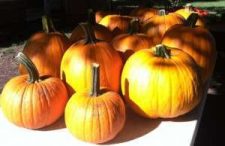
Photo credit: Rose Hill Meadowlark Farm Pumpkin Patch

Inquiring minds might want to know, is the orange orb a fruit or vegetable? The answer may surprise you! A pumpkin is, in fact, a fruit.

Joe Masabni, Ph.D., Texas A&M Agri Life Extension Service vegetable specialist in Dallas, said scientifically speaking, pumpkins are a fruit simply because anything that starts from a flower is botanically a fruit.

Why do you consider pumpkins fruit rather than a vegetable?

Usually, fruits and vegetables are named according to how they are consumed. How people eat them versus how people see them is often different.

“We tend to identify them in relation to whether we eat them as a dessert, salad or food,” Masabni said.

Consider a cucumber or tomato. People don’t typically eat those as desserts; they eat them in a salad or cooked in a meal, so they became classified as vegetables, even though they are officially fruits.

“Pumpkins are a tricky one,” he said, “because some people make soups or stews from pumpkins, which is a meal, while others make pies, which is a dessert. So that can sometimes be confusing.”

What is the difference between a fruit and a vegetable?

The difference between a fruit and a vegetable is established in how they grow.

“All plants start from seedlings,” Masabni said. “Let’s take the example of lettuce as a vegetable. It makes more and more leaves, and then you harvest it and eat those leaves. However, if you let it grow longer, it will eventually make a flower stalk and seeds for next year’s crop.”

A pumpkin starts the same; however, their flowers become the pumpkin we eat.

“It starts with a small plant and a few leaves, and as the leaves grow and more branches develop, flowers will start to bloom on the plants,” he said. “Those flowers then need to be pollinated by bees or other pollinators. Once that flower is pollinated, that flower develops into a fruit that we consume. So ultimately, any fruit relies on pollination of the flower to then grow the part of the plant that we eat.”

What other vegetables are actually fruits?

Although we may typically base our knowledge of fruits and vegetables from their sweet and savory tendencies or where they are placed in our meals, it seems that many of our regularly thought of vegetables are actually fruits, simply because they come from a flower.

Some of those often mislabeled like pumpkins include cucumbers, olives, tomatoes, eggplants, avocadoes, corn, zucchini, okra, string beans and peppers.

Now the biggest decision is how it will be consumed at your own table this holiday season. Will you consider it a vegetable in your main dish or a fruit on your dessert plate?

“The fruit and vegetable debate is a fun one that hangs on the technical horticulturist/scientific view of these plants that we consume,” Masabni said. “At the end of the day, we want to inform people, but we also want them to enjoy these plants as gardeners and at the dinner table.”

Lettuce Eat Local: The Pastry Problem

0

Amanda Miller
Columnist
Lettuce Eat Local


“When he wants something sweet, he nibbles through THREE pastries: a scone, a muffin, and a croissant.” 

Reading The Very Hungry Caterpillar Eats Breakfast with Benson brought to light a glaring lapse in his education. No, it wasn’t the numbers in this counting book he struggled with — he’s taking after his (foster) big sister, and loves counting allll the things. He had almost no trouble naming the nine colorful fruits the caterpillar likes to eat through (and to be fair, that grapefruit slice did look like an orange), and while he insists on calling the bacon (and most other meats) “ham,” he’s not entirely wrong. 

We still have some work to do, of course. He can’t always identify the numbers when written only as symbols, and he does adamantly “correct” us on multiple accounts when we come to the “Does he eat bagels for breakfast?” page. (“Yes! in fact, he tries FOUR.”). Clearly, those are doughnuts, and those are not raisins, they are candy pieces. To further imbed his faulty thinking, recently his aunt got him a doughnut with fall-colored sprinkles that matched the book’s illustration spot-on: the perfect “everything doughnut.” Whatever, child. 

No, the thing I couldn’t believe we hadn’t taught Benson yet was what a scone was. That hinges on moral failure in my book — scones are kind of My Thing, and here my very own flesh and blood has not been properly familiarized with them! 

He also didn’t know what a croissant was, but I’m not worried about that. The scone, the scone, the scone. It’s definitely not that I haven’t made any since he’s been around, but not in recent enough memory that his two-year-old brain could recall. 

There’s no time like the present, however, to fix the problem. Especially when that only requires turning on the oven and getting out the flour. 

It was serendipitous timing to uncover our educational deficiency, with the weather taking a few tentative steps into Autumn and our senses starting to call out for things warm and comforting. Scones are truly a 365-day pastry and infinitely variable as per the season, yet there’s something intrinsic that awakens this time of year in the heart — and stomach — of a baker. Plus I had friends coming over, and we needed a good fall pastry with our coffee. 

Brian and I were also just about to head to a friend’s lakehouse in Table Rock for the weekend, to get away for some time together before the baby comes as well as to celebrate our 12th anniversary. Brian really loves scones, and I really love him, so having some leftover to take along sounded like an ideal breakfast component. 

All that to say, scones are always the right idea, but they were really The right idea this week. Benson of course loved helping me make them as much as he loved eating them, so that was an unsurprising success. And now when we read about the very hungry caterpillar’s breakfast, the scone will be a source of shared joy instead of sudden horror. Even if the “ham” and “doughnuts” are still wrong. 

If only all parenting dilemmas and shortcomings were so easily remedied. Please pass the glaze. 


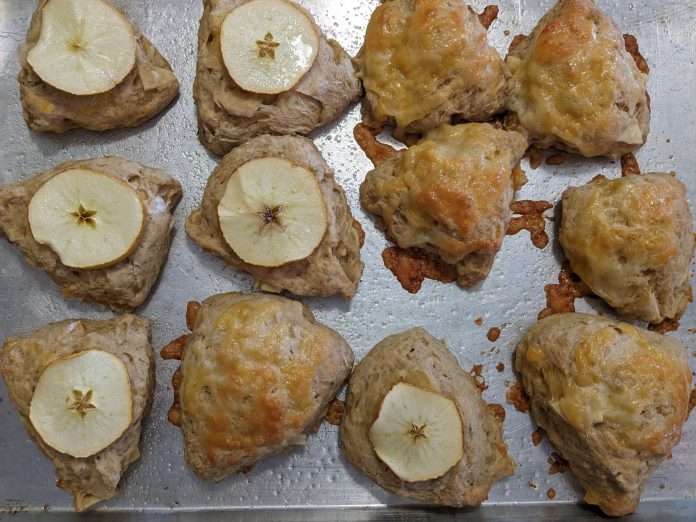
Apple Cheddar Scones

This is a flavor combo my mom loves and I’ve always been leery of, but I’ve been delving into my doubt recently and finding that in the proper situations, it’s truly delicious. The whisper of fresh rosemary pulls it all together, although sage or thyme would also be good here. This method for scones is quite different than some of my more standards ways, but it produces such soft cakey scones and is so quick and easy — which is great since Benson is on a kick of trying every single ingredient so the sooner I can get them in the oven and away from his snatching fingers, the better. (You should have seen his reaction when he stuffed a whole sprig of rosemary in his mouth.)

Prep tips: A simple glaze of powdered sugar with a pinch of salt and splash of apple cider is an unnecessary but not unwelcome finish. 

2 ¼ cups all-purpose flour

2 teaspoons baking powder

¼ teaspoon baking soda

¼ teaspoon salt

⅓ cup brown sugar

4 ounces cheddar cheese, shredded or cubed very small

6 ounces [about 1 ½ cups] peeled, diced apple

a sprig of fresh rosemary, minced

½ cup plain greek yogurt

¼ cup olive oil

¼ cup whole milk

1 egg

for topping: shredded cheese, thin apple rings, white sugar

In a mixing bowl, stir together flours, baking powder and soda, salt, and sugar. Stir in cheese, apple, and rosemary. In a separate bowl/measuring cup, whisk yogurt, oil, milk, and egg. Stir into bowl of dry ingredients. If it’s crazy sticky, add a little more flour; if not, dump it out onto a floured surface and lightly knead a few times. Divide dough in half and form into two 6-8” circles. Cut each into 6 wedges, and arrange these a couple inches apart on a lightly greased baking sheet. Top some with apple rings and some with shredded cheese, and all with a sprinkle of white sugar. Bake at 350° for 20-25 minutes, until nicely golden and cheese is browning. 

“Getting under your skin” with Varicose Veins

0


From the back of our hands to the back of our legs, pale blue blood vessels are visible just under the skin. Oftentimes these veins are flat and not painful. However when these vessels become abnormally swollen or dilated, they are called varicose veins. This swelling is caused by the valves inside the veins becoming weak and no longer sealing tightly. Varicose veins can become painful, quite large and stick out from the surface of the skin.
In order for blood to return from your feet back to the heart, the blood must be pumped up against gravity. Check valves in the veins are what keep the blood from pooling back down the legs in between heartbeats. When the heart beats (called systole), the valves open and allow the blood move upward. When the heart is paused, filling for the next beat (called diastole), the valves close and keep blood from flowing back towards the feet. As we age these valves become weak and do not fully close, then the surrounding veins become swollen with extra blood causing varicose veins to occur.
Women are also more likely to develop varicose veins than men due to hormonal changes during pregnancy and menopause. Standing or sitting in one position for long periods of time can also increase the risk of developing varicose veins since leg muscle contractions also help move the blood up against gravity. Older age, obesity, and family history are all common risk factors.
Varicose veins do not just look unsightly; they can also cause pain in the legs. They often lead to an aching or heavy feeling in the legs. Varicose veins additionally lead to burning, throbbing, itching or muscle cramping in the legs. If that is not bad enough, complications related to varicose veins can include ulcers, bleeding, or blood clots.
Unfortunately there is not a way to repair these valves once they are damaged. However, there are some things you can do to help manage varicose veins. Wearing compression stockings can help decrease swelling in the legs. Frequent movement of the legs such as pumping your ankles a few times an hour, raising your legs above the level of the heart for 15 minutes a few times each day, increasing exercise, and losing weight can all help increase blood flow.
If these measures do not give the relief you need, then it is time to talk with your doctor and discuss seeing a specialist for more advanced treatment. There are several different treatments available and they can help you find the one that is right for you. While varicose veins may be below the surface, do not let them get to the point where they really “get under your skin.”
Jill Kruse, D.O. is part of The Prairie Doc® team of physicians and currently practices as a hospitalist in Brookings, South Dakota. Follow The Prairie Doc® at www.prairiedoc.org and on Facebook and Instagram featuring On Call with the Prairie Doc®, a medical Q&A show providing health information based on science, built on trust, streaming live on Facebook most Thursdays at 7 p.m. central.