Friday, February 27, 2026
Home Blog Page 610

Lettuce Eat Local: Refrigerator clean out time

0

Amanda Miller
Columnist
Lettuce Eat Local

Especially in cooking magazines but in other publications as well, sometimes people like to ask celebrities what’s in their fridge. Often the feature comes with a full- or half-page picture of an open refrigerator, providing a visual fridge-scape and glimpse into their dining habits.
While I suppose it’s an interesting idea — we all have fridges and can relate — I can’t believe their fridges haven’t been at least some curated for the project, and even if they haven’t, do I really need to know what brand of yogurt Beyonce prefers or what vegetables Alec Baldwin likes to have on hand?
Also, while my fridge basically is always full, perhaps precariously so, it rarely ever has the same things in it, besides the staples (milk, homemade ricotta, a bunch of random fresh produce, a thousand condiments for my two-year-old). A single glimpse won’t tell you much about our eating habits, except that we do eat and it’s almost always homemade. Oh and that I like storing things in jars, or at least glass pyrex — because we all know what happens to too many leftovers in non-see-through containers.
All that said, it might have been interesting for me to take Before and After photos of my refrigerator this week. We actually have two fridges; the one in the garage is for large items, overflow produce, and longterm storage, like apples from our tree, a gallon of refrigerator pickles, and the maple syrup refilling jar.
The difference between what our refrigerators looked like a week ago versus today is rather drastic. While it’s not unusual for me to do catering for events, once a month would be about the most often I typically have them scheduled. But last week I had two fairly large events (for me) in a span of three days, coming in right after and right before an influx of more cooking classes than usual. There was just plain a lot of food being planned for, and large quantities of food coming in and going out of our house.
Just in those two events, I fed about a hundred people, so you can see why our fridge space looks very different than it had recently. The garage fridge feels almost eerily empty, and while the kitchen fridge had been full yet simultaneously awkwardly empty of food available for my poor guys to eat, it’s now replenished with desultory leftover tidbits of this and that. If you want one egg salad wrap, 12 red grapes, pork ragu but nothing to eat it on, or a whole bunch of sandwich-size-trimmed romaine, you’re in business.
Like I said, maybe I should have taken Before and After photos. But while I absolutely love being able to cater and to connect with people through food in that way, those fridges were not a glimpse into our normal life. Thank goodness. This week was not a sustainable pace for our household, but Brian and Benson handled it like champs. It’s a true gift to do what I love in my own kitchen that I love on our own farm that I love, more often than not with the two-year-old I love — it’s gotten so bad I literally can’t peel an orange in the kitchen workspace before my son has clambered onto a stool and is sitting on the counter to see what I’m doing and how he can “help.” But I wouldn’t have it any other way.
Now here’s to hoping we have enough leftovers to last us a few days before I need to cook again.

Roasted Pork Ragu

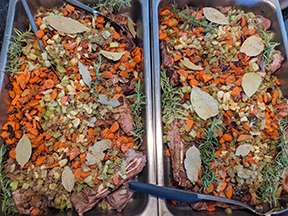
For some reason, while I’d never made pork ragu before, I really wanted to serve it for the regenerative ag field school lunch I prepared. Thank goodness my intuition was correct, and paired with a cheesy baked polenta, this dish went over extremely well. The heartiness and warmth of this rich stew feels right at home for these incoming cooler days, and is a perfect transition between summer and fall meals. The pork gets fall-apart tender during the long oven cook, so don’t skimp on time there.
Prep tips: I made like an 8-10x batch of this…so know that you can multiply amounts as necessary. Source local/farm-raised pork if you can, and you won’t be disappointed at the quality of your final dish. I’ve slightly abridged this recipe, so if you want the full version or recipe for the cheesy polenta, just email me.


2 pounds pork shoulder/butt, in 2” chunks (if using bone-in, just add some extra poundage)
1-2 onions, diced
2 carrots, diced
2 celerys, diced
3 garlic cloves, smashed/minced
1 teaspoon fennel seeds
2 bay leaves
2 fresh rosemary sprigs
2 anchovies
1 cup red wine or chicken broth
1 [28 oz] can diced tomatoes
fresh parsley
Sprinkle salt and pepper on pork, and brown in oil on two sides. Transfer to a baking dish.
Cook onion in same skillet, adding oil if necessary; then add in carrots/celery/garlic until browned. Add to pork in pan along with all remaining ingredients but parsley. Cover tightly with foil and bake at 350° for 2 ½ – 3 hours, or until pork is very tender. Pull out the pork and shred it — mine was tender enough that I just had to press it and it fell apart. Season and garnish with parsley; serve over polenta, rice, or past.
Lovina Prepares for Son Benjamin’s Surgery

0

Lovina’s Amish Kitchen
Lovina Eitcher,
Old Order Amish
Cook, Wife &
Mother of Eight


It’s Monday night, and I want to get this column written tonight. Early tomorrow morning (5:15 a.m.) I will be leaving with son Benjamin to go to the hospital. He will have surgery done on his leg and screws put in for his fractured fibula and torn ligaments. He’s been having a lot of pain, so hopefully the surgery will help with that. His brand-new buggy will need repairs as well, but that can be fixed. He can be so fortunate that it wasn’t worse and his horse was okay. He appreciates all the well wishes, cards, etc. It’s unbelievable what the estimated cost of the surgery will be, but I guess everything is going up. It could have ended so much worse, so we want to thank God for having his hand over Benjamin.

On Sunday evening, most of our family were home for supper. Joe grilled twenty pounds of chicken and some wings. Along with that, we had mashed potatoes, gravy, coleslaw, cheese, and dill pickles. Dessert was Swiss roll bars, M & M bars, cookies, grape salad, and ice cream.  Sister Verena also joined for supper. 

Tonight, our supper was leftovers from last night. That was an easy supper. 

We did laundry today and canned 22 pints of Thick and Chunky Salsa. I would like to can tomato chunks yet this week. 

Wednesday I am invited to a birthday surprise for a neighbor lady. I am hoping I can go. Frieda will have a birthday next week. Her married daughter is planning the surprise. When we moved out here 19 1/2 years ago, Frieda and Abe showed up to help us unpack. We used to be in the same church, but after it got too big, we had to divide it. Sister Verena is also invited, so we will probably go together. That is, if Benjamin’s surgery goes okay. Frieda is five years younger than I am—she is sister Susan’s age. 

Tomorrow, daughter Susan and Ervin plan to bring supper in. It was their date to bring supper in—our bishop’s wife Janie passed out slips of paper with a date on it to bring supper in for daughter Loretta and Dustin and our family. That really helps out and is greatly appreciated. 

September 26 is daughter Lovina’s special friend Daniel’s 22nd birthday. We wish him a happy birthday and many more to come. Sunday night after communion services, our whole family will come here in honor of Daniel’s birthday.

Sister Verena stayed here for the night, then left this morning to go help niece Emma. They will host church services in 2 1/2 weeks, Lord willing.

Leaves are starting to fall and the calendar tells us autumn has officially begun.

I need to sign off and get ready for bed. Daughter Verena came tonight and will be here tomorrow while I am at the hospital.

Good night to all and God’s blessings to all of you.

Cheddar Chowder Soup

4 cups potatoes, diced

1 cup carrots, diced

1 cup celery, diced

1 cup onions, chopped

4 cups water

4 cups cheddar cheese

2 cups ham

2 teaspoons salt

1/2 teaspoon pepper

White Sauce:

1/2 cup butter

1/2 cup flour

4 cups milk


In a large pot, cook all vegetables in water until tender. Add cheese and ham along with salt and pepper. To make white sauce, melt the butter in a saucepan, then stir in flour to let it start cooking. Gradually add the milk and cook until thick. Stir into vegetables. Makes 16 one-cup servings.

Lovina’s Amish Kitchen is written by Lovina Eicher, Old Order Amish writer, cook, wife, and mother of eight. Her two cookbooks, The Essential Amish Cookbook and Amish Family Recipes, are available wherever books are sold. Readers can write to Eicher at Lovina’s Amish Kitchen, PO Box 234, Sturgis, MI 49091 (please include a self-addressed stamped envelope for a reply); or email [email protected] and your message will be passed on to her to read. She does not personally respond to emails.

Mr. Chips

0
It’s no accident that in my dictionary the word “help” comes after “hemorrhoids” and before “Hell” as the following story will illustrate.
The man I call Mr. Chips made his millions with exactly that… chips. And I’m not talking Ruffles with ridges, no, I’m referring to computer chips. He used a week’s worth of interest income to buy a small “ranchette” that bordered part of a ranch we leased and he was the best, and the worst, neighbor we ever had. He had a new chain link fence installed between us and made a pest of himself wanting to help whenever we’d let him. The problem was he was raised on the pavement and the closest he’d ever come to a cow was the milk in his morning Cocoa Puffs.
Mr. Chips learned everything about the cow business from binge watching Yellowstone so he thinks all ranchers do all day is have torrid romances and play cowboys and Indians.
On his way to becoming a cowman Mr. Chips ordered some checks from the bank with the name of his 20 acre spread on them: “El Rancho Grande”.  He paid me to make him a silver buckle with his brand written in gold: CHIPS. He ordered a cow branding iron with letters five inches high and I worried that his calves, if he ever had any, wouldn’t be long enough for the brand to fit. He purchased a new 4 horse slant trailer that was 32 feet long and cost north of $100,00 and to pull it he bought a Peterbuilt he didn’t know how to drive, nor did he possess the necessary license to do so.
We let Mr. Chips buy lunch for several of us every day and the hefty price we had to pay was having to listen to him recite his cowboy poetry. Maybe we praised him too highly because the next thing we knew Mr. Chips reserved a room in Elko and started wearing gaudy wild rags and designer neon boots. Despite never having swung his leg over a horse before he bought a 22 year old nag that fully funded the retirement plan of a local horse trader of questionable repute.
Within the first week of his being a rancher Mr. Chips asked me to teach him how to rope and ride in preparation for branding season which was less than a month away. The first thing I told him to do was quit wearing his custom-made American flag shirts because we didn’t know if we were supposed to rise as one, put our hats over our hearts and sing our national anthem every time he entered the room. I also told him to lose the peacock feather in his new Stetson that he wore straight out of the box.
One week prior to our branding Mr. Chips asked, “Would this be a good time for you to teach me to ride and rope?”
“Maybe we’d better save that for another day.”
“Well then, what can I do to help?”
“I’ll tell you what Mr. Chips, why don’t you bring a pot of beans for the lunch?”
I could see disappointment in his face but on the day of the branding Mr. Chips showed up with a pot of beautiful beans. I should have known something was amiss because the beans were bubbling like a Yellowstone mud pot and they weren’t even over a fire. But they tasted good and Mr. Chips was proud to tell everyone he’d cooked them.
Ours was an all-day affair as we gathered cattle in the morning and went back to work after the noon meal to brand the calves. At least for a little while we did until one by one the ropers slid off their saddles in gastrointestinal distress and the ground crew was hunting for brush they could squat behind.
We only got half the calves branded and henceforth Mr. Chips didn’t dare show up at another branding. Not long after he sold his ranch for twice what he paid and moved back to Silicone Valley where, I’m told, he entertains his rich friends with his poetry while wearing all his cowboy garb. He insists everyone call him “The Computer Cowboy”.
As for me, I put up a big sign at the entrance to the ranch that reads, “NO MORE HELP WANTED!”

Potato Cakes

0

Potatoes, like beans, were a standard during the Great Depression. Potatoes were used as a side, a main entrée, or in breakfast dishes and breads. They’ve saved many families from starvation during war times and famines. I am thoroughly convinced if potatoes weren’t starches people would still be eating them in ample portions. Actually, of all starch’s potatoes are the best for us. Plus, if they are refrigerated for 24 hours, they become a resistance starch and ‘resist’ turning into 100% carbohydrate. Instead, they are absorbed at a slower rate and contain far less carbs. That’s definitely a win/win.

Potato Cakes have been a favorite in my family for generations. I grew up on them at Grandma & Grandpa Richardson’s farm, located in Monticello, Missouri. After a ‘big’ Sunday dinner there would frequently be leftover mashed potatoes.
Since the freezer was full of home-grown sweet corn it too would find it’s way into Grandma Lucy’s potato cakes. In other households it may have only been potatoes made into the cakes along with flour, egg, and leavening. Chives, green onions, herbs and other enticing flavors have made their way into the cakes through the years. Today we also find them topped with salsas, sauces,
cheeses and relishes. It’s not surprising to find them on the appetizer menu of southern and Ozarkian restaurants.’

When you’re gearing up for a card game night with friends, thinking about the snacks is half the fun, right? Potato cakes are like little bites of joy that can seriously amp up the gaming vibes. Imagine the scene: cards shuffling, laughter in the air, and the tempting aroma of potato cakes wafting through the room. It’s the perfect recipe for a fantastic poker night. And hey, if you’re ever in the mood for a virtual card game, online casinos are there too! Just make sure to stick with the legit ones for a worry-free gaming experience. It’s important to only use legal operators with valid license. You may refer to this page sportostrowiecki.pl/prawo-hazardowe-w-polsce/ to find out more about legal online casinos.

I’ll give you a fun hint, you can actually use the real mashed potatoes found at your local grocery store. I actually used them when I wrote this recipe because at the time, they contained exactly 3 cups of ‘real’ mashed potatoes. Unfortunately, these little gems aren’t quite as reasonable these days.

Served as a side I would accompany them with a variety of main entrees: fried chicken, roasts, black eyed peas and ham, pork dishes and the lists go on.
Surprise your family with a down-home batch of these lovely cakes. Your family will beg you to make them again and again.

Many foods of the Depression are making a comeback, as I’ve noted in a couple of my columns this past month. I’ll most likely dive into some fall foods for most of October and early November. Would I scare you if I told you I’m all ready thinking about Thanksgiving Dinner? Seriously, YES!!! Actually, I’m thinking about lots of cooking and preserving I want to get accomplished before this big holiday. The kitchen is calling, I’m trying to get my house back in order after the big wedding reception I did last weekend. Go forth and do good things & your life will be so fulfilling. Simply yours, The Covered Dish.

Corn & Potato Cakes
1 (15 oz.) can whole kernel corn, drained
24 ounces (3 cups) mashed potatoes
1 ½ teaspoons baking powder
1 large egg
1/2 cup shredded cheddar cheese
¼ cup finely diced onion
½ teaspoon seasoning salt
¼ cup flour

Mix all ingredients together in a bowl. You can make these cakes/fritters in a deep fat fryer or on a griddle. Brush the griddle with oil and drop just a few cakes on at a time. Cook until the fritter is golden brown and then flip over.

Consider using chives, green chilies, green onions, roasted red peppers, and different cheeses in this dish.

In many regions folks top their fritters or corn cakes with honey & sweet jellies, jams and salsas and the like. My family wouldn’t even consider any of these embellishments, they love them just the way they’re prepared.

Contrasting Viewpoints About Overpopulation Of Wild Horses In Nevada

0

Welfare for the population of wild horses in Nevada was heavily debated recently in Elko, Nevada.
State Senator Ira Hansen was challenged by Scott Beckstead, director of Animal Wellness Action and Center for Humane Economy.
They debated whether federal management has been successful in its efforts to curb wild horse and burro populations on Bureau of Land Management (BLM)-controlled land.
Critics claim helicopter roundups and lack of water are hardships for the wild horse population.
The debate came after 31 horses died in a roundup this summer and a ruling by U.S. District Judge allowed federal authorities to continue gathering mustangs in Nevada over the objections of animal advocacy groups that called the method inhumane and illegal.
Outcry against using helicopters for roundups began after witnesses reported seeing horses die from broken necks and one stallion euthanized after its rear leg was injured.
U.S. Representative Dina Titus from Nevada is backing legislation in Congress to outlaw the use of helicopters in wild horse roundups.
“I don’t want to be painted that somehow because I believe that we need some serious management of the feral horses on the Nevada ranges that I hate horses. Nothing could be farther from the truth,” Hansen said.
He explained the issue began with the Wild and Free-Roaming Horse and Burro Act of 1971 that created laws to manage, protect, and study unbranded horses and burros on public lands.
“That law required the BLM manage the horse herds in the areas where they were in 1971. They were to be managed in such a way that they would have a thriving, natural, ecological balance,” Hansen said.
He noted it had been modified twice in 1976 and 1978. First with the Federal Land Policy Management Act that allows the federal government to use helicopters and motorized vehicles to round up horses.
Then again with the Public Range Lands Improvement Act that required appropriate management levels (AML).
Hansen said Nevada’s lowest population is set at 7,000 horses and the highest level is 14,000 horses.
He pointed to the original 1971 act stipulating the Secretary of the Interior was required to “immediately remove horses and get the populations back to the appropriate management level” in horse management areas.
Photographs were used to illustrate wild horses with their ribs visible through their skin, small watering holes with at least one dead feral lying next to another, and barren landscape.
“All the pictures I’m going to show in every single case there have been no other livestock on these allotments, on these herd management areas, for at least 15 to 20 years,” Hansen said. “All the ecological damage was caused by horses.
“Mr. Beckstead and his position claim that we have no need to get involved in it because the horses will naturally regulate their populations,” Hansen said.
However, a National Academy of Sciences study showed that horse population growth “would probably double every four years.”
Hansen proposed that removing animals would promote healthy animals, improve range health, and balance between uses.
Beckstead, who lives in Sutherlin, Oregon, is a law professor at Willamette University. He disputed Hansen’s claims of ecological catastrophe and cited mass BLM public disinformation to justify inhumane helicopter roundups of wild horse and burros.
Horses originated and evolved in North America more than 50 million years ago, with fossil records dating horses on the continent 5,700 years ago, according to Beckstead.
“Sheep and cattle are invasive,” Beckstead said. “Horses evolved here, they originated here, they are native. That is why horses thrive out in these harsh arid mountainous landscapes, but cattle not so much.”
In 2013, the National Academy of Sciences (NAS) “took a top to bottom review” of the wild horse and burro program. “They could not find a single science-based rationale for the BLM’s wild horse overpopulation contention.”
Beckstead said, “The politically contrived number was snatched out of the air by the BLM to drive the agenda to keep horses at a number that livestock owners can live without them being a threat to commercial livestock.”
Nevada has the most BLM managed lands after the state of Alaska, Beckstead said. “So, it follows that because Nevada has the largest amount of BLM lands, it also has the largest population of wild horses by quite a large measure.”
Beckstead disputed the number of wild horses and burros in Nevada estimated at 50,000.
The BLM’s “own data reveals the negative impact by wild horses is negligible. Wild horses and burros are responsible for a failing allotment less than 1percent of the time compared to livestock,” Beckstead said.
“Horses and cattle treat their water sources very differently,” Beckstead explained. “Cattle are far more likely to congregate around the water sources and never leave. Horses are more likely to come in once or twice a day, drink and go back out on the range.
“I think it’s very important that we expose the mismanagement by the Bureau of Land Management,” Beckstead said. “The vast majority of Americans want to see wild horses living on public lands. There are bills pending in Congress to help our wild horses and burros.”
Hansen counter pointed: “There is a severe overpopulation of wild horses in Nevada and we need to get the BLM the money they need to do the job to round those horses up and save Nevada public range lands.”
+++30+++