Saturday, February 28, 2026
Home Blog Page 625

Lettuce Eat Local: Peanut Butter…tomato time?

0

Amanda Miller
Columnist
Lettuce Eat Local

I’ve long had unusual taste preferences, to the extent that Brian and I always joked (and legitimately wondered) if I would crave normal food during pregnancy. I’m sure he was hoping that would be the case. Unfortunately, both of my pregnancies have produced more food aversions than cravings, although the few things I did uncharacteristically desire have been very standard for an American diet: I needed lots of potatoes when Benson was in utero, and this little baby so far has created very atypical penchants for sausage and soggy breakfast cereal. Don’t worry, not together. It is the togetherness, or combining, of foods that is usually expected in pregnancy. For some reason I feel like pickles and/or ketchup and ice cream is a stereotypical illustration of prenatal cravings; I haven’t been tempted at all to try that, since decades ago I already experimented with cocktail sauce and vanilla ice and I can conclusively say that it’s a bad idea. One of the odder combinations I’ve sampled recently was yellow mustard on an Oreo, but that’s because a friend is (wrongly) convinced of its palatability, and I’m fairly certain he’s not pregnant.
I’m really much more adventurous in my flavor combos when I’m not with child, so our prediction has essentially come true. It makes me wonder, however, what the maternal status is of the people who create some of the food items sold at the Kansas State Fair, which is of course in full swing this week. Apparently you can buy, as in pay good money for, a dill pickle stuffed with hot Cheetos, wrapped in fruit roll-ups, drizzled with chamoy, and sprinkled with Tajin. On a stick of course. Rumor has it there are more strange new options like deep-fried coke, hot dogs stuffed into jelly doughnuts, and pickle-flavored popsicles — and I’m sure a whole host of other fried things. Just because you can doesn’t mean you should.
However, clearly, who am I to judge? I think it’s boring when everything is normal, and my curiosity and appetite are absolutely piqued when it’s something out of the ordinary, so fry away. I just want you to keep some of those combinations and considerations in mind when I present my recipe for this week. Mixing tomatoes, peanut butter, and sweet potatoes might sound like something dreamed up in a maternal maelstrom, but actually I knew I wanted this stew because I’ve cooked these things up together so many times before. They’re a normal pairing in West Africa, only sounding strange to our Midwestern selves because we haven’t grown up with it. But while Brian and Benson may not have found it as addictively delicious as I did, they both liked it — which means you can, too. And like Brian said, even though I didn’t necessarily give him a choice at input in our menu, “At some point, you get tired of just fresh garden tomatoes and have to do something different.” While I’m not sure I agree with him on the tomato bit, I do appreciate the sentiment.
If you can try a pickle popsicle at the fair, you can try a peanut potato tomato stew at your table.

West African Sweet Potato Tomato Peanut Stew

Seriously, it makes me happy just thinking about it. I’m not saying it will blow your mind with life-changing deliciousness, but it’s just such a pleasantly unique and more-ish kind of meal. It’s rich and savory and hearty, while also somehow being fresh and sweet and light. Rice is a good accompaniment, and throw in some beef or chicken if you want. 

Prep tips: I like the idea of the natural-style peanut butter, but standard will melt and meld better into the sauce. Skip the hot pepper if you don’t want any spice. 

a good drizzle of peanut or olive oil 

3 yellow onions, chopped 

2” piece fresh ginger, minced; or 1 tablespoon ground ginger 

1 hot pepper of choice, minced 

½ tablespoon cumin

2 tablespoons tomato paste 

2-3 cups fresh tomatoes, chopped 

2-3 cups chicken broth 

1-2 sweet potatoes, cubed 

½ cup creamy peanut butter 

Heat oil in a large saucepan, and add onions with a good pinch of salt; saute over medium heat until just browning. Stir in ginger and hot pepper, cook for a minute, then stir in cumin and tomato and cook for another minute. Add tomatoes, broth, sweet potatoes, and another good pinch of salt; bring to a simmer and cook for 15 minutes, until sweet potatoes are just tender. Stir in peanut butter, and simmer for another 15 minutes or so until the sauce is thickened and rich. Season to taste, and serve over rice with coarsely chopped peanuts.


No farm to table without ag labor

0

Gardeners know the amount of time and energy it takes to grow the tomatoes, cucumbers, and zucchini they share with friends and neighbors. Once the soil is prepared then the seeds need to be sown, the weeds need to be fought, the plants need to be watered, and the insects, diseases, and parasites need to be stopped. That is all before the first slice of tomato can be laid upon a plate.

Now imagine the sort of energy it would take to grow 200 acres of a crop, or 1,000 acres. This is the task before America’s agricultural employers.

Many crops in the United States must be handpicked for them to appear in your local grocery store. Automated machines can’t replicate how a human hand harvests crops such as garlic, strawberries, or asparagus.

Those crops that can use harvesting equipment still need humans to help move them through processing systems before they can enter the food supply. To protect those workers, labor laws were first established in 1938, according to U.S. Department of Labor website at bit.ly/3spIBHY, with the passing of the Fair Labor Standards Act.

The original laws put in place have changed drastically over the years but the need for agricultural labor has not. A recent webinar hosted by The National Agricultural Law Center discussed the labor laws agricultural employers should be familiar with when they need to hire outside help.

Host Brandon Davis is a farmer and a lawyer at the New Orleans office of Phelps Dunbar. He specializes in immigration as it pertains to labor issues facing agricultural businesses.

“We cannot go from farm to table without an adequate labor supply,” Davis said.

Davis said that agricultural jobs cannot always be filled by American citizens even though employers are required to advertise those positions on national job boards at bit.ly/3spGbJo. When no American applicants have been found, the federal government gives the employer the certification that will then need to be approved by immigration.

The act of finding stable agricultural employees is not quick and it is not cheap. Once those employees arrive on U.S. soil there are laws in place to ensure they have fair wages, which could be anywhere between $13 to $17 an hour; housing paid for by the employer that meets local and county standards that defaults to Occupational Safety and Health Administration and Migrant and Seasonal Agricultural Worker Protection Act standards; and training that allows the employees to remain safe and healthy.

Agricultural employees have “the right to be safe. The right to be healthy in their environment. The right to be safe from discrimination,” Davis said.

Safe and sound

Agriculture is one of the most rewarding professions but it is also one of the most hazardous. Safety for employees starts with thorough training on how to navigate the dangerous situations and materials they work with on a daily basis.

One of the biggest threats to agricultural employees is heat and heat-related illnesses. Agricultural employers and their managers must have policies in place and be flexible so employees can take adequate water and rest breaks during the hottest part of the day, which Davis said is between 11:45 a.m. and 3:15 p.m. These breaks are especially important for newly hired employees that need time and patience while they acclimate to the heat.

“The last thing that we want is a work-related illness or death that is absolutely preventable like heat related illnesses,” Davis said. He directed attendees to OSHA’s heat-related illness website at osha.gov/heat for more information.

Many retired farm kids can attest to the effects of prolonged exposure to loud machinery on their ability to hear later on in life. Davis emphasized that agricultural employers must make sure employees know how to protect their hearing with ear plugs or headphones when operating noisy combines, chainsaws, or trenchers, just to name a few pieces of equipment.

Additionally, operating that noisy machinery should be limited to those older than age 16, Davis said. Legally, 16-year-olds can only operate a tractor that has less than 20 horsepower. They are also not supposed to be working in an enclosed area with a stud horse, a bull, or a boar. Many farms are family operations and children are often tasked with work beyond their age and abilities. Davis said 12 years is generally the minimum age for working on the farm.

Mistakes can be made no matter the age of the employee and Davis said that’s where effective training becomes evident.

“Good mistakes are the ones where we’ve had training and we know what to do,” he said.

While some employers may see these laws as a hindrance to their productivity, Davis reminds them that there is not enough Americans who want to do farm labor, so employers must do what they can to protect those who are willing to work for them.

“We don’t have enough labor to produce the food that we need in the country and the food that we sell internationally,” Davis said.

As reported in the High Plains Journal.

Hot temps may encourage homeowners to delay seeding lawns this year

0
Source: Kansas Turfgrass Foundation

K-State horticulture expert says waiting a couple weeks may help cool-season grasses.

September is the best time to give cool-season grasses a boost in Kansas, but with triple-digit temperatures hammering many parts of the state recently, it might be a good idea to hold off just a little bit.

Kansas State University horticulture expert Ward Upham says you can still over-seed such cool-season grasses as tall fescue and Kentucky bluegrass in early September, but it’s going to hit your pocketbook a little harder.

“If it remains really hot, you may be watering three times a day to keep newly-planted seeds moist,” Upham said. “You may want to wait until this current hot spell ends before putting your seed down and starting your watering because then you won’t have to worry quite as much about keeping that soil moist.”

That puts the middle to late part of September as a good time for homeowners to think about thickening up their home’s lawn.

“There are certain steps that are involved, and you should about going through those in order,” Upham said.

Those steps include:

Fertilize the lawn

“We recommend you use a starter fertilizer, which will be higher in phosphorus,” Upham said, noting that fertilizer will give the seed a greater chance of getting started quickly.

Follow the directions on the bag to know how much fertilizer to put down.”

Prepare the soil

Upham said homeowners can use a hand rake to roughen up soil in small areas. For larger areas, he suggests either a verticut machine or core aerator.

“A verticut machine has solid vertical blades that can be set to cut furrows in the soil,” he said. “A slit seeder is a verticut machine with a seed hopper added so the soil prep and seeding operation are combined.”

By contrast, a core aerator literally punches holes in the soil, depositing the cores on the surface of the ground.

“Each hole produces an excellent environment for seed germination and growth,” Upham said. “Make three to four passes with the core aerator to ensure enough holes for the seed.”

A core aerator also reduces the amount of water needed to germinate the seed. Aeration increases the water infiltration rate, decreases compaction and increases the amount of oxygen in the soil.

Apply proper seeding rates

For tall fescue grasses, Upham suggests applying 6 to 8 pounds per 1,000 square feet. Apply three pounds per 1,000 square feet when seeding Kentucky bluegrass, which is a smaller seed. “You’re actually putting down more seed per square foot with Kentucky bluegrass,” Upham said, “but you need that extra seed in order to get a good stand.”

Using too much seed results in a lawn more prone to disease and damage from stress. Using too little seed may result in clumpy turf that is not as visually pleasing. Calculate the yard’s square footage to determine the appropriate amount of seed to apply.

Keep the soil moist

Upham suggests watering newly planted areas lightly, but often. “Keep the soil constantly moist, but not water-logged,” he said. “During hot days, a new lawn may need to be watered three times a day. If watered less, germination may be slowed.”

Cool, calm days may require watering only every couple days, Upham said. As grass plants come up, gradually decrease watering to once a week if there is no rain.

“Let the plants tell you when to water,” Upham said. “If you push the blades down and they don’t spring back up quickly, the lawn needs water. Once seeds sprout, try to minimize foot traffic that seeded areas receive until the seedlings are a little more robust and ready to be mowed. Begin mowing once seedlings reach 3 to 4 inches tall.”

As reported in the High Plains Journal.


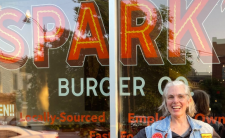
Sparks Burger Co. ignites passion for locally sourced food in Kansas

0

A vegetarian pastry chef opens a burger restaurant in the heart of Kansas cattle country—it sounds like the ultimate oxymoron or even the beginning of a corny joke, but for Genevieve McGregor it was a dream that became reality.

After years of baking sweet confections in the food service industry, McGregor felt the pull to open a restaurant that serves fast food that is locally sourced and sustainable. She has always loved making desserts, but more than that, McGregor loves the commercial kitchen atmosphere, working with a team of like-minded people to build a business she is passionate about.

“When I got to the point where I wasn’t feeling like making truffles and eclairs all the time, fate gave me an idea that incorporated everything I love about what I’ve dedicated my career to, which was serving people and the community, taking care of my co-workers, working tirelessly,” she said.

McGregor lived in Boulder County, Colorado, for 32 years and was raising a teenage son as a single mother when she started brainstorming on this restaurant idea, but she knew the concept did not make sense for the area she was living in. The community, which is north of Denver, is an extremely expensive area to purchase real estate and for McGregor, it was not an option.

“Additionally, because of mass development in many places in Colorado, I think the newer residents have lost touch with the historical ranching history and legacy of those areas,” she added. “To say locally sourced doesn’t resonate with people there as much as it does in an agricultural state like Kansas.”

McGregor said she also had trouble finding family-owned ranches that were in operation and had products to sell at the quantities and prices she needed. So, she made the difficult decision to take her locally sourced restaurant model and bring it to an area where it would flourish. After some research and travel, she decided on Manhattan, Kansas, partly due to its proximity to farms and ranches in the Flint Hills.

“There’s one thing more beautiful here than anywhere else, and it’s the people,” she said. “They are the most hard-working, honest, humble, down-to-earth people and I’m blown away. I felt a real connection and resonance with the community.”

Apart from the courage it took to pursue this dream, McGregor made an incredible sacrifice by moving away from her only child, who stayed in Colorado with his father while she moved to Manhattan to start her culinary venture. Sparks Burger Co., located at 405 Poyntz Avenue, was opened on Mother’s Day 2023 as a gift to her son to show him he can do anything he puts his mind to.

The restaurant serves American food commonly associated with fast food restaurants—including hamburgers, hot dogs, waffle fries and milkshakes—but in an approach that is counterintuitive to the way most view fast food. McGregor calls her concept fast food regeneration.

“I’m trying to take the food service industry and make it as sustainable and ethical as possible,” she said. “How can we take a fast-food meal, which historically has been corrupted both nutritionally and environmentally and make it in a way that is ethical and sustainable?”

McGregor’s burger shop is even more unique because she has been a vegetarian for the last 30 years. However, she knew from the get-go that her establishment would need to cater to carnivores for it to be successful. Her concern was finding products from operations that fit the criteria of ethically and sustainably sourced. Perhaps most surprising of all, McGregor’s diet has evolved through the design of the menu and opening the restaurant, so she is no longer a strict vegetarian. She slowly started eating meat again, but still tries to limit her intake and only eats meat in moderation.

“When I started eating red meat again I realized beef was what I had been missing,” she joked. “And I do feel better knowing that these animals were taken care of and they only had one bad day. It’s still hard for me to be a part of an animal dying, but when I decided to solidify this concept, I found a rancher in Missouri who was kind enough to let me go to her slaughterhouse and witness the whole process from start to finish. Part of why I did that was to reconcile with myself and see how it’s done and I’m OK with it.”

Every animal product served at Sparks Burger Co. is locally sourced within 120 miles of the restaurant. McGregor said she purchases her ground beef and roasts from Leffler Prime Performance in Americus, Kansas; bacon from R Family Farms in Lebanon, Kansas; dairy from Hildebrand Farms Dairy in Junction City, Kansas; hot dogs from Pacheco Beef in Alma, Kansas; cheese from Alma Creamery in Alma, Kansas; seasoning from Cowboy Prairie Dust in Rossville, Kansas; honey from Valor Honey in Manhattan, Kansas, and eggs from Eagle Ridge Ranch in Abilene, Kansas.

“I would have never in a million years thought a vegetarian would be in a slaughterhouse or in a field shaking a rancher’s hand and making a deal for 500 pounds of ground beef,” she mused.

Apart from the desire to serve sustainable and nutritious fast food, McGregor also made it part of her mission to provide a healthy work environment for others in the food service industry. She pushes back against the idea that there is currently a labor shortage.

“I think there’s plenty of people who want to work and I don’t think people are innately lazy or want to sit at home,” she explained. “People in food service love to be busy and we love to work. We just don’t want to work for a corporation who takes advantage of us. My hope is that if I give people the compensation as close to what they deserve as what I can, but also the environment that supports them, that they would be attracted to it and would want to stay.”

Although she has long-term plans to make Sparks Burger into a chain at some point, McGregor is currently focused on dedicating every day and night to the Manhattan establishment. She hopes after two years, she can create a cookie cutter version of the Manhattan location in a new town, with a different local food supply chain.

On its surface, the hot and hectic atmosphere of a bustling restaurant kitchen during a busy dinner service might seem like the exact opposite of a multi-generational ranch in the Flint Hills, but when brought down to their foundations, these two industries have striking similarities. The rancher and the chef are passion-driven individuals who put in the time needed for their businesses to succeed and they have common goals to feed the world. The desire to work in their industry is in their blood and when the rancher and chef come together it’s a beautiful thing.

“I think it’s a calling for both of us and it’s very divinely designed that there are people whose mission in life is to grow food and that there are people in life that their mission is to make and serve food,” McGregor explained. “How else will the human race survive if people aren’t interested in those two things? I feel a real kinship with these people and I’m just so honored to promote them because they do such noble work.”

As reported in the High Plains Journal.

In Kansas, child care can cost more than a mortgage

0

Ann Elliott runs one of the largest childcare centers in all of Kansas.

The Family Resource Center, or The Center, in Pittsburg, Kansas, is licensed to care for over 350 kids At $145 a week for toddlers, $135 a week for 30-month to 5-year-olds, and $185 a month for preschool — parents might assume Elliott and her staff are rolling in money.

They aren’t. They lose money on child care and grants help offset the loss.

“It doesn’t pay for an employee to make a living wage,” Elliott said. “We’ve been around 25 years. So somehow we’re continuing and we will continue as long as we can.”

Kansas is at a crossroads, childcare providers and experts say. Childcare slots are hard to come by and they are expensive. Some parents quit their jobs because childcare eats up entire paychecks and it’s just cheaper to be a stay-at-home parent. Others are paying more for child care than their mortgage.

Finding infant care is especially bad. Elliott said some kids have spent more than a year on her waiting lists.

“We tell people if you’re thinking about getting pregnant, get on a waiting list somewhere,” she said. “Get on a bunch of waiting lists and you need to do it right away.”

Providers say if nothing changes more day cares will close down and more staff will leave the field. Despite being an in-demand business, providers say they don’t make much money, they struggle to hire staff and just starting a business can be a headache.

Want to run a childcare business in Kansas? ‘It’s just hard’

Elliott started her day at 5:30 a.m., cooking for the kids. She’s been cooking for the last six days because the old cook left and they haven’t been able to hire a replacement yet.

It has become a lot harder to find staff at The Center, and this is a recent problem. Those who do apply might have little experience and need to be trained from scratch.

These jobs don’t always pay well, so The Center offers perks to keep people happy, like half off of child care and $1,000 bonuses every four months. But the wages are so low that staff members themselves qualify for childcare aid from the Department for Children and Families.

“Which is super, super sad,” she said.

Childcare businesses can struggle to offer pay raises because the cost of caring for kids can exceed what parents can afford.

Infant care is the most desperately needed type of care. State regulations require one caregiver for every three infants. At $200 a week per baby, a provider loses money paying someone just $15 an hour.

Providers say the local Walmarts can pay more, and it comes without the stress of having to take care of children all day.

At The Center in Pittsburg, Elliott said she loses $9,500 a year on every infant slot and $7,000 a year on every toddler slot. The business stays afloat because of grants that can offset the costs.

Stanton works with communities to find fixes to their child care problems. She said one common barrier to success is start-up costs.

Paying for a brick-and-mortar facility is not cheap and having an in-home business does not guarantee savings.

“You think you’ve got a handle on everything,” Stanton said.”(Then) you think, do I have enough sippy cups? Do I have enough wipes and diapers? Do I have enough cots? And what about cribs? And how do I feed 10 kids all at once? Do I just put them up to my table? Oh, wait, they can’t sit at my dining room table.”

It’s those expenses and limited income that might make some people’s time in this business limited. Multiple providers said they are seeing people retire with no workers to take their place, or younger providers open up only to close once their children age out of care.

Life of an in-home provider

That might be what happens to Trinity Johnson, who runs her business in Salina.

She used to work at an office job but she opened her own business once her daughter was born. The first few months were rocky, she said, as it is for most providers.

A state task force surveyed 500 Kansans about common issues with child care, one common complaint for providers was how complicated it was to start up a business. Licensing is slow and confusing, and it can be difficult to find useful information about the system.

Johnson stuck with it because she loves this work and dreams of opening her own child care center, but that might not happen. It’s financially risky and she is limited in how much more her business can currently grow.

“In order to expand out, I either have to hire another person or buy an actual building and I just don’t make enough to afford to do that,” Johnson said. “Right now it works and I pay my bills.”

Raising rates also isn’t something some providers want to do. Multiple providers told the Kansas News Service that they need to charge more to make money and pay higher wages, but if they do charge more, many families would be priced out.

The statewide survey also found that the subsidy from the Kansas Department for Children and Families offered to low-income families does not give them enough money to comfortably afford child care. Middle-income families also make too much to get the subsidy and have to pay by themselves, but they generally don’t make enough to comfortably afford it.

Tiffany Mannes, a provider in Johnson County, says she has some room to raise rates, but not much. She knows some families don’t have the financial means to pay more.

“We have a family who has three children in care. They pay more than a mortgage for child care,” she said.

Mannes has been in business for 20 years. She has a group license and runs her business with two other people. That helps families because a caretaker can take a sick day and the business will still be open. But having to pay three people makes it harder to make any profit, and she said her business has grown about as large as it can.

She can’t take on more kids because of state regulations. And she looked into a larger center but didn’t think the big cost would be worth it.

Mannes calls child care essential work. It helps kids develop, it helps other businesses grow. But no matter what she does, the money she makes just doesn’t seem to go far enough.

“I participate in the National Food Program, which some providers don’t,” She said. “I accept (a child care subsidy) from DCF, which a lot of providers don’t. To my knowledge, I’m doing everything that I can to be competitive and earn a living wage.”

Kansas is currently trying to address the issue.

The state is creating a new government office that will centralize state childcare programs, which should make them easier to access. Gov. Laura Kelly did set aside $53 million for one-time bonuses for childcare workers, which could be as high as $2,500. And there is a childcare subsidy offered through the Department for Children and Families, but participation among providers and families is low.

Kelly Davydov is executive director of Child Care Aware of Kansas. She is working on one possible solution to the infant care shortage.

Her group is helping coordinate a pilot program, called Baby Steps, that gives away thousands of dollars to providers to offset losses associated with infant care.

If a provider agrees to take on more infants, the program will provide an annual stipend so the business can raise wages to $15 an hour. A provider going from zero to one infant would get about $9,600. Going from one to two infants brings in $13,500 and jumping from two to three means $17,000.

So far, 53 providers are enrolled in the program and more than 50 new infant slots have opened up.

Davydov called it a dual-pronged approach that addresses both pay and capacity at the same time, and she said innovative ideas are needed to fix this problem. But even she worries this one pilot program isn’t enough to meet the extreme demand.

The Kansas News Service spoke with a dozen people in the childcare field, and solutions to the problem varied, but they generally started with the idea of the public, businesses and governments helping offset the costs of care.

That might mean legislative reform.

The Center in Pittsburg, Kansas, is licensed for more than 350 children at one time.

How are other states addressing childcare shortages?

Lawmakers return to Topeka in January and it isn’t clear what solutions they could pursue in the next legislative session.

Earlier this year, legislators did approve a bill that stripped away some childcare regulations. That bill would have changed adult-to-child ratios letting businesses take in more kids. Both the House and Senate passed the bill, but the governor vetoed it over fears it put children in unsafe conditions.

The Vermont State Legislature went even further, approving a new payroll tax on businesses and workers to increase funding for the childcare system.

Whatever the solution, most people are feeling optimistic Kansas is on the right path to find a solution, a statewide survey said. Statewide data did say there are 6,848 more childcare slots in July 2023 when compared to May 2022.

For providers like Elliott, the multiple decades in the field have all been worth it.

“It’s just the kids,” she said. “I love listening to them walk down the hall at night talking to their parents (about their day). And you know, their parents will say, ‘You did what?’ … I just love them.”

Blaise Mesa reports on criminal justice and social services for the Kansas News Service in Topeka. You can email him at [email protected].

The  Kansas News Service. is a collaboration of KCUR, Kansas Public Radio, KMUW and High Plains Public Radio focused on health, the social determinants of health and their connection to public policy.