Sunday, March 1, 2026
Home Blog Page 645

Arlington Farm and Art Market features produce, flowers and monthly meals

0

The Arlington Farm and Art Market is a prime example of good things found in small doses. It’s not a bustling marketplace and doesn’t offer all the options a bigger venue might, but it is all about quality.

“The vendors, market team, and customers create a welcoming place that shows the best aspects of small-town Kansas: friendly conversation, home-made and home-grown nourishment, a sharing of skills and challenges, and healthy community interactions,” said Kelsi Depew, market manager.

Depew helped start the market in 2014, after moving to Arlington the year before and being keenly aware of the need for local food sources. With the help of librarian Ginger Stiggins and the Friends of the Library, they got the ball rolling.

“So in just a couple weeks, I found people that grew things and made things and baked things and invited them to come try out our new market. We had story time and a book sale for the library and we somehow made it through a whole season. And we just haven’t quit yet, so next year, we will celebrate 10 years.”

Vendor fees go directly to support the Arlington City Library, as does the money from the monthly meal served at the market.

On the last Thursday of every month, several community ladies prepare pork burgers and sell them accompanied with seasonal toppings, chips, homemade dessert, and water, all for $5. Usually, a local band comes on these evenings as well and provides live music to round out the ambiance and party atmosphere of the evening.

In the beginning, the market used to be held in the mornings, but found the evening time slot seemed to bring people together better. In fact, “some people come just to visit,” said Betty Murphy, a supporter of and contributor to the market since it started.

Her lawn chair was set up on the grass for the evening, next to Betsy Trembly and her basket of caramel corn for sale.

“It is actually the best caramel corn you can find anywhere,” said Depew. “I’m not even exaggerating. Everyone that has tried it agrees.”

Trembly uses her Aunt Marge’s recipe, and while she doesn’t know why she started making caramel corn for the market since she never makes it at home, it’s clearly a popular item and sells out quickly.

David Miller, who grew up helping on his family’s produce farm and now has his own family Prairie Town Produce, said his most popular seller at the Arlington market is red slicing tomatoes, although his carrots, cucumbers and honey are all very tempting as well.

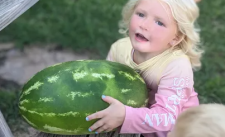
Three-year-old Gentry Serviss and his brother Miles, who is almost 2, however, had eyes only for the picnic table lined with gorgeous watermelons.

Another table is lined with bouquets, brought by Tina’s Blooms. Tina, the daughter and sister who loved flowers, died in service in Iraq in 2018 and the family started this business as her legacy.

They replaced their vegetable garden with more than 50 types of flowers last year, starting a lot in their basement in January and later planting more than 800 tulip bulbs. The resulting flower arrangements are nothing short of beautiful.These vendors are some of the consistent participants, “but it’s always a surprise on what else will be there,” said Depew.

“My absolute favorite part of the market is the community built there. People that lived in town for years would meet each other and make friends at the market,” she said. “For favorite finds, I definitely recommend the caramel corn, honey roasted almonds, all the fresh produce, and any jar of food you find. Ok, I just like everything.”

Find out for yourself at the Arlington Farm and Art Market from 4 to 7 p.m. every Thursday through September at 304 W. Main in Arlington.

As reported in The Hutchinson News.
The Slip-Of-The-Tongue Incident

0
lee pitts
There are two facts you need to know to fully appreciate this story. Number one is that my wife usually drinks a Diet Coke® for lunch, and number two is she is as fit as a fiddle and has kept her perfect shape the 51 years I’ve known her. She’d be the last person you’d think would need Weight Watchers, intermittent fasting or Keto diet gummies.
So here’s the setup: I took my wife to lunch at one of our favorite haunts and a familiar server waited on us. The place was packed, the servers were busy and our server noticed that my wife’s Diet Coke® was almost empty so she practically yells across the room at my wife so everyone in the place could hear and says, “How’s that Diet coming.”
YOU COULD HAVE HEARD A PIN DROP! Everyone in the joint looked at my wife to see how humiliated she must be because the server was talking about one thing, her Diet Coke®, and all the patrons thought she was talking about her diet, as in the Atkins or Mediterranean. When our server realized what she’d said she turned 15 shades of purple and apologized profusely. We just laughed a lot and advised her that perhaps in the future she might want to alter her vocabulary because another customer might not be so forgiving.
The rest of the story, as Paul Harvey used to say, was we didn’t see our server for two weeks after what is now known all over town as “The Slip of the Tongue Incident.” We were afraid she’d been fired or she figured she wasn’t cut out for restaurant work after all. Can you imagine the field day a human resources officer would have had if the restaurant had been part of a large chain? We finally asked another server who assured us that the perpetrator of The Slip of the Tongue Incident figured it might be a good time to slip out of town so she took a long vacation.
I too have been victimized by a troublesome tongue. Coincidentally, the setting just happened to also be in a restaurant and my wife and I were having lunch with my wife’s mother and stepfather, who just happened to be a trouble-making jerk. He considered himself quite the wordsmith and we were just talking about how one innocent word could mean different things to different people when all of a sudden he almost screams at me, “I’m gay aren’t you,” as he points to me. What I heard was “I’m happy aren’t you?” But what the rest of the folks in the restaurant heard was, “I’m a homosexual aren’t you?”
` I’m sorry to say that even I, who has made a living with words, have had vocabulary issues in the past. I’ve previously told the story about living in Australia and attending a cricket match. I turned to our hosts that day and asked in a fairly loud voice, “Who are you rooting for?” That’s innocent enough, right? How was I supposed to know that “rooting” in Australia is akin to our “F word.”

Always A Cowboy, Best Known For Owning Jackie Bee, World Renowned Quarter Horse Breeder Duane Walker Passes Away

0

Cowboys and Quarter Horse breeders have lost one of their very own
World renowned Quarter Horse breeder, always first a cowboy, Duane W. Walker, 87, passed away July 24, 2023, at his ranch near Canton.
Duane was born on December 18, 1935, at his Ellsworth County home in Carneiro to Raymond C. and Evelyn Mae (Sheridan) Walker.
One of 14 children, Duane acquired his love for horses from his father who worked as a ranch hand on the Fortner and CK Ranches at Brookville.
Duane met the love of his life, Arva Jo Janssen of Lorraine, at the Ellsworth County 4-H Fair in the summer of 1952. He didn’t see her again until later that year when he heard on the radio that she was in the hospital with polio.
Even though Jo was in isolation, Duane was determined to see her and decided to sneak in, with the help of the mail clerk, who was delivering get well cards. They were married on April 10, 1954, and remained inseparable for nearly 70 years.
The Walkers moved to Canton in 1958, where Duane was the manager of the Canton Grain Elevator for more than 40 years.
His passion for horses led him to purchase the gray stallion named Jackie Bee from a local horseman, which would change the course of Duane’s life.
His Tee Jay Quarter Horses, became a world renowned, breeding program, producing numerous American Quarter Horse Association (AQHA) world champions, in multiple categories.
In 2008, Duane and Jackie Bee were both inducted separately into the AQHA Hall of Fame.
In addition to the AQHA, Duane was a member and leader of the Kansas Quarter Horse Association and the Kansas Livestock Association. He served as a trustee for the Canton Community Church and board member of Canton Township.
In 1999, Duane was named Stockman of the Year by the Livestock and Meat Industry Council at Kansas State University in Manhattan. He also was inducted into the Kansas Cowboy Hall of Fame at Dodge City in 2009.
Just a few weeks ago, Duane and Jo were honored at the ground-breaking for a new Animal Science Arena in their name at Kansas State University.
Among their many clients, Duane and Jackie Bee were an integral part of football star player Terry Bradshaw’s Quarter Horse operation for nearly 40 years. Duane considered Bradshaw a friend, colleague, and business partner with mutual admiration of Jackie Bee horses.
Also, among Duane’s nationwide friends and Jackie Bee fans and customers was world champion saddle bronc rider Bill Smith.
Affectionately referred to as “Gramps” by his family, Duane is survived by his wife Jo, and their four children, five grandchildren, and seven great grandchildren.
The funeral was July 29th, 2023, at The Countryside Covenant Church in McPherson with Terry Bradshaw as a eulogist. It can be viewed online https://boxcast.tv/view/funeral-fbaokgjjo35ktes6ajym…
Memorials for the following can be sent in care of Olson’s Mortuary Canton: The Canton Community Church or the Duane Walker K-State Animal Science Arena at Manhattan.
Duane Walker returned to the horse business in 1964, when his oldest son, Tim, needed a 4-H horse. Duane purchased Frosty Money for $300 and the Tee Jay Ranch, named after Tim and Jo, was formed.
Frosty Money went on to win multiple national championships and Duane sold her for $10,000 in 1967.
Later that year, Duane purchased Jackie Bee who that would become kingpin of the Tee Jay operation,
In the 1972 Kansas Quarter Horse Breeders Futurity, Jackie Bee’s foals won more than 50 percent of the purse paid in the halter classes. In five classes, his get won four firsts, one second, one third, and three fourth places.
“If Jackie Bee had been a man instead of a horse, he’d have been the kind of man you’d like to partner up with. The kind of man you’d be proud to call a friend,” Duane said of the horse he shared 23 years of life with.
Foaled in 1962, the gray stallion was sired by Jimmy Mac Bee by Sonny Day Bee and out of a Jack R mare named Jackie Diane. He stood 15.2 hands and weighed about 1,300 pounds at maturity.
Duane and Jackie Bee, with the help of outstanding foundation Quarter Horse mares, started a new family of Quarter Horses that were unique in their look and consistent in their size, structure, muscling, and color.
Duane saw the colt on the day he was born and made several offers to buy him but was turned down for five years. By the time Duane purchased Jackie Bee, the stallion was past the age for a halter career, but Duane was convinced the big gray was just the horse he needed to take his breeding program to the next level.
“We never won any halter classes with Jackie, but we did accomplish what we set out to do. We wanted to get him out before the public,” Duane said. “They liked him, they bred to him, and they bought his foals, and that enabled us to build up our breeding program and stay in the horse business.”
From the early 1970s to the early 1980s, Jackie Bee foals became a fixture in the halter showring. In the 1980s, Jackie Bee foals were sought for their performance ability.
“Jackie liked people,” Duane said. “He’d come up to anyone, anywhere, to be petted and scratched.”
Jackie Bee’s legacy came to an end in October of 1990. After Jackie Bee’s death, at the age of 28, Duane buried him in front of the pen that had been his home for most of his life.
+++30+++

Roots of discord (4)

0
john marshal


Fourth of five articles on a history of trouble in the Kansas Republican party

Quarrels are inflamed in most political parties, a product of the beast, especially if the beast is dominant in a state. But in recent years, the struggles for attention and power among Kansas Republicans have turned venomous and vindictive. For many members, their party has soured.
Earlier this year at a GOP convention in Topeka, delegates elected a new state chairman, Mike Brown, a hard-right election denier and conspiracy theorist. Brown won a nasty fight by the thinnest margin over a longtime moderate who had preached “inclusion.”
In May, the state committee proposed exclusion. Groups representing women, Black, Hispanic and young Republicans were to be removed from the state party’s executive board. This would secure Brown’s power. The new order ‒ not yet enacted ‒ would also expunge Republicans holding state or federal office, including members of Congress, state executives and legislative leadership.
Brown’s bid for more power against the rising discontent of moderates is another chapter in the party’s legacy of dispute. It follows the trouble reignited during Sam Brownback’s first gubernatorial run in 2010 and the campaign hysterics of Kris Kobach, who was a candidate for secretary of state.
By 2010, Brownback had been Kansas Secretary of Agriculture (1986-’93), a member of congress (’95-’96) and a United States Senator for 14 years. He was unremarkable in Washington, a minor Republican voice known mostly for his pious fervor and his boorish staff.
In Kansas Brownback preached trickle-down economics, abolishing income taxes, banning abortion, funding faith-based education, cutting state aid, and privatizing the state’s social welfare, Medicaid and prison system, among other programs.
Kobach, a hard-right mercenary who had helped draft stringent voter and immigration laws in Arizona and Alabama, was running for secretary of state; he warned of immigrant hordes invading Kansas to flood the polls with illegal ballots.
Both were elected.
Early in his first term, Brownback orchestrated primary election campaigns against Republicans deemed disloyal because they questioned his policies. Eight Senate incumbents were in his crosshairs; six, including the senate president, were purged in the 2012 GOP primary election, replaced with dutiful Brownbackers who won general elections.
*
Over time, Brownback’s tenure and Kobach’s time in office were marked by trauma and embarrassment.
Brownback’s “Glide Path to Zero” income taxes brought the state a billion-dollar budget deficit and near-bankruptcy. Kobach’s charade was unmasked by courts that threw out his unconstitutional schemes, and by a federal judge who ordered him back to law school for a refresher course.
In Topeka the Speaker of the House and Senate President commanded loyalty, preferring to rule rather than lead. Dismayed Republicans, fearful, remained mum. The party had come under the authoritarian spell of special interest crusades and the hardened dogma of President Trump.
But by then Brownback, his popularity gone, left office to become the president’s special ambassador for international religious freedom. Kobach ran for governor.
Brownback was gone but his acolytes remained in Topeka. Republican leaders demanded loyalty to a stringent conservatism, their legislation and talking points scripted by distant cause lobbies and political action committees.
Local concerns were put aside. Immigrant invasions and voter fraud took priority over school finance, fixing bad roads, rising local taxes.
*
For the 2018 primary elections, Republican officials measured candidates for their loyalty. They were to sign contracts that restricted debates to party-sanctioned events with questions screened or scripted in advance.
One candidate for governor, Jim Barnett, would not sign. He had been the Republican nominee in 2006 but was now banned from debates, blacklisted because he had changed. In 2006 he was as far right as Republican conservatives went, and campaigned for governor that way. He lost to incumbent Kathleen Sebelius. Over time, Barnett embraced moderation.
Kobach won the primary election, then lost to Laura Kelly. Voters had grown weary of Kobach’s sharp elbows, his fear-tactics, his authoritarian edge, his fists.
Kansans ‒ Republicans, Democrats and independents ‒ had elected a governor and legislators to pull the state from its pool of red ink, to rejuvenate local schools, restore the highway budget, to fix mangled welfare and Medicaid programs.
As the state turned moderate, the Republican party turned inward, stiffened. The spirit of traditional conservatives ‒ of Landon, Eisenhower and Dole ‒ was shoved aside for the national megaphone, its dogma imperious and absolute. Local matters, community concerns, no longer seemed important.
(Next: Good people, bad politics)


Farmer juggler

0
Thayne Cozart
Milo Yield
Trying to outrun economic inflation and tough economic times on his farm, an  enterprising, innovative farmer trained himself as an entertainer for hire. He became semi-famous with an act he billed as “Living on the Cutting Edge in Ag.” That was a fancy way of promoting his newly-acquired skill as a knife juggler.
Well, one night he was speeding his way home from a booking, when he was pulled to the shoulder of the road by a highway patrolman. As the officer approached the vehicle, he flashed his flashlight into the back seat where he noticed a large number of knives of all sizes.
Looking at the farmer/entertainer he asked sharply, “Sir, do you have a good reason for needing all those sharp knives?”
Smiling back soberly, the farmer answered, “Why, yes, officer, I’m an agricultural entertainer. I juggle those knives. They are the most essential part of my performance.”
Realizing the patrolman was giving him a highly skeptical look, the farmer/entertainer said, “Officer, with your permission, I’ll be more than glad to give you a demonstration.”
Cautiously, the officer stepped back and said, “Okay, I doubt you. But, give it a whirl. You’d better be telling the truth or I’m going to have to arrest you for both speeding and for posing a threat to the public.”
Soon, the farmer had unloaded his knives and was on the side of the road, squarely in the headlight beam of his vehicle, tossing the knives and juggling them high into the air with ease.
At that precise moment, two old men travelers happened to drive by. They were returning home from an Alcoholic Anonymous meeting and both gazed at the improbable scene in astonishment.
One of the oldsters looked at the other and said, “Aren’t you glad we gave up drinking. These sobriety tests are getting ridiculous!”
***
You can’t live in the Flint Hills without having some interaction with wildlife almost every week.
I noticed a couple of days ago that the purple martins have reared their brood and vamoosed for the winter. They were later than usual to arrive last spring and now they’ve left for the winter earlier then usual. The barn swallows are still busy.
Last week, ol’ Nevah had a surprise when taking her morning walk as part of her hip- replacement therapy. She wuz moseying along and walked right upon a pair of skunks that were still foraging along our driveway. She quickly stopped and redirected and the stinky varmints didn’t unleash their odoriferous protection.
A kindly reader from Ainsworth, Neb., ol’ “Tip” D. Spencer, read about the tsunami of walnut webworms that have de-leafed my walnut trees. He said he had a solution. Here it is:
“All you need is a stick long enough to reach the webworms. We had an infestation of webworms in our plum thickets year after year. Just poke the end of the stick into the web and do a few zig-zags, enough to break open the web and spread most of the worms here and there for the birds to feast and not allow the worms to find their way back. They use a slimy trail to find their way back. This I promise will do the trick. At least we have not had a web worm in 5-6 years.”
Good advice, Tip, but too late for me this year. The webworms ate their way to maturity and went underground until next year, so no problem for me then. The worms will be Damphewmore Acres new owners’ problem then.
***
That’s because the builders are making fast progress on our new home. Nevah and I drove up to the build-site last week and found a beehive of activity. The sheet-rocking crew was rocking along and close to being done. Another crew was prepping the exterior for its first coat of paint.
The plumbing trenchers were almost finished with the trenches for the waterlines from the well to the house and outdoor hydrants.
The recalcitrant electric company had its trench dug for the underground electric service and transformer.
So, our new home news is “thumbs up.”
***
My words of wisdom this week come from a wise reader at Mt. Vernon, Mo. Here they are: “A golfer walks into the pro shop at the local course and asks the golf pro if they sell ball markers. The golf pro says they do, and they are $1.
  The golfer gives the pro a dollar. The golf pro opens the register, puts the dollar in, and hands the golfer a dime to use as the marker.
This economic model is also used by our government”.
Have a good ‘un.