Monday, March 2, 2026
Home Blog Page 650

September is the ideal time to plant your new cool season lawn

0

It’s has hit over 100 degrees so far this summer so it’s hard to think of planting a lawn but it will be September before you know it! September is the ideal time to plant your new cool season lawn like tall fescue or Kentucky bluegrass. The keys to successful lawn seeding are proper rates, even dispersal, good seed to soil contact, and proper watering. Evenness is best achieved by carefully calibrating the seeder or by adjusting the seeder to a low setting and making several passes to ensure even distribution. Seeding a little on the heavy side with close overlapping is better than missing areas altogether, especially for the bunch-type tall fescue, which does not spread. Multiple seeder passes in opposite directions should help avoid this problem.

A more serious error in seeding is using the improper rate. For tall fescue, aim for 6 to 8 pounds of seed per 1,000 square feet for new areas and about half as much for overseeding or seeding areas in the shade.

Kentucky bluegrass has a much smaller seed so less is needed for establishment. Use 2 to 3 pounds of seed per 1,000 square feet for a new lawn and half that for overseeding or shady areas.

Using too much seed results in a lawn more prone to disease and damage from stress. The best way to avoid such a mistake is to determine the square footage of the yard first, and then calculate the amount of seed. Using too little seed can also be detrimental and result in clumpy turf that is not as visually pleasing.

Establishing good seed to soil contact is essential for good germination rates. Slit seeders achieve good contact at the time of seeding by dropping seed directly behind the blade that slices a furrow into the soil. Packing wheels then follow to close the furrow. The same result can be accomplished by using a verticut before broadcasting the seed, and then verticutting in a different direction a second time.

Core aerators can also be used to seed grass. Go over an area at least three times in different directions, and then broadcast the seed. Germination will occur in the aeration holes. Because those holes stay moister than a traditional seedbed, this method requires less watering.

If the soil that has been worked by a rototiller, firm the soil with a roller or lawn tractor and use light hand raking to mix the seed into the soil. A leaf rake often works better than a garden rake because it mixes seed more shallowly.

Water newly planted areas lightly, but often. Keep soil constantly moist but not waterlogged. During hot days, a new lawn may need to be watered three times a day. If watered less, germination will be slowed. Cool, calm days may require watering only every couple of days. As the grass plants come up, gradually decrease watering to once a week if there is no rain. Let the plants tell you when to water. If you can push the blades down and they don’t spring back up quickly, the lawn needs water. Once seed sprouts, try to minimize traffic (foot, mower, dog, etc.) seeded areas receive until the seedlings are a little more robust and ready to be mowed. Begin mowing once seedlings reach 3 to 4 inches tall.

KU News: Hip-hop’s 50-year influence on musical theatre revealed in new book

0

From the Office of Public Affairs | http://www.news.ku.edu

Headlines

Hip-hop’s 50-year influence on musical theatre revealed in new book
LAWRENCE — It was 50 years ago this summer that DJ Kool Herc used two turntables to entertain friends and family at a Bronx neighborhood party, thus kicking off hip-hop’s gradual rise toward being a pillar of pop culture. But this musical style and culture also began immediately influencing the musical theatre scene. A University of Kansas professor’s new book, “Hip Hop in Musical Theatre,” offers a historical look at the movement’s effect on acting, dancing, singing, design and music.

KU school announces new undergraduate certificate in name, image and likeness
LAWRENCE — The University of Kansas Department of Health, Sport & Exercise Sciences, part of the School of Education & Human Sciences, has created a new program — the first of its kind to be offered at a Power Five university — to train students as leaders in the rapidly growing area of athletics name, image, and likeness (NIL).

KU nominates student, alumna for Rhodes international scholarships
LAWRENCE — A recent graduate and a current student at the University of Kansas will compete for prestigious Rhodes Scholarships specifically for international students to pursue graduate study in the United Kingdom. Alumna Aylar Atadurdyyeva, originally from Turkmenistan, has been endorsed for the Rhodes Global Scholarship, and senior Navya Singh, from Chandigarh, India, has been endorsed for the Rhodes India Scholarship.

KU Theatre & Dance announces 2023-24 performances
LAWRENCE — The University of Kansas Department of Theatre & Dance has unveiled its 2023-24 performance season, offering a diverse array of theatrical genres and dance forms featuring student performers. Highlights include the Tony Award-winning “Sweeney Todd: The Demon Barber of Fleet Street.” A new student ticket endowment fund will aid KU and Haskell Indian Nations University students needing assistance to attend shows.

Full stories below.

————————————————————————

Contact: Jon Niccum, KU News Service, 785-864-7633, [email protected]
Hip-hop’s 50-year influence on musical theatre revealed in new book
LAWRENCE — It was 50 years ago this summer that DJ Kool Herc used two turntables to entertain friends and family at a Bronx neighborhood party, thus kicking off hip-hop’s gradual rise toward being a pillar of pop culture. But this musical style and culture also began immediately influencing the musical theatre scene.
“When we think of theatre as a vehicle to talk about the human condition, hip-hop is a part of that story,” said Nicole Hodges Persley, a professor of American studies and African & African-American studies at the University of Kansas.
Her new book titled “Hip Hop in Musical Theatre” offers a historical look at the movement’s effect on acting, dancing, singing, design and music. It is part of the “Topics in Musical Theatre” series published by Methuen Drama/Bloomsbury.
“The impetus for this book is to say, ‘Let’s go back even further to some of the early musicals and see when hip-hop is rising in the American soundscape,” she said. “We start to see it impact artists, choreographers, musicians and writers in ways where they want to bring those strands into their work.”
Also vice provost for diversity, equity, inclusion & belonging at KU, Hodges Persley is one of a small group of scholars in the U.S. who focuses on hip-hop’s musical and cultural influence in theatre.
“While looking at the 50-year history of hip-hop, it’s interesting to see it not only impacting music and society writ large in our country, but globally. This is an art form that has been adapted and translated across cultures around the world – and it started right here in the United States. Like blues and jazz, hip-hop is part of that continuum.”
Her book chronologically traces musicals from the 1970s such as “The Wiz” (right as hip-hop music and culture were emerging in underground New York) to lesser-known contemporary examples such as “Holler If Ya Hear Me,” Broadway tourist shows “SpongeBob SquarePants: The Broadway Musical” and acclaimed international hit “Hamilton.” With each entry, she attempts to “decode the sights and sounds of hip-hop culture” within the sociological context in which these musicals were produced.
“Many people think ‘Hamilton’ was the first time we saw a hip-hop connection in theatre, but there were other artists who wanted to bring this groundbreaking music and culture to their artistry and use it as texture in their work,” she said. “Sometimes they used it successfully, sometimes in a commodified way. So if you look at ‘Starlight Express,’ with folks awkwardly rapping and roller skating, it’s like, ‘What is happening right now?’ and ‘Why is this happening?’”
Despite acknowledging some criticisms about “Hamilton,” she said it remains “the most famous hip-hop theatre musical ever.”
She added, “Lin-Manuel Miranda’s success in bringing visibility to the impact of hip-hop — and Black and Latinx music in general — on the American theatre is pretty substantial.”
In addition to her analysis, Hodges Persley provided a Spotify playlist for each section she discusses. She said she intended for the reader to appreciate the aural landscape present in popular culture at the historical moment these musicals were being created.
As for her own breakthrough hip-hop moment, Hodges Persley said it was in the late 1970s when she heard some of the genre’s early pioneers.
“The Sugarhill Gang was probably the first record I was introduced to by my brother. We were just mesmerized by the storytelling, and we wanted to memorize it. It was funny and very theatrical. There’s storytelling in it. There are sketches of the way people interact and a lot of things we witness in Black life,” she said.
A Detroit native, Hodges Persley came to KU in 2009, where she honed her expertise in African American theatre and hip-hop performance. Her recent publications include “Breaking It Down: Audition Techniques for Actors of the Global Majority” (Rowman & Littlefield, 2021), “Sampling and Remixing Blackness in Hip-Hop Theater and Performance” (University of Michigan Press, 2021) and “Black Matters: Lewis Morrow Plays” (Methuen Drama/Bloomsbury, 2022).
Ultimately, Hodges Persley said she hoped “Hip Hop in Musical Theatre” serves as a reminder that artistic barriers of accessibility can be lifted by even a seemingly small event … like an unknown DJ at a house party.
“This is a call to action for us to open up access to the American theatre. We don’t need to wait any longer for another ‘Hamilton’ to surface. I’m happy it’s made history. But we should ask what has it opened for not only long-serving artists who still haven’t broken through in this space but emerging artists who are just starting their careers?” she said.
“If we don’t run to really support artists of color in the American theatre, we’re going to be extinct. And that is a tragedy when we think about the amazing impact artists of color have had to shape this institution. I want this book to help bring awareness that global majority artists are here, and we impact all aspects of the American theatre landscape.”
-30-
————————————————————————
The official university Twitter account has changed to @UnivOfKansas.
Refollow @KUNews for KU News Service stories, discoveries and experts.


————————————————————————

Contact: Aspen Grender, School of Education & Human Sciences, [email protected], @KUSOEHS
KU school announces new undergraduate certificate in name, image and likeness
LAWRENCE — The University of Kansas Department of Health, Sport & Exercise Sciences, part of the School of Education & Human Sciences, has created a new program — the first of its kind to be offered at a Power Five university — to train students as leaders in the rapidly growing area of athletics name, image, and likeness (NIL).
The Undergraduate Certificate in Name, Image, and Likeness is a 12-hour program designed for students interested in careers or gaining expertise in the emerging NIL field – the fastest-growing area for new positions in college athletics. The certificate serves both students who are interested in working in the name, image, likeness space as well as student-athletes at KU looking for training on how to manage their name, image and likeness. The curriculum, which consists of four courses, will include curriculum focused on sport management, athlete and personal branding, content creation and more.
“There is perhaps nothing more important in the modern college athletics space than name, image and likeness,” said Jordan Bass, chair of the Department of Health, Sport and Exercise Sciences. “We are excited to leverage the unique expertise of our faculty in our department, and at KU as a whole, to be a leader in this space.”
The program was developed in response to rising, wide-spread interest in the NIL area due in large part to 2021 legislation that allowed collegiate athletics to profit off their name, image and likeness, a monumental shift from the previous infrastructure that required collegiate student-athletes to be amateurs.
The program will begin during the fall 2023 semester.
-30-
————————————————————————
Subscribe to KU Today, the campus newsletter,
for additional news about the University of Kansas.

http://www.news.ku.edu
————————————————————————

Contact: Erin Wolfram, Academic Success, 785-864-2308, [email protected]
KU nominates student, alumna for Rhodes international scholarships
LAWRENCE — A recent graduate and a current senior at the University of Kansas will compete for prestigious Rhodes Scholarships specifically for international students to pursue graduate study in the United Kingdom.
Recent graduate Aylar Atadurdyyeva has been endorsed for the Rhodes Global Scholarship, and senior Navya Singh has been endorsed for the Rhodes India Scholarship. Both awards provide funding for one to three years of study at the University of Oxford. Regional panels review applications for both programs, and finalists are invited to participate in interviews between September and November.
The Office of Fellowships, a unit of Academic Success, coordinates KU’s endorsement process and supports candidates with their applications. Students interested in applying for these awards in future years are encouraged to contact the office by email at [email protected]. Depending on other eligibility requirements, students may apply for these awards as graduating seniors or recent graduates.
KU students have previously won 27 Rhodes Scholarships.
Navya Singh is the daughter of Suman and Raju Singh. She is a senior in biochemistry on the pre-medicine track. An international student from Chandigarh, India, Singh’s academic interests include drug development, global health and medicinal chemistry. She plans to focus her graduate studies on the intersection of drug development and public health. At KU, Singh has served as the president of the Association of Indian Students, bringing together more than 200 students for each of the organization’s events. She also served as a student ambassador for the Center for Sexuality & Gender Diversity, where she performed research to write a history of the center while organizing initiatives to increase affordable health care access for queer and trans students. Additional leadership roles include being an honors seminar assistant and ambassador, vice president of Global Jayhawks, director of service for Honors Community Advocates and academic chair for alpha Kappa Delta Phi International Sorority. Singh has also conducted significant research including designing hyaluronic acid-deferoxamine hydrogels for local treatment of bone regeneration and analyzing mating behavior of Drosophila suzukii flies.

Aylar Atadurdyyeva is the daughter of Abdyrahym Atadurdyyev and Bagty Atadurdyyeva. She is a recent graduate in microbiology, global & international studies, political science and Slavic languages & literatures with minors in German studies and psychology. An international student from Turkmenistan, Atadurdyyeva plans a career in global public health to develop health research and apply it through education and policy interventions. Atadurdyyeva’s primary interests involve understanding and combating antimicrobial resistance, particularly in Central Asia and other regions in which health outcomes are impaired by social factors like policy and health access. She was selected as a Key into Public Service Scholar by the Phi Beta Kappa Society and has won the RWJ Scholars Award, Mai Anh Do & David Nguyen Foundation Scholarship and Laird Essay Award. In addition, her record of service to KU and the Lawrence community has been widely acknowledged through her work with the KU Homecoming Steering Committee, International Student Association and University Honors Program, for which she served as an ambassador and seminar assistant. Atadurdyyeva was also the executive director of The Big Event and director of finance and partnerships of Student Union Activities. Additionally, she was named the KU Student Employee of the Year as well as the State of Kansas Student Employee of the Year in 2022 for her work in the Office of Graduate Studies. Most recently, Atadurdyyeva was one of two students to receive the KU Class of 1913 award, and she was recognized as the 2023 Outstanding International Woman Student.

-30-
————————————————————————
Don’t miss new episodes of “When Experts Attack!,”
a KU News Service podcast hosted by Kansas Public Radio.

https://kansaspublicradio.org/when-experts-attack
————————————————————————

Contact: Lisa Coble-Krings, Department of Theatre & Dance, 785-864-5685, [email protected], @KUTheatre, @KUDanceDept
KU Theatre & Dance announces 2023-24 performances
LAWRENCE — The University of Kansas Department of Theatre & Dance has unveiled its 2023-24 performance season, which engages talent within the University Theatre, University Dance Company, School of Music and Department of English, among others. Guest artists from professional theatre and dance companies will also contribute to the season’s offerings.
The season offers a diverse array of theatrical genres and dance forms featuring student performers. Select students will produce, choreograph, direct, design, dramaturg and work the box office this season.
“It’s a consistent emphasis on student-centered creativity and well-rounded development,” said Markus Potter, artistic director and professor in the department. “Our lineup has been carefully selected for its potential to captivate audiences, its pedagogical value and its ability to foster a broad range of knowledge sharing to instill an appreciation for cultural and global diversity. At the same time, these productions, through the narratives they convey and the collaborative process they require, challenge our students to consider and uphold ethical integrity and social responsibility, an especially important step as they move toward their professional careers.”
Theatrical works will explore themes of social inequalities, belonging and community. Humor and satire will unify several works. Audience members will have opportunities to witness improvisation, cheer on original student-created works and participate in discussions and receptions.
“This year’s season offers lively and relevant takes on the way we live and work together in tumultuous times,” said Henry Bial, professor and chair of the department. “We are grateful to our Friends of Theatre and Dance nonprofit organization and to all the other members of our community who have continued to support our students, and we are excited to welcome audiences back to Murphy Hall as we mark the 100th anniversary of theatre education at KU.”
The fall season opener, “Collective Rage: A Play in Five Betties,” is a dark comedy and provocative exploration of self-expression by Jen Silverman. It will be directed by Marzi Ashrafian, doctoral student in theatre, and will feature puppet design by KU graduate, puppeteer and puppet fabricator Spencer Lott and by painter, sculptor and illustrator Grace Townley. Together they operate Simple Mischief Studio, a company they founded.
The University Dance Company Fall Concert will follow, taking on the theme of “mythos” and featuring ballet, hip hop, contemporary and tap works by faculty members and guest choreographer Logan Pachciarz. He is the co-founder and co-artistic director of Moving Arts and previously performed with Twyla Tharp, Boston Ballet and Kansas City Ballet. Additionally, a repertoire concert of select senior dance majors work will comprise the Fall Senior Showcase.
The fall schedule will conclude with the new musical and comedic critique “Milking Christmas,” which was composed by Ryan McCall, KU lecturer and accompanist, and written by Friend Dog Studios. Michelle Miller, lecturer in theatre, will direct, with McCall as musical director.
The spring season will open with a vengeful narrative and feature the KU Symphony Orchestra. The University Theatre’s production of the Tony Award-winning musical thriller “Sweeney Todd: The Demon Barber of Fleet Street” by Stephen Sondheim and Hugh Wheeler is staged in collaboration with the School of Music.
Following the opera will be a gritty portrayal of working class struggles in “SWEAT” by two-time Pulitzer Prize-winning playwright Lynn Nottage. That drama will be directed by award-winning playwright Darren Canady, who is also professor of English at KU.
The University Dance Company will present its Spring Concert featuring high-energy and exceptional work by faculty and select senior dance majors, and the season culminates with the Jayhawk Performance Lab/Spring Senior Showcase, an initiative that underscores the department’s commitment to student-driven work and fosters an environment where they can examine and question societal norms and grow as creators. The season finale also celebrates diverse dance forms and narratives.
Individual tickets and season subscriptions are available for purchase online at kutheatre.com, by calling 785-864-3982, or in person at the box office in Murphy Hall, noon-5 p.m. weekdays starting Aug. 23. KU Theatre & Dance offers discounted tickets for KU faculty, staff, students and retirees as well as groups. The Jack B. and Judy L. Wright Student Ticket Endowment is a resource for KU and Haskell Indian Nations University students needing assistance attending shows. Contact Jim Dick, managing director, at 785-864-3985.
KU Theatre & Dance Calendar:
1. Oct. 6, 7, 8*, 10, 11, 12, 2023 – “Collective Rage,” William Inge Memorial Theatre
2. Nov. 3, 4, 5*, 2023 – University Dance Company Fall Concert, Crafton Preyer-Theatre
3. Nov. 18, 19, 2023 – Fall Senior Showcase, Elizabeth Sherbon Blackbox Theatre
4. Nov. 30, Dec. 2*, 2, 3, 4, 6, 2023 – “Milking Christmas,” William Inge Memorial Theatre
5. Feb. 16, 18*, 20, 22, 2024 – “Sweeney Todd: The Demon Barber of Fleet Street,” Crafton Preyer-Theatre
6. March 22, 23, 24*, 26, 27, 28, 2024 – “SWEAT,” William Inge Memorial Theatre
7. April 5, 6, 7*, 2024 – University Dance Company Spring Concert, Crafton Preyer-Theatre
8. April 25, 26, 27, 28*, 2024 – Jayhawk Performance Lab/Spring Dance Showcase, Elizabeth Sherbon Blackbox Theatre

Showtimes: 7:30 p.m., *2:30 p.m. matinee. All dates subject to change.
The University Theatre and University Dance Company are production wings of the KU Department of Theatre & Dance, offering six public productions throughout the academic year. The University Theatre and University Dance Company productions are funded in part by KU Student Senate, and the theatre’s season is supported by Truity Credit Union.
-30-

————————————————————————

KU News Service
1450 Jayhawk Blvd.
Lawrence KS 66045
Phone: 785-864-3256
Fax: 785-864-3339
[email protected]
http://www.news.ku.edu

Erinn Barcomb-Peterson, director of news and media relations, [email protected]

Today’s News is a free service from the Office of Public Affairs

Wheat Scoop: Kansas Wheat CEO breaks down how the wheat world turns on podcast

0
Kansas Wheat

Contact: Marsha Boswell, [email protected]

For audio version, visit kswheat.com.

Understanding the price of wheat is not as simple as driving to the local elevator to see the posted prices or checking bids on a website. Understanding the complexity of factors that go into setting that price includes analyzing supply and demand, logistical costs, geopolitical influences and other macro- and micro-economic factors. Kansas Wheat CEO Justin Gilpin sat down with Aaron Harries, Kansas Wheat vice president of research and operations, to break down the 2023 wheat harvest and provide his perspective on domestic demand and global trade issues influencing the wheat world in the latest episode of the organization’s “Wheat’s on your Mind” podcast.

“Every year is a little bit different, but 2023 is probably going to be one of those years that does stand out for a long time on charts, and not just due to the overall challenges this crop faced,” Gilpin said. “Combined with the market volatility and unprecedented geopolitical events — everything that is occurring simultaneously within the wheat market right now is pretty incredible.”

The pair started by walking through the 2023 Kansas wheat harvest, which USDA’s National Agricultural Statistics Service currently estimates will be the smallest since 1966 at 208 million bushels on 6.5 million acres.

Gilpin referenced how that harvest number has shifted over the last two months, referencing a prior episode of the podcast with Dave Green, executive vice president at the Wheat Quality Council. The podcast followed the organization’s annual Hard Winter Wheat Tour in May 2023, during which participants calculated crop estimates from 652 wheat fields from Manhattan to Colby to Wichita.

The tour’s official yield estimate was 30 bushels per acre — right on target with USDA’s current projections — but the projection for total wheat production was 178 bushels. In comparison, USDA NASS predicted in its May 1 report that the Kansas crop would come in at 191 million bushels with average yields of 29 bushels per acre and abandonment at 18.5 percent.

“That low prediction was a surprise,” Gilpin recalled. “We knew it was a bad crop, but we didn’t know it was that bad.”

In the weeks immediately following the tour, however, rain started coming. Some producers received as much moisture in a four-week period than they had received in the previous 12 to 18 months.

“The rain started to change the tune a little bit,” Gilpin said. “Farmers started feeling a little better when it started replenishing some moisture. Some of that later-planted or later-maturing wheat benefitted from the rains and so the yield prospects from some of those areas started to improve.”

The rains did help fill heads, making a better-than-expected crop for many. USDA NASS currently estimates average yields at 32 bushels per acre compared to 19.5 bushels per acre in 1966, a gain directly attributable to improvement in available wheat genetics, recommended farming practices and decades of on-farm knowledge. Test weights also started strong with heavy heads at 62 pounds per bushel.

“Kansas farmers are proud of the Kansas Wheat Innovation Center that they’ve invested in and the strides that we’ve made in the past decade to address the challenges that farmers are facing — whether it’s through double haploid production or identifying heat and drought tolerance,” Gilpin said. “It’s an important investment that farmers are making. It’s harder to see dividends from those investments in years like this, but I like to think that those strides have kept this from being a bigger disaster than it could have been.”

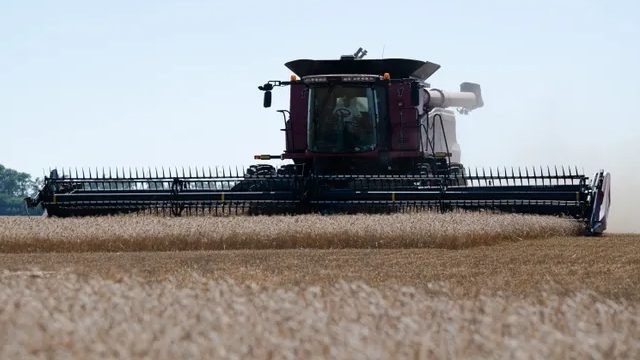
There’s no question that drought took a heavy toll with higher-than-average abandonment across the state. Rain also brought its own challenges, mainly in the form of increasing weed pressure and continual harvest delays. As a result, test weights dropped from their early highs as harvest progressed and more fields were abandoned, some due to weeds. All that means the final numbers for the 2023 Kansas wheat crop are likely to continue to drop. USDA-NASS will put out an updated estimate on the Kansas wheat crop in August, but the final count for the Kansas wheat crop will not come until the agency’s Small Grains Annual Summary on September 30.

“Whether it’s been the hailstorms or the weed pressure, with all the challenges we’ve had trying to get this crop out of the field for Kansas, it wouldn’t surprise me to see that number come down a bit,” Gilpin said.

The good news is that while the crop did not make the bushels, it did have high protein. Protein and yield are usually inversely proportional — so lower-yielding crops have higher protein and vice versa. The central corridor in Kansas reported proteins averaging 13 or 14 percent, while the western third of the state had more variability from 10 to 14 percent. That’s good news for millers and bakers who utilize hard red winter (HRW) wheat for products like bread or tortillas that require that strength.

“The early comments we’re hearing from industry is that the wheat is performing adequately, similar to last year,” Gilpin said.

But while the combines are finally finishing rolling in Kansas, the value of that protein won’t be fully defined until the spring wheat harvest is complete in the northern Great Plains. Hard red spring wheat is generally a high-protein crop, so if the crop in those states is more successful than in Kansas, the market may not reward producers or elevators with premiums for protein. In fact, it’s equally as likely some buyers will seek out lower-protein wheat to offset some of the higher-protein wheat.

In addition, producers further east grew an almost record soft red winter (SRW) wheat crop in the Mississippi and Ohio river valleys. There is currently a $1.50 to $2.00 per bushel difference between HRW and SRW wheat — primarily because soft wheat doesn’t have the bread-making capability of hard wheat. Despite the milling and baking differences, a large supply of SRW wheat is tempting when the HRW crop suffers.

“Buyers are going to be able to buy what they want, but it’s certainly going to be an interesting year,” Gilpin said. “You are going to see some millers and bakers that are trying to offset some of the costs that they’re seeing. That includes trying to blend in some soft wheat when the hard red winter wheat crop is going to be the smallest in years.”

All these supplies factor into the overall stocks-to-use ratio, which is used to estimate how much wheat is available globally to meet the needs of consumers around the world. While overall wheat supplies are tighter than anyone in the supply chain would prefer, stocks-to-use ratios remain above the concerning levels from 2007/2008. Geopolitically, however, the enduring tensions between Russia and Ukraine will continue to have a direct impact on the availability of world wheat stocks as well as from where the world buyers can source those stocks.

“The Black Sea does create some uncertainties that do start to question some of that availability of the stocks-to-use ratio because of an availability issue out of that region,” Gilpin said. “There’s been a strategic intent of Russia attacking grain terminals and then explicitly saying that even without Ukrainian wheat exports, Russia can be that supplier and replace them.”

“One out of every five vessels is going to be delivering food around the world from Russia. When they have that control, they are following it up with their intention of trying to leverage influence in friendly countries and governments. It’s a very unnerving place that world trade is entering right now.”

All these influences on the price of wheat bear watching as producers shift their focus from a frustrating and challenging 2023 wheat harvest to putting the 2024 crop into the ground. Gilpin said Kansas Wheat is continuing to look even further down the road to forecast what the world of wheat will look like and how to position Kansas wheat farmers in that economic landscape.

“We’re going to need prices to stay favorable and we’re going to need Mother Nature to cooperate,” Gilpin said. “And we must start thinking longer term, not just where we’re going to be a year from now. What do we have to be doing to put in place all the things across the whole value chain in the wheat industry to make sure that we’re protecting our national interest in having a productive and successful wheat crop from farmer to baker to consumer.”

Learn more about Gilpin’s perspectives on this year’s harvest, supply-and-demand factors across wheat classes, end-use quality, international market influences and more in the latest episode of the “Wheat’s On Your Mind” podcast at wheatsonyourmind.com.

###

Written by Julia Debes for Kansas Wheat

“Drug Prices”

0


High costs and shortages of pharmaceuticals are serious, on-going issues. Drug prices in the US are among the highest in the world. A recent survey by the Rand Corporation looked at drug prices in 32 developed countries. US prices were the highest in the group and were more than twice the average of prices in other countries. What is especially troubling is that the products sold in many of these countries are the same drugs produced by the same manufacturers as those sold in the US at much higher prices.

When it comes to drug prices, consumers – and even third-party payers – have little bargaining power. The reality is, drug companies are free to charge “what the market will bear”.

Recently developed, brand name drugs are typically the most costly. New drugs are usually covered by patents which give the developers exclusive rights to market the product without competition. Patents are for 20 years and begin when a new drug application is filed. This usually occurs years before the product actually comes to market. Nonetheless, companies typically enjoy 10 or more years without any direct competition.

When patents are nearing expiration companies have numerous ways to “game” the system. One of the most common is to make minor, often insignificant, changes in the product and apply for a new patent. Sometimes major producers actually buy up smaller potential generic competitors or pay such companies to delay the introduction of competitive products. Regulators have blocked some but not all such practices.

The patent process is defended as a way to give firms some assurance that they can recoup the expenses they incur if they undertake the costly and highly unpredictable process of drug development. The public clearly has an interest in encouraging new drug development. Critics, however, have pointed out that often much of the early development is done in academic centers, usually at public expense.

Even when patents expire the usual market forces do not always bring about effective cost control. The best example is insulin. There are three major producers of insulin who produce very similar products. Instead of competing on price all three companies progressively raised the retail prices of insulin. Insulin prices in the US climbed to as much as ten times those in Canada. Recent legislation has forced companies to limit out-of-pocket insulin costs for Medicare recipients to no more than $35 per month. Subsequently, public pressure led all three insulin producers to agree to a limit $35 per month for all users. In this situation competition produced real benefits. However, one wonders if the companies can afford to drop the price from over $100 to $35, what was their margin before the reduction?

What about prices that are too low? Some older drugs are still vitally important. In several of these cases the prices – and the profitability – have dropped to the point where producers have left the market leaving us with seriously limited production capacity.

Vincristine is a cancer drug, a key component in the treatment of childhood leukemia. Because of low profitability virtually all vincristine has come from a single manufacturer. When that producer ran into production problems no other source was available. Cancer physicians struggled for months with heart rending decisions of having to ration among seriously ill children the very limited amounts of vincristine they could get.

There are other more recent examples. This past winter there were serious shortages of amoxicillin, a widely used antibiotic and, more recently, we are facing dangerous shortages of albuterol, a key treatment for asthma and COPD. In each of these situations the companies have made what they considered to be sound business decisions but decisions which were clearly not in the public interest.

What to do? Open market principles have often served us well but we need to be smart enough – and tough enough – to recognize when we are benefitting and when we are not. We need regulatory limits that protect creativity and innovation yet prevent price gouging and insure availability of vital medicines. That is a high bar but one we as a society must keep working toward.

Tom Dean, MD is a retired family physician who practiced for over 40 years in Wessington Springs, SD and a past member of the Medicare Payment Advisory Commission (MedPAC). Dr. Dean is a recent inductee into the SD Hall of Fame, these articles were previously published in SD Searchlight. Follow The Prairie Doc® at www.prairiedoc.org and on Facebook featuring On Call with the Prairie Doc®, a medical Q&A show providing health information based on science, built on trust, streaming live on Facebook most Thursdays at 7 p.m. central.

Fall Seed Supplies Could Be Tight: “It’s just flat ugly.”

0

If you’re looking for seed wheat, rye or triticale to plant this fall, you might want to start looking sooner rather than later.

One of the consequences of having the worst Kansas wheat crop in the past 50 to 60 years is that the supply of seed wheat will be much shorter than normal. The tight seed supply situation also affects triticale and especially rye. Prices will also be higher. And, in cases, much higher.

In addition to reduced new crop yields with the ’23 crop, the amount of carryover certified seed from last year is at extremely low levels, according to Steve Schuler, Kansas Crop Improvement Association.

He notes that normal certified seed wheat carryover runs about 800,000 bushels. “This year it’s only 183,000 bushels.” And that makes new crop production all the more important. But for many Kansas-certified seed wheat producers yields of 20 and 30 bushels per acre were far more common than the normal 40, 50 and 60-bushel per acre yields.

While the supply of certified seed is smaller, likely the demand is higher. For instance, many Kansas wheat growers harvested no wheat whatsoever because of the drought and later hail storms or because they abandoned their crop because of poor stands or because weeds simply took the crop. Too, many hauled their crop to the elevator because of concerns about quality issues like head sprouting, high moisture contents, low test weights and weed contamination. Other farmers need additional supplies of seed wheat because they fallowed the acres they abandoned this spring and will plant back to wheat this fall.

Commercial seed cleaner Rusty Swonger, Minneola, KS says, “It’s just flat ugly”. His seed wheat cleaning jobs are off easily 35 to 50%. Not only that but Swonger is concerned about the quality of seed wheat he is cleaning. For instance, while cleaning for one farmer, he noticed the grain was already hot because it was harvested at too high of a moisture content, then heated in the bin.

“And that heat can destroy the ability for the seed to germinate.”

Swonger says other things to be concerned about with seed that was saved for fall planting include high loads of weed seed, grain that had sprouted in the head or seed that could have low germination because pre-harvest herbicide treatments were applied too early before hard dough.

“All of these things point out the need for having germination and quality tests on your seed especially if it’s home-produced. These tests have already been done on certified seed,” he says.

Co-worker Caleb O’Hanlon says the seed situation is even more critical with triticale and rye. His seed cleaning jobs have easily been cut in half because this year’s rye and triticale production was so poor.

O’Hanlon cites one example of a rye grower who normally produces 40,000 to 50,000 bushels but this year he binned just 15,000 bushels because of the drought. Other low-yielding fields were abandoned this spring because of severe weed infestations.

A major north central Kansas seed dealer says supplies of rye are almost non-existent. And prices reflect that with asking prices on some rye running $20/bushel and more.

And while seed wheat prices are also higher because of the shortage, on the upper end some wheat prices are running between $25 and $30/bushel. However, other certified seed wheat growers like Orville Williams from Montezuma, Kansas feels a strong obligation to long-term customers to hold the line as much as possible on prices. But neither can you overlook the supply realities with production of many popular varieties cut by 50 to 75% in cases. “Many of us just don’t have a lot to sell.”

Yet another western Kansas certified seed wheat grower says he’s almost afraid to put out ads on his seed. “We were already getting calls two to six months ago from farmers looking for seed knowing they were going to need it because of the drought. Several of these farmers produced no wheat whatsoever and will have to buy everything they plant.”

On the optimistic side, Tyler Benninghoven with Plains Gold says seed wheat growers in northeastern Colorado had very good crops. “Thus, many of the Colorado State University varieties could find their way into Kansas fields this fall. A lot of the dryland wheat in this region yielded 50 to 70 bushels per acre with some irrigated running as high as 105 to 115 bushels per acre,” he says.

Benninghoven cautions, though, about farmers selling wheat to their neighbors for planting. “Most of the current wheat varieties are PVP protected so farmer-to-farmer sales are illegal though in most cases the farmer is allowed to plant back on his own land,” he concludes.

As reported in The Hutchinson News. Vance Ehmke is a farmer in Lane and Scott counties in Kansas. He runs a seed business and is a former editor for Progressive Farmer. Ehmke also is a past president of the Kansas Association of Wheat Growers.