Monday, March 2, 2026
Home Blog Page 651

KU News: Paper offers glimpse of 500-million-year-old sea worm named after ‘Dune’ monster

0

From the Office of Public Affairs | http://www.news.ku.edu

Headlines

Paper offers glimpse of 500-million-year-old sea worm named after ‘Dune’ monster
LAWRENCE — Excavations by a University of Kansas paleontologist working in a treasure trove of fossils called the “Spence Shale Lagerstätte” have revealed an ancient sea worm unknown to science until now. The fieldwork took place in the High Creek area of the Spence Shale, a geologic formation straddling northern Utah and southern Idaho. The findings recently were published in the peer-reviewed journal Historical Biology.

Researchers to identify key brain, behavioral changes in aging women with premutations of the Fragile X gene
LAWRENCE — Only in the past 20 years have scientists recognized a condition known as Fragile X-associated tremor/ataxia syndrome (FXTAS). First documented in a small group of men who had grandchildren with Fragile X syndrome, it has more recently been identified in women. Researchers at the University of Kansas Life Span Institute and partners are currently recruiting women ages 60-75 with known FMR1 premutations and those without to participate in tests examining changes in cognition, grip strength and posture, and brain function in aging.

Full stories below.

————————————————————————

Contact: Brendan Lynch, KU News Service, 785-864-8855, [email protected], @BrendanMLynch
Paper offers glimpse of 500-million-year-old sea worm named after ‘Dune’ monster
LAWRENCE — Excavations by a University of Kansas paleontologist working in a treasure trove of fossils called the “Spence Shale Lagerstätte” have revealed an ancient sea worm unknown to science until now.
When she found the fossil, Rhiannon LaVine, a research associate with the KU Biodiversity Institute and Natural History Museum, was part of a team camping and carrying out fieldwork in the High Creek area of the Spence Shale, a geologic formation straddling northern Utah and southern Idaho. The area has been famed since the 1900s for its abundance in some 90 species of Cambrian trilobites and soft-bodied fossils.

Their findings recently were published in the peer-reviewed journal Historical Biology.
“One of the last times we were out there, I split open one of these pieces of rock and instantly knew it was something that wasn’t typical,” LaVine said. “The first thing we see are these radial blades that look like stars or flowers. Immediately, I showed it to (lead author) Julian Kimmig. He was perplexed. He’s said, ‘I’ve never seen anything like that.’ We were out with Paul Jamison, a local who’s been working the site for years — and if there’s something in there that somebody’s seen, he’s seen it. But he hadn’t seen it.”
After transporting the fossil specimen back to the KU Biodiversity Institute — where today it’s part of the permeant paleontological collection — LaVine consulted with colleagues about the mysterious fossil.
“I was showing it to everybody, asking, ‘What do you think this is?,’” LaVine said. “Nobody had an idea. We thought maybe it’s a wiwaxia, a very peculiar animal from about that time — but we don’t have too many representatives of it from the Spence area. Or maybe it’s a scale worm, but there’s no real scale worms known from that time. Maybe it was a juvenile jellyfish, but it’s so bladed and the lines are so straight on those things, it would be kind of odd. So, I couldn’t get a solid answer.”
Next, LaVine teamed with colleagues at the University of Missouri to conduct scanning electron microscopy and energy-dispersive X-ray spectrometry on the fossil.
“We mainly wanted to make sure that this was a biological thing, because it’s possible it could have just been some weird mineral growth with the way it looked,” said the KU researcher. “So that was primarily why we brought it to them. It’s about 7 or 8 centimeters long, maybe a little shorter than the length of a smartphone. It’s sizable for a fossil of that sort. We did the scanning to rule out that it wasn’t just a mineral growth, and we were able to do that.”
Finally, LaVine and her co-authors were able to determine the fossil to be a previously unknown species of annelid, a diverse phylum of some 21,000 “segmented worm” species found in terrestrial, freshwater and marine environments all over the world.
As the discoverer of the new fossil worm and a co-author on the paper describing it, LaVine bestowed the species with its scientific name: Shaihuludia shurikeni. Shai-Hulud is the indigenous name for the worms on the planet Arrakis in the “Dune” novels by Frank Herbert, while “shuriken” is the Japanese word for throwing star, representing the shape of the blade-like chaetae (chaetae are the stiff bristles that characterize many annelids).
“I’ve been involved in describing species before, but this is the first one I’ve named,” LaVine said. “Actually, I was able to name its genus — so I can put that feather in my cap. It was the first thing that came to mind, because I’m a big ol’ nerd and at the time I was getting really excited for the ‘Dune’ movies.”
Like worm’s sci-fi namesake, Shaihuludia shurikeni is a big deal: Describing a new species of Cambrian annelid doesn’t happen every day.
“Annelids are very rare in the Cambrian of North America, and so far we only knew of a single specimen from the Spence Shale,” said lead author Julien Kimmig, a paleontologist with the State Museum of Natural History in Karlsruhe, Germany. “The new annelid Shaihuludia shurikeni is especially interesting, as it had some very impressive chaetae, which makes it unique among the Cambrian annelids. The way that the fossil is preserved is also of particular interest, because most of the soft tissue is preserved as an iron oxide ‘blob,’ suggesting the animal died and was decomposing for a while before it was fossilized. However, with the analytical methods used in the paper, we show that even with limited preservation you can identify fossils.”
In the process, the team reexamined a fossilized annelid previously found in the Spence Shale and reclassified it as Burgessochaeta — a surprise because until then, Burgessochaeta have only been found in another famed fossil deposit in British Columbia, Canada.
“Burgessochaeta is really only known from the Burgess Shale,” LaVine said. “A similar worm was collected in our Spence Shale decades ago, and it was named Canadia, which is kind of a wastebasket genus for a lot of the annelids that come out of these types of deposits.
“Nobody really looked into it for a long time, but when we got this one, we took a little closer look at the other annelid found there. Maybe this was another version of it, or it was related in some way,” LaVine said. “We determined the other annelid from the Spence Shale is actually closer to Burgessochaeta — this is the first time it’s been described outside of the Burgess Shale.”
Both worm species would have inhabited a marine ecosystem ruled by invertebrate organisms, like trilobites, brachiopods, mollusks and early forms of arthropods. The mid-Cambrian is noted for the intense biodiversity of its marine life.
“This discovery gets us to think about deep time,” LaVine said. “When we look outside, we see all the animals that we know. Now we can walk past a duck, go to the beach and see a starfish and all the critters that exist in the ocean. We kind of know what to expect. But then we can let our imaginations go a little bit to imagine what happened a million years ago or, in this case, over 500 million years ago. What does the ocean look like then? You’re going to see a lot of the similar players, but they’re a little bit alien because evolution has taken place. It’s very cool to think about our planet as a record of history and all of the different environments that have happened over billions of years, all on the same ground we stand on. We’ve had alien worlds beneath our feet.”
LaVine and Kimmig’s co-authors were James Schiffbauer, Sven Egenhoff, Kevin Shelton and Wade Leibach.
-30-
————————————————————————
The official university Twitter account has changed to @UnivOfKansas.
Refollow @KUNews for KU News Service stories, discoveries and experts.


————————————————————————

Contact: Christina Knott, Life Span Institute, [email protected], @kulifespan
Researchers to identify key brain, behavioral changes in aging women with premutations of the Fragile X gene
LAWRENCE — Only in the past 20 years have scientists recognized a condition known as Fragile X-associated tremor/ataxia syndrome (FXTAS). First documented in a small group of men who had grandchildren with Fragile X syndrome, it has more recently been identified in women. Researchers at the University of Kansas Life Span Institute now are working to learn more about its effects in women.
At one time, the genetic markers, or premutation alleles, of the Fragile X gene FMR1 were thought to be relatively benign in an individual carrying them in their genetic code; researchers only knew that the premutation alleles contributed to the risk for having a child with Fragile X syndrome, which causes a range of developmental problems in young children. Scientists now know that premutation alleles can contribute to severe changes in cognition and movement as carriers age. Those changes include tremor, balance issues and memory loss, and it can lead to a loss of independence.
“We know very little about which premutation carriers will develop FXTAS,” said Matt Mosconi, associate director and senior scientist at KU’s Life Span Institute and professor of clinical child psychology. “We know males are at greater risk than females. Otherwise, we don’t know a whole lot about which premutation carriers are going to get it. And we don’t know what changes are happening in the brain, as those seem to be different in men and women.”
Mosconi’s team, in collaboration with colleagues at Kansas State University and the University of California-Davis, are leading new studies of motor, cognitive and brain changes in female FMR1 premutation carriers to identify key symptoms to track during aging. They hope to better understand the causes of FXTAS in females.
Approximately 1 in 450 men carries the premutation that can lead to FXTAS, compared to about 1 in 200 women. Of those, about 40% of men and 16-20% of women will develop FXTAS symptoms. While usually more severe in men, FXTAS can still be debilitating in women.
FXTAS symptoms typically present when individuals reach their 50s or 60s but often are missed during early stages or misdiagnosed as Parkinson’s or Alzheimer’s disease. Greater knowledge of the key brain and behavioral changes associated with FXTAS in women is essential for identifying initial disease stages when treatments may be most effective.
Mosconi’s team is currently recruiting women ages 60-75 with known FMR1 premutations and those without to participate in tests examining changes in cognition, grip strength and posture, and brain function in aging.
The long-term goal of this study is to clarify neurodegenerative mechanisms of FXTAS in women so that more sensitive methods can be established to track disease progression and development, as well as to advance targeted therapeutic interventions.
For more information about participating in FMR1 research, visit the KU FMR1 research website or contact the KU BRAIN Lab at [email protected].

-30-
————————————————————————

KU News Service
1450 Jayhawk Blvd.
Lawrence KS 66045
Phone: 785-864-3256
Fax: 785-864-3339
[email protected]
http://www.news.ku.edu

Erinn Barcomb-Peterson, director of news and media relations, [email protected]

Today’s News is a free service from the Office of Public Affairs

Horticulture 2023 Newsletter No. 30

0

https://hnr.k-state.edu/extension/info-center/newsletters/index.html

Blog Post: http://www.ksuhortnewsletter.org

Video of the Week: Spider Mites on Tomatoes
https://kansashealthyyards.org/all-videos/video/spider-mites-on-tomatoes

REMINDERS
• Seed beets, carrots and beans
• Never fertilize warm-season grasses such as zoysia, bermuda and buffalo after August 15
• Remove sucker growth and watersprouts from fruit trees, especially apples

Prioritizing Water in the Landscape
During periods of drought, it may be necessary to prioritize which plants will be first in line to receive supplemental water due to time and water restrictions. As with many decisions, cost plays a major role in determining where to begin watering.
Start with the large, established trees. These are the most difficult and expensive to replace if they don’t survive. They also take the longest to become established. While they may not require supplemental water during a short drought period, if it becomes prolonged established trees can still suffer. Next, care for the young trees which are still developing their root systems.
Take care of shrubs next, followed by perennials, lawn and finally, annuals. This order will direct your attention to the plants that have had the most invested in them saving you time and money if you must replace plants that don’t survive. (Cynthia Domenghini)

Watering Newly Planted Trees and Shrubs
Young trees and shrubs have not established the root system necessary to survive extreme heat and dry spells without supplemental water. After planting, it is essential to keep the root ball area moist for several weeks, but even a couple years later it may be necessary to periodically apply water to the area.
Give newly planted trees 10 gallons of water weekly. Apply the water slowly so it can sink deep into the root zone and promote new growth. Build a reservoir, about three to four-inches tall around the tree to keep the water in the desired area. Alternatively, drill a 1/8-inch hole in a plastic 5-gallon bucket. Place the bucket beneath the tree and fill with water. After it has drained fill it a second time. When it has emptied, the tree will have received ten gallons. There are also bags available commercially that serve a similar purpose. They can be secured to the tree and filled with water which then slowly enters the soil. Mulch is recommended to help retain moisture, moderate soil temperature and prevent damage to the trunk from lawn mowers and other tools. (Cynthia Domenghini)

VEGETABLES
Green Beans Producing Flowers but not Beans
Though relatively easy to grow, green beans may not produce efficiently when adequate growing conditions are not met.
Temperature is a key factor that affects bean production. High (above 85 degrees F) or low (below 70 degrees F) can cause plants to create flowers but no beans.
Periods of dryness between watering can also inhibit bean development. Hot, dry winds can exacerbate this problem.
The best way to ensure a healthy bean crop is proper crop management. Use mulch to regulate soil temperature and retain moisture. Plant a windbreak crop such as corn to shield green bean plants. Harvest beans regularly to encourage the plants to continue producing. If beans are left on the plant beyond their peak harvest time they will use energy to develop seed rather than create new beans. (Cynthia Domenghini)

FRUIT
Watering Fruit Plants During the Summer
Monitoring soil moisture of fruit crops is important to preserve the quality of the harvest. Allowing fruit crops to be under heat or drought stress during fruit development restricts cell division. This directly affects the size of the mature fruit even if additional water is added later. Drought stress can also lead to wilting and yellowing leaves as well as leaf and fruit drop. Next year’s crop could be affected too as buds may fail to develop.
The takeaway message is to monitor the soil at the rootzone to ensure proper moisture levels. This can be done by pushing a probe into the soil. A wooden dowel, rebar or even a screwdriver can work for this task. Try to insert the probe at least 8 to 12 inches. Dry soil will be very difficult to penetrate indicating water should be applied.
Add water slowly to the rootzone using a sprinkler, soaker hose, drip irrigation or other method. The amount of water necessary will vary depending on plant size, but use the soil probe as your indicator. When the probe can reach 12-inches into the soil, the moisture level should be adequate.
Monitor fruit crops weekly during hot, dry weather. Newly planted fruit crops and strawberries, with shallow root systems, will need to be checked at least twice a week for soil moisture. (Cynthia Domenghini)

TURF
Should I Water My Lawn?
We have been receiving questions recently on whether to water lawns, especially the cool-season lawns tall fescue and Kentucky bluegrass. Tall fescue and Kentucky bluegrass can go drought dormant for 6 to 8 weeks without harm. Therefore, some homeowners allow their lawn to go dormant during summers such as this. However, when the rains return, the grass will be thin and weeds may become a problem. The weeds can be controlled but that adds an additional expense. Also, if we reach that 6-week period, the grass needs to be given 1/4″ of water a week to keep the crown hydrated so the turf doesn’t die.
If your lawn has been dormant for a while and are wondering if the turf is still alive, pull up an individual plant and separate the leaves from the crown. The crown is the area between the leaves and the roots. If it is still hard and not papery and dry, the plant is still alive.
If you want to keep the grass going through the summer, wait until you see spots in the lawn turn a purplish hue and then water well so the soil is moist about 6 inches deep. Continue to do this until the rains return. Of course, watering more won’t hurt except for your water bill. (Ward Upham)
Crabgrass Control
You may have noticed a lighter green, low-growing grass amongst your lawn. Crabgrass tends to make its appearance this time of year, particularly in areas where the lawn is less dense. Identified by the wide, flat blades, crabgrass is a warm-season annual. It dies back either after flowering and setting seed or with the first hard frost. However, it is very efficient at reproduction leaving behind thousands of seeds to invade the lawn next year. Though not particularly harmful, when it dies back in August large sections can leave unsightly bare spots in the lawn. Fortunately, cool-season grasses should also begin to flourish this time of year so if the crabgrass infestation is minimal, treatment is not necessary.
Aside from manually removing plants, crabgrass can be difficult to control once it has germinated. Therefore, prevention is the best approach for controlling crabgrass. Maintaining a thick, healthy lawn will prevent crabgrass seeds from germinating. Mow your lawn no shorter than three-inches which will help prevent sunlight from reaching the seeds on the soil surface. Around mid-April apply a pre-emergent to combat seeds from the previous growing season.
At this point in the season, it is too late for a crabgrass preventer. If manual removal is not an option there are some herbicides that will kill crabgrass plants including: Ortho Weed-B-Gon Max + Crabgrass Control, Fertilome Weed-Out with Crabgrass Control, Monterey Crab-E-Rad and BioAdvanced Lawn Weed & Crabgrass Killer. Each contains quinclorac, which is a crabgrass herbicide, as well as other active ingredients that control broadleaf weeds. Quinclorac is an excellent crabgrass killer that controls not only crabgrass but also has good activity on foxtail and certain broadleaves such as field bindweed, black medic and clover. However, it does little to nothing to goosegrass. If you use crabgrass killer on your lawn bag the clippings. Do not use them as mulch or in compost. (Cynthia Domenghini)

PESTS
Cicada Killer Wasps
Description: At about 1 ½-inches long, cicada killers are an intimidating wasp. They have reddish colored wings and legs and a black abdomen with wide, yellow stripes. Cicada killers live independently though nests may be relatively close to each other. Females have a stinger which is used to paralyze their prey. They rarely sting people unless agitated. Males are smaller and do not have a stinger.
Females are responsible for locating cicadas and paralyzing them with their stinger. She then carries the cicada back to her burrow. Each burrow can house up to 20 cicadas.
Life Cycle: Adult females lay a single egg on each cicada they drag into the ground. Eggs hatch in two to three days into legless, white grubs which feed on the cicada. The larvae then create a protective case in which to overwinter. Adult wasps die in early fall. In spring the larvae pupate in the pupal cases and emerge as adults in June/July. There is one generation per year of cicada killers.
Damage: Cicada killers typically cause very little damage to the landscape. A heavy infestation may become a nuisance as they protect their nests. The burrows may be considered unsightly, especially in a lawn area.
Control: Cicada killers prefer well-drained, light soils in full sun. They may burrow along sidewalks or flowerbeds but do not like areas covered with mulch. Maintaining a thick, healthy lawn is the best control for preventing burrows. Pesticides are not usually necessary since adults are only present for about two months beginning mid to late summer, but Permethrin may be used for control. Treat the burrows at dusk when females have returned. Males are often found perched nearby. Products with permethrin include:
(Dusts) Eight Garden Dust – Bonide, Multipurpose Garden and Pet Dust – Green Thumb Garden, Pet & Livestock Dust – Hi-Yield
(Liquids) 38 Plus Turf, Termite & Ornamental Insect Spray – Hi-Yield, Eight Vegetable, Fruit & Flower Conc. – Bonide, Eight Yard & Garden RTS – Bonide, Garden and Farm Insect Control- Hi-Yield (Cynthia Domenghini)

MISCELLANEOUS
Wood Chips as Mulch
Mulching the landscape is a recommended practice to moderate soil temperature and moisture and prevent weeds. Wood chips created by tree trimming companies can be an inexpensive way to mulch around trees and shrubs in the landscape. Homeowners have some concerns about the effect green wood chips may have on their landscape plants.
Will using fresh wood chips as mulch deplete nitrogen from the soil? Microorganisms found in the soil break down organic matter using nitrogen from the soil. Wood chips are very low in nitrogen so more is pulled from the soil to break down the wood chips making the nitrogen less available for the desired plants. However, when used only on the surface as a mulch, this is not a concern. It is not recommended to incorporate fresh wood chips into the soil. Recognize the difference between mulch and compost.
Will wood chips from a diseased tree spread the disease into my landscape? The short answer is “it could.” However, if handled properly, the wood chips can be safely used in the landscape. If it is known that the wood chips are from a diseased tree, allow them time to dry out completely before spreading in the landscape. To be safe, avoid spreading the mulch around trees of the same species where the wood chips originated.
Will using wood chips near my home encourage termites? This can be a concern if the wood chips are mulched right up to the foundation of the house. Termites are light and heat sensitive and will not bother the chips themselves if they are 3 inches deep or less. Therefore, keep the depth of the mulch less than three-inches near the house and other buildings. Also, leave a bare area several inches wide next to the house so that any termite activity is noticeable. (Cynthia Domenghini)

Contributors:
Cynthia Domenghini, Instructor
Ward Upham, Extension Associate

Division of Horticulture
1712 Claflin, 2021 Throckmorton
Manhattan, KS 66506
(785) 532-6173

For questions or further information, contact: [email protected] OR [email protected]
This newsletter is also available on the World Wide Web at: http://hnr.k-state.edu/extension/info-center/newsletters/index.html
The web version includes color images that illustrate subjects discussed. To subscribe to this newsletter electronically, send an e-mail message to [email protected] or [email protected] listing your e-mail address in the message.

Brand names appearing in this newsletter are for product identification purposes only. No endorsement is intended, nor is criticism implied of similar products not mentioned.

K-State Research and Extension is committed to making its services, activities and programs accessible to all participants. If you have special requirements due to a physical, vision or hearing disability, or a dietary restriction please contact Extension Horticulture at (785) 532-6173.

Kansas State University Agricultural Experiment Station and Cooperative Extension Service K-State Research and Extension is an equal opportunity employer. Issued in furtherance of Cooperative Extension Work, Acts of May 8 and June 30, 1914, as amended. Kansas State University, County Extension Councils, and United States Department of Agriculture
Cooperating, Ernie Minton, Dean.


KU News: KU Alumni Association invites campus, community partners to participate in Homecoming 2023

0

From the Office of Public Affairs | http://www.news.ku.edu

Headlines

Contact: Paige Freeman, KU Alumni Association, 785-864-0953, [email protected], @kualumni
KU Alumni Association invites campus, community partners to participate in Homecoming 2023
LAWRENCE — The University of Kansas will host its 111th Homecoming Oct. 23-28, culminating in the KU football game against Oklahoma on Oct. 28 in David Booth Kansas Memorial Stadium. The theme for this year’s celebration is “Rah Rah Jayhawk,” a nod to the origins of the Rock Chalk chant and Jayhawk nostalgia.
The KU Alumni Association has selected the members of its student-led Homecoming Steering Committee, who will work with Paige Freeman, the association’s director of student programs, and Ryan Edmonds, assistant director of student programs, to coordinate activities for Homecoming 2023.
Steering committee members:
1. Thanh Tan Nguyen, a senior in business analytics and supply chain management from Phu Yen, Vietnam, executive director.
2. Nana Ansere Amfo Sackey, a junior in visual communication and design from Accra, Ghana, and Lawrence, programs chair.
3. Jess Mumm, a junior in strategic communications and business from Omaha, Nebraska, programs co-chair.
4. Andy Denekas, a graduate student in business and pre-law from Omaha, Nebraska, awards chair.
5. Shayslyne Campos, a senior in marketing and psychology from Kansas City, Missouri, and Lawrence, public relations/outreach chair.
6. Anna Korn, a junior in sport management from Phoenix, Arizona, competitions chair.
7. Aria Woolsey, a junior in strategic communications and psychology from River Falls, Wisconsin, public relations/outreach co-chair.
8.
KU’s Homecoming experience aims to celebrate KU history and tradition and instill Jayhawk pride in all members of the KU community, near and far, through the engagement of students, faculty, staff, alumni and community members. To help foster engagement, the Alumni Association and Homecoming Steering Committee encourage campus and community partners to submit an event for the Homecoming calendar on behalf of your department or organization. Program submissions will be accepted until Sept. 4.

The association and steering committee will hold a virtual Homecoming Information Session from 3 to 4 p.m. Aug. 14 and invite any KU campus or Lawrence community partner interested in hosting an event to attend. Register here for the information session, which will be recorded and available later to those who register.
This year’s Homecoming celebration is sponsored by Central Bank of the Midwest, Konica Minolta, KU Bookstore, Pepsi Zero Sugar and StoneHill Hotel.
The Alumni Association will continue to update kualumni.org/homecoming as more information on the week’s activities becomes available.

-30-
————————————————————————

KU News Service
1450 Jayhawk Blvd.
Lawrence KS 66045
Phone: 785-864-3256
Fax: 785-864-3339
[email protected]
http://www.news.ku.edu

Erinn Barcomb-Peterson, director of news and media relations, [email protected]

Today’s News is a free service from the Office of Public Affairs

Horticulture 2023 Newsletter No. 31 

0

https://hnr.k-state.edu/extension/info-center/newsletters/index.html

Blog Post: http://www.ksuhortnewsletter.org

Video of the Week: Composting: Making Black Gold
https://kansashealthyyards.org/all-videos/video/composting-making-black-gold

REMINDERS
• Divide iris if needed.
• Do not fertilize the warm-season turfgrasses, buffalograss, zoysiagras and bermudagrass, past August 15. Doing so may increase the chances for winter damage.
• Check mulch layers and add additional material if needed.

VEGETABLES
Still Time for a Salad Garden
Though we’re very much still experiencing the heat of summer it’s time to make plans for fall gardening. Choose crops that tolerate the weather as it turns cooler, but also the warm soil at planting. Cool season vegetables can be started from mid-August through early September. Some leafy greens that tolerate these conditions include: green and red leaf lettuce, kale, spinach, mustard, bok choy and endive. Radishes, beets and carrots are also good fall crops that can be tossed into a salad.
Prior to planting, turn the soil and incorporate a balanced fertilizer to replenish the garden from the previous crop. (Cynthia Domenghini)

FRUIT
When Are Apples Ready to Pick?
Apples mature over a long period of time depending on variety. Some varieties such as Lodi can mature in July and others as late as October or even November. Here are some guides to help you decide when to pick your apples.
Days from bloom: The number of days from bloom is a reliable guide for general maturity time, but weather conditions will have some influence. Some kinds of apples and approximate days from bloom to maturity are Jonathan, 135, Delicious, 145, Golden Delicious, 145, and Winesap,155 days.
Flesh color: As apples mature and starches change to sugars, the flesh changes from very light green to white. When you cut a thin slice and hold it up to the light you can see the difference.
Seed color: The seeds of most apples change from light green to brown as the fruit ripens. This indicator should be combined with other changes since it is not absolute. The flavor of the apples, the change in color of the stem and calyx basins and flesh color are important in deciding if apples are ready to harvest.

Color change: As apples mature, the skin color in areas of the stem and the calyx basin at the bottom of the apple turns from an immature green to a light-yellow color. Some apples will develop a red skin color over most of the fruit before they are ripe, so this is not a reliable indication of maturity.
Flavor: This is a good guide if you are familiar with the apples, you have and know how they should taste. Even if you do not know the characteristic flavor of the kind of apple you have, you can still sample slices of a few apples and decide if they have a sweet flavor. If they are not ready to harvest, they will taste starchy or immature. If apples have already fallen and taste a bit starchy, store them for a period to see if they become sweeter. (Ward Upham)

Fertilize Strawberries
Early- to mid-August is the time to fertilize strawberries in order to increase the number of fruits produced next spring. Plenty of daylight and warm temperatures during June, July and August promotes the growth of new runner, or daughter, plants. As daylight hours dwindle and temperatures grow cooler in September and October, fruit buds for the next year’s fruit crop develop. To get a good berry crop next spring, it is important for strawberry plants to be vigorous during this period of fruit bud development. Nitrogen, applied now, will help promote fruit bud development. A general application rate is ^ to 3/4 pound of actual nitrogen per 100 feet of row. The nitrogen may be in the form of a fertilizer mixture such as ammonium phosphate or 12-12-12, or in a fertilizer containing only nitrogen such as urea or ammonium nitrate. Some specific examples would include:

Iron + (11-0-0) at 6 pounds per 100 feet of row.
12-12-12 at 5.5 pounds per 100 feet of row.
Nitrate of Soda (16-0-0) at 4 pounds per 100 feet of row.
Ammonium sulfate (21-0-0) at 3 pounds per 100 feet of row.
Urea (46-0-0) at 1.5 pounds per 100 feet of row.

Generally, each cup of fertilizer weighs ^ pound. On sandy soils, the rate may be increased by about one-half.?
After spreading the fertilizer, water the area applying at least 1/2-inch of water to move the nitrogen into the strawberry root areas. (Ward Upham)

PESTS
Mimosa Webworm on Honeylocust
Description: Larvae of Mimosa webworms are about one-inch long and light green to gray/brown with five longitudinal stripes on the body. The adult moths are silver-grey and have small black spots on the wings.
Life Cycle: There are two generations of Mimosa webworm each year. The first-generation moths emerge in early June and lay eggs on the honeylocust leaves. Caterpillars can be seen from mid-June through early July. The second generation of moths appear in mid to late July to lay another round of eggs. The larvae from this generation feed from early to late August.
Damage: Though Mimosa webworms can defoliate trees, healthy, established trees tend not to suffer greatly. Damage is primarily aesthetic as the larvae create tight webs of silk around the leaflets. Foliage in the webs turns brown and is unsightly. Additionally, the silk hanging from the trees as the larvae lower to the ground is a nuisance.

Control: Chemical control is not typically necessary. Treatment is ineffective if applied this time of year when the webs and brown leaves are already present. At the beginning of the caterpillar phase, prior to webbing, an insecticide can be used. BT (Dipel or Thuricde) or spinosad (Natural Guard Spinosad, Captain Jack’s Deadbug Brew, Bonide Colorado Potato Beetle Beater and Monterey Garden Insect Spray) can be used as well as traditional controls that contain cyfluthrin or bifenthrin. If you’re having problems with Mimosa webworms now, plan to apply treatment mid-June and possibly again in early August of next year. (Cynthia Domenghini)

MISCELLANEOUS
Plants for Late Season Bloom
Landscapes are often drab this time of year. You can add interest to your home by planting shrubs this fall or next spring that flower later in the growing season. Consider one or more of the following.
Rose of Sharon (Hibiscus syriacus) is a tall shrub that produces single or double flowers. Colors range from white to red, purple or violet, or combinations, depending on the variety.
Crapemyrtle (Lagerstroemia indica) are dwarf-to-tall shrubs or trees. They are not reliably winter hardy in Kansas and often die back to the ground. Crapemyrtle flowers on new wood, so plants pruned (or killed) to the ground while dormant in late winter or early spring will bloom later the same year. Flower color varies from white, pink, to purple or deep red on different plants.
Bluebeard (Caryopteris x clandonensis) is also known as blue-spirea, blue-mist shrub, or caryopteris. It usually is found with blue flowers, but some cultivars have a bluish-violet to violet flower color. Plants are usually cut back in late winter or early spring. Flowers are borne on the current season’s growth.
Sweet Autumn clematis (Clematis terniflora) is a vigorous vine with large masses of small, white flowers that have a wonderful fragrance. Be careful with this one; it can easily outgrow its bounds. It is often a good idea to cut it back to the ground in early spring.
Davidiana clematis (Clematis heracleifolia var. Davidiana) is a bush-type clematis with small but interesting violet-blue flowers. Female plants bear interesting fluffy seed heads into the winter. This clematis needs to be cut back to the ground each year to help maintain the shape of the plant.
PeeGee hydrangeas (Hydrangea paniculata Grandiflora) are somewhat coarse with large clusters of white flowers. They can be trained into a tree-like form. (Ward Upham)

Composting: The Science
Using compost in the landscape provides plenty of benefits for the soil including improved water holding capacity, drainage and added nutrients. Understanding the science behind composting makes it a feasible project that can turn waste into treasure.
Composting is a process that occurs naturally as organic materials breakdown in the landscape. This process can be expedited by balancing the ingredients and maintaining air circulation to create a healthy environment for bacteria, actinomycetes and fungi work to decompose different compost particles and thrive at various temperatures. Psychrophilic bacteria are most active when the temperature is around 55 degrees F. As these bacteria work, they generate some heat creating a warmer environment for the mesophilic bacteria which prefer 70 to 100 degrees F.
Thermophilic bacteria prefer even hotter temperatures and take over the decomposing work when the pile reaches between 100- and 160-degrees F. After their work is done and the temperature leaves the preferred range, the microorganisms die off.
Actinomycetes are important to the decomposition of materials such as lignin and cellulose. As the pile cools down, actinomycetes and fungi take over along with invertebrates such as earthworms and centipedes. These are considered “finishers” in the composting process.
The heating and cooling process of composting is what supports the life cycle of the microbes and expedites decomposition. Next week’s article will include details about what is needed to make a compost pile. Follow the link below for more information about compost microbes. https://calrecycle.ca.gov/organics/homecompost/microbes/ (Cynthia Domenghini)
Contributors:
Cynthia Domenghini, Instructor
Ward Upham, Extension Associate

Division of Horticulture
1712 Claflin, 2021 Throckmorton
Manhattan, KS 66506
(785) 532-6173

For questions or further information, contact: [email protected] OR [email protected]
This newsletter is also available on the World Wide Web at:
http://hnr.k-state.edu/extension/info-center/newsletters/index.html
The web version includes color images that illustrate subjects discussed. To subscribe to this newsletter electronically, send an e-mail message to [email protected] or [email protected] listing your e-mail address in the message.

Brand names appearing in this newsletter are for product identification purposes only. No endorsement is intended, nor is criticism implied of similar products not mentioned.

K-State Research and Extension is committed to making its services, activities and programs accessible to all participants. If you have special requirements due to a physical, vision or hearing disability, or a dietary restriction please contact Extension Horticulture at (785) 532-6173.

Kansas State University Agricultural Experiment Station and Cooperative Extension Service K-State Research and Extension is an equal opportunity employer. Issued in furtherance of Cooperative Extension Work, Acts of May 8 and June 30, 1914, as amended. Kansas State University, County Extension Councils, and United States Department of Agriculture Cooperating, Ernie Minton, Dean.

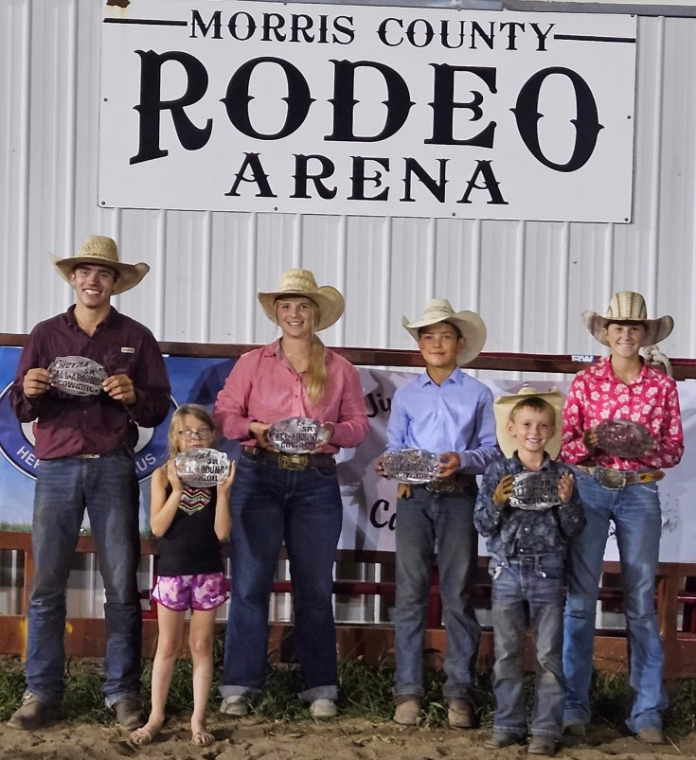
YOUTH RODEO WINNERS

0

All-around award winners at the annual youth rodeo sponsored by the Morris County Youth Rodeo Association Saturday night at Council Grove were Lakoddah Downes, Council Grove, senior boy; Hazelynn Wilson, Osage City, junior girl; Sadie Bathurst, Allen, senior girl: Drew Ritchie, Olpe, intermediate boy; Newt Parkin, Miller, junior boy; and Atley Johnson, White City, intermediate girl. (Amy Allen photo)