Tuesday, March 3, 2026
Home Blog Page 671

KU News: Global study details microplastics contamination in lakes and reservoirs

0

From the Office of Public Affairs | http://www.news.ku.edu

Headlines

Global study details microplastics contamination in lakes and reservoirs
LAWRENCE — A University of Kansas research professor contributed to new work published in the journal Nature that reveals concentrations of plastic found in freshwater environments are higher than those found in so-called “garbage patches” in the ocean. Ted Harris and recent KU graduate Rebecca Kessler contributed samples from nearby lakes and reservoirs. “Places like Clinton Lake are relatively low in microplastics because — while there are many animals and trees — there aren’t a lot of humans, relative to somewhere like Lake Tahoe where people are living all around it,” Harris said.

Barbara Kerr receives Fulbright U.S. Scholar Award to Iceland
LAWRENCE — A University of Kansas professor of counseling psychology has received a Fulbright U.S. Scholar Award to travel to Iceland this fall to study creative communities. Barbara Kerr’s research will contribute to her capstone work, a book on the psychology of creativity that summarizes 15 years of research.

Full stories below.

————————————————————————

Contact: Jon Niccum, KU News Service, 785-864-7633, [email protected]
Global study details microplastics contamination in lakes and reservoirs
LAWRENCE — Around 14 million tons of plastic end up in the ocean every year. But that is not the only water source where plastic represents a significant intrusion.
“We found microplastics in every lake we sampled,” said Ted Harris, associate research professor for the Kansas Biological Survey & Center for Ecological Research at the University of Kansas.
“Some of these lakes you think of as clear, beautiful vacation spots. But we discovered such places to be perfect examples of the link between plastics and humans.”
Harris is one of 79 researchers belonging to the international Global Lake Ecological Observatory Network (GLEON), which examines processes and phenomena occurring in freshwater environments. Their new paper, titled “Plastic debris in lakes and reservoirs,” reveals that concentrations of plastic found in freshwater environments are actually higher than those found in so-called “garbage patches” in the ocean. The article is published in Nature.
For his role, Harris teamed with Rebecca Kessler, his former student and recent KU graduate, to test two Kansas lakes (Clinton and Perry) and the Cross Reservoir at the KU Field Station.
“That entailed us going out, tolling a net with tiny little holes in it, dragging it for about two minutes, then collecting those samples of microplastics and sending them off to (the lead researchers),” Kessler said.
The research project was designed and coordinated by the Inland Water Ecology and Management research group of the University of Milano-Bicocca, Italy (headed by Barbara Leoni and Veronica Nava). The team sampled surface waters of 38 lakes and reservoirs, distributed across gradients of geographical position and limnological attributes. It detected plastic debris in all studied lakes and reservoirs.
“This paper essentially shows the more humans, the more plastics,” Harris said. “Places like Clinton Lake are relatively low in microplastics because — while there are many animals and trees — there aren’t a lot of humans, relative to somewhere like Lake Tahoe where people are living all around it. Some of these lakes are seemingly pristine and beautiful, yet that’s where the microplastics come from.”
Harris said that many of the plastics are from something as outwardly innocuous as T-shirts.
“The simple act of people getting in swimming and having clothing that has microplastic fibers in it leads to microplastics getting everywhere,” he said.
The GLEON study cites two types of water bodies studied that are particularly vulnerable to plastic contamination: lakes and reservoirs in densely populated and urbanized areas; and those with elevated deposition areas, long water retention times and high levels of anthropogenic influence.
“When we started the study, I didn’t know a lot about microplastics versus large plastics,” Harris said.
“When this paper says ‘concentrations as much or worse than the garbage patch,’ you always think of the big bottles and stuff, but you’re not thinking of all that smaller stuff. You don’t see a huge garbage patch in Lake Tahoe, yet it’s one of the most impacted lakes when it comes to microplastics. Those are plastics you can’t really see with the naked eye, and then you get underneath a scope at 40,000x, and you see these little jagged pieces and other particles that are the same size as algae or even smaller.”
Part of Harris and Kessler’s enthusiasm for taking part in this project was to highlight a region of the U.S. that is often overlooked.
“In this study, there’s one dot in the middle of the country, and that’s our sample,” he said. “In Iowa, Missouri and Colorado, there’s this huge swath of area that has water bodies, but we often don’t get them into those massive global studies. So it was really important for me to put Kansas on the map to see and contextualize what these differences are in our lakes.”
Harris has worked at KU since 2013, where his research focuses on aquatic ecology. Kessler graduated KU in 2022 with a degree in ecology, evolutionary & organismal biology.
“The biggest takeaway from our study is that microplastics can be found in all lakes,” Kessler said. “Obviously, there are different concentrations. But they are literally everywhere. And the biggest contributing factor to these microplastics is human interaction with the lakes.”

-30-
————————————————————————
The official university Twitter account has changed to @UnivOfKansas.
Refollow @KUNews for KU News Service stories, discoveries and experts.


————————————————————————

Contact: Christine Metz Howard, International Affairs, [email protected], @KUintlaffairs
Barbara Kerr receives Fulbright U.S. Scholar Award to Iceland
LAWRENCE — Barbara Kerr, University of Kansas Williamson Family Distinguished Professor of Counseling Psychology, has received a Fulbright U.S. Scholar Award to travel to Iceland to study creative communities.
Co-funded by the National Science Foundation Arctic Scholars program, the Fulbright Fellowship will allow Kerr to spend the 2023 fall semester in Iceland exploring how communities composed of creative people differ from other organizations. Icelanders have a high participation rate in creative industries, and the country has more patents, copyrights and art sold per capita than much larger nations.
“We want to see if creative communities in Iceland have some part to play in national innovation,” Kerr said.
Fulbright U.S. Scholar Awards are prestigious and competitive fellowships that provide unique opportunities for scholars to teach and conduct research abroad, as well as forge partnerships with international institutions. Kerr is one of 800 U.S. citizens who will teach or conduct research abroad for the 2023-2024 academic year through the Fulbright U.S. Scholar Program.
Kerr’s research will contribute to her capstone work, a book on the psychology of creativity that summarizes 15 years of research at KU’s Counseling Laboratory for the Exploration of Optimal States in the School of Education & Human Sciences.
For years, Kerr has studied creative individuals but recently began exploring creative communities. With a group of doctoral students, she observed and interviewed people in Kansas at makerspaces, art collectives and writers’ workshops.
Because so much of Iceland’s creativity takes place in community, Kerr said it’s important to study not just the individuals but the organizations in which the creativity and innovation occurs.
Kerr has conducted research in Iceland several times. In 2013, Kerr and her daughter, a photographer, documented their experience interviewing creative people in Iceland. She has since returned three times with doctoral students to study why Iceland is so creative. This summer Kerr is leading a study abroad group to Iceland where they will study creative communities.
“In Iceland, I discovered that creativity takes place not only in the context of community but also in the context of gender equality and tolerance, social democracy and high economic equality,” Kerr said. “From that point on, I have studied how variables of gender, privilege and opportunity interact with individual variables to predict the development of creative talent.”
While in Iceland, Kerr will collaborate with Hanna Olafsdottir, a professor at the University of Iceland who teaches courses in art education, art and nature, and art therapy. Kerr will guest lecture in Olafsdottir’s classes and visit creative groups with her. Through the National Science Foundation Artic Scholars program, Kerr will also work with scientists and scholars in the fields of geology, natural history and culture of Arctic regions.
The Fulbright Program is the flagship international educational exchange program sponsored by the U.S. government and is designed to build lasting connections between the people of the U.S. and the people of other countries. Since its establishment in 1946, the Fulbright Program has given more than 400,000 students, scholars, teachers, artists and scientists the opportunity to study, teach and conduct research, exchange ideas and contribute to finding solutions to shared international concerns.

-30-
————————————————————————

KU News Service
1450 Jayhawk Blvd.
Lawrence KS 66045
Phone: 785-864-3256
Fax: 785-864-3339
[email protected]
http://www.news.ku.edu

Erinn Barcomb-Peterson, director of news and media relations, [email protected]

Today’s News is a free service from the Office of Public Affairs

Wheat Scoop: Wheat growers advocate for enterprise unit separation

0
Kansas Wheat

Contact: Marsha Boswell, [email protected]

For audio version, visit kswheat.com.

“Continuous wheat and fallow wheat are two different crops.”

That statement was made at a resolutions session of the Kansas Association of Wheat Growers (KAWG) last fall from northwest Kansas wheat farmer Chris Tanner, who serves as KAWG vice president. As two different crops, they should be able to be insured separately, he said.

“Farmers currently don’t have the option to insure wheat enterprise units by fallow and continuous separately and must combine them,” said Tanner. “Fallow APH and continuous APH are reported separately but blended for crop insurance purposes.”

This sentiment was never more evident than when Tanner’s wheat was threatened by hail, once again, this week.

Even with the multiyear drought and rains during harvest, Tanner’s fallow wheat was yielding about 70 bushels per acre, compared with his wheat after corn that was yielding only 20 to 40 bushels per acre. Wheat in northwest Kansas was fortunate this year, benefiting from the early summer rains because of its later development than wheat in other parts of the state.

At the fall resolutions session, KAWG voted to add a resolution stating, “The KAWG supports efforts to improve crop insurance performance for farmers through the separation of enterprise units by fallow and continuous, while still offering combined units to those who it would benefit.” This resolution was then approved by the full KAWG membership in January 2023 and presented to the National Association of Wheat Growers in March.

Then last month, U.S. Senators Roger Marshall, M.D. (R-KS) and Michael Bennet (D-CO) introduced legislation that will allow farmers to insure wheat enterprise units by fallow and continuous, while still offering a combined option for those who it would benefit. This is similar to the 2014 Farm Bill provision providing for separate enterprise units for irrigated and non-irrigated acreage of crops.

KAWG commends the bipartisan efforts of Marshall and Bennet to work on behalf of farmers to improve the safety net in the upcoming Farm Bill.

KAWG president Kyler Millershaski said, “Making the change to be able to separate the two cropping styles would be a great benefit to wheat farmers by allowing them to protect their crops and operations effectively, giving them more confidence in their business decisions, and bringing an important tool (crop insurance) up to date with modern farming practices.”

For now, Tanner’s good fallow wheat is safely in the bin and harvest continues on the lower-yielding wheat after corn. Millershaski isn’t as lucky, since this year’s delayed harvest has yet to begin on his farm in southwest Kansas. Even so, harvest won’t last long once it gets going, as his family will only be able to harvest about 10 percent of last fall’s planted acres. The other 90 percent were already lost to the drought.

Even while in the combine cab, Millershaski, Tanner and others are working on behalf of all Kansas farmers for the betterment of the industry. To bring up other issues that would benefit Kansas farmers or to become a KAWG member, contact [email protected].

###

Lettuce Eat Local: Harvest, when we-eat wheat

0

Amanda Miller
Columnist
Lettuce Eat Local

Here in central Kansas, there is always a feeling in the air around wheat harvest. It’s more than dust and chaff, although there’s definitely that too — it’s hard to really describe. It’s just harvest, you know? 

I’m guessing the feeling isn’t as noticeable for people who aren’t farmers, but even though I didn’t grow up experiencing the phenomenon and our family doesn’t have much wheat acreage, I can always feel it. It’s a mixture of energy and exhaustion, excitement mixed with apprehension, sweat running alongside satisfaction…or disappointment.

Let’s be honest, this year there was more disappointment. To put it bluntly, the wheat was trash. But that happens sometimes, and maybe it’ll be different next year. We are fortunate we don’t base our livelihood on the wheat harvest, and it’s a good (although not necessarily good-feeling) reminder that we can do all we can do, but it’s the Lord who provides the harvest and we are dependent on him. 

We never even got to the stage of waving seas of golden wheat that I so love. The amber waves of grain were there, but so short and weedy that they barely even rustled in the breeze, which is one of my favorite sounds. Nonetheless, we did get something, and that’s more than we are entitled to or could even count on earlier in the year; I still love harvest.

Keep in mind that my role in harvest is very minimal…I run people and food to the fields sometimes, and that’s about it. My love is an air-conditioned, I-still-go-to-bed-on-time kind of love. 

Part of the reason I love wheat harvest so much is that it’s so Kansas. I try hard to bloom where I’m planted, and there is something deeply meaningful and satisfying about these undulating golden fields stretching far and wide that just belong here. The combines and grain trucks are out in full force, the farmers in their sweat-stained hats are putting in the hours, and our whole nation (and beyond) reaps the benefits of their reaping. Kansas doesn’t do all things well, but (most years) it does grow wheat — and we should celebrate that. 

I have a special way I get to celebrate Kansas’s “Breadbasket of the US” identity all year round, since Brian always saves me a bucket or few of wheat berries from our very own fields. Talk about local! We don’t have a fine-tuned method of cleaning them, so we get a little extra “fiber and terroir” (i.e. chaff and dust), but freshly-ground whole wheat flour from our farm is a true gift. 

Benson loves all parts of this arrangement. We got to spend a few mealtimes with Daddy in the combine last week; he was mesmerized by the stalks rolling in through the header and the wheat filling up the hopper window. He will tell you many times how “the combine cuts the wheat, and then it goes into the grain truck, who takes it to the…(needs a cue) grain elevator!” And while it is assuredly not the efficient method, I try to make bread when Benson can “help.” He often shakes with excitement dumping in the flour and watching the mixer go around and around, and it’s all I can do to keep him from pinching off a hundred pieces of dough while it’s rising. 

Not many two-year-olds get to see their slice of bread go from sprout to oven, and honestly neither do many adults. Wheat harvest is never as romantic and easy as I like to make it sound, but it’s a true gift, and we’ll look forward to it coming around again next year. Until then, we’ll eat bread.


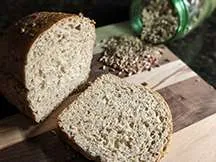
Cracked Wheat Loaf Bread

While auto-steer in the combine means Brian got some actual plate-and-fork meals delivered during harvest, sandwiches are still the general name of the game. I usually have a whole-wheat oat bread on hand, but it seemed appropriate to make wheat the star this time. The cracked wheat berries add this surprising yet enjoyable texture to a standard crumb, and I might just start adding them to other loaves more often. This recipe makes two loaves. 

Prep tips: you don’t need to own a wheat field to get wheat berries! Many groceries, especially bulk or health-food stores, sell both whole and cracked wheat berries (you want cracked, unless you have a Vitamix/other grinder at home). Just make sure you let the berries soften to chewy, not still crunchy, in the hot-water step. Hudson Cream flour is local and lovely, and what I buy for all-purpose flour. 

2 cups cracked wheat berries

¾ cup brown sugar

1 tablespoon salt

2 tablespoons butter

2 cups boiling water

2 eggs, beaten

5ish cups all-purpose and/or bread flour

2 tablespoons instant yeast

Mix wheat berries, brown sugar, salt, and butter in a heat-proof bowl, and pour in the boiling water. Let set until cool and the wheat berries are softened, then mix in eggs. Measure in 4 cups of flour and sprinkle the yeast over, then mix in thoroughly, adding the rest of the flour plus more as necessary to achieve a cohesive, moist but not sticky, dough. Knead for several minutes, then return to oiled mixed bowl to rise until doubled. Press down, divide into two, shape, and place in two buttered bread pans to rise again. Bake at 325° for about 35 minutes. 


Lettuce Eat Local: Making much room for mushroom burgers

0

Amanda Miller
Columnist
Lettuce Eat Local

“Ahhh! No don’t eat those!” 

It’s not often I yell at my child to not eat his vegetables. Benson’s been such a distracted eater recently, that if he’s on a roll with whatever’s on his plate, in general I try not to make any sudden movements or noises so as to not break his concentration. I’m clearly not just tiptoeing around or only speaking in a whisper, but as long as he’s not simply spooning up one of the forty-seven sauces he thought necessary for the meal, I probably want him to keep going. 

Unless, of course, the vegetable he is bringing excitedly up to his mouth is a mushroom from the grass. He usually enjoys mushrooms at the table, so why shouldn’t he in the yard? 

Poor kid, it can be hard to explain context. 

All this glorious rain last week changed the environment a little bit around here, at least for a couple days. Not only did the humidity encourage wild mushrooms to start popping up, but it made the garden comfortably soggy, our Muscovy and Peking ducks waddle around in bliss, and the corn in the fields rocket their canopying stalks skyward. 

We pray for long-term benefits too, like bringing soybean and milo sprouts up and replenishing the aquifer, but in our household, we were selfishly grateful for the short-term benefits of actually seeing Brian again. The last few weeks of time-sensitive harvesting, planting, and spraying, on top of the daily needs of the dairy, required much from our hardworking, farmer man; he was tired, and we were tired of missing him. Benson was starting to really feel his absence, and it was both adorable and heartbreaking the day he refused to go to bed until after Daddy came in at 10:30, woke up in the middle of the night screaming for Daddy, and got up with the sun immediately wondering where Daddy was (already out feeding calves). 

The good news is, he likes his dad, and in general we are spoiled by getting to at least catch glimpses and moments of him throughout the day. The other good news is, it rained that night. We’ve trained Benson to run around yelling, “Happy rain!” when we get some precipitation, and it makes it all that much better. 

Another thing that tends to happen around here when it rains is that we break out the grill. Now, I know most people tend to operate in the opposite pattern, but I’m assuming you’ve picked up by now that we are not most people. 

We have just enough of an overhang from the garage that Brian can wheel out the pellet grill and cook something up without getting soggy. And when it rains, that means he might have time to not only come in for supper but to also participate in its cooking. It’s not that grilling is only a male milieu, or that I can’t do it, but it’s not my natural bent. Our old grill had a problem lighting and I didn’t feel like getting blown up, and this new grill is a new style, so I’m still learning. Slowly, without much motivation. 

Which is ironic, because I love grilled food. I did roast two chickens and a bunch of tomatoes all by myself the other day, so I’m getting there. But if Brian offers? The answer is yes please. 

So this past weekend when he offered to grill something, I said perfect, the meat is already thawing in the fridge. All three of us contributed to the making of the meal: I formed the burgers and prepped all the veggies; Benson peeled the onions, salted the mushrooms, and got out all the sauces; and Brian did the actual grilling. (The baby didn’t help much except to catch the stuff I dripped on my belly.) 

It was a lovely meal, another blessing through the gift of rain. Even though Benson didn’t want to eat these mushrooms after all. 


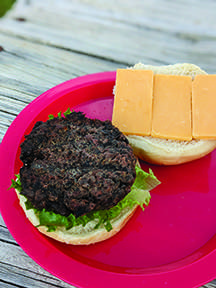
Beef and Mushroom Burgers

Now, don’t go hating on me, but even though I’m a dairy farmer’s wife, I don’t love burgers. Naturally, they’re one of Brian’s favorite things. But we may have found a tasty middle ground in this mushroomy version. I will definitely not be allowed to mix mushrooms in with the beef every time, but maybe I can make at least a few burgers like this and look forward to them, too. 

Prep tips: I used button/white mushrooms, but I expect you could use mostly any type. Also this isn’t a recipe so much as an idea, so vary the ratio to your liking, although I wouldn’t go any higher on the mushroom content than 50/50. If you have a problem with them crumbling while you’re trying to grill them, just pop them on a piece of foil so you still get that nice smoky cook. 

4 ounces mushrooms (not from the yard)

1 lb good quality ground beef

salt and cracked black pepper

Chop mushrooms finely using a blender or food processor. Add to a mixing bowl along with ground beef, and mix with your hands or a dough whisk just until combined — try not to overwork. Form into 4-6 patties, and season both sides with salt and pepper. Grill over medium-high heat to your desired temperature, but keep the middle pink if you’re going to talk to Brian about it. 

Lettuce Eat Local: The raw thrill of sweet corn

0

Amanda Miller
Columnist
Lettuce Eat Local

Something gets me every time I hear a kid bite into a fresh corn on the cob, the juicy kernels popping and crunching: the sound of summer, made tangible. And with the level of our two-year-old’s enthusiasm for corn on the cob, “every time” is pretty often these days.
While we do have two rows of sweet corn planted on the north side of our garden, it’s just tasseling and isn’t quite mature enough to pick yet. Benson is learning, at least somewhat, the concept of waiting and letting the plants and vegetables in the garden keep growing and growing until they’re ready — something he’s also seeing with my expanding belly and the growing baby inside. He hasn’t been too impatient with the corn, but I’m guessing that if I let him peel back some of the husk to see the little kernels hidden inside, he’d be overcome with enthusiasm and not be able to hold himself back. Unattended, he could pose as much a risk to the young corns as a band of marauding raccoons.
Because that boy loves sweet corn. We’ve come by it several times this year as we wait for ours, whether from the farmers’ market or the neighbor or friends, and without fail Benson has tucked into it with a specific toddler eagerness that makes the crunching of the kernels sound all the more glorious.
Since the cows love a good corn husk, we like to go prep the ears over by the holding pen while the cows are waiting to be milked. He might pull off a few husks, then consider his work done; he should help me get the silk off, but he hates anything with a stringy texture so much that it may be beyond what his sensory input can handle. He’ll transfer his assistance to earnestly beckoning the cows for their corny snack, unless there’s a cleaned corn cob within reach — and the munching will commence.
He has not yet mastered the art of eating his corn in any sort of organized manner, so his cobs end up mangled or very artistic, depending on how you look at it. And because I’m a pushover when it comes to him wanting to eat vegetables, frequently Benson attacks a second cob before he actually finishes the first. This makes the step of actually cooking the corn look quite humorous, or uninviting, again depending on how you look at it.
On the subject of cooking corn, I have a few thoughts. First, don’t overcook it. The whole point is that it’s fresh, so don’t kill it. Five minutes in boiling water should be more than enough, and less doesn’t hurt. Second, microwaving is actually a delicious cooking method; wrapping ears in a damp paper towel and cooking for 4 minutes on high essentially steams the kernels and helps them retain all their sweetness and crunch.
And third, the best way of all to maintain sweetness and crunch is to not cook at all. I have zero problems with cooked corn (I once ate I think seven ears in one sitting as a child), but also love it raw here and there. You can follow Benson’s example and tuck straight into the corn as soon as it’s husked, or you can find lots of delicious ways to use raw fresh sweet corn in various dishes. Now is the time to experiment, in this beautiful window of sweet corn summer.

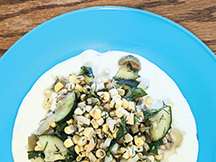
This delicious salad was full of pleasant surprises: in addition to the luscious pops of raw sweet corn kernels, there was a punch of brininess from the olives and salty creaminess from the cheese-infused yogurt. Together they created an unexpected harmony, one both myself and my “traditional” eater husband enjoyed. Benson didn’t like the stringy-looking bits of the dill so he just picked out the corn kernels.
Prep tips: grab homegrown sweet corn while you can! Farmers’ markets are a great resource, although you might even find some listings on Facebook. Technically Benson and I are gone this week and if you can get past Brian, you can help yourself to our patch since it’s probably ready….

½ cup plain yogurt
1-2 ounces crumbled feta cheese
a drizzle of fruity olive oil
3 ears of raw sweet corn, kernels cut off the cob
1 small cucumber, diced
½ cup good quality green olives, sliced; plus a splash of brine
a splash of red wine vinegar
a handful of fresh dill weed, chopped (or basil, if you’re like Benson)
a handful of fresh parsley, chopped

Stir or blend together the yogurt, feta, and olive oil, and season with salt and pepper. Spread onto a serving plate.
In a bowl, toss together the remaining ingredients, and season to taste. Spoon onto yogurt and eat.