Thursday, March 5, 2026
Home Blog Page 687

Standout Calgary Stampede Bucking Horse John Wayne Passes Away

0

A long-time legend of the Professional Rodeo Cowboys Association (PRCA) rodeo arena, Calgary Stampede bucking horse John Wayne has passed away at the remarkable age of 32.
The Calgary Stampede is an annual rodeo, exhibition, and festival every July in Calgary, Alberta, Canada. The ten-day event is billed as “The Greatest Outdoor Show on Earth.”
It attracts more than one million visitors per year and features one of the world’s largest rodeos, a parade, stage shows, concerts, agriculture competitions, and chuckwagon racing.
In 2008, the Calgary Stampede was inducted into the Pro Rodeo Hall of Fame.
Named in honor of movie star cowboy legend John Wayne, the bucking horse’s longevity is testament to the care he received throughout his life, as well as his own incredible strength and spirit.
John Wayne, the bronc, joined the Stampede herd in 1995, thanks to a smart purchase at a local bucking horse sale.
The big buckskin gelding went on to become a rock-steady performer for just shy of two decades.
“He was a money horse. Rain, shine, indoors, outdoors. Wherever he was, he was a winner. It doesn’t get more Calgary Stampede than John Wayne,” said Tyler Kraft, manager of the Calgary Stampede Ranch and Stock Contracting operations.
The renowned bucking horse made 19 Calgary Stampede appearances, had 11 invitations to the National Finals Rodeo (NFR), and performed at 17 Canadian Finals Rodeos.
More than $300,000 was won on the powerful bucking horse throughout his career, perhaps a record itself if such tabulations are maintained.
“I had the pleasure of drawing the ‘Duke’ close to 20 times. He was great every time, never took a day off,” 20-time NFR qualifier Rod Hay said. “He would be in my top five favorite horses of all time. He was a beauty.”
Bucking horse John Wayne had the final out of his career in the spotlight of the National Finals Rodeo in 2013.
He spent the last few years of his long and remarkable life showing the yearlings and two-year-olds of the Stampede’s Born to Buck program the ways of the world.
Wild and free, like his namesake, John Wayne, the bronc, was surrounded by the blue skies and wide-open grasslands of the 23,000-acre Stampede Ranch.

CUTLINE
Renowned rodeo bucking horse John Wayne had the final out of his career at the National Finals Rodeo in 2013. (Profession Rodeo Cowboys Association photo)

Squeezing hope

1
john marshal

Tuition at the Kansas’ six state universities will increase at least five percent next year, the first general increase in five years. State aid to the universities is expected to drop six percent.
The legislature squeezes, tuition goes up.
At KU, K-State, Pittsburg and Emporia State, undergraduate tuition will increase five percent; at Wichita State, six percent and at Ft. Hays State, seven percent.
In the past five years, the Consumer Price Index has increased 20 percent and the Higher Education Price Index is up 14 percent..
Student tuition payments are estimated to outrun state aid by more than $60 million next year. State aid to the universities is to drop $43 million, from $742.2 million to $699.1 million. Tuition is estimated to increase from $753 million to $760.4 million.
Here are new tuition rates per semester, approved in mid-June by the Board of Regents:
Kansas University, increased from $5,046 to $5,298; K-State, from $4,744 to $4,981; Wichita State, from $3,421 to $3,623; Emporia State from $2,639 to $2,770; Pittsburg State, from $2,918 to $3,064; and Fort Hays State, from $2,073 to $2,218.
*
In most cases, tuition is less than half the cost of attending school. At a recent meeting of the William Allen White Foundation in Lawrence, overall expenses were outlined during a discussion of the need for KU scholarships.
An account of expenses for KU students in the recent school year will reflect expenses at the state’s other universities:
– Tuition for Kansas residents, $10,182; (out-of-state, $26,393);
– Fees, $966 ( for student health, campus transportation subsidy, student recreation, and so forth);
– Housing, $11,262;
– Books, $1,076;
– Transportation, $1,892;
– “Personal” expenses, $1,188;
– Total for in-state students, $26,566;
– Total for non-residents, $42,777.
These costs are up about 40 percent since 2010. At that time, state legislators began to cut taxes and carve budgets. Higher education would get less, students would pay more ‒ and borrow more.
*
Republican legislators in charge acknowledge the pattern and seem unlikely to reverse course, although the starvation policy set during the Brownback years has been pulled back slightly.
Meanwhile, things lost will take years if not generations to replace: The professors and teachers who fled disparagement and disappointment; staff who could no longer afford to work for less; administrators who could watch no longer as institutions of achievement and stature were ground away, and as colleagues left for places that would embrace learning, not stifle it.
Tuition increases signal a larger problem. They foreshadow a place that weakens attempts to understand more our civilization, a legislature that dismisses the pursuit of reason, or views experimenting with ideas as a needless frill. A place of sagging education is a place that fails to give the life of every day a certain dignity and purpose.
Many legislators remain proud of the disparities in education finance; a four-year college is no longer necessary, they say. The trend in post-secondary education is toward trade schools, technical colleges and the quicker, less costly two-year associate’s degree. This is important, given the increasing press of student debt.
That may be. But we also need a climate of longer-term learning, an environment that says history has something to tell us, that the Earth is round, that happenings abroad are of consequence in our lives, and that character is still as precious, if not more, than specialized knowledge; vision is more than something arrived at through a well-ground lens.
Universities touch all of us, starting with the students, our most hopeful resource. They may be a line item in the budget but they can underline life in Kansas by offering the broadest education to the next generations, and not at a crippling personal cost.

Celebrating the 150th anniversary of Swiss Volhynian immigration

0

An important event is coming – the 150th anniversary of our Swiss Volhynian ancestors coming to the U.S. in 1874. We will celebrate all year ending with special events on August 22-25, 2024, at Eden Mennonite Church, Moundridge, Kansas.
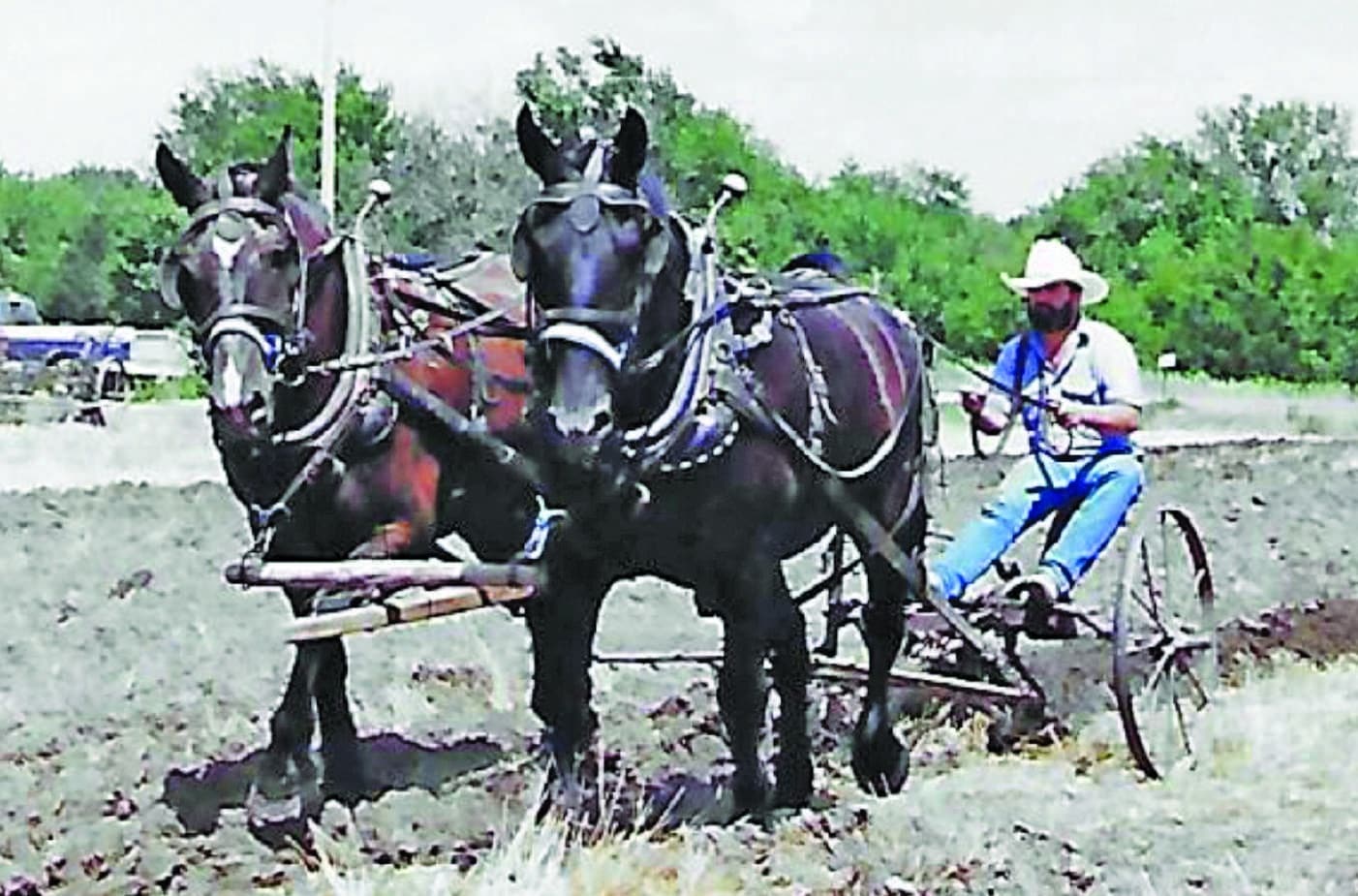
The first event will be Old Fashioned Plowing Bee on 22 acres west of the Moundridge Museum on Saturday, July 15, 2023. 8:30-2:00. Afternoon Vintage Tractor plowing demonstration. Glen Goering, Darrell Schrag, Nathan Graber and the Ag Committee have invited horse and plow owners from around the state to show us how plowing was done with horses. Concessions will be available from Lone Tree Mennonite and a tent for shade. You might bring a lawn chair. The Museum will also be open. Some of you have never seen horses working the field so come out and see it on Saturday, July 15.
About 150 years ago, back in 1874, many groups were leaving Russia to travel to America. One of those was a group of Swiss Mennonite families who were about to start a new life near Moundridge, Kansas and Freeman South Dakota.
Known as, “Schweitzers,” because of their unique German dialect, they sold what they had and kept only what they could carry as they started their journey by horse and wagon, trains, and ships from villages in Russia, all the way to the middle of the United States.
It was a journey of faith, brought on because of their faith. They were thankful for over 100 years of benefits in Russia including good land for farming and an exemption from serving in the military because of their pacificist views. But those benefits were about to change, so it was time to go. They trusted that God was leading them to leave and that He would take care of them along the way.
It wasn’t always easy, but God did take care of them. Today, there are many families who can trace their roots back to those bold followers of Christ who traveled from Switzerland, to France, Germany, Austria, Poland and Ukraine and then to the U.S. still speaking their Schweitzer dialect.
Schweitzers and Friends (that includes you) are invited to a celebration in honor of the faith and courage of those brave pioneers.
We’ll kick it off this summer with an old-fashioned plowing bee, to be held just west of the museum in Moundridge Kansas. Then in the fall we’ll use historical methods to plant Turkey Red Wheat, the same variety of wheat, the same variety of wheat that they brought over from Russia that helped them begin farming as soon as they arrived.
There will be a variety of events in 2023 and 2024 all leading up to a celebration together on August 22 thru 25, 2024, at the Eden Mennonite Church in Rural Moundridge. Included will be tours to nearby historical sites, outdoor farm equipment displays, indoor exhibits, history seminars, music, storytelling and more. Schweitzers AND FRIENDS are welcome to attend and enjoy the fun.
This special celebration of faith and courage demonstrated 150 years ago, continues to inspire faith and courage for the years ahead.

Lettuce Eat Local: Chocolate, coffee, and vegetables

0

Amanda Miller
Columnist
Lettuce Eat Local


I wouldn’t exactly call this trio my life-blood, but I also wouldn’t say they’re not. The coffee category needs to be interchangeable with or include hot tea, but other than that, it’s fair to say that Amanda Joy Miller runs on these things. 

Except for when she doesn’t. I recently went through a very strange phase where I could not stand those three; in fact, even thinking about a salad or smelling coffee was enough to make me feel so sick. This counterintuitive phenomenon persisted for around three months. It was clear something was very wrong…or very, very right. 

You guessed it, we look forward to welcoming a baby into our family in early November! Actually, Brian, Benson, and I already welcome this baby into our family, as it’s clear that while it’s tucked away for a while yet, it’s a sweet tiny human worthy of all the love we can give. Although it will have to get a few things right about our diet in this house — we eat chocolate, coffee, and vegetables, and that’s a fact. 

Fortunately, shortly after I hit the second trimester, I could handle most foods again. The first 13ish weeks, though, phew, those were rough. I know time glosses over memories, but I definitely don’t remember Benson being this finicky in utero. Most of the time my food aversions were funny, at least if we didn’t take into account the overwhelming nausea, because they were so incredibly uncharacteristic. 

I went for weeks without a taste of chocolate; usually I’m doing good if I can go a couple hours. Coffee was horrifying for months, so bad that Brian had to move his coffee paraphernalia to the barn and leave his mug outside when he came in for breakfast. We planted our garden in good faith, but it was a struggle for me to pretend like I cared whether the beets, spinach, or tomatoes even survived, because ew. Who eats those. (I’m still very noncommittal about some, particularly carrots and peppers, but that’s fine because they’re either missing or sad, respectively.)

Couple those strong aversions with my random cravings, and my goodness we have to wonder who this baby is and what it’s doing to me. I can’t say I’ve had any real cravings, mostly the opposite, but the one thing I actually wanted to eat in those super rough weeks was meat. Now, I am not a vegetarian, but I get asked that sometimes because I naturally gravitate towards veg-centric foods. This baby, though, is a carnivore: I could barely swallow water it was so gross, but plain meat sounded quite nice. Especially sausage; just give me some sausage. I have never said that in my life. 

I have moved past that stage, although I still like meat more than normal. The other odd mannerism I’ve hung onto is eating my son’s leftover cereal. Typically I’m very picky, and I have to eat cereal in increments, pouring just enough into my bowl of milk so that I can eat it while it’s still crunchy and crisp. But now I relish the idea of Benson not finishing his mini wheats (and in fact I might accidentally pour a little too much) so that I have an excuse to put it in the fridge and eat it a couple hours later. This cereal does not hint of sogginess; it yells it from the rooftops, and it’s truly delicious. 

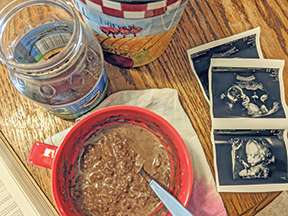
We are not finding out if the baby is a boy or girl until it’s born — although Benson thought it looked like a dinosaur from the sonogram last week — but we’re pretty certain it’s precious, in spite of/because of its strange, strange effects on me. Little Mini Wheat, we love you. 


Mocha Morning Oats

Consider this my glorious return to the better things of life, bringing my trio of favorites all together into one perfect breakfast. (That is unequivocally not how Brian described it when he found carrots in his oatmeal, but we all know his opinion doesn’t always count. I’m the pregnant one; I’m right.) It is healthy and filling but tastes decadent, and is arguably a better way to start the day than a bowl of soggy mini wheats. Leftovers firm up in the fridge, but warm up easily with a little extra milk the next day. 

Prep tips: I used decaf coffee, but if you need a boost in the mornings, consider this your shot (haha) at a bit of bonus caffeine. Maybe don’t feed it to your 2-year-old then, unless they have a calmer temperament than mine does. 

2 cups old-fashioned oats

5 cups water

a good dash of salt

1 medium carrot, shredded

¼ – ⅓ cup cocoa powder

2 – 3 tablespoons instant coffee

1 cup milk, plus more

sugar, local honey, or maple syrup to taste

Bring oats, water, salt, and carrot to a boil in a medium saucepan, and simmer until soft and creamy, stirring often. Remove from heat and stir in cocoa, coffee, and milk, and sweeten to taste. Serve with more milk.