Thursday, March 5, 2026
Home Blog Page 691

Coping with the “out of our control” reality of Agriculture

0


Marrying a farm kid has shown me the immense amount of pride in being part of the Ag community. It is prevalent that the agricultural profession, while rewarding, is challenging. Running big dollar operations that are both physically and mentally demanding creates some serious strain on our mental health. Whether it’s a co-op employee spraying chemicals or spreading fertilizer for 70+ hours a week or a farmer during planting or harvest, the demand never truly stops.
In my practice I talk a lot about focusing on what is within our control. I can control the way I cope in a situation, but I cannot control how someone else chooses to cope. Likewise, I can control my choices on what products I utilize in my operation, but some things are simply out of my control, like grain and livestock prices, or the unpredictable weather of the Midwest. The livelihood of Ag operations and families balances on influences out of our control. We are forced to leave many factors up to chance, and that creates a lot of pressure.
When we focus on things out of our control, we can start to experience negative mental health impacts. During times of stress, our body releases hormones to help regulate our stress responses. We experience toxic stress when our body is constantly releasing stress hormones into our body, which can create negative effects on our health. Starting in childhood and throughout our life, we learn mechanisms to help ourselves cope during stressful experiences.
In Agriculture there are many things outside of our control. So, what can we control? We can control how we choose to take care of ourselves and whether we use healthy coping mechanisms to manage stress. Healthy mechanisms might include exercise, healthy diets, spending time outside, mindfulness, relaxation, quality time with loved ones, or taking time to do things we enjoy. Likewise, when we are experiencing high stress moments, it is okay to step away from machinery, our phone, or other people for short periods of time. This is an example of one healthy coping skill to take care of ourselves in those moments.
There is no shame in seeking support. If you or someone you know is struggling, please reach out:
• Avera Farm and Rural Stress Hotline at 1-800-691-4336.
• Dial 2-1-1 to be connected to the Helpline Center for additional resources based on your community.
• Call or text 9-8-8 anytime to be connected to a professional crisis counselor for free.
The old adage goes, “pull yourself up by your bootstraps and deal with it.” Mental health stigma still exists, but how wonderful would life be if we learned to pair our Midwestern resilience with taking care of ourselves and showing others it’s okay to need and accept support? Don’t wait to take care of yourself. Your family, your legacy, and YOU deserve a healthy you.

Curstie Konold, MPH, CSW, QMHP is the Outpatient Clinical Mental Health Therapist Avera Medical Group Behavioral Health Brookings Clinic. Follow The Prairie Doc® at www.prairiedoc.org and on Facebook featuring On Call with the Prairie Doc® a medical Q&A show based on science, built on trust for 21 seasons, streaming live on Facebook most Thursdays at 7 p.m. central.

Celebrating 100 Years of Farmall

0

My Father-in-Law and I enjoyed an opportunity that only comes along once a Century…Celebrating 100 Years of Farmall, The One For All, at Red Power Roundup, June 15-17, 2023 in Grand Island, NE. We invite you to watch the attached video of our trip to the Show: https://lnkd.in/grevBwCC

For more information on the 100th anniversary of Farmall, visit: www.Farmall100.com
For more information on the Red Power Roundup, visit: https://rpru2023.com/

Food Safety is the Main Ingredient to a Successful Cookout

0

Whether you’re a grill master or a first-time barbecue cook, food safety should always be part of your routine to ensure a healthy and happy Fourth of July.

“Recent USDA consumer behavior studies have shown that individuals don’t always properly wash their hands or use a food thermometer,” said USDA Under Secretary for Food Safety Dr. Emilio Esteban. “Show your family and friends that you’re a true grill master by cooking food to a safe temperature and washing your hands after handling raw meat and poultry.”

Ensure your food is safe to eat this Fourth of July by following these food safety steps:

Clean: Scrub the grill clean before use. Clean utensils and plates before they touch food. No access to a faucet? Carry bottled water, soap and paper towels. Wash your hands before and after handling raw meat and poultry. Follow proper handwashing steps to stop bacteria from spreading from your hands to your meal. Make sure to wet hands, lather with soap, scrub for 20 seconds, rinse and dry.

Separate: Avoid cross contamination. Separate raw meat and vegetables by using different cutting boards. Place raw meat or poultry on one plate and cooked meat and poultry on another. Don’t use the same utensils to place raw meat and poultry on the grill and take cooked food off.

Cook: Use food thermometers to ensure your grilled food is ready. Insert the thermometer through the side of the patty until the probe reaches the center. Color is never a reliable indicator of doneness. Cook food to a safe minimum internal temperature by using a food thermometer:

  • Cook whole cuts of meat to 145 F with a three-minute rest time.
  • Cook fish to 145 F.
  • Cook ground meats to 160 F.
  • Cook poultry (ground or whole) to 165 F.

Although frozen products may appear to be pre-cooked or browned, treat them as raw food and cook thoroughly. Products labeled as “Cook and Serve,” “Ready to Cook” and “Oven Ready” must be cooked.

Chill: Bacteria multiply rapidly between 40 F and 140 F — aka the Danger Zone. Perishable food should be consumed or refrigerated within two hours (one hour if outdoor temperatures are 90 F and above).

For more food safety information, call the USDA Meat and Poultry Hotline at 1-888-MPHotline (1-888-674-6854), email [email protected] or chat live at ask.usda.gov from 10 a.m. to 6 p.m. Eastern Time, Monday through Friday.

Access news releases and other information at USDA’s Food Safety and Inspection Service’s (FSIS) website at www.fsis.usda.gov/newsroom. Follow FSIS on Twitter at twitter.com/usdafoodsafety or in Spanish at: twitter.com/usdafoodsafe_es.

USDA touches the lives of all Americans each day in so many positive ways. In the Biden-Harris Administration, USDA is transforming America’s food system with a greater focus on more resilient local and regional food production, fairer markets for all producers, ensuring access to safe, healthy and nutritious food in all communities, building new markets and streams of income for farmers and producers using climate smart food and forestry practices, making historic investments in infrastructure and clean energy capabilities in rural America, and committing to equity across the Department by removing systemic barriers and building a workforce more representative of America. To learn more, visit www.usda.gov.

Compliments of USDA.

Stress to Trees and Shrubs is Cumulative 

0

Stress is cumulative. In other words, trees and shrubs can be affected by stresses that happened up to several years in the past.  Recent stresses in Kansas include sharp drops in temperature in the fall before some trees had hardened off.  This occurred in 2019, 2020 and 2022.  This was accompanied by last fall and winter’s extremely dry weather which often resulted in damaged root systems.  This damaged root system may have been further weakened due to too much rain in some part of the state and continued dry weather in other areas this spring.  The excess water in areas that received it harmed root systems due to saturated soils driving out oxygen.  Roots need oxygen as much as they need water.  Though the roots were able to keep up with moisture demands during the cooler spring weather, they may not be able to keep up when the weather turns hot and dry. Such trees and shrubs may suddenly collapse and die or slough off branches they can no longer support

This does not mean that all of our plants are doomed.  Some plants are just better adapted to our tough Kansas conditions and have suffered little to no harm.   However, it is a good idea to check the overall health of your trees.  So how do you tell?

One of the most important clues in determining the health of your trees is the amount of new growth that tree has produced. A healthy tree should have a minimum of 4 to 6 inches of new growth each year and usually much more. Check branches with the tips in the open and not shaded by the tree itself. Anything less than 4 inches on the majority of branches suggests the tree is under a great deal of stress.

The only thing poor growth  tells you is whether a tree is under stress or not. It does not tell you what is causing or has caused poor growth. This year, the most common cause by far is environmental stress caused by the dry fall and winter followed by excessive rain this spring.

So, what do we do for trees under stress?  The most important practice is to water as needed.

Ward Upham, Extension Agent

Tomato Leaf-Spot Diseases

0

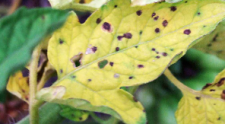
Two common leaf-spot diseases will likely appear on tomato plants soon if they haven’t already. Septoria leaf spot and early blight are both characterized by brown spots on the leaves.

Septoria leaf spot usually appears earlier in the season than early blight and produces small dark spots. Spots made by early blight are much larger and often have a distorted “target” pattern of concentric circles. Heavily infected leaves eventually turn yellow and drop. Older leaves are more susceptible than younger ones, so these diseases often start at the bottom of the plant and work up. Mulching, caging, or staking keeps plants off the ground, making them less vulnerable. Better air circulation allows foliage to dry quicker than in plants allowed to sprawl.

Mulching also helps prevent water from splashing and carrying disease spores to the plant. In situations where these diseases have been a problem in the past, rotation is a good strategy. It is too late for that now, but keep it in mind for next year. Actually, rotation is a good idea even if you have not had problems in the past. But many gardens are too small to make it practical. If you have room, rotate the location of the tomatoes each year to an area that has not had tomatoes or related crops (peppers, potatoes, eggplant) for several years.

 If rotation is not feasible, fungicides are often helpful. Be sure to cover both upper and lower leaf surfaces, and reapply fungicide if rainfall removes it. Plants usually become susceptible when the tomato fruit is about the size of a walnut. Chlorothalonil is a good choice for fruiting plants because it has a 0-day waiting period, meaning that fruit can be harvested once the spray is dry.

Chlorothalonil can be found in numerous products including Fertilome Broad-Spectrum Landscape and Garden Fungicide, Ortho Garden Disease Control, GardenTech Daconil, Bonide Fungonil and others. Be sure to start protecting plants before these diseases are first seen if they have been a problem in the past. It is virtually impossible to control these diseases on heavily infected plants.

If chlorothalonil doesn’t seem to be effective, try mancozeb (Bonide Mancozeb Flowable). Note that there is a five-day waiting period between application and when the fruit can be harvested.

You may wish to pick some tomatoes before they are fully red just before you spray if you use Mancozeb as the tomato fruit will ripen inside.

Ward Upham, Extension Agent