Saturday, March 7, 2026
Home Blog Page 706

Media advisory: KU professor, author can comment on appeal of narcocorridos

0

From the Office of Public Affairs | http://www.news.ku.edu

Media advisory

Contact: Rick Hellman, KU News Service, 785-864-8852, [email protected], @RickHellman
KU professor, author can comment on appeal of narcocorridos

LAWRENCE — When a city official in Cancun imposed a ban hours before a May 19 concert by pop musicians associated with the narcocorrido, or drug ballad, accusing them of fomenting violence, the ensuing headlines may have brought the genre to the attention of many Americans for the first time.

But it probably won’t be the last time, especially with Mexico’s top young singer-songwriter, Peso Pluma (Featherweight), mashing up regional music styles, narcocorridos and rap and topping the Billboard Hot 100 in the United States this summer.
A University of Kansas expert is available to comment on the appeal of the drug ballad in a country that has seen so much bloodshed on all sides of the drug trade.
Rafael Acosta Morales, associate professor in KU’s Department of Spanish & Portuguese and author of the 2021 book “Drug Lords, Cowboys and Desperadoes: Violent Myths of the U.S.-Mexico Frontier,” said Americans must put themselves in the place of the average Mexican to understand the narcocorrido’s appeal.
“Once you frame it in a different context, it becomes easier to understand why people relate to it,” he said. “Some people watch ‘Top Gun: Maverick,’ a movie that blatantly promotes bombing countries just because, and no one thinks anything of it. A lot of people look up to those who make money in the drug trade in the same way others look up to famous billionaire business tycoons, even if they are unethical. They fit the description of success, and people want to see films and read books and hear songs about how to become one of them.”

Acosta noted that in Mexico, there has already been backlash against the ban imposed on concerts by El Komander, Alemán, El Millonario and Grupo Firme, and the Cancun political leader who led the charge has been forced to step down from his position.

The KU scholar is working on two research papers about current Mexican popular music, and he is available to reporters to comment on any aspect of narcocorridos.

-30-
————————————————————————

KU News Service
1450 Jayhawk Blvd.
Lawrence KS 66045
Phone: 785-864-3256
Fax: 785-864-3339
[email protected]
http://www.news.ku.edu

Erinn Barcomb-Peterson, director of news and media relations, [email protected]

Today’s News is a free service from the Office of Public Affairs

Fish Telemetry Project Underway at Tuttle Creek and Milford Reservoirs

0

Nadia Marji CMP®, Chief of Public Affairs

The Kansas Department of Wildlife and Parks is partnering with Kansas State University on a long-term telemetry study to examine movement patterns and space use of Kansas’ most recreationally valuable fish. Data collected during this study will give Fisheries biologists a better understanding of fish movement within reservoirs and fish passage downstream through reservoir dams.
Biologists will be implanting 15 acoustic transmitters in the following species at Tuttle Creek and Milford reservoirs:
Blue catfish
Channel catfish
Walleye
Saugeye
These transmitters will allow biologists to monitor fish movement over the next several years. Fish fitted with the acoustic transmitters will be externally marked with a small purple vinyl tag affixed just below the dorsal fin. Each tag is labeled with “KSU RESEARCH – PLEASE RELEASE” on one side and a tag ID number with contact information on the other. Because of the limited number of tagged fish, it is imperative that anglers release all fish affixed with the purple tag. Since external tags can sometimes dislodge, anglers are also encouraged to thoroughly examine captured fish for a small 1- to 2-inch incision scar, possibly with sutures, near the pectoral fins.
In addition to transmitters, underwater receivers will also be utilized and have been placed in Tuttle Creek and Milford reservoirs, as well as the Republican, Big Blue, Kansas, and Smoky Hill rivers. Receivers are placed on mooring lines marked by yellow or orange bullet floats with white stickers labeled “FISH RESEARCH EQUIPMENT – DO NOT DISTURB.” These receivers are deep underwater and continuously “listen” for telemetered fish, allowing biologists to know when a specific fish was near each receiver.
This collaborative effort with KSU complements earlier blue catfish tagging studies conducted by KDWP in Tuttle Creek and Milford reservoirs. Fish tagged in the earlier studies are marked with an orange or yellow tag and do not have implanted transmitters; these fish may be harvested if they meet the legal length requirements.
Data collected from tagged fish is crucial for biologists to manage fisheries and assist in future angling success. Anglers should report the catch and release date, and location, of fish with purple tags to [email protected]. If a blue catfish with an orange or yellow tag is caught, please instead call (620) 342-0658 to report the catch.

Recent Rains Trigger Mushroom Development  

0

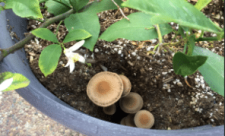
Recent rains in certain areas of Kansas have resulted in the appearance of mushrooms in home lawns and landscape beds. Although mushrooms are often spectacular in size and color, most are relatively harmless to plant life. Some of these mushrooms are associated with arc-like or circular patterns in turfgrass called fairy rings. The ring pattern is caused by the outward growth of fungal mycelium. The mycelium forms a dense, mat-like structure in the soil that decomposes organic matter. This decomposition releases nitrate into the soil, which in turn stimulates the growth of the grass at the outer portion of the ring. This results in a dark green appearance of the grass at the margin of the ring. Unfortunately, the thick fungal mat formed by the fungus interferes with water infiltration. The fungus also may release certain byproducts that are toxic to the turf. This may lead to dieback of the turf close to the ring. Therefore, in some cases the ring is evidenced by a darker green color and in others, by a brown ring with the outside edge being darker green than the rest of the turf.

Fairy rings are difficult to control. You can sometimes eliminate the ring by digging to a depth of 6 to 12 inches and 12 inches wide on both sides of the ring, refilling the hole with non-infested soil. Or you can try to mask the symptoms by fertilizing the rest of the lawn so that it is as dark green as the ring. This often isn’t a good idea because it tends to promote other turf problems. Commercial people can use certain fungicides to control fairy rings but these products are not available to homeowners. See http://www.ksre.ksu.edu/bookstore/pubs/EP155.pdf for more info on these fungicides.

Some mushrooms in lawns are not associated with fairy rings. These may be mycorrhizal (symbiotic association with tree roots) or saprophytic (live on dead organic matter such as wood, etc.) in the soil. Because some of these mushrooms are beneficial, you don’t really want to kill them. Besides, a fungicide spray to the mushroom itself does little good. Remember the mushroom is simply the fruiting structure of the organism. Most of the fungus is below ground and inaccessible to the chemical. If mushrooms are a nuisance, pick them and dispose of them as soon as they appear. If there are too many for that to be practical, mow them off. Removing sources of organic debris from the soil can help if such is possible. Also, mushrooms tend to go away as soil dries. Patience may be the best control. Some of the mushrooms in the lawn are edible, but others are poisonous. Never eat mushrooms unless you are sure of their identity.

Ward Upham, Extesion Agent

Thatch Control in Warm-Season Lawns    

0

Thatch control for cool-season lawn grasses such as bluegrass and tall fescue is usually done in the fall but now is the time we should perform this operation for warm-season turfgrasses such as bermudagrass and zoysiagrass. Because these operations thin the lawn, they should be performed when the lawn is in the best position to recover. For warm-season grasses that time is June through July. Buffalograss, our other common warm-season grass, normally does not need to be dethatched.

When thatch is less than one-half inch thick, there is little cause for concern; on the contrary, it may provide some protection to the crown (growing point) of the turfgrass. However, when thatch exceeds one-half inch in thickness, the lawn may start to deteriorate. Thatch is best kept in check by power-raking and/or core-aerating. If thatch is more than 3/4 inch thick, the lawn should be power-raked. Set the blades just deep enough to pull out the thatch. The lawn can be severely damaged by power-raking too deeply. In some cases, it may be easier to use a sod cutter to remove the existing sod.  Bermudagrass will often come back if rhizomes remain in the soil.  If not, you will need to start over with seed, sprigs or plugs.

If thatch is between one-half and a 3/4- inch, thick, core-aeration is a better choice. The soil-moisture level is important to do a good job of core-aerating. It should be neither too wet nor too dry, and the soil should crumble fairly easily when worked between your fingers. Go over the lawn enough times so that the aeration holes are about 2 inches apart.

Excessive thatch accumulation can be prevented by not over-fertilizing with nitrogen. Frequent, light watering also encourages thatch. Water only when needed, and attempt to wet the entire root zone of the turf with each irrigation.

Finally, where thatch is excessive, control should be viewed as a long-term, integrated process (i.e., to include proper mowing, watering, and fertilizing) rather than a one-shot cure. One power-raking or core-aeration will seldom solve the problem.

Ward Upham, Extension Agent