Monday, March 9, 2026
Home Blog Page 721

Protect yourself from health insurance scams

0

Health insurance can be confusing, and unfortunately, scammers use this as a way to exploit Kansans. Whether you are entering a special enrollment period or are otherwise in the market for a new health insurance plan, Kansas Insurance Commissioner Vicki Schmidt cautions consumers to be on guard against health insurance scams.

“If you are in the market for health insurance, it pays to do your homework before making a decision that could cost you more than just your hard-earned dollar,” Schmidt said. “Be cautious when you receive unsolicited offers, thoroughly review any policy you might buy, and contact the Department if you suspect that an offer might be fraudulent.”
Common health insurance scams to watch out for include:

• Fake insurance plans: A scammer will contact you unsolicited by phone or email and offer a plan that sounds too good to be true because it is. The plan does not exist; the scammer simply wants to get your personal information for their own illegal uses or to steal your identity. Remember to never give out your personal information to a stranger, especially over the phone. If you receive a call from someone selling a policy, contact the Department to confirm the agent is licensed to sell in Kansas.

• Medical discount plans: Scammers may try to sell you a medical discount plan. Discount health plans are not a replacement for health insurance and the promised discounts may be exaggerated or may not exist. You may even receive a policy number or other so-called proof of insurance, but the reality is that these are not health insurance products. Avoid giving your credit card and checking account numbers to strangers selling discount plans over the phone or Internet. Check with your agent before purchasing a discount plan.

• Phony benefits: Scammers offer a fake plan that offers full benefits at low prices. It will often assure consumers that the plan covers pre-existing conditions, specialists and other essential benefits, usually at no extra cost. Remember to always review the policy thoroughly before buying it and contact the Kansas Insurance Department to confirm that a company is authorized to sell the plan in Kansas.

If you or someone you know suspects they are a victim of health insurance fraud, contact the Kansas Insurance Department’s Anti-Fraud Division at 785-296-5203 or by email at [email protected]. You can also report fraud using the National Association of Insurance Commissioners online reporting form.

Cucumber Beetles and Bacterial Wilt

0

If you had cucumbers or muskmelons that suddenly turned brown and died last year, you may have had a disease known as bacterial wilt. The cucumber beetle carries this disease. Once a plant is infected, there is no cure, so prevention is the key. Because cucumber beetles overwinter as adults, early control measures are essential.

There are two types of cucumber beetles: striped and spotted. The striped cucumber beetle is the most common but both can carry this disease. The 1/4-inch-long beetles are conspicuously colored: black head and antennae, straw-yellow thorax, and yellowish wing covers with three distinct parallel and longitudinal black stripes. Young plants can be protected with row covers, cones, or other types of mechanical barriers. Edges must be sealed to ensure that the beetles do not find a place to enter.

Plants will eventually outgrow these barriers, or they will need to be removed to allow insect pollination of the flowers. Apply insecticides before beetles are noticed in the planting. Continue to spray weekly throughout the season.

Homeowners can use permethrin (Bonide Eight Vegetable, Fruit & Flower Concentrate and Hi Yield Garden and Farm Insect Control ). Once plants have started flowering, spray in the evening after bees have returned to the hive and the flowers are closed.

Ward Upham, Extension Agent

Straw Bale Gardening 

0

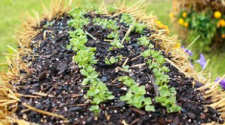
Straw bale gardening is an innovative approach to overcome traditional obstacles in the garden. Using a straw bale as a natural raised bed allows gardeners with little to no in-ground space to raise a variety of annual crops. This technique requires a bit of preparation and as with many aspects of gardening, learning tips from more experienced gardeners can be useful.

”           Ensure you are using straw and not hay to avoid introducing weeds

”           Use the “small” straw bales that are about 2-feet high by 3-feet long

”           Place the bales on the narrow edge so the twine is not in contact with the ground to prevent it from rotting and releasing the bale

”           Place the bale where it will be planted prior to conditioning. Once conditioning begins it is difficult to move the bale.

Bale Conditioning

Conditioning is the process of preparing the bale for planting by encouraging the bale to begin decomposing. This creates a healthy base for plant roots to be established and grow throughout the season.

”           Water the bales and keep them wet for three days. The bale will heat up as decomposition occurs.

”           On days 4, 5 and 6, sprinkle fertilizer on top of each bale with 1 cup of ammonium sulfate (21-0-0) or ½ cup of urea (46-0-0). Water in the fertilizer. This speeds up decomposition.

”           On days 7, 8 and 9 continue to sprinkle fertilizer on each bale but reduce the amount by half.

”           Water the bale on day 10 (no fertilizer) and begin to monitor the bale temperature. When the temperature drops below 100 degrees F it is ready to plant.

Planting

”           Pocket method: Make a hole for each plant several inches deep into the top of the bale. Fill the hole with growing medium and plant.

”           Flat Bed Method: Cover the top of the bale with 3 to 4 inches of growing medium (well-aged manure, compost or potting soil) – This method works well for planting seeds.

Number of Plants per Bale

”           Cantaloupe: 2

”           Cucumber: 3-4

”           Peppers: 3-5

”           Squash (winter): 2

”           Squash (summer): 2-3

”           Tomatoes: 2-3

Watering

Straw bales dry out quickly so regular watering is essential for successful crops. A drip system set on a timer can be a good solution.

Some of this information was taken from a publication put out by Washington State University.

Cynthia Domenghini, Extension Agent


What are the best trees for Kansas homes?

0
Swamp white oak makes a great street tree. Pagoda dogwood is a good option near power lines. These local sources have more Kansas and Missouri tips.

Over the decades, we’ve had love affairs with specific types of trees — filling entire neighborhoods with hundreds or thousands of single species.

Experts say cities need variety to prevent situations where a fast-moving fungus or insect, or extreme weather, kills many trees at once.

So if you’re a homeowner keen on adding trees to your yard, what should you plant?

Kim Bomberger, of the Kansas Forest Service, puts it this way: “Dare to be different.”

“Just last week, I told an audience to look around their own yard and neighborhood and pick something different,” she said, “to build landscape resiliency.”

Here are links where you can read about the best-performing trees in our region — and some that you should avoid when you spot them at garden centers.

Remember: Just because your local store stocks a certain tree species, doesn’t make it a good choice. Tree experts continue to spot maple varieties for sale that don’t do well in the lower Midwest. They also see ash trees and Callery pears at garden centers, but widely agree that homeowners should not plant either.

Multistudio’s Kansas City tree lists


A Kansas City landscape and architecture firm asked top experts in the region to rank hundreds of trees. Here you’ll find their favorites, broken down into separate lists for evergreens and for small and large deciduous trees. You’ll also find the best options for planting right next to the street, where pavement can pose a challenge. (Check with your city before planting street trees, because some cities set rules about which species to plant.)

You’ll also find a list of options that make experts groan. The top no-no: Bradford pear, an invasive ornamental.

Kansas Forest Service resources by region


The Kansas Forest Service has lists of top performers by region.

Whether you need a drought-tolerant option for south-central Kansas, or want to know the biggest trees that will do well in Colby, this website can help.

The Kansas Forest Service also offers a guide to planting trees. If you want an affordable way to buy many trees or shrubs at once, the agency also sells them for limited windows of time each spring and fall.

So does the Missouri Department of Conservation.

Want to stick to native options?


The resources above include a mix of native and non-native species.

But some people feel strongly about sticking with native species to support regional wildlife. The Missouri-based project Grow Native publishes top 10 lists, including the best flowering trees and ideas for what you can safely plant near utility lines.

The Powell Gardens website includes a curated list of native trees that do well in eastern Kansas and western Missouri. And former Powell Gardens Director of Horticulture Alan Branhagen has published two thorough guides to landscaping with trees, shrubs and flowers native to the Midwest.

Keep your kids busy this summer for free!

0

This summer, your kids can explore the state of Kansas without emptying your wallet.

Sunflower Summer is a program of the Kansas State Department of Education and is designed to offer numerous opportunities for families to discover new experiences, spend quality time together, and venture outdoors. Kansas families can avail themselves of free visits to museums, zoos, historic landmarks, and other attractions.

From May 26 – August 13, Kansas residents with students enrolled in Pre-kindergarten through 12th grade are eligible for 1 free ticket per child to over 90 attractions, museums, zoos, and more. Up to two adults may get a ticket voucher on the Sunflower Summer app, when accompanying enrolled Kansas students.

Anyone, from anywhere, can download the app and track their Kansas summer travel fun, but are not eligible for free admission to ticketed venues.

Parents and guardians can register their students by downloading the Sunflower Summer app from either Google Play or Apple app stores.

Get a list of participating locations and more information on the Sunflower Summer website.