Tuesday, March 10, 2026
Home Blog Page 730

Thinking about sweet corn

0

The only thing worse than having a cast on my ankle is thinking about gardening with a cast on my ankle! Thinking about sweet corn makes me wish I could get in my garden now but I have to wait until my doctor says I can. Anyway, sweet corn is a popular summer vegetable but requires a significant space investment to have a good yield. Sweet corn does not adapt well to small garden areas because closely spaced plants will produce only 1 to 2 ears. Sweet corn is also wind-pollinated, and different varieties can easily cross in small spaces and impact the quality of ears. Types of sweet corn are categorized based on their genetic types.

• Normal sugary (su types). This is the oldest, traditional type of sweet corn. It is tender and creamy but will quickly become starchy. These varieties must be isolated from sh2 and sy types.
• Sugary enhanced and Triplesweet (se types). These types have an increased sugar level and even more tender kernels. The sugar turns to starch more slowly than su types. These varieties must be isolated from sh2 types.
• Supersweet (sh2 types). Supersweet varieties have up to 50% more sugar than regular sugary types. They have a crisp, crunchy texture to the kernels and will keep their sweetness for a week in the refrigerator. The shriveled seeds do not germinate well in cold soil. This variety must be isolated from other sweet corn types.
• Synergistic (sy types). Synergistic types of sweet corn have a combination of the above genes. They have at least one se gene and may have a combination of sh2 or su or both. They combine the beneficial traits of all the other genes to have improved sweetness, texture, and storage life. Isolation requirements must be determined for each variety, or plan to isolate from all other types.
• Augmented supersweet (sh2 with some se characteristics). This type of corn is a supersweet that also has the se trait in the kernels, resulting in a corn with high sugar, tender texture, and good storage life.

Variety considerations.
Many new hybrid varieties of sweet corn are available in all of the genetic categories previously discussed. The colors range from yellow to white to bicolor, yellow and white kernels together on the same ear. Early varieties that require 65 to 75 days to mature produce smaller stalks and ears, while later varieties requiring 75 days or longer produce larger plants and larger ears. Varieties are available with resistance to several common diseases such as maize dwarf mosaic, smut, and bacterial wilt. For early season planting, choose a type that is adapted to cold soils.

When to plant.
Sweet corn is a warm-season crop and should be planted in mid- to late April. The sh2 varieties and other newer varieties that have a smaller, more shriveled seed will rot in cold soil; do not plant these types until early May. Soil temperature should be at least 60°F when planting corn seed. Successive plantings of corn are important to spread the harvest over a longer period. Make additional plantings when the previous planting is ½ to ¾ inch tall.

Spacing.
Plants should be 8 to 12 inches apart in rows at least 3 feet apart. Do not crowd plantings, as weak, spindly, unproductive plants will result. Plant the kernels an inch deep. If many seeds fail to germinate, do not attempt to replace missing plants; replant the entire planting. Plant corn in blocks of at least four rows to ensure adequate pollination.

Crop rotation.
There are no major crop rotation concerns for sweet corn planted in a home garden. Do not plant sweet corn in the same location in successive years.

Care.
Sweet corn requires wind to transfer pollen from the tassel (male) to the ear (female). Plant corn in small blocks or several short rows rather than a single row to encourage better pollination. Sweet corn pollinates poorly in 100-degree weather, and ears with missing kernels or gaps may result.

Another option for isolating sweet corn varieties is by time. One way to do this is to plant multiple varieties with significant differences in days to maturity (about 2 weeks) so that pollen production does not occur at the same time. You can also plant one variety earlier than another variety to ensure the time differential in pollen production.

Sweet corn is a member of the grass family and needs considerably more nitrogen fertilizer than other garden plants. A side-dressing of additional fertilizer sprinkled along the row every several weeks is important. Sweet corn needs regular watering as well because its sparse, inefficient root system does not reach to deep soil water. Apply 1 to 1½ inches of water per week. Weed control is necessary, especially in young plantings.

Harvesting.
Sweet corn is ready for harvest when the juice in the kernel appears milky as you puncture a kernel with your finger. The ear should be well filled to the tip. This ideal harvest stage lasts for only a few days in hot weather, and regular checking for maturity is important. The silks of mature ears are generally completely dry and brown. Twist and pull the ear from the plant by bending the ear down sharply. Use corn immediately or store it in a cold place immediately after harvest. Pick corn early in the morning when it is cool outside. Store corn for only a few days in a refrigerator before using. Corn is easily frozen for later use.

 

“Corny” gullibility

0
Thayne Cozart
Milo Yield

Sometimes I have to chuckle out loud at the gullibility of some consumers. My latest chuckle happened yesterday with the arrival in the mail of an advertising flyer from a prominent local lumberyard and general supply store.
In the first place, I’m surprised that lumberyards and general supply stores in recent years have expanded their wares into furniture, some clothing, groceries and pet food. Guess it proves that those selling those kinds of “stuff” on the side is profitable. Must be or stores wouldn’t do it.
Well, I saw my “consumer gullibility chuckle” when I browsed through the store’s offerings for bird seed, suets, and bird feeders. But the item that really caught my eye was the “sale” on whole ears of corn for squirrel food. The “sale” was for “7 lbs of corn on the cob for $9.99.”
That piqued my curiosity. So, according to what I found on the internet, in general 70 pounds of dry ear corn equals 56 pounds of shelled corn. Seventy pounds of ear corn is ten times the seven pounds advertised for $9.99 for squirrel food. That, folks, comes out to an astounding price of $99.99 for a for a bushel of ear corn.
Not five blocks away from the lumberyard is a general farm supply store. There I can buy a 50# bag of shelled corn for $14.49 — and that’s quite a mark-up to the cash price for shelled corn of around $7.25/bu. And, just think, squirrels eat only the corn kernels, not the cob.
At $99.99/bushel, I think I might come out of retirement and start raising ear corn for gullible urbanites to buy for squirrel feed.
***
I mentioned last week that I might go back in time and re-publish parts of some columns from long ago. Here’s a tidbit from March 11, 1981, and it’s about the drought that wuz happening at that time. Here goes:
“Last week I attended my ol’ pappy, Czar E. Yield’s, farm dispersal sale. While I wuz standing around, I struck up a conversation with a Bart McRae, a farmer from Mound City, Kan. As aggies always do, the conversation turned to the on-going drought — and our mutual worries about it.
That’s when he said, “I once heard a story with a moral to it that might ease your mind about the drought.
“It wuz in the midst of a severe drought and a big, bad bull wuz hungry, but all the grass wuz burnt up. Then he spied a few mouthfuls of green clover growing in a damp spot in a dried-up creek and he hurried over and ate the whole clump of clover in one mouthful. However, in his haste, the bull also swallowed a bumble bee that wuz on a clover blossom.
“Well, the bumblebee got to buzzing in the bull’s rumen and gave the bull a stomach ache. So, he laid down to take a nap. The bee also got tired of trying to escape the bull’s stomach, so it took a nap, too.
“After a few hours, when the bumblebee woke-up, the bull wuz gone and the bee wuz released.”
“McRae said the moral of the story is that it never pays to worry. Everything will work out at the end.”
I guess that’s good advice for all of us who worry about weather we can’t change one whit by worrying.
***
Overheard at the local grain elevator coffee stop: “I attended a conservation district annual meeting recently and the speaker told the audience that he would give a speech like a cross-eyed javelin thrower — he wouldn’t set any records, but he sure would keep the crowd awake.”
Another “keeper” from the grain elevator kibitzers: “Nothing separates the men from the boys these days like the cost of vehicle insurance.”
***
It ain’t only men who gossip. Women can keep up when they want to. Recently I wuz standing in the cashier line at the local supermarket and I couldn’t help but hear the conversation going on between two ladies. They were conversing about a newly-wed bride in their rural community.
I heard one of the ladies lean over to her friends and confide, “Sally is so inexperienced about life. Did you hear about the problem she got into because she didn’t know the difference between Vaseline and window putty and caused their marriage to go cold?”
Naturally, my ears perked up at that statement. So I eavesdropped even more intently and heard the woman answer her own question:
“Sally’s windows fell out the first time the wind blew hard last winter,” she laughed.
***
Seems to me from observation and experience that many farm women get the urge to spring clean, and re-arrange the furniture in their homes, about this time of year. I think it a modern expression of the primordial maternal nesting instinct.
Regardless of the reason, just the topic of spring cleaning brought to my mind my words of wisdom for the week: “The happiest women are those who have furniture and a man around to move it as they direct.”
Have a good ‘um.

Take cover: Farmer-led initiative can add to the bottom line

0
Photo by K-State Research and Extension

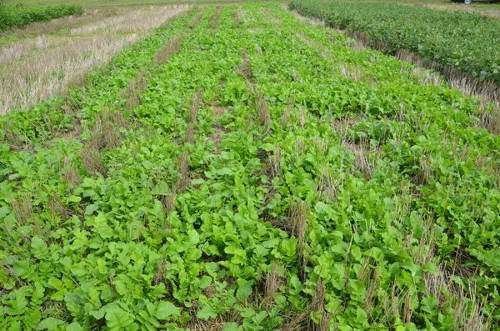
As reported in High Plains Journal, farmer-led initiatives are a proven formula for building conservation practices. A cover crop initiative follows that blueprint.

The Kansas Climate Smart Initiative had set a goal of 100,000 acres in 2022, according to Troy Munsch, an agreement consultant for the Kansas Association of Conservation Districts. The program worked with multiple entities and enrolled 100,000 acres in half of the state’s counties and he hopes to double that number and include all 105 counties. Partners include ADM, the U.S. Department of Agriculture’s Natural Resources Conservation Service and National Fish and Wildlife Foundation.

KACD received assistance from the National Fish and Wildlife Foundation to help producers. Awarded under the NFWF’s Midwest Cover Crop Initiative, the grant supports implementation of beneficial agricultural practices. Other partners participating include the Kansas Department of Agriculture’s Division of Conservation and the Soil Health Alliance.

KACD’s role has been to promote the program and provide technical assistance if requested. Local conservation districts take the signups and submit applications to ADM, which then pays farmers.

“What we liked when we started working with ADM was the program helps to tell the story of all the good farmers and ranchers have been doing all along,” said Munsch, who lives in Salina and has an extensive background in agronomy and crop production. “They just don’t want to brag it up.”

Those many untold stories from unsung heroes included reducing greenhouse gas emissions, providing water infiltration and building soil health he said. Cover crops also can help provide habitat for wildlife.

Participants in the Kansas program received $10 an acre for their stewardship.

A cover crop had to be planted in 2022 and meet Natural Resources Conservation Service requirements, Munsch said. The cover crop cannot be hayed or removed mechanically; however, it could be set up to graze, which can help livestock producers.

Contracts could be for one year or multiple years, he said. Providing flexibility helped producers who may have factors beyond their control in the same year. The KACD—besides promotion—can also be called upon to provide technical expertise. He uses his connections with the NRCS to find answers to producers’ complex questions.

“Implementing conservation on the landscape has always been about building partnerships,” said Andrew Lyon, director of the Kansas Department of Agriculture’s Division of Conservation. “Many private companies have established sustainability goals and need state and local partners to help implement programs such as the Midwest Cover Crop Initiative. The success of the ADM program paves the way for other companies to get involved which ultimately benefits farmers and ranchers across Kansas.”

A new tool

Cover crops can have different meanings to producers, he said. Growers understand cover crops can be positive for soil health. At one time cover crops were thought to be a single-species mix and growers would use it for weed control or lowering surface temperature.

As farmers learned more,they found they could take out a shovel and as they dug deeper if they found hardpan they could deploy deep-rooted cover crops to break it up, Munsch said. Cover crops can also help reduce fertilizer costs.

Having a familiar local partner is reassuring to them, he said. The simplicity and flexibility within the program is appealing to Munsch. The Kansas Climate Smart Initiative is “very straight forward about planting cover crops.”

The commitment is echoed by ADM. Munsch said when the program started western Kansas farmers in particular were in a drought that lingers today. ADM said if producers could not plant a cover crop there would be no financial ramifications, he said.

In eastern Kansas, particularly in the northeast region, the drought’s impact was minimal and that raised hopes for a successful start and conservation districts promoted the program to producers.

Marshall County has 20,057 acres under contract to lead the state. The next four are also in that region, Nemaha, 8,684 acres; Jackson, 8,237 acres; and Doniphan, 7,463 acres.

The goal is to get to 200,000 acres in 2023 and also to expand it to central and western Kansas. Even in 2022, there were several counties from those regions with significant enrolled acres. They included Pawnee, 6,241 acres; Ellis, 4,821 acres; and Meade, 4,520 acres.

As the initiatives grows in popularity, Munsch said, the overall simplicity has been a selling point. Arrangements offer flexibility for the landowner and tenant.

Farmers wanted a streamlined application process. The forms for the Kansas program are two pages and farmers can sign up via application in about 15 minutes that a district conservation manager then submits to ADM. An ADM contractor reviews the application and may have some follow up questions for the producer.

ADM officials enjoy working with producers and that commitment is genuine, Munsch said. About 90% of the producers received checks for their 2022 participation by late April.

Raising awareness

Working in partnership with producers helps to raise awareness, according to another supporter of the program. Jennifer Simmelink of Jewell County, coordinator for the Kansas Soil Health Alliance, works with and supports district managers in each conservation district. One suggestion that took hold was to have farmer-to-farmer discussions at the grassroots level. The goal is to enhance peer-to-peer soil health learning.

“When we talk soil health or with someone who may not know as much about cover crops, we know there are different ways to approach it.”

As much as having success with seeded acres is a benchmark so is building relationships and support systems, she said.

Simmelink said in addition to the farmer-to-farmer discussions, conservation districts can have a formal event that might include field tour days. The soil alliance can help by providing topic and speaker suggestions. She has set up a private Facebook group as another way for district managers to have peer-to-peer discussions and in that group flyers can be shared about events and up-to-date information. She also works with district managers who may not use social media. Those farmers can reach out to their local conservation district to be included on flyers and learn other information.

The private Facebook group is for the conservation district managers so they can see what other counties are doing for their farmer-to-farmer discussions, she said. District managers who are not on Facebook are emailed a summary each month.

In the 95 Kansas counties where USDA services centers are located conservation districts are co-located with NRCS, which helps with convenience.

Dan Meyerhoff, the KACD executive director, praised the program.

“This program provides sustainability and emphasizes the benefits of regenerative agricultural practices. The ultimate goal is to create more value for the crops farmers are growing,” he said. “This is a total team effort, but the majority of the credit goes to our local conservation districts. They are the driving force behind making sure local producers are made aware of those opportunities.”

It is working well

Simmelink said the team effort has taken hold and lends itself to optimism.

“We’re barely three months in and ‘we’re starting to roll.’ There will continue to be strong interest,” Simmelink said. “We’re trying to keep it simple. We know our conservation district managers wear a lot of hats.”

She also said the board of supervisors, who are farmers and ranchers, are encouraged to participate in farmer-to-farmer discussions because they can help share information with neighbors.

“We really appreciate all the partners on the project,” she said, adding that farmer-led initiative is the right approach.

The High Plains receives desperately needed moisture

0

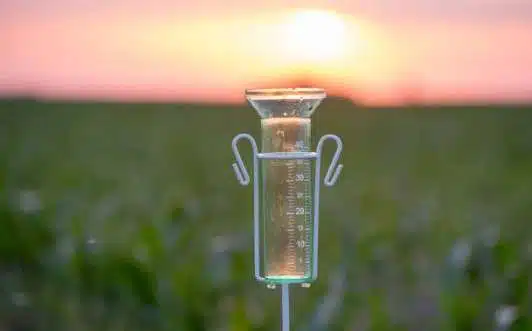
The High Plains experienced an almost forgotten weather pattern the last week of April, when widespread thunderstorms brought several days of rainfall to extremely dry areas of Kansas, Oklahoma, Texas, Arkansas and Colorado. It was a slow, soaking rain that allowed for full absorption over several days. Oklahoma in particular benefited from the first wave, a four-day storm system in which the entire state received rainfall.

According to iWeatherNet.com, between April 23 and 26, some areas of Garvin County, Oklahoma, received as much as 4.5 inches of moisture. Miami, Oklahoma, received the least rainfall with 0.18 inches during those days. Certain areas of southwest Kansas received 1 to 3 inches of rain, with Garden City, Kansas, measuring 2.35 inches and 2.04 in Dodge City, Kansas, over the first four-day wave. Texas’ rainfall was sporadic, with some areas receiving as much as six inches, and others in West Texas having 0 to 0.02 inches.

The weather dried up on April 27, but by April 28 the sky was cloudy again and drought-stricken areas were able to add to their overall rain total for the week. The Tulsa, Oklahoma, region received an additional 2 to 3 inches during Friday’s storms and Oklahoma City accumulated another 1.5 inches of water. Most areas in Oklahoma received between 2 to 5 inches of rain over six days. Dodge City received another 1.3 inches on April 28, bringing their six-day total to around 3.3 inches. Garden City received similar rainfall to Dodge City on Friday, bringing their five-day accumulation to about 3.6 inches. Areas of Arkansas and east Texas saw heavy precipitation on April 28, with the Tyler, Texas, region seeing between 3 to 4 inches on Friday alone that week. The Little Rock, Arkansas, area received as much as 2.5 inches on that Friday.

It has been months since some parts of the High Plains have received more than a half-inch of moisture in one rain event, making the last week of April an enormous blessing and in some ways a small setback. Although this desperately needed moisture is just what the doctor ordered for the dry condition of the High Plains, it also comes with side effects for the wheat that is ripening and heading out in certain places. Wheat growers are already noticing white heads in their fields, a sign of root rot. Wheat that has been experiencing extreme drought stress can develop root rot quickly in response to sudden, late season moisture.

According to the Oklahoma State University Plant and Soil Science Department, root rot is caused by fungi that attack the roots and crown tissue of the plant. In plants that have root rot, the crown and root tissues are damaged and water and nutrient uptake stops. These plants will develop white heads long before they are expected to mature and the heads will either be sterile or filled with shriveled grain.

This year’s wheat crop was already expected to be poor quality, but root rot problems could be another obstacle for farmers to deal with this harvest. However, farmers will take the rain at any cost after such an extended drought. No matter the effects on the wheat crop, this rain should get pastures jumpstarted and provide enough moisture for crops such as sorghum, corn and cotton to be planted. This weather event could also be the start of a cooler, wetter summer as some meteorologists have predicted for the rest of the year. As reported in The High Plains Journal.

176 Year Old Cottonwood Tree comes down

0

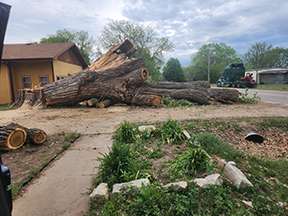
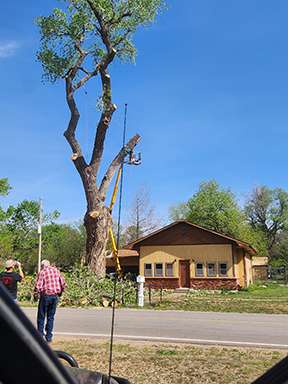
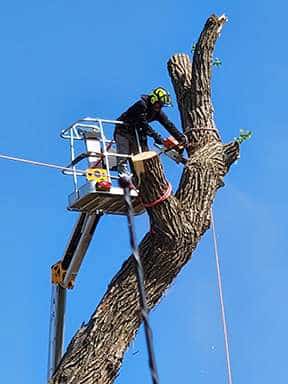
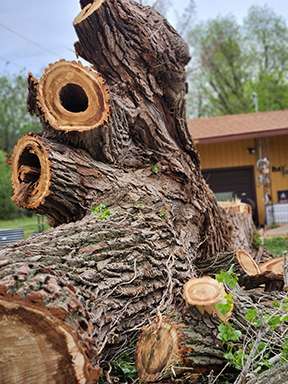
Imagine living in present day Langdon, KS in 1846. Luther Hobbs would have been one of the first settlers in the area. According to family member Judy Parsons, Luther went out alone and gathered cottonwood seedlings and planted them. As time went on a home was built near the tree. For the past 176 years the cottonwood stood tall in the small town of Langdon with a large Trumpet Vine climbing up the trunk of the tree. The cottonwood finally dropped a large limb. The limb crushed a garage. It destroyed 8 rafters, a roof and totaled out two vehicles. As most of you may already know a cottonwood can continue to live and produce leaves while the inside of the trunk and large branches are hollow. For this reason, the current owner of the tree decided to have the tree cut down.