Thursday, March 12, 2026
Home Blog Page 760

Transplanting Tomatoes Early

0
Photo credit: Nick Ares

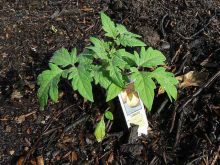
This time of year, most people are eager for homegrown tomatoes. As tempting as it may be to get those tomato plants in the ground early with hopes of an earlier harvest, remember the requirements to promote healthy tomato growth.

Root Growth: Tomatoes require a soil temperature of at least 55 degrees F. The soil can be covered with plastic mulch to raise the temperature, but this may take several days. Measure the soil temperature at a depth of 2.5 inches at about 11:00 AM. Or take an average of the soil temperatures from a morning and an afternoon reading. Laying a line of drip irrigation beneath the plastic mulch will make watering more convenient and safer for the plants.

Air Temperature: Tomato plants do not tolerate frost well. Temperatures below 55 degrees F may prevent plants from setting flowers. Though the plants may grow and look healthy, blossoms may not produce fruit or the fruit that does result may be misshapen. Protect young plants by using hot caps or water teepees. This will provide a higher average temperature and promote growth.

Cynthia Domenghini, Extension Agent

A wonderful new “Crew”

0
Thayne Cozart
Milo Yield

Last week, the date 3-23-23 became indelibly etched into our family history. That historic day was when a new Crew joined our extended family. Yep, we welcomed our fourth great-grandchild into the world. “Crew” is our third great-grandson.
Crew joined slightly bigger and older brother, Hudson. Everyone in the family is doing great — which is a big blessing.
With any luck at all, Nevah and I will be moving to our new home in Riley, KS, about the time Crew gets big enough to be really cute enuf to play with. It’s something to look forward to.
***
Now I’ve got a mystifying true story to tell. I fully realize that it sounds like I’ve been toking on the wacky weed, or nibbling on hallucinatory mushrooms, but I swear it’s true. As the old saying goes, “It’s my mystery story and I’m sticking to it.
Last week on a cool drizzly mid-morning I wuz driving my UTV down to the henhouse to let the chicken flock free-range for the day. But, on my drive down, my eye caught sight of something “horizontally white” down by my south border and some live critters were around it.
Upon closer look, I couldn’t believe my eyes. First, I recognized the “white” as a 10-foot length of rigid 4-inch PVC pipe with a collar. Second, two young (but not quite mature) identical Blue Heeler pups were excitedly barking into each end of the pipe and in their excitement rolling the pipe slowly downhill.
Now what makes this story mystifying is, first, I don’t have any lengths of 10-foot white PVC pipe. It wuz like the pipe had been dropped on my place from a helicopter. Second, I had never seen the Blue Heeler pups before, but they were well-fed and clearly hadn’t been abandoned. I had difficulty running them away from the pipe and down the road.
When I went back to the PVC pipe, I figgered the pups had a critter of some type trapped inside. However, I couldn’t see through the pipe, nor get any critter to fall out when I banged the pipe vertically on the ground.
So, I tossed the pipe into a shed close to the chicken house. But, that evening, I again checked on the pipe and it was open from end to end. My only conclusion is that some critter had squeezed itself so tightly into the pipe that my effort to dislodge it was futile.
Those Blue Heeler pups looked like chicken-killers on the loose, so, as a precaution, I didn’t let the chickens free-range that day — or the next day.
But, that’s not the end of the story. The next morning, the pups returned about the same time and I could see them hanging around in front of the chicken house — probably salivating because they could hear and smell the chickens inside. However, by the time, I went outside, the pups had moved on to wherever.
A phone call to a neighbor-in-the-know solved the pups part of the mystery. They belong to a neighbor I don’t know who lives a full mile east of me. Their owner said he’d take care of the pups neighborhood escapades. And, I think he has, because I haven’t seen them since.
But, the mystery as to where the PVC pipe came from is still a mystery — and I guess it will remain that way.
***
After disappointing tournament defeats by my men and women’s basketball teams from Bea Wilder U, my primary sporting attention turned to the Kansas City Royals baseball team. The Royals are rebuilding this year with new coaches and a lot of new faces on the team. They could be exciting. At least I hope so.
***
Here’s a true, but cautionary, story. A few days ago I received in the mail an unsolicited letter addressed to M. Yield. Inside was an authentic-looking letter from the Canadian law-firm of Woodland, Brent & Partners LLP in Toronto, compete with letterhead stationery, phone number, email addresses, and a website.
The letter’s contents were these: A wealthy Canadian real estate tycoon named Bruce Yield had died in a car wreck about six years ago and he left behind an unclaimed life insurance policy (ULIP) worth $10,550,300. A search for his relatives proved unsuccessful and the good-hearted folks at the law firm had found my name and wanted me to allow them to put my name into a legal effort to cash-in on the ULIP. Furthermore, the lawyers would only keep 10% of the settlement and use their funds for charitable distribution. It was 100% risk-free on my part.
The letter reeked of scam. So, at our Old Boar’s Breakfast I brought the subject up. And, lo and behold, we discovered a remarkable coincidence. Last week two others of the geezers got similar letters — only their relatives who died in the same car crash were named Bruce Jones and Bruce Smith (I changed the last names). What are the odds?
On a final note, when I called the law firm, the Mr. Woodland who answered, had a distinctive foreign accept — definitely not Canadian, eh? Sadly, the scam will probably rope in a few gullible folks.
***
Wise words for the week: “Pay attention. Don’t get scammed!”
Enjoy spring. Have a good ‘un.

Growing Vegetables Vertically

0

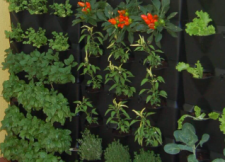
If space is an issue in your garden, consider growing vertical. Vertical gardening offers many benefits in addition to maximizing your garden space, leaving room for more crops in a small garden. Elevating plants off the ground increases the air flow which can help prevent disease. Bringing the height of the produce up also makes harvesting easier.

Many crops can be grown vertically including the more traditional tomatoes, pole beans, and peas as well as vining crops such as cucumbers, melons, squash and gourds. Edible-pod and snow peas have longer vines and are therefore more appropriate for growing vertically than English (shelling) peas. “Bush-type” vining crops produce short vines and are consequently less suitable for vertical growth. Be mindful of crops that grow large fruit as they could damage the vine if grown vertically.

Support your vertical garden with a sturdy structure. Bamboo poles work well to support pole beans. Create a “pup tent” or “A-frame” structure by leaning two cattle panels or pallets together and securing them at the top. Alternatively, a single panel can be tied upright to T-posts for support. Plant vining crops at the base and train them to grow upward.

Cynthia Domenghini, Extension Agent

Extreme want… It’s an old story

1
john marshal

A bank gets big, then bold. The bank plays fast and loose with money ‒ funds from depositors, borrowers, investors. Fast and loose becomes slow and strained, the money begins to dry up and soon people are nervous. They want their cash.
It happened again recently when Silicon Valley bank (California), followed by Signature Bank (New York), began to run dry after their risky investments failed. Silicon had invested heavily ($42 billion) in low-interest, long-term bonds that lost value when overall interest rates went up and kept rising. To cover losses, Silicon began selling the bonds and planned to sell bank stock to raise cash. Depositors got wind of this and made a run on the bank.
The banks would have failed without a federal rescue. Depositors were assured that up to $250,000 of deposits are federally insured; deposits beyond the limit were covered by the backup insurance financed by bank fees, not taxpayers. First Citizens, a North Carolina-based bank, will acquire the Silicon deposits and loans, including $72 billion in assets.
Another bailout, another lesson not learned. Eyes are on other big banks tempted to gamble large on the next big thing. Silicon and Signature catered to tech startups and venture capitalists peddling cyberworld visions and earth-bound shell games. Some of them work, many do not.
*
In global finance, the smallest big banks hold at least $100 billion in capital and surplus cash. Middling banks are in the $50-to-$100 billion range. New York’s JP Morgan Chase, America’s big bank ($3.5 trillion in assets), operates a branch in Leawood, in Johnson County. Bank of America ($2.4 trillion) also operates branches in Kansas.
Commercial banks and bank holding companies out here in the boondocks are not among the Earth’s big players. Their depositors are mostly locals who keep a steady eye on their checking and savings accounts. They invest in government securities and local (municipal) bonds; they loan to farmers, ranchers and merchants, for area housing and business, and they donate to local causes. They sustain the force and flare of local life.
State and federal bank examiners keep an eye on local banks.
*
Recent history, elsewhere:
In 2012 JP Morgan suffered a suffered a trading loss of between $2 billion and $3 billion. Investors were worried that this would nibble into their fortunes. Depositors with checking and savings accounts worried more.
During that Wall Street melee, two factors were overlooked. The first was a law, enacted two years earlier to head off the kind of hanky-panky that leads to multi-billion dollar gambles with depositors’ money.
The second factor was the long, slow grinding of congressional gears.
In 2010, congress had passed the Dodd-Frank bill, named for Sen. Christopher Dodd and Rep. Barney Frank of Massachusetts, who wanted something done about the government’s toothless regulation of huge banks. This law carried a provision called the Volker Rule, named for former Fed Chairman Paul Volker. It forbid commercial banks – which accept deposits from customers – from making speculative (“proprietary”) trades, or, gambling with depositors’ money.
The gambling was left to investment banks, such as Goldman Sachs, which are in business to wager their own money or clients’ funds.
The question was whether the commercial bank JP Morgan was gambling in the markets or simply investing to “hedge” against risks in other parts of its (then) $150 billion portfolio. This argument would not be resolved soon. In fact, the entire JP Morgan debate had been speculative.
That’s because Dodd-Frank was mostly an outline; regulators were to write the fine print later, but not much writing happened. The Volker Rule had been sterilized and consigned to a dark shelf. When JP Morgan’s gamble failed there was no law to argue because, two years after it passed, the Dodd-Frank outline continued to gather dust.
In 2018, President Trump signed a weak and debilitated version into law, a green light for covetous money changers.
Lesson again: The persistence of extreme want in wealthy institutions and an agreeable congress ensure that the law won’t bother them any time soon.
Megabanks aren’t too big to fail. They’re too big to regulate.

Watering the Landscape

0

I know I am probably sounding like a broken record, but so much of Kansas is in a severe or exceptional drought that this needs repeating.  Watering now is important if soils are dry to help alleviate moisture stress.

A good, deep watering with moisture reaching at least a foot down into the soil is much better than several light sprinklings that just wet the top portions of the soil. A deep watering will help ensure that the majority of roots have access to water. Regardless of the watering method used, soil should be wet at least 12 inches deep. Use a metal rod, wooden dowel, electric fence post turned upside down or something similar to check depth. Dry soil is much harder to push through than wet.

Although all perennial plants benefit from moist soils before winter, it is especially important for newly planted or overseeded lawns as well as newly transplanted trees and shrubs due to limited root systems. Even trees and shrubs planted within the last 2 to 3 years are more sensitive to drought than a well-established plant. Evergreens are also more at risk because moisture is lost from the foliage.

Trees or shrubs planted within the last year can be watered inexpensively with a 5-gallon bucket. Drill a small hole (1/8″) in the side of the bucket near the bottom. Fill the bucket and let the water dribble out slowly next to the tree. Refill the bucket once more, and you have applied 10 gallons. Very large transplanted trees and trees that were transplanted two to three years ago will require more water.

A perforated soaker hose is a good way to water a newly established bed or foundation plantings. However, soaker hoses are notorious for non-uniform watering. In other words, you often receive too much water from one part of the hose and not enough from another. Hooking both the beginning and the end of the soaker hose to a Y-adapter helps equalize the pressure and therefore provide a more uniform watering. The specific parts you need are shown in the photo above and include the soaker hose, Y-adapter and female to female connector. It is also helpful if the Y-adapter has shut off valves so the volume of flow can be controlled. Too high a flow rate can allow water to run off rather than soak in.

On larger trees, the soaker hose can circle the trunk at a distance within the dripline of the tree but at least ½ the distance to the dripline. The dripline of the tree is outermost reach of the branches. On smaller trees, you may circle the tree several times so that only soil which has tree roots will be watered.

If using a soaker hose, note the time watering was started. Check frequently to determine the amount of time it takes for water to reach 12 inches. From then on, you can water “by the clock.” Use a kitchen oven timer so you remember to move the hose or shut off the faucet. If you are seeing surface runoff, reduce the flow, or build a berm with at least a 4-foot diameter around the base of the tree to allow the water to percolate down through the soil, instead of spreading out.

Fall planted or overseeded lawns can be watered with an overhead sprinkler.  Watering to a depth of 12 inches with this method would be a challenge but try to reach at least 6 inches deep.

Ward Upham, Extension Agent