Thursday, March 12, 2026
Home Blog Page 759

Riding Lessons

0
lee pitts

The first thing in life I remember wanting to be was a jockey and the second thing was a professional basketball player. Alas, I was too big for one and too small for the other. So I figured that being a cowboy would be a better fit.

I hate to admit this but I’ve never had riding lessons in my life. I’ve never crossed an angry river on a horse, never rode a bronc in a rodeo and was never a member of the National Cutting Horse Association. I learned to ride sitting astride a saddle in my Grandpa’s “bunkhouse” which wasn’t really a bunkhouse at all but a shed filled with old bits, spurs, saddle blankets and two saddles sitting on stands. My favorite thing to do as a child was to go to Grandpa’s house where I’d head straight to his bunkhouse, mount up and play cowboy. My grandpa coached me, “Keep your heels, down, don’t jerk back on the reins and NEVER, under any circumstances grab the horn.” Or as he called called it, “reaching for the apple or squeezing the biscuit.”

My second favorite thing to do was ride the mechanical horse in front of the grocery store and I’m proud to say that neither the saddle stand or the mechanized equine ever bucked me off despite some really hairy predicaments. When I went to the county fair I always rode the horse on the carousel, not the ostrich, tiger, elephant or swan so at that point in my career I felt like I could ride anything that wore hair, wool or feathers.

Oh, I’d been on real horses before and have photographic evidence that I rode before I could walk, but I was always in the arms of Grandpa at a rodeo. It wasn’t until I was a sophomore in high school that I got on real horses and was a real cowboy. My best friend in high school lived on his grandfather’s ranch and every chance I got I went there to haul hay in exchange for riding horses. From the beginning I was assigned Buck, a horse that never did. Buck was the horse they always assigned to dudes, small children, infirm old timers and me. I loved that old horse. On a gentle horse like Buck everybody is an accomplished equestrian but simply polishing my pants on saddle leather didn’t make me any more of a cowboy than wearing spurs did. It wasn’t until I got my first job out of college as a cowboy that I had to ride rank horses. I wouldn’t say that any of the cribbers ever bucked me off but there were a few times I had to make an unscheduled dismount to tighten my cinch.

I wouldn’t necessarily call it “getting bucked off” either when one of those renegades with lethal tendencies took off at a lightning pace that would have won the All American in Ruidoso had he been there instead of a forest full of trees with low hanging branches, everyone of which tried to knock me out of the saddle. The whole time it was happening I kept hearing the words of my Grandpa, “Don’t jerk back on the the reins and NEVER grab the horn.” I wouldn’t say I was bucked off, it was more like I was scraped off.

If I ever had to ride one of those owlheads in the presence of my contemporaries I always hoped a rattler would bite my mount so he’d die and I’d have a good excuse for walking back to headquarters.

Years later when I had my own cow herd I always rode my horse Gentleman who must have been a son of Buck because he too never did. But one day Gentleman was busy trying to breed my neighbor’s Paint mare so he lent me one of his outlaws. Everything was fine until I tried to make him cross over a rock strewn stream. When he balked I may have tapped him a little with my spurs and the next thing you know I was knocking a hole in my chest with my chin. One minute I was soaring with eagles and the next thing I swimming with fishes.

It was then I formulated Lee’s theory on how to never get bucked off… never climb aboard in the first place.


Laying Plastic Mulch

0

Plastic mulch comes in a roll and can be used to warm the soil so gardeners can start tomatoes and melons earlier in the season. It can also be useful as a weed barrier and to retain water in the soil. In a commercial setting, growers use a machine to lay the mulch. Here are some tips for home gardeners to do this manually.

            1.) Prepare the soil by applying fertilizer based on soil test recommendations. Once the soil is covered fertilizer cannot be applied topically.

            2.)Work the soil so the bed can be shaped easily.

            3.) Form a trench along all sides of the bed, six-inches in from the edge. Pull the soil to the outside of the bed. The edges of the plastic will be buried in this trench so ensure it is deep enough to accommodate.

            4.) Lay drip irrigation tubing down the center of the bed. Though not required, it will greatly facilitate watering and reduce runoff.

            5.) Roll out the plastic mulch. Cover the edges with soil in the trench.

            6.) Evaluate soil temperature for several days to ensure it is stable and ready for planting.

When the soil reaches proper planting temperature (crop dependent), make an “x” in the plastic with a knife or burn a hole with a hand-held propane torch in each spot where a plant will be placed.

Asparagus Strata

0

Hustle, hustle, we just had Palm Sunday and we’ve got Easter weekend, it’s here!
We have good friends coming for Easter dinner and as my friend, Olcie said: ‘Why not change it up?’ That is exactly what we plan to do. However, I truly do enjoy deviled eggs on the menu, so that has to stay! Will we have ham? I’m not sure just yet, I’ll have to let you know next week. Olcie was joking with me again when he commented: ‘How about rabbit?’ Really, not on Easter, that’s a little ‘unholy’, don’t you think? I did however tell him if that’s truly what he wanted I would prepare it for him. Thankfully, he was only jokin’.

We spent the last weekend watching our son and nephew, Ari, test run their ‘Legends’ car on the track in Nevada, Missouri. We drug Grandpa Jerry along, and Phillip was so glad he went. Yes, if you want to find me on a Saturday night I could be at the track! Never thought you’d hear me saying that!

My chosen dish this week is a dish I’m very comfortable about making, strata’s.
This breakfast or main entrée dish would be perfect anytime, especially spring if you go the asparagus route.

As strata’s and egg casseroles go the base foundations are all pretty much the same: bread, milk, egg, and cheese. Once the base is in place you can design different flavors of casseroles right and left. This week I’ve chosen asparagus with sausage and cheese. I don’t know why you couldn’t go with asparagus and ham or even kielbasa/polish sausage. Kick out the entire asparagus theme and create an Italian strata with Italian sausage, peppers, tomatoes, olives and Italian cheese.

I’m also of the opinion that the choice of bread can make a substantial difference in the outcome. If I make French toast, dressing or bread pudding with my homemade sourdough bread there’s just no comparison.

For those of you who totally enjoy a Reuben sandwich consider this one: rye or marble bread, Swiss cheese, eggs, pastrami and for the very brave a bit of drained and rinsed sauerkraut. Oh yeah, I could easily sketch this one out, it would be delicious!

When you can’t figure out what to prepare for supper consider a green salad and a 9 x 13 pan of strata. You will also find there are some breakfast casseroles which can be frozen for later consumption. Not a bad idea for quick fix breakfasts.

Have a Blessed Easter, He is Risen, Hallelujah.
Simply Yours, The Covered Dish

Asparagus Strata
9 eggs, whisked
2 cups milk
3 slices bread, cubed (sometimes I use more)
1 cup grated cheddar cheese
1 pound sausage, cooked and drained
2 cups asparagus, cooked and cut into 1-inch pieces
4 ounces chopped/sliced mushrooms
Salt & Pepper to taste

Mix all ingredient together and pour into a greased 9 x 13 baking dish. Refrigerate overnight. Bake at 375 degrees for approximately 45 minutes.
Bake until a knife inserted in the center comes out clean. Allow to set for five minutes before slicing.

Turfgrass – How Low Should You Go

0

We often are asked whether it is good to mow lower in the spring. The answer is yes and no. It doesn’t hurt to mow lower than normal the first mowing or two. As a matter of fact, it can actually speed green-up by removing old, dead grass and allowing the soil to warm up more quickly.  But the mowing height should be raised to normal after the first or second cutting to discourage crabgrass and encourage deep rooting.

Crabgrass seed must have light to germinate and a high mowing height will help shade the soil.  Also, root depth and mowing height are related on upright growing grasses such as tall fescue and Kentucky bluegrass — the higher the height of cut, the deeper the root system. A deeper root system means a more drought-resistant turf.

So, how low should you go on the first cutting? On tall fescue and Kentucky bluegrass, you can mow as low as 1 to 1½ inches. Be careful you don’t go so low that you scalp the turf.   After that, raise the mowing height for Kentucky bluegrass to 2 to 3 inches but 3 to 3½ inches for tall fescue.

Ward Upham, Extension Agent

Wrens by the Houseful

0

We have a nice deck just off our kitchen, and when we added a roof a few years ago, we “boxed-in” an area of the ceiling and hung a ceiling fan there, leaving a small space the thickness of a 2×4 between the fan framework and the ceiling. Early last spring a male Carolina Wren took a shine to that enclosed area and began preparing it as a nesting site to show a potential mate. The starlings soon found it too, so I had to close-in the access. I got some wren nest box plans and hung a couple new nest boxes under the eaves of the house and workshop, hoping to attract a couple House Wren couples, and possibly our Carolina friend too.

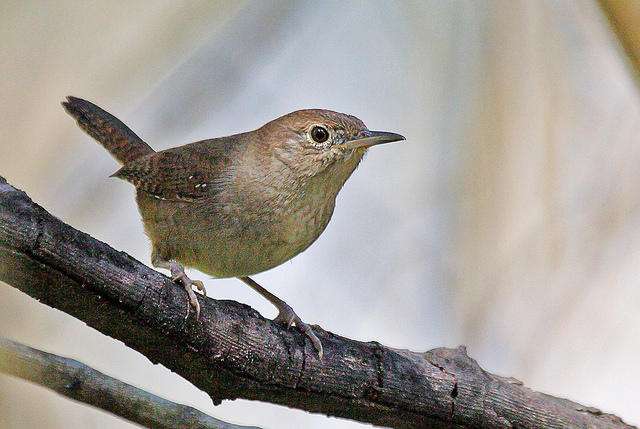
House wrens are cocky brownish little birds with long pointy beaks that can easily be recognized by the way their tails point upward at a jaunty little angle. Next to Purple Martins, House Wrens seem to be the second most popular backyard songbird home owners like to provide with housing. Having wintered in the south, male House Wrens arrive here several days before the females, intent upon staking out their territories early and having a nice selection of summer homes for the ladies to choose from when they arrive. They take very well to the homes we provide for them, but wrens have been seen nesting in many places other than those nifty houses we build. Their nests have been found in overturned flower pots in garden sheds, in the small hole in the center of a ball of twine, in a large abandoned hornet’s nest, in old shoes, boots and hats, and in the pocket of a scare crow’s coat. The style of the house doesn’t seem to be important, as long as the interior is kept fairly small, as wrens are cavity nesters and feel secure in small tight places. I found directions showing entrance holes anywhere from 7/8 to 1 1/8 inches in diameter. Smaller holes keep out starlings, sparrows and other bigger birds. I found results of a study suggesting that slotted holes seem to work well and are evidently appreciated by the males as slots allow them easier access into the house with nesting materials in their mouths.

When the male arrives (often to the same general nesting area each year,) he chooses several nesting sites and immediately sets about stuffing them all full of sticks and twigs. After he has successfully wooed a female, she makes her choice from the options he’s provided and adds a lining of feathers, hair or wool to his bachelor pad and moves in. Male wrens are known to literally stuff these chosen sites so full of material that the female has to remove some just to get inside. One writer once watched a male wren in her backyard as he crammed a house so full of sticks, they stuck out the hole. When the female arrived, she threw most of it back out into a pile on the ground below. While she was gone to hunt for suitable lining material, the male put one of his precious twigs back inside, and when the female arrived back, she again threw the stick out into the pile. I guess it’s that “When mammas happy everyone’s happy” thing.

Wrens often raise 2 broods a year. Five to eight tiny ½ inch eggs are laid, 13 to 15 days later the hungry youngsters hatch, and 12 to 18 days after hatching are ready to fly from the nest. A wren’s diet is primarily insects, and for those 12 to 18 days the parents’ life is put on hold as they strive to keep a house full of ravenous little insect guzzlers fed. One observer (who had way too much time on their hands and obviously a worse social life than even I) counted over 1000 feeding trips made by a pair of wrens in one day! Just one of many good reasons to place wren houses near your garden. Also, using pesticides sparingly in your flower and vegetable gardens, if possible, will provide lots of good high-protein snacks for wren families.

Years ago, I had a wren house under the house eaves just outside my office window. I haven’t had a lot of luck over the years attracting wrens to my nest boxes, but the year we had a family in that nest, they provided us with hours of entertainment. I cut a slot in the opening of that house, and the wrens seemed to like that idea just fine. The slotted hole also gave them something more to perch on as they tended to the hungry mouths inside, and they could often be seen hanging onto the front of the house as if stuck there on a suction cup. Between the hordes of bugs they eat and the hours of entertainment they provide, in my book wrens are top notch and yet another good reason the Explore Kansas Outdoors.

Steve can be contacted by email at [email protected].