
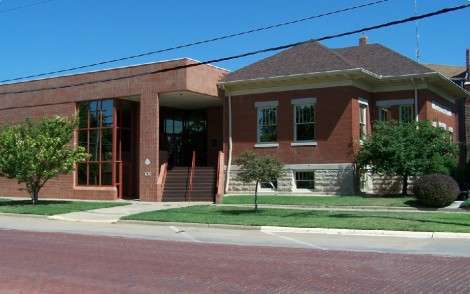
The Rice County Historical Society/Coronado Quivira Museum in Lyons, Kansas will host “The Civil War in Kansas,” a presentation and discussion by Will Haynes on Sunday, March 26 at 1:30 p.m.at the Coronado Quivira Museum, 105 West Lyon, Lyons, Kansas. Members of the community are invited to attend the free program.
For Kansans, the violent guerrilla warfare between proslavery and antislavery forces known as Bleeding Kansas foreshadowed the national Civil War to come. From 1861-65, the border struggle continued to heat up as Kansans fended off Confederate attacks, accepted the formerly enslaved into their communities, and engaged in bitter political debates. Men of all backgrounds—white, black, and Native American—served in uniform, while women managed farmsteads and formed societies to help the needy. This talk presents the story of Kansas during the Civil War and how it helped shape the state’s image for years afterward.
Will is the director of engagement and learning for Watkins Museum of History in Lawrence, Kansas. He earned a PhD in history from the University of Kansas and has contributed to public history projects involving the New York Times, the Truman Library Institute, and the Kansas City Public Library.
“The Civil War in Kansas” is part of Humanities Kansas’s Speakers Bureau and “21st Century Civics,” a collection of resources that invite Kansans to participate in community discussions and learn more about the history of American democracy and the shared responsibilities of citizenship. “21st Century Civics” is made possible with support from “A More Perfect Union: America at 250,” an initiative of the National Endowment for the Humanities.
Support for “The Civil War in Kansas” has been provided by the Freedom’s Frontier National Heritage Area.
Contact the Rice County Historical Society at 620 257-3941 for more information. The program is made possible by Humanities Kansas. Humanities Kansas is an independent nonprofit leading a movement of ideas to empower the people of Kansas to strengthen their communities and our democracy. Since 1972, our pioneering programming, grants, and partnerships have documented and shared stories to spark conversations and generate insights. Together with our partners and supporters, we inspire all Kansans to draw on history, literature, ethics, and culture to enrich their lives and serve the communities and state we all proudly call home. Visit humanitieskansas.org.
Presentation Explores the Story of Kansas During the Civil War
Ten Rules for Planting Trees

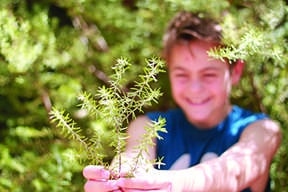
Before you begin spring landscaping, here are some tips on planting trees.
1. Select the right tree for the site. To avoid serious problems, choose trees that are adapted to your location. Consider whether the tree produces nuisance fruit or if there are disease-resistant varieties available. For example, there are a number of crabapple varieties that are resistant to apple scab and rust diseases. Also consider the mature size of a tree to be sure you have enough room. See https://hnr.k-state.edu/extension/info-center/recommended-plants/index.html or ask a local nurseryman for suggestions for trees adapted to your area.
2. Keep the tree well watered and in a shady location until planting. When moving the tree, lift it by the root ball or pot and not by the trunk.
3. Before planting, remove all wires, labels, cords or anything else tied to the plant. If left on, they may eventually girdle the branch to which they are attached. The root flare (point where trunk and roots meet) should be visible. If it isn’t, remove enough soil or media before planting so that it is.
4. Dig a proper hole. Make the hole deep enough so that the tree sits slightly above nursery level. Plant the tree on solid ground, not fill dirt. In other words, don’t dig the hole too deep and then add soil back to the hole before placing the tree.
The width of the planting hole is very important. It should be three times the width of the root ball. Loosening the soil outside the hole so it is five times the diameter of the root ball will allow the tree to spread its roots faster.
5. Remove all containers from the root ball. Cut away plastic and peat pots; roll burlap and wire baskets back into the hole, cutting as much of the excess away as possible. If you can remove the wire basket without disturbing the root ball, do it. If roots have been circling around in the container, cut them and fluff them out so they do not continue growing so that they circle inside the hole and become girdling roots later in the life of the tree.
6. Backfill the hole with the same soil that was removed. Amendments such as peat moss likely do more harm than good. Make sure the soil that goes back is loosened – no clods or clumps. Add water as you fill to ensure good root to soil contact and prevent air pockets. There is no need to fertilize at planting.
Note: Adding organic matter to larger area than just the planting hole can be beneficial, but it must be mixed in thoroughly with the existing soil and should “feather out” toward the outside edge of the area. This should be done before the planting hole is dug. Adding amendments to just the planting hole in heavy soil creates a “pot” effect that can fill with water and drown your new tree.
7. Don’t cut back the branches of a tree after planting except those that are rubbing or damaged. The leaf buds release a hormone that encourages root growth. If the tree is cut back, the reduced number of leaf buds results in less hormone released and therefore fewer roots being formed.
8. Water the tree thoroughly and then once a week for the first season if there is insufficient rainfall.
9. Mulch around the tree. Mulch should be 2 to 4 inches deep and cover an area two the three times the diameter of the root ball. Mulching reduces competition from other plants, conserves moisture and keeps soil temperature closer to what the plants’ roots prefer.
10. Stake only when necessary. Trees will establish more quickly and grow faster if they are not staked. However, larger trees or those in windy locations may need to be staked the first year. Movement is necessary for the trunk to become strong. Staking should be designed to limit movement of the root ball rather than immobilize the trunk.
Lettuce Eat Local: Forget cookie monster, we have a cocoa monster

Amanda Miller
Columnist
Lettuce Eat Local
Although it’s not a common occurrence, it’s very distinctive: an instant puff of dark brown powder out of the mouth. It’s the cocoa cough.
You may have never even seen this happen, but you don’t live in my house. I have a thing for dark chocolate, as dark as it gets, and the chocolaty bitterness of straight cocoa powder can be almost a craving for me. Rarely does a day go by that I don’t eat a spoonful right out of the canister. In fact, there is a handy spoon stored right in with the cocoa, and an eternal telltale ring of cocoa dust on the adjacent canister where I set the lid.
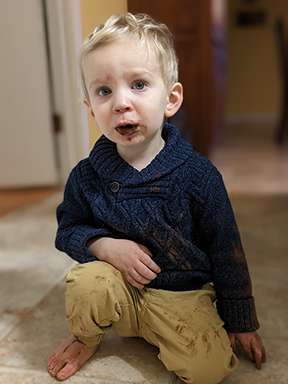
As they say, “monkey see, monkey do,” and Benson has picked up on my oober-dark chocolate habits. He has not yet, however, mastered the art of the cocoa chew like I have in my years of experience — hence his cocoa coughs. You can’t have a dry mouth when you take the spoonful, although you can carefully take a sip of a beverage to help moisten the bite; otherwise you just slowly chew and let your saliva do its work, letting your mouth be filled with bitter and intense chocolate.
What you can’t do in process is breathe through your mouth, because that will start the coughing, and then everything is a mess. Cocoa puffs everywhere, and not the cereal kind.
I got a bulk bag of cocoa powder the other day, and not only was Benson desperate to help me scoop it into containers, but he was also desperate to take bites of it during the process. You would think after the first bite went not-so-great, he would be reluctant to take the next, but no, he kept shoveling his little spoon right in there, taking several more bites before I had to physically remove him from the temptation.
Between his coughs and his transfer scoops gone awry, there was a fine film of cocoa powder on every surface in the vicinity, and it felt like as much went on the floor as went in my canister. Add to that his attempts to help clean up, and I began to thoroughly regret my decision to not wait to open the bag until naptime. At least the fiasco smelled delicious, not something we can always say on the farm.
Cocoa powder is created when cocoa butter is removed from cacao beans. Since it is almost entirely cocoa solids, it has an intensely chocolatey flavor, but none of the mouthfeel or sweetness of chocolate bars. This powder is processed into two major types: more common “natural” cocoa retains the acidity of pure ground cocoa, and is more of a reddish-brown color; whereas “Dutch” cocoa (called that because a Dutch chemist developed the process) has been treated with an alkaline solution to make it have a chemically neutral pH, and is thereby darker in color and mellower in flavor.
Cacao powder is also in this family, and it’s not just a fancy-sounding name to try and sell the same product; it is made from whole (instead of de-cocoa-buttered) cocoa beans, and is processed at a temperature low enough to be considered still “raw.”
It does matter which type you use in baking, as the different acidity levels interact differently with the leaveners and other ingredients. Flavor, color, and texture will also be different, although of course they’re all chocolate so they’re all winners.
Benson agrees. He gets the cutest impish grin when you ask if he likes cocoa, followed by a resounding “yes!”…and probably some more spilled cocoa dust.
Charming Chocolate Truffles
12 ounces chopped chocolate, dark or milk
6 ounces heavy cream
3 tablespoons cocoa powder, plus more for rolling
optional: dashes of cinnamon and cayenne
coarse salt
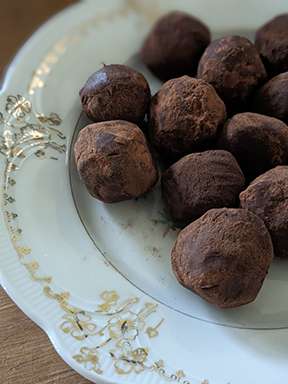
Have chocolate in a heatsafe bowl. Heat cream just to a simmer, then carefully pour over the chocolate. Let this sit for a minute or two, then whisk until smooth, adding in the cocoa powder. If you are looking for a kick, sprinkle in some cinnamon or cayenne to taste; otherwise, let it be. Chill this mixture until it’s firming up but not solid, an hour or two. Roll scoops of it into the size balls you want, then roll and coat in some cocoa powder with a good dash of coarse salt. Refrigerate until firm, and enjoy.
What could be better than chocolate with added chocolatey-ness? Truffles sound and taste immensely fancy (although I’m going to be honest, mine didn’t look upscale), and are remarkably easy to make. The very basic recipe is a solid winner, although adding cinnamon and/or cayenne is also dynamite. Since this recipe doesn’t bake, you can use whichever type of cocoa powder you want.
Prep tips: it’s better to use bar chocolate instead of chocolate chips, as chips are designed not to melt well, but it’s worth a shot still if that’s what you have on hand.
Popular Walk Kansas program gears up for 2023

Pat Melgares
K-State Research and Extension news service
Walking or running or biking more than 400 miles across the state of Kansas over the next eight weeks would seem a bit intimidating to most folks.
Yet, an estimated 5,000 people in Kansas and beyond are gearing up to do just that as part of a popular program that kicks off on March 26.
Walk Kansas, a team-based challenge that encourages teams of six to exercise and live more healthfully while working toward a common goal, will run through May 20. Registration is available online through the end of March. The cost is $10 per person.
“When we created Walk Kansas in 2001, we were looking at the Physical Activity Guidelines for Americans, which recommend a minimum 150 minutes of activity per week,” said Sharolyn Jackson, a K-State Research and Extension northeast area specialist and the state leader for Walk Kansas for more than two decades.
“So we determined that if six people would collectively meet the minimum guidelines of physical activity, they could virtually walk across the state of Kansas, which is 423 miles, in about eight weeks.”
Jackson said many forms of activity count toward “miles” accumulated. She said miles are calculated based on minutes of activity, with adjustments for moderate or vigorous forms of activity. To reach 150 minutes a week, she urges participants to make a goal to exercise 20-30 minutes per day.
“We count any type of activity that gets your heart beating a little bit faster, or exerting energy to where you can carry on a conversation just barely, but you can’t sing; that’s the moderate intensity level,” she said. “And vigorous activity also gives real benefits, such as short bursts of 30 seconds to a minute while you’re walking; you can kind of gauge vigorous exercise by whether you can say a few words but not really carry on a conversation.”
This year’s program offers four Walk Kansas routes:
Route 1 is 435 miles past Eight Wonders of Kansas. An online map shows team members some of the sights they’ll pass as they work toward their goal. Teams can reach this goal by meeting the minimum guideline of 150 minutes per week for each team member.
Route 2 is new this year – and actually begins in New Mexico. The distance covered is 640 miles and requires 200 minutes per week for each team member.
Route 3 challenges teams to cover 764 miles, beginning in the northeast corner of Kansas and finishing in the southwest corner. It requires about 240 minutes of exercise per week for each team member.
Route 4 is called the Little Balkans route, beginning in southeast Kansas to Nicodemus, with numerous turns. Those teams ambitious enough to take on this challenge will cover 1,200 miles – or six hours of exercise per week, per person.
There is also a solo trail for those who don’t have a team, or just prefer to take on the challenge themselves. Participants do not have to live in Kansas to be on a team or to do the solo challenge.
In addition to tracking their minutes of activity, participants are asked to report the number of cups of fruits and vegetables and, optionally, water they consume weekly. Participants are also encouraged to add in some type of strength exercise at least two days per week.
From April 2 through May 14 – Weeks 2 through 7 of Walk Kansas – Jackson said organizers will offer a weekly webinar on healthy eating, focusing on the Mediterranean eating style. The course is called Med Instead of Meds,’ to reflect the goal to help participants learn ways to potentially replace medications with healthy eating.
More information about Walk Kansas also is available at local extension offices in Kansas.
Insight: Community Through Coverage

Greg Doering,
Kansas Farm Bureau
My phone alerted me to a four-year-old photo a few days ago, or rather it alerted me to a photo taken four years ago of a newspaper clipping from decades ago. The clipping was a photo of a much younger version of me proudly standing next to a giant pumpkin I had grown in our garden.
Sadly, that was the peak of my farming career, but proof it ever existed was enshrined in that photo, which was published in the local paper. A family friend clipped it out, probably intending to give it to my parents in short order.
Instead, it got lost for a few decades, likely resurfacing when the family friend was going through a box long ago stowed away in a closet. Once discovered, however, it was put in the mail and arrived at my mother’s house for us to share a good laugh about the time I grew the giant pumpkin.
It’s a noteworthy family memory and a great example of the power of local newspapers and their unique ability to thoroughly cover their communities. My giant pumpkin didn’t make the front page, which is reserved for more serious topics, but it was important enough to be preserved for decades.
At its best, a community newspaper is a running dialogue of the area it covers. It’s a family-friendly version of the town talk in watering holes, coffee shops and beauty salons. The latest about all the area sports teams, board meetings, letters, announcements and more is collected and packaged based on what an editor believes the community needs to know. Over time, the articles also become artifacts of what life was like last week, year or decade.
Today anyone with a phone can tap a couple of buttons and blast a message to the masses. But that doesn’t replace a seasoned reporter’s intuition or a veteran editor’s judgment on elevating stories that will resonate within the community. The internet has certainly given us all options in the who, what, why and how we get our news, but local papers are still the most durable fabric to hold a community together.
They’re not perfect by any means, but your local newspaper is just as important to a town’s sense of itself as the school, hardware store or area landmark. In addition to keeping up on current events, readers get a sense of civic pride by knowing what’s going on in the community. The reach of a newspaper extends far beyond its circulation area.
Just the other day I received a call from a gentleman who had retired and decided to trade Kansas winters for the sunshine in Arizona. Must be nice. Even though he’s no longer a resident, he mentioned how he stayed connected with his former town from more than 1,000 miles away through the local newspaper.
Despite the distance, he’s still receiving updates on the births, deaths, weddings, high school events, city council meetings and more that local papers cover. Some, maybe even all, of that is available through social media, but good luck finding it in the same place day after day or week after week. A local newspaper will reliably show up on your porch, driveway or mailbox.
However, such service doesn’t come cheap. Readers are being asked to shoulder more and more of the cost through subscriptions as advertisers look elsewhere. While it might seem like a raw deal, the value of living in a community connected through coverage is a bargain.
“Insight” is a weekly column published by Kansas Farm Bureau, the state’s largest farm organization whose mission is to strengthen agriculture and the lives of Kansans through advocacy, education and service.
