Sunday, March 15, 2026
Home Blog Page 798

Livestock Trucker Kenny Livingston Known For Providing ‘Best’ Service

0
Frank J Buchman
Frank Buchman

“The livestock industry has lost one of the best of its very own.”
Nationwide well-known, most respected livestock trucker Kenny Livingston of Abilene passed away Christmas morning.
“Dad was recognized for his excellent service transporting livestock locally and throughout the country,” according to daughter Stacia Wiley, Chapman.
Raised as a farm boy in Dickinson County, Livingston was a lifetime farmer, who became best known for Livingston Trucking.
With a diverse farming operation, Kenny was an innovator, “Of course Dad raised milo, soybeans, and wheat, but was the first farmer in the county to grow cotton,” Stacia said. “He also tried growing sunflowers but decided traditional grain crops of the area were the best.”
His main business was still trucking, nearly all livestock but occasionally transporting other freight.
“The business developed so Dad had a half dozen tractor trucks and livestock trailers to go with them,” Stacia said.
Behind the semi-tractor steering wheel millions of miles personally, Kenny had just completed hauling a load of cattle to Georgia the week prior to becoming ill.
“Actually, Dad trucked all over the nation,” Stacia said. “Cattlemen everywhere appreciated his dedicated service and care in handling their livestock.”
There were a handful of fulltime truck driver employees as well that many or more owner-operators who worked for the company.
“My older brother Chad has been in partnership with Dad in both the trucking and farming operations,” Stacia said. “There’ll be some transition, but Chad will continue the businesses like he has been working with Dad.”
A graduate of Dickinson County Community High School in 1966, Kenny then graduated with a mechanics degree from Salina Vo-Tech.
“Operating a trucking business requires considerable repairs and maintenance which Dad was capable of handling,” Stacia acknowledged.
Married to his wife Dana in 1986, family was always very important to Kenny. “Dad had a special interest guiding us in whatever my brothers Chad and Brian and I were doing,” Stacia credited.
His three grandchildren were quite special to Kenny. “Dad loved spending time with Kaylee, Tori, and Jaxon,” Stacia said. “There weren’t very many of their school and athletic activities that Dad wasn’t in attendance.”
Bishop Ron Bowell, Brethren in Christ Midwest Conference, conducted memorial services at Zion-Brethren in Christ Church, north of Abilene.
“Jesus is the resurrection and the life. He is Lord and Savior. He is the way, the truth, and the life. Those who believe in Him will live even though they die,” Bishop Bowell clarified.
“Kenny would want you to know this because he knows fully now. He has been face-to-face with his creator,” Bishop Bowell declared. “Kenny is in now in God’s hands. The God who made him and knows him perfectly. Many remember Kenny on the basis of their relationship with him. God remembers Kenny on the basis of his relationship with him. Not on his religion or lack of religion, but on the basis of their relationship.”
That emphatic message was soothing inspiration to the family, friends and customers attending the service.
“It became even more meaningful because Kenny accepted Jesus Christ as his savior after diagnosed terminally ill the first of December,” said cattleman-friend Arden Peterson.
Appropriate for Kenny’s dedicated service to his country, graveside military honors were presented by American Legion Post and Fort Riley Color Guard.

CUTLINE

Kenny Livingston, Abilene, served the livestock industry locally and nationwide through his Livingston Trucking.

The Livingston Trucking cattle triple-deckers were widely recognized throughout the country.

Lovina Recalls Fond Childhood Memories

0
These cherry pies were part of the birthday celebration for granddaughter Abigail.

We have had mild winter weather so far this month. This morning it is raining, and the mercury in the thermometer is down to 30 degrees. It’s cold enough to turn to ice. Hopefully, everyone will have safe travels if it does freeze. 

My husband Joe and sons Benjamin and Joseph have left for work. I want to get this column written before I leave this forenoon, so I decided to do it right away. The coffee is brewing and should be ready soon. It sounds windy outside. Some schools are closing today due to the roads becoming dangerous later. 

Recently, granddaughter Abigail, six, was asking her mother (daughter Elizabeth) if she knew any of the parents of the children in her class. Elizabeth told her she knew Mariana’s Daddy Ritchie because he was her bus driver when she went to school. Abigail said, “What? He lived that long?” 

We had a good laugh about that. Richie drove the bus for all our eight children during their school years. Now his daughter Mariana is one of Abigail’s good friends in school. 

Friday, we had a delicious supper at Elizabeth and Tim’s house. Andrea enjoyed the attention when we sang happy birthday to her. On the menu were cheesy ranch potatoes, meatballs, lettuce salad, homemade bread, butter, jam, pickles, hot peppers, chips, cherry pie, cupcakes, and ice cream. After supper, we played games. It was an enjoyable evening with family. We have so many blessings! Do I thank God enough?

Sunday, we attended church. It was hosted by a family who lives one and a half miles from here. It was a nice day but chilly in the morning. Benjamin, Joseph, and Grace (Joseph’s special friend) decided to walk to church. It was 50 degrees by midafternoon. It gave us all spring fever. We spent the rest of the day at home. Daughter Verena told us to come to her house for supper, but it was just good to stay home and relax in our recliners. 

Monday morning, I was in slow mode and was taking my time gathering the laundry to wash. A minivan drove in around 10:30, and it was Uncle Joe and Aunt Betty from Geneva, Indiana. I decided to visit and wait to do laundry until after they left. I set out some snacks and coffee, and we had a good visit with them. Daughter Loretta and seven-month-old Denzel were here for the day too. Uncle Joe will be 81 on February 25, so we wish him a happy birthday. My dad is an older brother to Joe and would have been 92 on February 17. Dad passed away 23 years ago at age 69. He was a good father, and I will always treasure the memories I have of him. 

Albert Jr., the oldest of my dad’s siblings, had his 93rd birthday in January. My dad had 12 siblings, and he was the second oldest. There were ten boys and three girls. Uncle Bill (William) is 84; Uncle Menno, 83; Uncle Bobby (Robert), 82; Uncle Melvin, 77; and the youngest of the siblings is Amos, 75. Six of the siblings have passed away. My uncles are all full of fun, and the Coblentz reunions are never dull. May they all have great health in the future ahead. 

My favorite memory is when the Coblentzes decided to have a full-out water battle. It wouldn’t stop until every member that didn’t find safety somewhere was wet. One time at our house, my dad climbed up the windmill steps and jumped on the roof of the buggy shed with a five-gallon bucket of water for protection. Anyone daring to come up after him would get the bucket of water on them. What kept everyone away even more was the idea that he dipped the water from the livestock water tank. We had a lot of fun back then when the Coblentz family gathered. Precious memories—how they linger! God’s blessings to all!

Chicken Alfredo Bake

1 pound spaghetti

2 cups cooked chicken, cubed

1 16-ounce jar alfredo sauce

1 10.5-ounce can cream of mushroom soup

1 4-ounce can mushroom pieces

1 pound Velveeta, cubed

Cook and drain the spaghetti, then add the rest of the ingredients and combine well. Bake in a greased casserole dish at 350 degrees for 45 minutes or until thoroughly heated. 


Lovina’s Amish Kitchen is written by Lovina Eicher, Old Order Amish writer, cook, wife, and mother of eight. Her newest cookbook, Amish Family Recipes, is available wherever books are sold. Readers can write to Eicher at Lovina’s Amish Kitchen, PO Box 234, Sturgis, MI 49091 (please include a self-addressed stamped envelope for a reply); or email [email protected] and your message will be passed on to her to read. She does not personally respond to emails.

NOTES TO EDITORS: text=731 words; end material=75 words 

Contact: [email protected];  316-281-4413

From school choice to parents’ rights, Kansas lawmakers are pushing education changes

0
Conservatives want to make it easier for Kansas families to send their children to private schools, and they’re once again pushing for more parental control over what’s taught in public school classrooms.

Dozens of education bills making their way through the Kansas Legislature this session could have a profound effect on public schools.

Conservatives want to make it easier for families to send their children to private schools — including diverting tax dollars — and they’re once again pushing for more parental control over what’s taught in public school classrooms.

Other proposals include a push to fully fund special education, a bill that would allow pay for school board members, and one that would dramatically increase the time students spend in school.

Here is a look at some of the education-related measures debated in the Statehouse:

House Bill 2218, an education savings account measure, would give qualifying families about $5,000 of tax money to use toward the cost of private school tuition or homeschooling.

Conservatives say ESAs, which have passed in several other states, would give more families an alternative to public schools, which they say are failing some kids.

Opponents — including public school superintendents, teachers’ unions and the Kansas State Board of Education — say that’s an attempt to defund and undermine public schools. They say there’s no evidence that voucher programs work or that students do better academically in private schools.

House Bill 2048 would expand a tax credit that allows taxpayers to write off up to $500,000 worth of scholarships they provide for private schools. A similar bill, Senate Bill 128, would give taxpayers a refundable income tax credit when their K-12-aged children are not enrolled in public schools.

Opponents say the programs could be used to divert personal or business tax liabilities from the state’s general fund into private school scholarships.

“Holy tax scams, that is a masterful shell game,” said Rep. Mari-Lynn Poskin, an Overland Park Democrat, during a recent committee hearing. “Any religious organization of dark money special interest group can basically divert their group’s entire Kansas tax liability … for distribution to private schools that are not subject to the same oversight as our Kansas public schools.”

Opponents also worry about tax dollars going to religious education. Poskin pointed to a case in Ohio where a white supremacist homeschool shared Nazi-related lesson plans.

“Should a homeschool become a dissonant homeschool in Kansas, the state would be paying for neo-Nazi curriculum and materials,” Poskin said.

Conservative lawmakers continue to push for parental rights legislation. Last year, Kansas Gov. Laura Kelly vetoed a proposed Parents’ Bill of Rights that would have required school districts to develop and adopt policies that guaranteed parents’ rights.

This session, House Bill 2236 would establish parents’ right to direct their children’s education and “to object to harmful or inappropriate educational materials and activities.”

A House committee also approved a last-minute amendment to an open-enrollment bill that would require districts to have an online “parent portal” that lists all curricula, textbooks and other similar materials.

Opponents say the measures are vague and unnecessary because parents can already opt their children out of any lesson.

The governor wants to increase funding to special education by about $72 million a year to bring the state’s contribution to the fully funded level required by Kansas law.

So far, the House has passed a bill that creates a task force to study the issue. Some lawmakers want a resolution asking the federal government to pay more. But there has been no real action on funding.

Another bill would allow — but not require — school districts to pay board members out of their district budgets. The Kansas Association of School Boards is opposing the measure, saying no board member requested it and that many say volunteer service is important to their mission.

Other education bills include one that would allow school board candidates to list a political party affiliation on the ballot, one that would require districts to establish an independent review policy for complaints about bullying, and one that would drastically increase the time students spend in school.

Suzanne Perez reports on education for KMUW in Wichita and the Kansas News Service. You can follow her on Twitter @SuzPerezICT.

How tiny saddles and youth rodeo might help keep another generation in rural Kansas

0
As small town populations decline, people in places like western Kansas look for ways to keep their rural farming and ranching lifestyle alive for the next generation. Some families think youth rodeo might be part of the answer.

How do you turn kindergartners into wranglers?

“Little bitty saddles,” Melissa Vander Hamm said, “for little bitty kids.”

There’s a bit more to youth rodeo than that. You need your own horse. Plus a trailer to haul the horse and a truck to tow it all. To ride, you’ll need one of those little saddles and a bunch of other tack, which could put you back thousands of dollars.

In all, a youth rodeo family is an extensive, expensive commitment to living the rural Western lifestyle.

But Vander Hamm knows all that. She’s been competing in rodeo since she was nine years old. Her two sons started at age five. Now, she helps run the Young Guns Extravaganza, a youth rodeo series in Dodge City.

“It’s not a cheap hobby,” Vander Hamm said. “Drive through our parking lot on rodeo weekend and the amount of money just in pickups and trailers … it’s crazy.”

For rodeo families — most of whom, she said, come from agricultural backgrounds — the cost of competing is worth every penny as they look for ways to sustain their traditional way of life and their town’s population of young folks.

In a place where farms and ranches go back generations, rodeo is sewn deep into the cultural fabric of rural Kansas. But the number of people living in the region’s small towns has been shrinking for decades as young adults leave the rural life for bigger cities. Most counties in western Kansas have been steadily emptying since the Dust Bowl.

And parents like Vander Hamm, who lives in the neighboring town of Ingalls (population 288), hope that introducing more kids to the rodeo world might spur them to fall in love with their hometowns’ cowboy culture. Then maybe when those kids grow up, they’ll want to get back in the saddle again.

“The ones that do love it,” Vander Hamm said, “are inclined to come back and be part of the family farm.”

Despite any financial barriers to getting started, youth rodeo is growing.

Vander Hamm founded Young Guns in 2014 with a few other parents who wanted their kids to get more practice during the winter, when other competitions shut down.

The first year, she expected around 50 kids to show up. She got 120.

This season, Young Guns has welcomed nearly 400 little cowpokes into the arena, as they dummy rope, pole bend or barrel race their way to glory. And it’s just one of several youth rodeo associations across the state.

“I do think it’s a trend,” Vander Hamm said. “It’s a time when it’s cool to be a cowboy.”

Back in the saddle

On rodeo day, hundreds of horses trot through an expo center on the south edge of Dodge City. They kick up fine brown dust from the arena floor into clouds that hang in the air.

The morning starts with a prayer from the rodeo chaplain. Then comes the national anthem as the Miss Santa Fe Trail Queen gallops in with a flag.

Mesa Hedland stands near the arena entrance decked out in a brown Western shirt with leather tassels dangling from leopard print shoulder patches.

She’s waiting for her favorite event, which involves chasing down a goat and untying a ribbon from its tail, with help from her trusty steed named Ott.

“He’s addicted to me,” Hedland, who’s from Anthony, Kansas, said. “We can’t spend a day without hanging out with each other.”

Hedland is only five years old, but this is far from her first rodeo. She’s been chasing those goats since she was three.

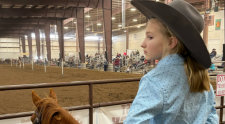
In the horse warm-up area, nine-year-old friends Paisley Davis and Braylin Barratt offer a tour of the bridles and stirrups strapped to their four-hoofed friends. The pair live a few hours apart in southern Colorado, so they’re making up for lost time here.

Listening to them as they inspect their saddles and laugh about the odd things one particularly ravenous horse has eaten, it’s not hard to spot what rodeo families see as the upside of all this and what they hope kids take away from the experience.

The hard work it takes to care for an animal 10 times their size. The hours of practice required to master skills that most adults can’t pull off. The grit they need to ride into the arena — where every kid but one ends up leaving a loser.

“Be grateful that even though you didn’t win, someone else won,” Barratt said. “Always be grateful.”

And the bonds they form — with people and animals — along the way.

Davis walks up to her horse Thunder until the two stand eye-to-eye. She rests her hand on his neck near the black mane that she’s carefully woven into braids.

“When you do have a bad day,” Davis said, “you can just talk to your horse about it.”


Fertilizing Spring-flowering Bulbs   

0

The best time to fertilize spring-flowering bulbs is when foliage emerges in the spring rather than at flowering. Traditionally, gardeners have applied fertilizer during bloom or a bit after, but because bulb roots start to die at flowering, fertilizer applied at bloom is wasted. Roots are active when the foliage first pokes through the ground.  Nutrients applied then help the plant produce flowers the following year. If bulbs have been fertilized in the past, there is often plenty of phosphorus and potassium in the soil. It is best to take a soil test to be certain.

If the soil needs phosphorus and potassium, use a complete fertilizer (such as 10-10-10, 9-9-6, etc.) at the rate of 2.5 lbs. per 100 square feet. This would equal 1 rounded teaspoon per square foot. If phosphorus and potassium are not needed, blood meal makes an excellent fertilizer. It should be applied at the rate of 2 lbs. per 100 square feet or 1 teaspoon per square foot. Lawn fertilizers such as a 27-3-3 or 30-3-3 can be used, but cut the rate to a third of that applied for blood meal. Also make sure the lawn fertilizer does not contain a weed preventer or weed killer.

Remember to leave the foliage until it dies naturally. The energy in the foliage is transferred to the bulb as the foliage dies and will help the bloom for the next year.

Ward Upham, Extension Agent