Monday, March 16, 2026
Home Blog Page 818

Free Deer Tags May Cost More Than We Think

0
Trail Camera[MP:06]

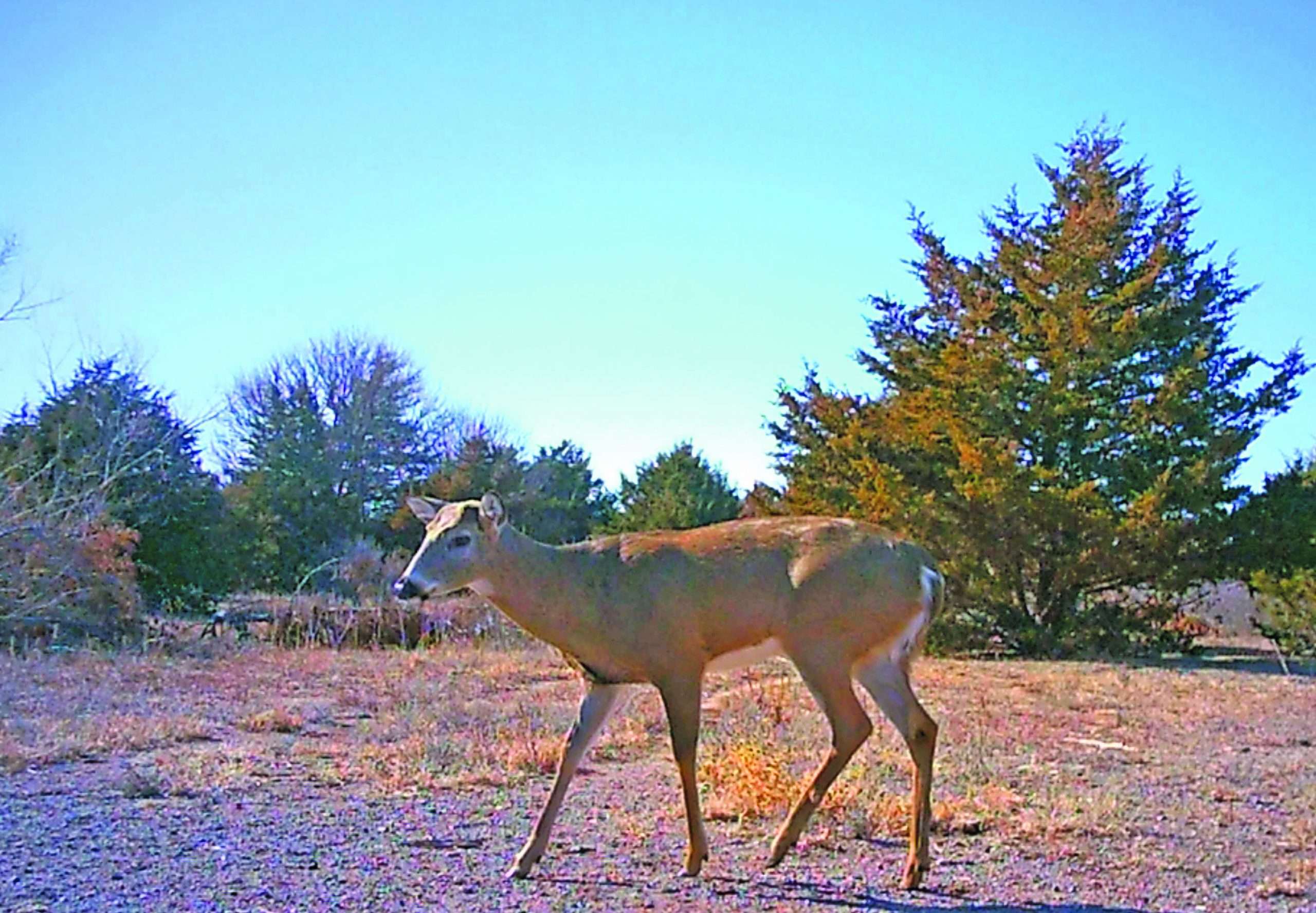
All Kansas sportsmen should be very concerned about a new bill that has been introduced in our legislature. House Bill 2079 states that the KDWP shall provide a free any-season white-tailed deer tag to every resident who owns a lifetime hunting license. Any resident non-lifetime hunting license holder will get a free antlerless tag. In addition, the long-standing 10 day rifle season will be extended another week. The bill does not give any indication of why these changes are necessary, but in my conversations with a few state representatives, the deer population and deer/vehicle accidents both came up.
Free deer tags! More rifle season! This sounds great, right? Here is the concern. The North American Model of Wildlife Conservation was created in 1860 from the likes of Aldo Leopold, Teddy Roosevelt and John Muir. The founded principles have worked wonderfully over the years and are proven. The hunting and fishing opportunities found in America are the envy of the world. Let me get to my point. Our wildlife conservation model has seven tenets. One of those tenets states that science is the proper tool for use in determining wildlife policy. If that is one of the principles, then what is our state legislature doing meddling in the affairs of our wildlife department? I certainly doubt that our state reps have looked over years worth of data regarding our deer population, yearly harvest rates, license sales, CWD damage reports, vehicle accident reports, etc. I wonder who in our state legislature has the biology credentials to understand the ramifications of such a bill – a bill that could possibly defund KDWP. Furthermore, why would our state create a department with the sole purpose to manage the wildlife, and then pass laws that supersedes that department. Here lies the problem with this bill. It’s nothing more than a few legislators’ opinions. I assure you that managing wildlife based on opinions is not found in the seven principles of our wildlife conservation model.
This new bill has been discussed extensively on social media and I’m sure the news has made it to your local coffee shop. Ask a hundred hunters and I’m sure you’ll find a hundred opinions. Many would like these changes and many would not. The one thing that us sportsmen and women should be united on is that our wildlife should be managed by our state biologists and not our state legislators. For that reason alone, this bill should be struck down.
Mike Miller
Hutchinson

Trail Camera[MP:06]

Kidding goats is no joke in cold snap

0

Shelby Varner
Kansas Living
Magazine

“You’ve got to be kidding me!” That was my initial reaction when I saw the predicted forecast for winter break. As a college student at Kansas State University, I love going home and seeing my family and animals, but when temperatures are expected to be below zero plus windchill, my joy in going home decreases. My sisters and I raise goats and when the weather gets cold, we go into what I call, “survival mode.”
Caring for goats throught the night
While K-State calls it winter break, it isn’t much of a break when I go home. The Wednesday before break, my sister called and said we had started kidding (birthing) season. When one goat kids it usually starts a chain reaction of babies. That meant my family was about to have babies being born in cold, windy weather. The combination of wet babies and wind can quickly become deadly. While we have sheds  to help block the wind, and the body heat from the goats keep babies warmer, it does not mean the mother goats will have their babies in them. This meant my family and I were checking goats at least every two hours, even through the night. I would take the midnight and 6 a.m. shifts while my middle sister, Tara, got up at 2 a.m. and my oldest sister, Amy, got up at 4 a.m. We were all cold and tired, but we knew if we didn’t check the goats in these extreme conditions that they’d suffer. Being caretakers of animals is a full-time job, even through 35 below zero wind chills and 2 a.m. alarms.
Kidding goats through the harsh conditions of winter
Nine goats decided they would continue to have babies the frigid days before Christmas, which filled up our kidding pens very quickly. Our kidding pens are small enclosures in our shed where we can closely monitor the mom and babies to make sure the mom and baby recognize each other, and the baby will drink from the mom and the mom will let it before putting them with other goat families. It also allows us to check the babies and be confident they are getting enough milk.
One issue we ran into this time was moms producing enough milk for their babies, which is a rare problem for us. Usually when a mom has babies, she produces plenty of milk. We think because of the cold, the goats lowered their water consumption and couldn’t produce milk right at birth for their babies. This added extra stress because we bottle fed babies extra milk to get them going while enticing the mothers to drink and start producing more milk. Also, if the babies got too cold, we would take them into my dad’s shop to warm them up. Thankfully, usually after a day the mom would start keeping up with their baby’s milk needs which helped keep the baby warm.
The hard part of raising goats
During this cold snap, we didn’t lose any meat goats, but we did lose a couple of dairy goat babies. My family had just fed babies milk and we were back in the house and ready to watch our first Christmas movie together. Amy wasn’t back in the house, but that isn’t uncommon because she gets easily distracted by the goats, so I texted her the movie was about to begin. A few moments later the door burst open, and she said, “Shelby,” in a tone that put Tara and I on our feet in a heartbeat.
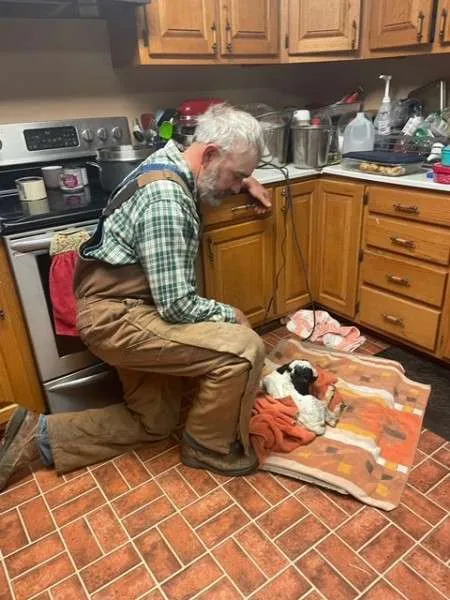
A first-time Nigerian dwarf mom decided to have her babies in an area of the pen with little wind block. She also didn’t naturally come by mothering skills because the babies didn’t seem to be cleaned up at all. Amy brought two babies in, and we rubbed them while trying to warm them up. We were only able to save one by putting him under warm water. We then put him on a heating pad and rubbed a towel on his legs while using a hairdryer to warm him up even more. While Tara and I worked on this baby, Amy went back outside and found two more that had passed.
The King of the house
I was able to get warm milk in the survivor’s tummy and kept him on the heating pad in the kitchen for the night. It’s not uncommon to see goats in my family’s house so when I put him on the heating pad with nothing around him at bedtime, no one was shocked. When I went to bed that night, I just hoped I would see him in the morning. When I got up at midnight he was still snuggled on his pad and looked the same that morning. Now he is a growing boy named King.
As we got past the cold and were no longer hauling water buckets everywhere, the goats continued to kid and only one person got up in the middle of the night. While the goats are under the herd name of 3 Varner Girls, there are so many more people who help make everything function. My dad is almost always on call for kidding problems and will probably always be able to outwork all of us, combined. My mom made sure we had warm food to eat and we didn’t destroy the house. There is also my boyfriend Jared who helps us care for the goats, even on the frigid days. While I don’t love putting on layers of clothes just to have my toes feel like they are still freezing, I love being able to spend time with the people I love and being responsible, nurturing caretakers of these animals.

Cloning Apple Trees  

0

We occasionally receive calls from gardeners who want to know how to treat an apple seed so it will germinate. Usually, the gardener is trying to reproduce an old apple tree that was special for some reason (good quality fruit, planted by grandparents, etc.) Unfortunately, apples grown from seed will not be like the parent. About 1 in every 80,000 apple trees grown from seed will be as good as the apples we are used to eating. Apple trees grown from seed usually have small and inferior quality fruit.

If you want a tree exactly like the parent, you must propagate that tree vegetatively. In the case of apples, this usually means grafting for homeowners. Apple trees are actually quite easy to graft, even for novices. Don’t be afraid to try even if you haven’t grafted before. The step that needs to be done at this time of year is the choosing and cutting of scion wood or small branches that will be grafted on top of a rootstock. The rootstock is a separate tree that has good root characteristics and often disease resistance.  Also rootstocks can have a dwarfing effect on the grafted tree.  So our fruit trees are actually two trees spliced together.  The roots and beginning of the trunk is the rootstock.  The upper portion of the trunk and all the branches is called the scion.  It is the “good” part of the tree.  For example on apples, the scion might be a Jonathan, Winesap, Granny Smith or any other of a number of different cultivars.  The rootstock for all of these varieties may vary or may be the same depending on the desires of the propagator.  See the accompanying article in this week’s newsletter for instructions on how to collect scionwood.

If you don’t have an existing tree to graft onto, you will need to plant a rootstock this year for grafting onto next.  Fruit trees are normally grafted (or budded) onto specially selected rootstocks. These rootstocks usually reduce tree size. For example, a tree that normally would reach 25 feet tall will only reach 10 feet if it is grown on a certain rootstock. Dwarfing rootstocks also allow apples to bear fruit a year or more earlier.

Note that rootstock  reduces tree size, not fruit size. Therefore, a Golden Delicious tree that only reaches 8 feet tall due to a dwarfing rootstock, will bear the same size fruit as a Golden Delicious tree that is 25 feet tall.

A tree on its own roots normally takes 5 to 7 years before it will bear. Semi-dwarf trees bear in 4 to 5 years, and dwarf trees bear in 3 to 4 years. Unfortunately, not all dwarfing rootstocks are well adapted to Kansas conditions. Semi-dwarf trees usually are a better choice for us.  Fully dwarfed trees often are uprooted or break at the graft during high winds.  Semi-dwarf trees are usually more than 50% the size of a standard (non-dwarfed) tree.

So, where do you buy rootstocks to graft onto?  Most nurseries only sell trees that are already grafted. A company that does sell rootstocks is Raintree Nursery, Morton, WA, (360) 496-6400.  See https://raintreenursery.com/collections/apple-rootstock for apple rootstocks.

Another is Cummins Nursery, (865) 233-3539, https://www.cumminsnursery.com/buy-trees/index.php?type=rootstock .

What rootstock is best?  There are a several choices that should work well in Kansas.  An old favorite is Malling-Merton (MM) 111 as it is well-adapted to Kansas conditions and can tolerate heavier soils.  Trees will be 80% the size of a “standard” tree.  Malling-Merton (MM) 106 is a good choice for well-drained soils.  Trees will be about 70% the size of a standard tree.  Other rootstocks can be used but make sure they are well-anchored and not described as brittle.

It is also possible to buy a tree from a local nursery and graft your clone onto a side branch.  This will give you one tree that produces two different apples. One disadvantage of this method is that it is possible to prune off the special clone by mistake in later years.

This information does not include the details of grafting or budding or subsequent care.  The Missouri Extension Service has an excellent publication on grafting at

https://extension.missouri.edu/publications/g6971  as well as a second publication on budding at https://extension.missouri.edu/publications/g6972  .

If you use a knife, be sure to practice your cuts on wood you prune off in March. After you do about 100 cuts, you will start to get the hang of it.  A grafting tool can make this job even simpler as it makes the proper cut automatically.  Do a search on “grafting tool” to see what is available.

If you find grafting intimidating, Raintree Nursery does custom grafts.  In other words, you must collect your own scionwood and send it to Raintree Nursery.  They will make the graft and send it back to you.  See https://raintreenursery.com/collections/pear-rootstock/products/custom-graft for details. (Ward Upham)

Multiple Grafts on Apple Trees

Nurseries often sell apple trees that bear more than one variety of fruit. The secret is grafting. All apple trees are grafted, which is done by grafting the apple-producing variety (the scion) on a variety chosen for its dwarfing effects (the rootstock). A tree with more than one variety simply has more than one fruiting variety grafted onto a single rootstock. Grafting allows growers to have a single tree that could produce Jonathan, Red Delicious and Golden Delicious apples. These trees can be a unique attraction and a good conversation point in a fruit garden. If space is limited, a multiple grafted tree may allow growers to have a greater variety of fruit than with individual varieties on separate trees. However, there are some possible drawbacks. Whoever prunes the trees may not recognize the individual grafts and may unknowingly prune off one of the varieties. Also, varieties may vary in vigor, and stronger varieties can crowd weaker ones. There also may be a difference in susceptibility to disease among varieties and among different kinds of fruit. Some may have resistance to a disease and not require protection, but others are susceptible and do require protection. If the susceptible fruits are protected, the more resistant ones will be sprayed unnecessarily.

Ward Upham, Extension Agent

Saving Vegetable Seeds from Crops Grown This Year

0

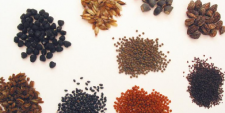
If you wish to save vegetable seeds from one year to another, there are certain things that must be kept in mind.  Seed from hybrid varieties will not come back true.  In other words, the plants grown from seed from a hybrid will grow but will be quite variable and will not be like the parent. For example, if you save seed from a hybrid tomato, you will still get a plant that produces tomatoes but yield will likely be much less and the fruit will lack many of the good characteristics of the parent.   If you want a plant just like the parent, you must use seed from an open-pollinated variety rather than a hybrid.  Heirloom plants are open-pollinated.  Any plant listed as an “F1” is a hybrid.

Not only must you use open-pollinated plants but you must prevent contamination from other plants of the same species.  Note that contamination from other varieties has absolutely no effect on the current season’s fruit characteristics.  It only affects the fruit grown from seed of those contaminated varieties.  Preventing cross-contamination can be done via several methods.

  • Distance: make sure that your plants are far enough away from other varieties of the same species that the pollen from neighboring plants cannot reach yours.  The distance varies considerably depending on species and whether the plant is wind or bee pollinated.
  • Mechanical: This can be as simple as covering the unopened female flower of a bee pollinated plant with a bag and then hand pollinating with the male flower of the same variety. The bag is then placed back over the flower until the fruit starts to form.  This is commonly used for the vine crops such as squash, muskmelon and watermelons as these produce separate male and female flowers and are bee pollinated.  Another mechanical method is to place a screened-in cover over plants that are bee pollinated.  This would work well for peppers.
  • Time of Flowering: Commonly used for sweet corn.  Many farmers will plant a small area of sweet corn in with their field corn even though sweet corn quality is much less if it crosses with field corn.  The reason this can work is usually the sweet corn has finished pollination by the time the field corn tassels, thereby preventing contamination.

This seems way too complicated.  Is there an easy way to start?  Yes there is!  Start with tomatoes.  They will not cross-pollinate unless you grow a potato-leaved variety.  Therefore, you can grow several different open-pollinated varieties in the same garden without worrying about contamination.

If you would like to save seed from other species, I would suggest you buy a good reference.  The book I use is “Seed to Seed” by Suzanne Ashworth.

Ward Upham, Extension Agent

Preventing Potatoes from Sprouting in Storage

0

Home gardeners have had to rely on proper storage conditions (cool and moist) to prevent potatoes from sprouting. But sprouting will eventually occur even if the gardener does everything right. Research by Mary Jo Frazier, Nora Olsen and Gale Kleinkopf from the University of Idaho have found products that should help home gardeners.

These researchers were looking for an organic method to control potato sprouts. They found essential oils from some herbs and spices to be effective sprout inhibitors. Specifically they found that spearmint oil, peppermint oil and clove oil suppressed sprouting by physically damaging rapidly dividing cells in the sprout. Each of these products is so safe that the FDA has approved them for addition to food.

Several application methods were considered though most were only suitable for commercial storage facilities. The only practical method for homeowners was one the researchers labeled a “low-tech” wick method. This was accomplished by placing a small piece of blotter paper saturated with spearmint or peppermint oil in a box with the potatoes. This method was not recommended for the clove oil. Though it was found that peppermint and spearmint oils were equally effective in suppressing sprouts, the peppermint oil was less likely to affect flavor of the potatoes. Reapplication at two- to three-week intervals will be needed for continued sprout suppression. Little to no residue was found on the potatoes from these products due to their high volatility. The first application should be done before sprouting occurs.

Blotting paper is much more difficult to find than it was in the past and so you may want to substitute blank newsprint. However, if blotting paper is desired, try herbarium supply houses. Blotting paper is used to press plant specimens.

Ward Upham, Extension Agent