Tuesday, March 17, 2026
Home Blog Page 835

Daughter Susan and Ervin Get Married

0

Lovina’s Amish Kitchen
Lovina Eitcher,
Old Order Amish
Cook, Wife &
Mother of Eight


I am Lovina’s “English” friend Ruth, and I had the opportunity to help Lovina the week of Susan and Ervin’s wedding by taking photos of the wedding prep, running a few last-minute errands, and also attending the wedding on Friday, December 30. Typically, Amish weddings are held in the shed (pole barn) of the bride’s parents’ house, but with it being winter Susan and Ervin decided to use the CYC (Community Youth Center), which is a beautiful building that is used primarily for the youth to gather on Saturday nights for social activities but is also available for the Amish community to use for special events. It has two large rooms (the size of a gym) plus a fully furnished kitchen. This building has solar power, and the kitchen even has electrical outlets, which are not allowed in Amish homes even if they have solar but are allowed in the CYC building. The one large room was set up for the wedding ceremony and the other large room was set up for the noon meal after the wedding.

On Tuesday, Wednesday, and Thursday before the wedding, friends, family, and church members came to the CYC to set up for the wedding, to prepare food for the noon meal, and to support Susan and Ervin. More folks gathered early Friday to start the cooking for the meal.  Each morning when Lovina and I arrived for the preparation, Susan and Ervin and the children were there before everyone else to get started on that day’s list, and they were the last to leave each afternoon. They greeted everyone as they came in with smiles and words of gratitude for the help given. Many of you know Susan lost her husband Mose about two years ago, and Ervin lost his wife Sarah a few months before Mose passed. What I found so endearing was that both Sarah’s and Mose’s families were not only supportive of the marriage but came to help with the wedding prep. On the day of the wedding Omer and Rose (Sarah’s parents) and William and Rosanna (Mose’s parents) were seated at the head tables with the family. Susan and Ervin also were intentional about honoring and acknowledging Sarah and Mose as they started their new journey as husband and wife. 

A typical Amish wedding ceremony goes from about 9:00 a.m. until noon. It includes preaching by a number of local ministers, some singing, and finally the pronouncing of the couple as married near the end of the service. Before the service begins, the couple and their witnesses sit near the door where people come in and greet all guests as they arrive. Then they go to a private room to meet with the Ministers, the Bishop, and a deacon to receive advice on having a good marriage and to pray. They are then seated in special chairs in the middle of the room where the wedding is. The bride and her witness sit across from the groom and his witness.  After the ceremony there is typically a noon meal, a 5:00 p.m. meal, and a meal with the youth at 7:00 p.m. Susan and Ervin only had a noon meal and limited the guests to family, church members, and some close friends. Even with cutting back, there were still about 425–450 people there.  Typically everyone sits down and table waiters pass food to everyone, but only the head table and immediate family was served this way. Everyone else walked through a buffet line to get their food. It was done very efficiently and we were all served quickly.  

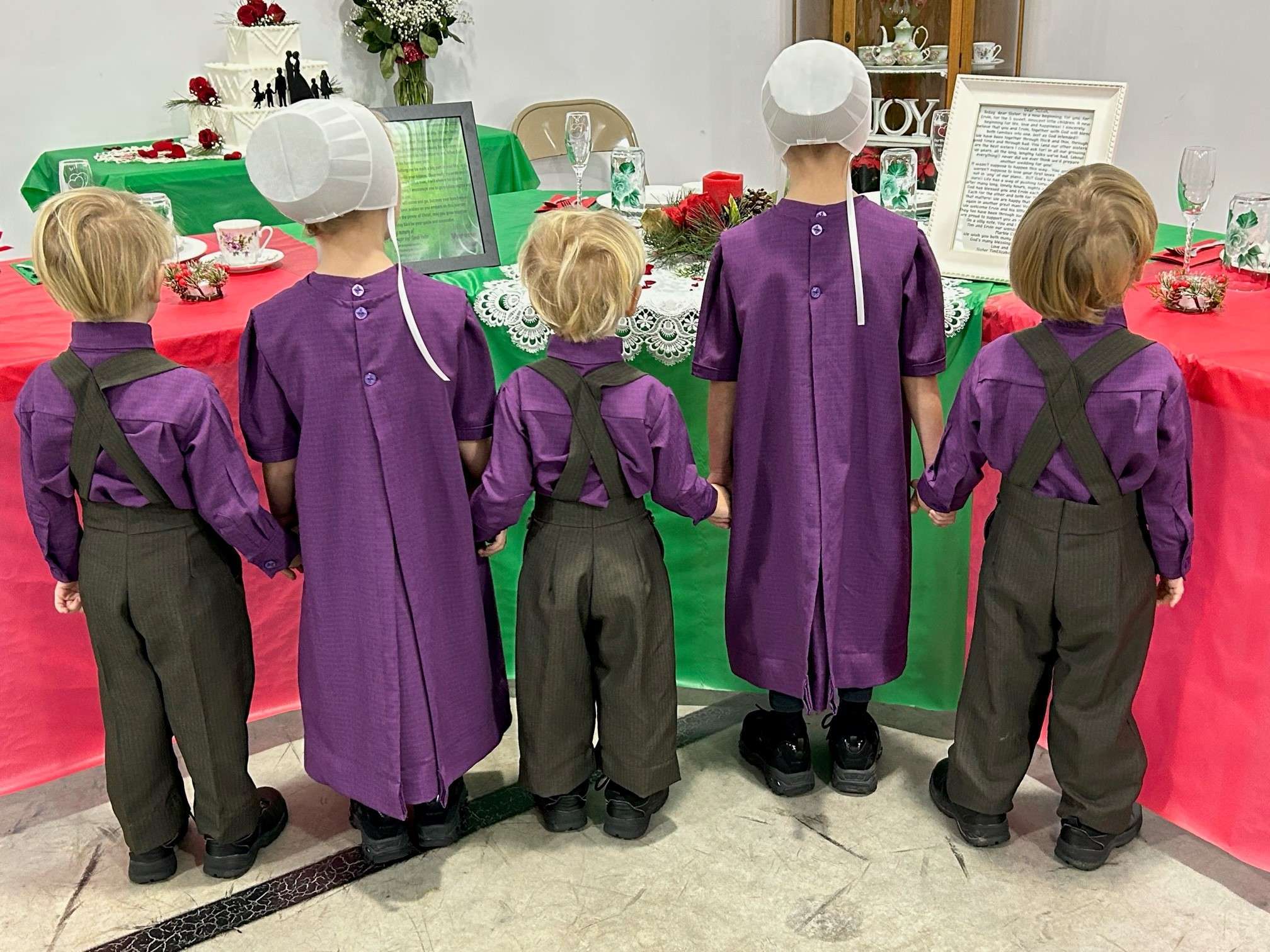
Susan chose jewel tones of burgundy, purple, red, and green for the wedding. The cooks wore hunter green, family wore burgundy, Susan, her and Ervin’s children, and the mothers wore purple, and Ervin wore a black suit and a white shirt. Susan’s cape and apron were white, as were Verena and Sarah’s, who were witnesses. Susan chose sister Verena and brother Kevin as her witnesses, and Ervin chose his brother Nelson and his wife Sarah as his.  

The décor was red and white with Christmas-themed touches of evergreen, pine, poinsettias, and candles. The “Eck,” or corner table, where they sat was set beautifully with china, special glasses, and candles. Lovina will write more about the wedding in upcoming columns.

My impression of the week and the wedding was that Susan and Ervin are loved and supported by their families and community, and that was shown by the gifts of time and words of encouragement they received. It was clear that Ervin and Susan love each other and love their children, both their own and each other’s. May God continue to bless them richly as they begin their new life together and may their home be filled with love and laughter.
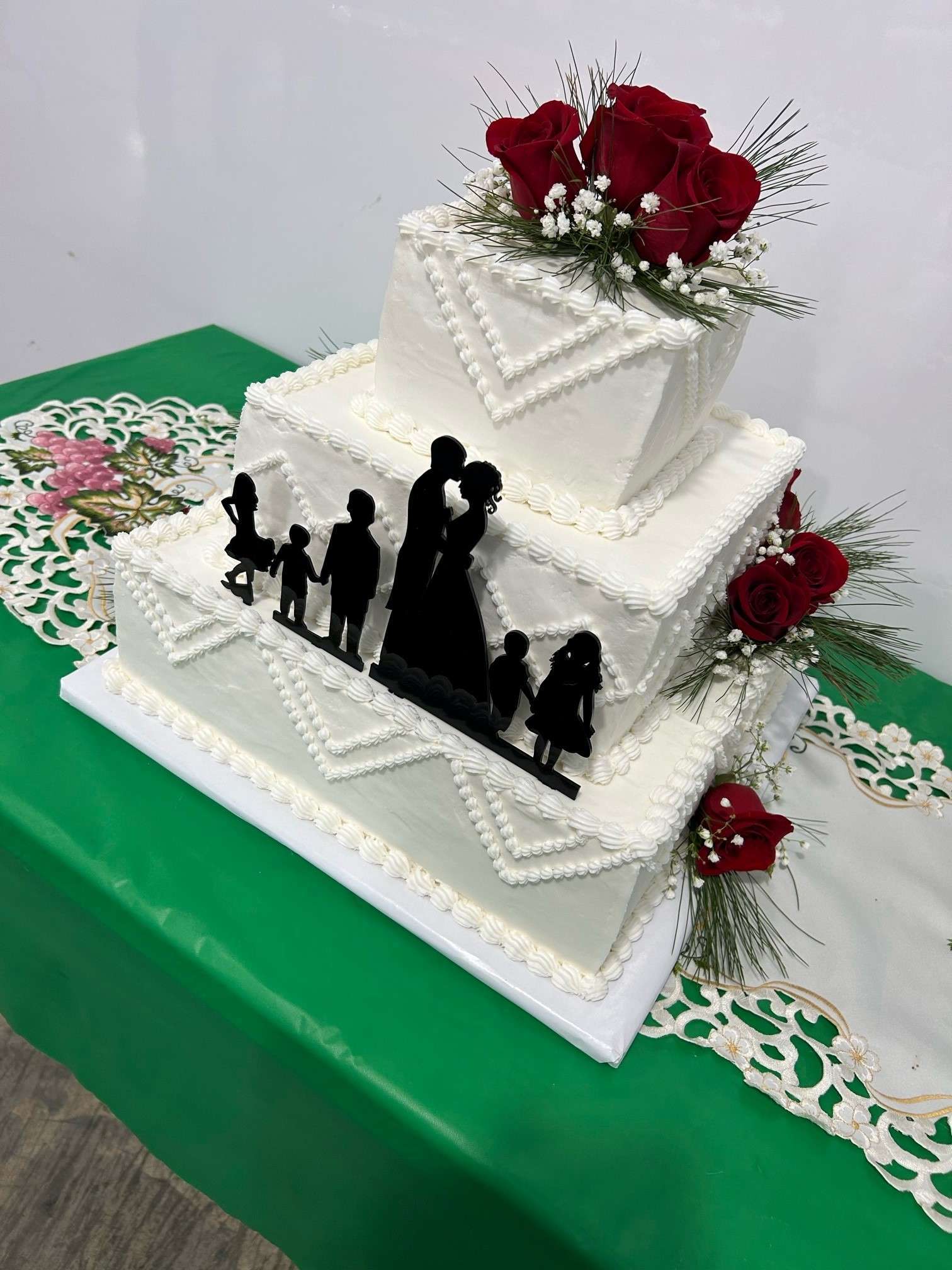
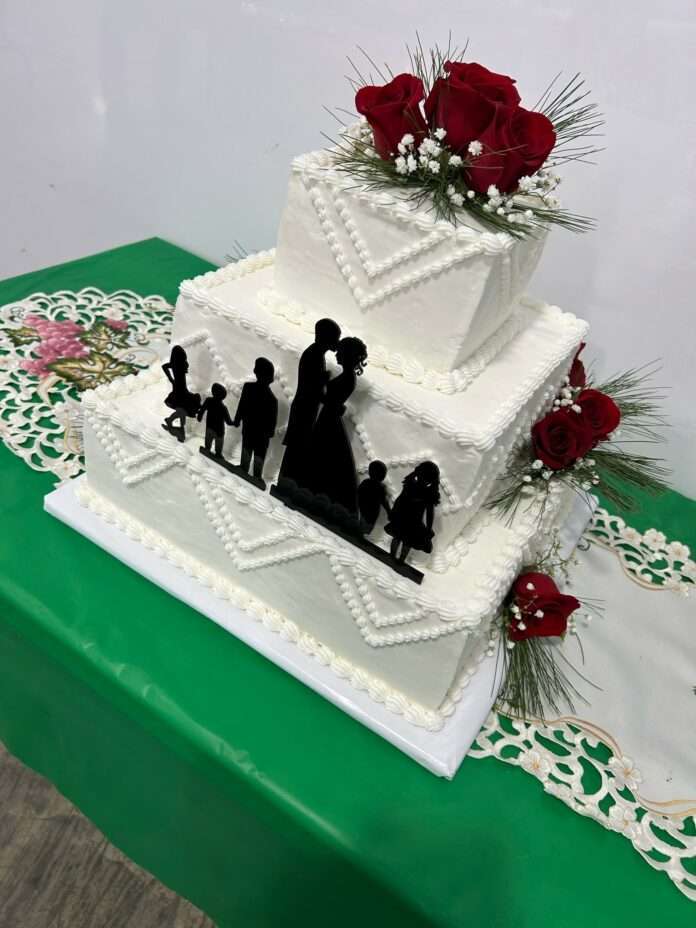
A beautiful wedding cake to celebrate the marriage of Susan and Ervin.
Lovina Shares More from Susan and Ervin’s Wedding

0
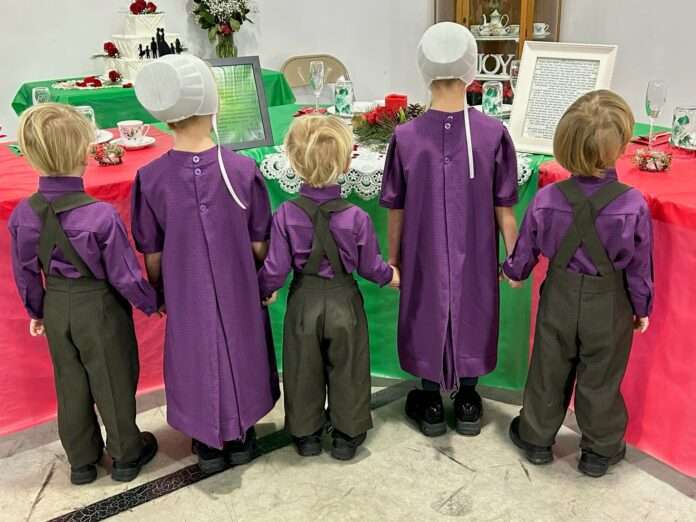
Susan and Ervin’s children take a look at the eck (corner wedding table) at last month’s wedding.

Lovina’s Amish Kitchen
Lovina Eitcher,
Old Order Amish
Cook, Wife &
Mother of Eight

A brand new year lies before us—2023. What does it hold in store for us? Do we thank God enough for all the many blessings he sends to us?
This is now 11 days since the wedding of daughter Susan and Ervin. The five children are enjoying living together in one house. It’s like having their friends come to stay all the time. Susan and children Jennifer and Ryan moved in with Ervin and children Kaitlyn, Isaiah, and Curtis. It’s not “his” children or “her” children now…it’s their children. They are a well-blended family already. May God give them many happy years together.
On Saturday we moved some more of Susan’s belonging to their house and moved all of daughter Verena’s belongings to Susan’s house. It tugged at my mother heart, and a few tears were shed, to have another child fully moved out of our house. Life goes on, and we must accept the changes. Verena is brave to attempt living on her own, especially with the extra challenges she has with her muscular dystrophy. We wish her many happy days as she adjusts to yet another different living arrangement. She has a lot of good neighbors, and Ervin and Susan are only a few minutes’ walk away. Ervin has horses in the barn there, so he goes over to do the daily chores.
Ervin and Susan had a very nice wedding. We appreciate all the support they received and everyone that helped in any way. A big thank you to my friend Ruth, who ran after all the last-minute errands and furnished transportation, took photos, etc. She and her friend Dawn made all the centerpieces for the tables. We were glad for their help!
The menu was grilled chicken (350 pounds of boneless thighs), mashed potatoes (16 eight-quart kettles), buttered noodles (20 pounds of noodles), dressing (three batches of the recipe included in column today), corn (60 quarts but had a lot left), taco salad (30 heads of lettuce and 30 pounds of hamburger—we had way too much), mocha pudding, peanut butter pies (25) and pumpkin pies (25-plus), and wedding cake.
Sister Emma and her daughter Elizabeth did a great job being head cooks and lining up jobs for the women that came the days before the wedding.
On Tuesday, Ervin and Susan’s family gathered at the community building to set up tables and benches, unload all the groceries, etc. Everyone brought a dish to eat lunch there. The cook wagon and cooler were set up Monday afternoon.
On Wednesday, over 20 women came to help chop vegetables for the dressings, make mocha pudding, and all the little jobs needed to be done.
On Thursday, another 20-plus women came to help, baking the crusts for the peanut butter pies and baking over 25 pumpkin pies, plus a lot of other jobs that needed to be done. Both days everything was done early.
On Friday, over 40 cooks were there to make the meal. Wedding services were in the other section of the building. Sarah’s father Omer had the opening of the wedding, then Mose’s father William read a chapter from the bible. Our bishop Marlin married the couple. They were married around 11:30 a.m.
After the wedding meal and visiting with the guests, it was time for cleanup. By 5:30 p.m. everything was back in place. Ervin and Susan had rented an enclosed trailer to take everything back and forth. We went to their house and helped unload the trailer and get the food put on the tables in the cold pole barn so they could put it in the freezer the next day.
Ervin and Susan spent a few nights in White Cloud, Michigan, at The Shack. It was a short honeymoon, but they didn’t want to be away from their children longer. Daughter Verena and Sarah’s sister Regina stayed at Ervin and Susan’s house with the five children. They had a nice time together but I’m sure five children six and under kept them busy.
Ervin and Susan want to thank all the readers that sent cards and gifts. May God bless you for your kindness.
I have quite a few readers that have received mail back because they sent it to the old address. Please send all mail to P.O. Box 234, Sturgis, MI 49091.


Susan and Ervin’s children take a look at the eck (corner wedding table) at last month’s wedding.

Five-And-Dime Dogs

0

I was fortunate to grow up knowing two of my four great-grandmothers. Nora and Grace were as different as a bed and a bedpan.

Nora was what we used to call a “big woman”. She wasn’t fat but was what my mom called “big boned”. She stood nearly six feet tall, was extremely strong and lived to be over 90. She never spent a day in the hospital and had all her faculties at the end. Although not highly educated, Nora knew about things that mattered, like how to grow a garden, tie a bowline and how to thump a watermelon. She taught me how to prune roses, what to feed orchids (bloodmeal) and how to sharpen shears.

Grandma Nora’s clan were oilfield folk: roustabouts, roughnecks, drillers and pumpers and she’d led what I’d call a hard life. She kept her cussing to a minimum and worked hard right up until the day she died because she had to because her husband died early from TB. For years she ran her walnut ranch (always a “ranch”, never a “farm”), taking no charity from anyone and she lived a frugal life. Her home and her yard were spotless, she was an early riser and after she shook your hand with her big, calloused paw it took awhile before you regained feeling in your extremity. She knew how to hobble a horse, drive a team and she considered asking for help a sign of weakness.

Grandma Grace was the exact opposite, being very delicate and frail, she spoke softly and from what I could tell, had never done any hard labor. She was what you’d call “a refined woman” and a bit snooty. She had both a housekeeper and a groundskeeper (that would be me). She didn’t live nearly as long as Nora and lived in a rest home before being committed to a mental institution to live out her days.

Grace’s father was a preacher and despite his meager salary Grace always thought of herself as “upper crust”. She never sewed or canned, and she wore gloves all the time. Grace did marry well. Her husband was both the mayor and fire chief of our volunteer department and was a town leader. Grace played the role of his first lady.

Grandma Grace was a terrible cook and apparently didn’t know the difference between canned cat food and canned stew because she was finally sent away when it was discovered she’d been eating the cat food instead of the stew.

On Thanksgiving and Christmas grandpa would make two separate trips to pick up my great-grandmothers to deliver them to our house where they spent the day in recliners not four feet apart. They never said a word to each other the entire time. Knowing it would heighten tensions, I always asked if I could bring either one of them a beer. Grandma Nora would always have one but Grace was horrified that I’d even ask. Alcohol had ever touched her pious lips.

My siblings and cousins thought grandma Nora was mean but I really liked her and always thought I was her favorite, and not just because I took care of her yard. Even before that I enjoyed going to her home because she had the neatest collection of porcelain dogs she bought at the five and dime store. She insisted I never touch them but I think she liked it when I would point to one and she would then tell me what breed it was and all its interesting traits. As I recall she didn’t care much for poodles and the collie was her favorite.

One day when I was about six, my mom and Nora were engrossed in a canning project and for some reason I just had to pick up the Boxer and sure enough I dropped it and snapped a hind leg right off the delicate dog. I was terrified so I snuck around, found some cheap white glue and performed a hasty operation to reattach the appendage.

I thought I’d gotten away with it until one day she caught me eyeing her dogs and asked, “Which is your favorite?”

“The Boxer,” I rapidly replied, “because my cousins have a real one.”

“An interesting choice,” grandma Nora replied, staring me down. “They are amazingly fast healers but they don’t stay where you put them.”

Broadband map holds the key to how much federal funding states will get to expand internet service

0

Katie Peikes
Harvest Public Media

States, local governments and internet providers have until Friday, Jan. 13 to challenge the Federal Communications Commission’s National Broadband Map. The map shows where service is and isn’t across the country.
Where you live can have a big impact on your internet connection.
More than 20% of  Americans in rural areas lack broadband with sufficient speeds, according to a 2020 report from the Federal Communications Commission. That’s compared to just 1.5% of Americans in urban areas.
But there’s an effort to get more broadband resources, including faster internet, to the areas that need it most.
The Bipartisan Infrastructure Law is funding a federal grant program that will distribute $42.5 billion across the country to get all Americans online and tighten the broadband gaps. Each state and territory will get $100 million through the Broadband Equity, Access and Deployment Program, with the remaining funds handed out based on the number of unserved locations in a state.
To help divide up those funds, the FCC created a national broadband map showing where service is and isn’t around the country. The final version will help determine how much funding states will receive for broadband access.
“By painting a more accurate picture of where broadband is and is not, local, state, and federal partners can better work together to ensure no one is left on the wrong side of the digital divide,” said FCC Chairwoman Jessica Rosenworcel in a statement.
Challenging the map
Since mid-November, state and local governments and individual residents have had the opportunity to file a challenge against the map if they feel any information about location or broadband availability is inaccurate. Those challenges are due by Jan. 13.
The Kansas Office of Broadband Development posted a notice online encouraging Kansans to challenge the map. The state’s broadband office says the map shows the state at about 5% unserved, while it’s more likely about 15% unserved.
The office’s director, Jade Piros de Carvalho, said if that’s not fixed, the state can’t do what it needs to.
“It’s not about getting the most amount of money,” she said. “It’s about making sure that the allocation aligns with the need for our state. So if we get much less funding, we’re not going to be able to connect everyone.”
She adds that Kansas is struggling with broadband access in the more sparsely populated areas of the state, and people and communities without adequate broadband access are “left behind,” without the ability to apply for a job, access health care, do homework for school or stream a TV show on Netflix.
“We’re really creating a lack of opportunity for these rural areas if they don’t have the same level of broadband access that is available in more populated areas,” she said.
The Kansas Office of Broadband Development is partnering with the University of Kansas on filing a bulk challenge against the map.
The need
In Missouri, the state’s Office of Broadband Development estimates about 400,000 homes and businesses either have limited access to high speed internet or no access at all.
Director BJ Tanksley said it’s about a “$2 billion problem” if a provider were to try to build a system to connect all of those locations to the internet.
But his office didn’t find major inaccuracies with the FCC’s map. Tanksley said the funding Missouri gets will be used to expand broadband service across the state.
“Priority number one is bringing service to unserved locations,” he said. “Priority two is bringing it to underserved locations. And then it goes beyond that also, you know, addressing digital equity concerns and things like that.”
The COVID pandemic highlighted a need for better broadband, as children relied on internet access for virtual schooling and homework, and people sought access to telehealth.
Tanksley said some people were able to continue their everyday activities on the internet from the comfort of their own home, while others who had slower or no broadband access had to drive to the nearest town or a McDonald’s parking lot to access the internet.
“We want people to be able to live wherever they choose to live and not have to make that decision based solely off of what service may be available,” he said.
Better maps
Broadband providers, experts and offices have praised the FCC’s latest map for using address-level reporting for the data, versus census-block level reporting that it had used in the past.
Whitney Zahnd, a University of Iowa health management and policy professor and the deputy director for the Rural Policy Research Institute Center for Rural Health Policy Analysis, said the FCC had previously faced criticism for census-level reporting “overestimating” broadband access across the country.
“In the past, those maps have indicated if you have one connection in a census block, which is this very small geographic area at the sub-county level, then that whole census block is seen to have broadband access,” she said.
Broadband providers were tasked with providing data for the maps.
Stratford Communications, a small service provider that provides fiber-based internet and fiber-based telephone to about 2,000 customers in central Iowa, was asked last summer to provide address-level data to the FCC.
General Manager Steven Frey called the map “more navigable than anything [the FCC] had prior.” He said he found very few discrepancies with his company’s coverage area on the map. Overall, he said, the map is much improved from the past, and it helps provide a picture of the state of broadband to providers and customers.
Though the current map is an improvement on past ones, Zahnd said it doesn’t show how much broadband costs at each location.
“I think a couple key things we think about access to anything, whether it’s broadband or health care, it’s not solely is it available, but is it affordable? And is it high quality?” she said.
Zahnd said it’s important to challenge any of the map’s inaccuracies so residents can get reliable and affordable broadband access. The funding amounts could be announced this summer.
This story was produced in partnership with Harvest Public Media, a collaboration of public media newsrooms in the Midwest. It reports on food systems, agriculture and rural issues.