
Wednesday, March 18, 2026
Home Blog Page 845

Wheat Scoop: Wheat Industry Celebrates 10th Anniversary of the Kansas Wheat Innovation Center

0
Kansas Wheat

Contact: Marsha Boswell, [email protected]

For audio version, visit kswheat.com.

Traditionally, the 10th anniversary is celebrated with a gift symbolizing the strength and resilience of a relationship. Those traits describe well the ties between Kansas wheat farmers and the public and private research partners that come together at the Kansas Wheat Innovation Center in Manhattan for the betterment of the wheat industry.

The halls of the Center were filled with cheer in mid-December as these partners celebrated the 10th anniversary of the state’s single-largest, farmer investment in wheat research. The open house and holiday party also recognized the successful conclusion of the Fields Forward campaign supporting the Kansas Wheat Commission Research Foundation and unveiled a brand-new virtual tour of the facility.

“I don’t think we could have imagined the relationships and the projects that would have resulted from the Kansas Wheat Innovation Center 10 years ago when the building just opened,” said Aaron Harries, Kansas Wheat vice president of research and operations. “It’s exciting to know that it’s exceeded expectations, and we anticipate even bigger things in the next couple of decades.”

The Kansas Wheat Innovation Center was built by the Kansas Wheat Commission, through the Kansas wheat checkoff, to get improved wheat varieties into the hands of farmers faster at a time when private research in wheat was limited. The Center was built on land owned by Kansas State University; the Kansas Wheat Commission has a 50-year lease on the property.

Construction on the $15 million Kansas Wheat Innovation Center began in October 2011, and the facility was completed in November 2012. An additional four greenhouse bays were completed in spring 2018. Today, the facility boasts more than 10,000 square feet of office space, 15,000 square feet of laboratory space and 23,000 square feet of greenhouse space.

“The Kansas Wheat Innovation Center is a great story,” Harries said. “It’s really from the ground up about how farmers were telling the board of directors they wanted more investment in wheat research because they see the tangible results of that from the new varieties that are released.”

“The leadership of Kansas Wheat at that time really went out on a limb and decided to invest a large amount of producer dollars in the Kansas Wheat Innovation Center. Research was the main motivator, having a public face for the wheat organizations and the research that was being done. And it has just led to bigger and better projects.”

The Kansas Wheat Innovation Center is home to public and private wheat breeding programs conducting cutting-edge research on advanced wheat breeding, end-use quality and ancient wheat relatives, in addition to consumer outreach. While each project has its individual aims, they have a unified goal — using advanced techniques in wheat research to improve yield and quality of new wheat varieties while shortening the time needed to develop those varieties.

“In 20 years, or even in 10 years, from this anniversary, we’ll be talking about how we’re developing novel traits here in the Kansas Wheat Innovation Center, about wheat varieties that result from work in the center that are specialized with nutritional value or other features,” Harries said.

There is no doubt the future of Kansas wheat has excellent support, especially as the 10th anniversary also celebrated the successful conclusion of Fields Forward, the campaign for a sustainable wheat future by the Kansas Wheat Commission Research Foundation.

The KWCRW was established in 2011 as the official fundraising organization for the Kansas Wheat Commission. The Foundation works to raise private dollars to combine with public funds for the advancement of wheat research, including the accelerated release of wheat varieties. The Fields Forward Campaign was launched in January 2019 and accepted many types of gifts to support wheat research, including cash, stock transfers, donations of grain and deferred gifts such as will bequests.

While the doors to the Kansas Wheat Innovation Center are open during regular business hours, anyone can take a virtual tour of the facility and its research projects anywhere at any time, thanks to a new virtual tour unveiled during the open house. Check out what the partners at the Center have accomplished over the last 10 years and what they have planned for the decade ahead at https://innovation.kswheat.com or watch a video overview at https://www.youtube.com/kansaswheat.

###
Written by Julia Debes for Kansas Wheat
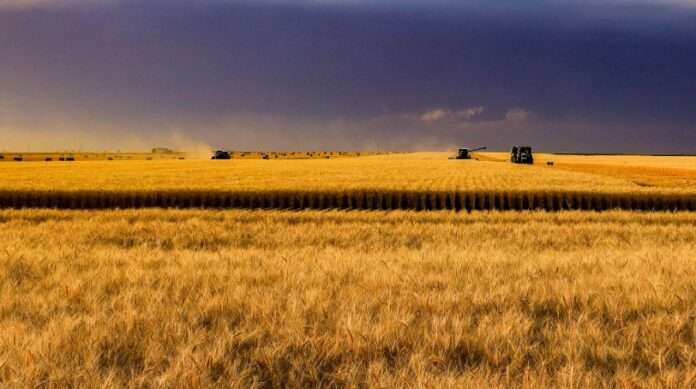
 

Farmland Values Go Higher Despite Interest Rate Increases

0

“Strong commodity prices are creating opportunities for farmers to profit despite the risks posed by drought and higher production costs.”
That’s according to the Ag Finance Update last week from the Kansas City Federal Reserve Bank.
The report indicated farmland prices increased 20-percent in the Farm Belt during the summer despite higher interest rates.
“Demand for farmland has remained strong alongside strength in the farm economy. But the acceleration in values over the past year has shown signs of easing in recent quarters,” said the monthly Update.
However, the 20-percent increase for non-irrigated cropland during the third quarter was the smallest since early 2021.
“Despite the more measured pace, farm finances remained solid following especially strong incomes during the past two years,” the report said. It is based on data from regional Federal Reserve banks in Chicago, Dallas, Kansas City, Minneapolis, and St. Louis.
“Volatility in crop markets, higher expenses, and drought are key risks but profit opportunities remained favorable alongside strong commodity prices.”
The United States Department of Agriculture (USDA) estimates net farm income will be the highest ever this year. This is due to strong global demand and high commodity prices, while warfare in Ukraine pushed prices higher.
Corn and soybean will be higher this year, tempered by slightly lower yields per acre, said David Oppendahl, policy adviser.
Midwest agriculture “has been pretty resilient,” said Oppendahl. Production is strong while input costs are up dramatically.
“So that’s creating a bit of pressure on the margins for agricultural producers. Still, momentum of increases in farmland values has been maintained even with rate increases in the past year.”
Ag bankers raised interest rates 85 basis points on operating loans and 110 basis points on real estate from the previous quarter. With the rapid increase, financing rates were above the 2015-19 average in all regions.
Increases in farmland values were the largest in states with the highest quality farmland, Ag Finance Update indicated.
High commodity prices and low interest rates helped drive farmland values in Iowa to an average of $11,411 an acre. That’s, up 17-percent from 2021, when they rose 29-percent, according to Iowa State University’s annual Land Value Survey.
“Farmers have a lot more cash on hand and supply chain issues led to a shortage of equipment. So, the money that farmers normally spend on equipment is devoted to land,” said Iowa State University professor Wendong Zhang.
Seventy percent of the professionals surveyed said land values were “too high” or “way too high,” Zhang commented.
Still, 48-percent of participants said they expected prices to be higher a year from now. About 28-percent expected lower values and 24-percent expected prices to hold steady.
The 2022 Iowa farmland value of $11,411 an acre is highest in the history of the survey, started in 1941. When adjusted for inflation, this year’s value still exceeds the 2013 value of $8,716 an acre.
Farmland values in western Missouri soared 34-percent compared to the third quarter of 2021. In northern Indiana, farmland values surged 29-percent.
According to the latest USDA report, August 6, 2022, Kansas farm real estate value for 2022 averaged $2,630 per acre. That’s up $530 per acre, 25 percent, from last year.
Kansas cropland value, according to the August 6, 2022, USDA report, increased 24 percent from 2021 to $2,950 per acre.
Dryland cropland value averaged $2,850 per acre, $600 higher than last year. Irrigated cropland value averaged $4,000 per acre, $300 above a year ago.
Pastureland, at $1,850 per acre, was $350 higher than the previous year.
Important interesting sidenote, Kansas rents paid to landlords in 2022 for cropland increased from last year.
On August 6, 2022, irrigated cropland rent averaged $143.00 per acre, $4 above last year. Dryland cropland rent averaged $61.50 per acre, $3.50 higher than a year earlier.
Pasture rented for cash averaged $21per acre, one dollar above the previous year.
+++30+++

CHRISTMAS TIME

0
Roger Ringer
Roger Ringer

“AND KNOW THAT I AM WITH YOU ALWAYS; YES TO THE END OF TIME.”

Jesus Christ

Amid all the hustle and bustle of Christmas the world looks away at the reason that we celebrate. Politicians can scheme, elitists make plans for your future, manipulation of money occupies the few who control it and those who take it away. Churches are planning special services, news people find it loath to feature good stories that detract them from spreading fear. Kids from one to 21 are dreaming about how much is given to them as the retailers fill the shelves with things that are not needed. Mom’s, grandma’s, and aunts are busy making a feast to put before people that they only see three times a year. People confined to nursing homes and hospitals hope that someone comes to visit. Schools and factories are looking forward to some time off.

Do you ever stop and just listen to the birds singing? While I was penning this I heard a big flock of geese fly over, a sound that I have not heard much this year. Do you think of the voice of God and you listen in a storm or strong wind and yet you hear it when there is just a whisper in a quiet breeze? I am thinking of what the man who discovered and brought the sound of the common people to the radio and records said; “we have two ears and one mouth, we should use each proportionally.”

I have many friends that have written and recorded wonderful songs for the Christmas season and it is nice to have it on in the background. Buy you need to take the time to stop and listen without something making sound. It is inquiet that we hear God speaking to us. Remember what was said? They look and they do not see, hear but they do not listen.

Why don’t you take some time and open the family bible and read, then close your eyes. Take time out of the day to read it to others. Sit and contemplate all the good things you have in your life then share the blessings. There is much to learn by sitting quiet and meditate on what has happened, what is happening, and what is ahead. Does it take special effort to hear your name and say ‘speak Lord, your servant is listening’?

May you and yours have a blessed Christmas.

KU News: Internet of Things financial sustainability depends on quality and security

0

From the Office of Public Affairs | http://www.news.ku.edu

Headlines

Internet of Things financial sustainability depends on quality and security
LAWRENCE — A new scholarly article finds that despite the proliferation of platforms such as Amazon Alexa and Google Home, customers do not perceive them as valuable unless experiencing adequate levels of quality and security. This research studies the financial viability of the platform provider (like Amazon’s Alexa) and app developers, finding collaboration between these two sides plays a significant role in the profitability of all parties.

KU professor awarded gold medal of the Mexican Physics Society
LAWRENCE — Christophe Royon, Foundation Distinguished Professor in the Department of Physics & Astronomy at the University of Kansas, was awarded the gold medal of the Mexican Physical Society, Division of Particle and Fields, earlier this fall. Royon was selected for his leadership in the discovery of odd-gluon state odderon from elastic proton-proton and proton-antiproton collisions at TOTEM and D0 detectors, among other accomplishments.

Full stories below.

————————————————————————

Contact: Jon Niccum, 785-864-7633, [email protected]
Internet of Things financial sustainability depends on quality and security
LAWRENCE — Modern technology terms such as “data mining,” “cryptocurrency” and “influencer” went from obscurity to pervasiveness in a matter of months. It’s time to add the Internet of Things (IoT) to that list.

The term describes physical objects that connect and exchange data with other devices/systems over communication networks.

“Internet of Things is everywhere,” said Anurag Garg, an assistant professor of analytics at the University of Kansas.

“Even before this term came into existence, lots of things were getting connected to the internet, and the idea behind IoT was to connect dumb things — those which are not supposed to be connected to the internet — like a coffeemaker, for example. It can be connected so that you can set the timer, make coffee while you’re sleeping and wake up to that smell. So the main idea behind IoT is to give consumers more services.”

But his new article titled “Financial sustainability of IoT platforms: The role of quality and security” finds that despite the proliferation of platforms such as Amazon Alexa and Google Home, customers do not perceive them as valuable unless experiencing adequate levels of quality and security. This research studies the financial viability of the platform provider (like Amazon’s Alexa) and app developers, finding collaboration between these two sides plays a significant role in the profitability of all parties. It appears in the journal Production and Operations Management.

Garg, who co-wrote the paper with Emre Demirezen, Kutsal Dogan and Hsing Kenneth Cheng of the University of Florida, notes IoT spending is expected to reach $1.1 trillion globally by 2023. More than 10 billion connected IoT devices are currently used worldwide, with this number estimated to exceed 25 billion by 2030.

Yet quality and security continue to be the key drivers for customer acceptance.

“Quality is a consumer-facing aspect,” he said. “Is a coffee maker making the coffee right on time?

“Is it making good-tasting coffee?”

While quality is viewed as important, security is another essential aspect of the consumer experience when using these IoT devices.

He said, “If you look at the security standards of an iPhone, these are well set – you cannot hack into one easily. But all these IoT devices are being hacked regularly using different methods. Recently, researchers found a way to hack Alexa or other digital home assistant devices by pointing a laser light at the device. The mics in these devices react to the light and produce electrical signals as if they have received real audio commands.”

Garg observes that the largest DDoS (distributed denial of service) attack in U.S. history occurred in 2016 when a large chunk of the internet was brought down on the Eastern Seaboard. This happened because of security vulnerabilities in IoT devices.

“It was propagated through the cameras connected to the internet, but the password and username (of the Domain Name System provider) never changed,” he said. “Malware was propagated through these IoT devices, which opened the door for the DDoS attack.”

In November, it was announced Amazon is losing $10 billion a year on Alexa. A key reason was reported as a trust issue with the AI software. People may rely on the device to hear local weather forecasts or solve film trivia questions, but they aren’t using it to make purchases.

Probably a smart move. Garg argues that consumers do not actually trust the Alexa platform (or AI in general) to order products on their behalf, thus the monetization of Alexa did not happen as Amazon planned.

Garg, who joined KU this fall, first became interested in researching IoT when he took a course on it in 2014 while pursuing his master’s in computer engineering at North Carolina State.

“I still remember in my statement of purpose when applying for my PhD (at the University of Florida) that I wanted to do research on Internet of Things and its impact on society,” he recalled.

His academic expertise also includes the effects of digitization of information and products due to information technologies such as online-media platforms, financial technology (FinTech) and education technology (EdTech).

Twenty years from now, how pervasive will IoT platforms be in our everyday lives?

“Rather than going 20 years in the future, I can say that right now almost everyone has some kind of smart speaker or smart digital home assistant like Alexa, Siri or Google,” Garg said. “So IoT is already incredibly pervasive.”

-30-

————————————————————————
The official university Twitter account has changed to @UnivOfKansas.
Refollow @KUNews for KU News Service stories, discoveries and experts.


————————————————————————

Contact: Heather Anderson, 785-864-3667, [email protected]
KU professor awarded gold medal of the Mexican Physics Society
LAWRENCE — Christophe Royon, Foundation Distinguished Professor in the Department of Physics & Astronomy at the University of Kansas, was awarded the gold medal of the Mexican Physical Society, Division of Particle and Fields, earlier this fall.

“This is a great recognition for the work related to the odderon discovery and also to the search for beyond standard model physics using intact protons at the LHC. People had been looking for the odderon for the last 50 years, and now it became a reality,” Royon said.

Royon was selected for his leadership in the discovery of odd-gluon state odderon from elastic proton-proton and proton-antiproton collisions at TOTEM and D0 detectors, his contributions to QCD and physics beyond the Standard Model, and for his support to the Mexican High Energy Physics Network community. Royon worked in collaboration with researchers in Mexico on common projects on analysis in the CMS and TOTEM collaborations at CERN, Switzerland, and in the D0 collaboration at Fermilab, Batavia, Illinois, and U.S. phenomenology and hardware, making this an international undertaking.

“The odderon discovery was made possible because of the work of an international team where I was coordinating the activities in the D0 and TOTEM collaborations. In that sense, this award is a great recognition of the work of a team,” Royon said.

The original announcement from the Mexican Physical Society can be found on its website, and the award ceremony took place Nov. 23 in Puebla, Mexico.

Royon was previously director of research at CEA Saclay, France. He is a specialist of nuclear and high energy physics and worked on the proton and heavy ion structure, as well as potential signal of beyond standard model physics at the HERA, DESY, Hamburg, Germany, the Tevatron, Fermilab, and the LHC, CERN, Geneva, Switzerland, colliders. Royon was awarded the Humboldt Research Award in Germany in 2018 and the High Energy Physics Prize by the European Physics Society in 2013 and 2019 for the Higgs boson discovery and the discovery and analysis of the top quark, respectively. He is an honorary professor at the University of Gyongyos, Hungary, and the leading international editor of Acta Physics Polonica.

-30-

————————————————————————

KU News Service
1450 Jayhawk Blvd.
Lawrence KS 66045
Phone: 785-864-3256
Fax: 785-864-3339
[email protected]
http://www.news.ku.edu

Erinn Barcomb-Peterson, director of news and media relations, [email protected]

Today’s News is a free service from the Office of Public Affairs

Why not a houseplant?

0

As Christmas time is coming around you might be trying to decide what to get a special someone. Why not a houseplant? House plants have a way of brightening up the indoor environment on those long winter days. What do houseplants in Kansas need to survive in the winter time? We know if we have them outside in the winter they will freeze and die. So how do we care for and keep them alive?

Very few plants tolerate dark corners. Most houseplants require the light that would be found within four to eight feet of a bright south window. Some will tolerate a spot very near the window, while others will prefer less light some distance away. Too little light can result in tall, lanky, small-leafed plants. Too much light can cause leaf burn on sensitive species like African Violet. Drapes should be left open during the day where houseplants are being grown; however, be careful not to allow the plants’ leaves to touch the glass of the window.

If the room is not naturally lit, artificial lights should be used. A 100-watt table lamp can be used about three feet above plants. Specially built fluorescent plant lights are available. Either fluorescent or incandescent plant lights are satisfactory for growing plants.

Avoid placing plants in hot spots or cold drafts. Almost none will survive the hot, dry air from a furnace vent, nor like being placed near a door where cold drafts enter.

Most houseplants prosper in a temperature of 65°F to 75°F, but the humidity of the average home is too low to suit them. A plant prospers in relative humidity of about 50 to 60 percent, which is more than most people like.

This can be helped by using a humidifier or by setting the pot on a tray of moist gravel or pebbles. Do not allow the water to touch the bottom of the pot, as the water would then be wicked into the potting medium and keep the plant too wet. A transparent polyethylene bag can be draped over the top of plants that are extremely humidity sensitive or are in poor condition.

More houseplants succumb from improper watering than from any other single cause.
In general, most houseplants need to be thoroughly watered and then allowed to nearly dry before the next irrigation. Use tepid water when watering houseplants. Enough water needs to be poured over the potting medium to allow water to drain freely through the drain hole at every watering. If water does not drain out the bottom, rewater until it drains freely. Never leave a houseplant standing in water, as this will cause the roots to rot.

Generally, plants are watered when the potting medium becomes dry to the touch. However, some plants such as African violet and Rex begonia, need to be watered before the potting medium becomes completely dry to the touch. Cacti and other succulents need to be allowed to remain dry a few days before watering, even though the top of the potting medium may be dry to the touch.

Watering frequency depends on the potting medium used, season, amount of light, temperature, humidity, plant species, and pot size. Small pots are more difficult to manage in the home than larger pots, since they dry more rapidly, and water does not move as uniformly through the potting medium. Small pots may require watering every two to three days, while large pots may not need watering more than every seven to fourteen days.