Friday, March 20, 2026
Home Blog Page 879

Epidermal Cowboys

0
lee pitts

The most influential person in my life was my grandpa and I found it very comforting recently when I was told I turned out to be just like him. After my grandmother rodeo was my grandpa’s favorite thing, so much so that he started an RCA (forerunner to the PRCA) rodeo in our town and with the proceeds bought land for a big sports park that now bears his name.

My grandpa’s favorite rodeo cowboy was Gene Rambo and he told me countless times that when Gene came to town for the rodeo he stayed in grandpa’s “bunkhouse”, which was just a big building behind grandpa’s house for cowboys to stay.

The one thing I did in my life that most pleased my grandpa was I became friends with Gene. I wrote a story one time about Gene’s setup where he could gather a single animal from the big country he ran in, take it to the corrals and lock the animal in the squeeze all by himself without getting off his horse through the use cowboy engineering that included several ropes and pulleys. I wrote that Gene’s commercial cattle were so good other cattlemen bought his crossbred calves to use as herd bulls.

My grandpa let me know he thought that story was my greatest literary accomplishment.

Another thing my grandpa always told me about Gene was that he always wore a cowboy tuxedo: clean Levis and a white shirt. And he competed across the board, entering every event and I still have the entry sheets to prove it.

Gene competed at a time when other contestants looked like they shopped at Goodwill, picked out the cleanest shirt in the dirty clothes hamper and threw their clothes on with a pitchfork. So my grandpa didn’t know how to take my next rodeo hero, Larry Mahan.

For you youngsters, Larry Mahan was one of the greatest rodeo cowboys to ever straddle a horse. He won six All Around Cowboy awards and two bull riding championships riding in all three rough stock events. “Larry literally could ride anything that wore hair.” But old-timers like grandpa didn’t know how to take Larry because they had preconceived notions of how a cowboy should look and Larry didn’t look like that. He wore his hair a little longer, looked like he just stepped off a Hollywood film set and wore his pants so tight you could count the change in his pockets. In other words, he was no Gene Rambo. And guys like Gene never spent their days off in western wear stores. I don’t know if Gene Rambo was ever in a “changing room” in his life. Let’s just say that he was a man of few fashion surprises.

But then Gene Rambo never appeared in movies, released a record with Warner Brothers or signed big dollar deals with boot and hat labels that carried his name like Larry did. And there was some resistance amongst old-timers because Larry didn’t exactly come from rodeo country. I mean, for gosh sakes he was born in Salem, Oregon! That’s one of the reasons I liked Larry, he was more living, breathing proof that the far west could produce championship cowboys too. And did Larry have charisma! I got to see this from a front row seat one time when he and Les Vogt invited my wife and I to a horse camp near my house to sit around a campfire singing old cowboy songs along with an original member of the Sons of the Pioneers.

Now I’m old and I can understand how my grandpa felt about guys like Larry Mahan. I was devastated the first time I saw one of my basketball heroes, Michael Jordan, wearing a diamond earring. And I was just getting used to guys wearing women’s jewelry when along came tattoos. Watching a rodeo recently I saw a “tat” wink at me from the neck of a bull rider and I have a feeling there’s a lot more of those than I’d like to think.

But I’ve learned my lesson. People with style like Larry are “trendsetters” and it’s because of them we now have blunt toed cowboy boots, “formal wear” that includes shirts with advertising embroidered all over them, and cowboys with tattoos of ex-girlfriend’s names they’ve tried desperately to have erased.
Winter Forage Conference to be Held December 15 in Great Bend

0

The Kansas Forage and Grassland Council and Kansas State University are teaming up to host their Annual Winter Forage Conference: Drought Survival, Recovery, and Success, on Thursday, December 15th, in Great Bend, Kansas. The meeting will be held at the Burnside Room, 1214 Stone Street, and will run from 9:00 a.m.to 3:00 p.m., with a meal included.

This year’s conference features a great mix of university and industry presentations, with sessions covering range weed control, cattle markets, drones, soil fertility, alfalfa management, and tips for building a resilient business. Featured industry partners include Forage Genetics and Star Seed.

Tentative Agenda

  • Weed Control – Keith Harmony
  • Cattle Market Update – Glynn Tonsor
  • Drones, Not Tomorrow’s Fantasy – Trent Page
  • Soil Fertility – Lucas Haag
  • Alfalfa Management Decisions – Jerry Gano
  • “Plan B” Ranch: Building a Resilient Business – Kevin Wiltse

“Our presenters are some of the leading experts in Kansas, with a wealth of knowledge and experience,” said Dale Helwig Black, KSFGC President. “And we have a great mix of Industry Partners presenting at the conference. Companies with a long history and great forage expertise, like Forage Genetics and Star Seed,” said Mark Nelson, KSFGC Executive Secretary.

The event is free for current KSFGC members and $45 for non-members (which includes your KSFGC membership and lunch). To renew your membership or join KSFGC prior to the meeting, go to https://www.afgc.org/restricted-content/?amo_redirect_to=https://www.afgc.org/member-center/, or you can join at the door.

For more information, to RSVP for the meal count, or inquire about a vendor table, contact the Cottonwood Extension District Barton County Extension Office at 620-793-1910.

 The Kansas Forage and Grassland Council was organized in 1988 and serves to provide education and programs to strengthen the forage industry in Kansas.

International Star recognition for Kansas Wetlands Education Center

0

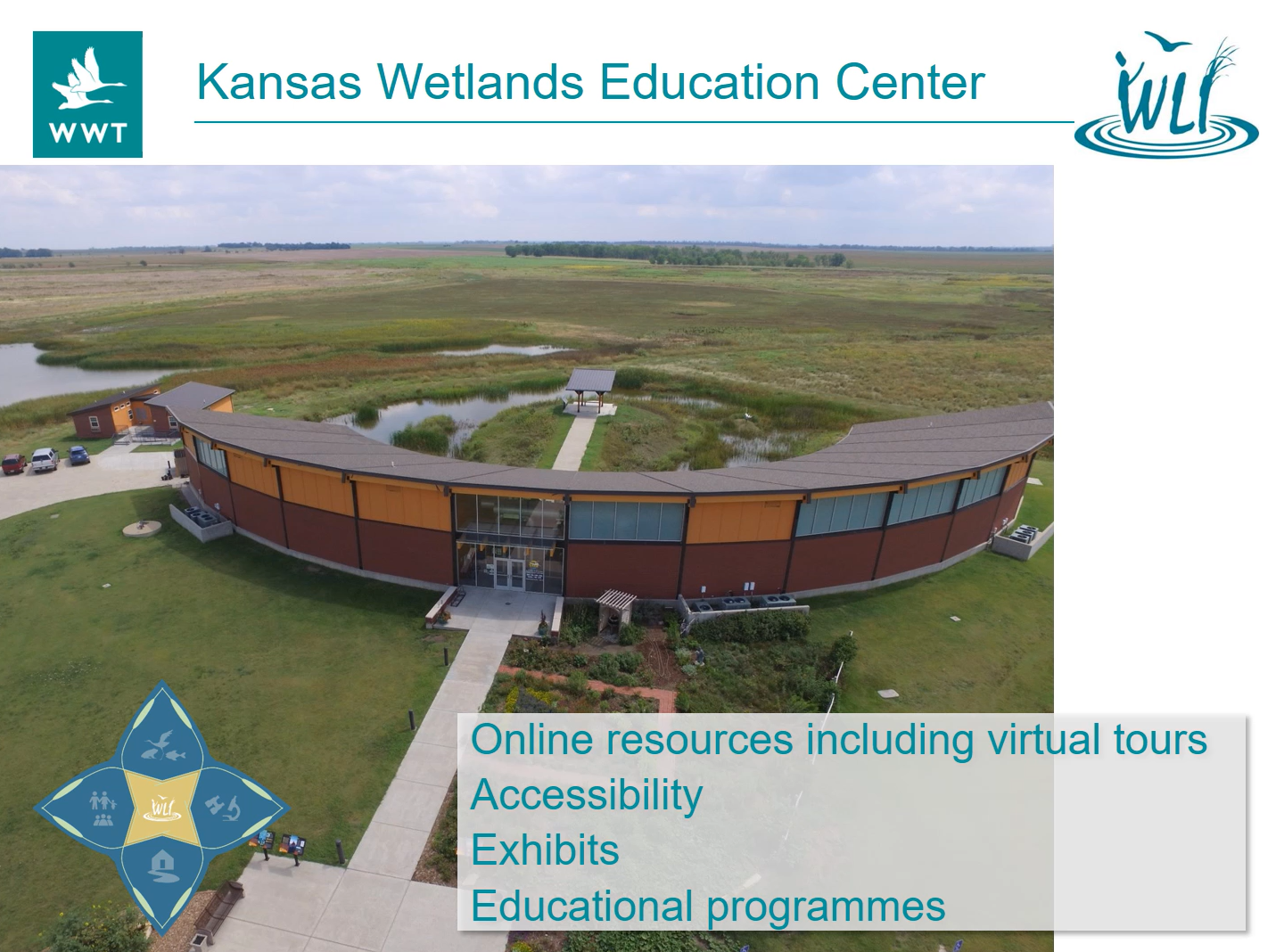
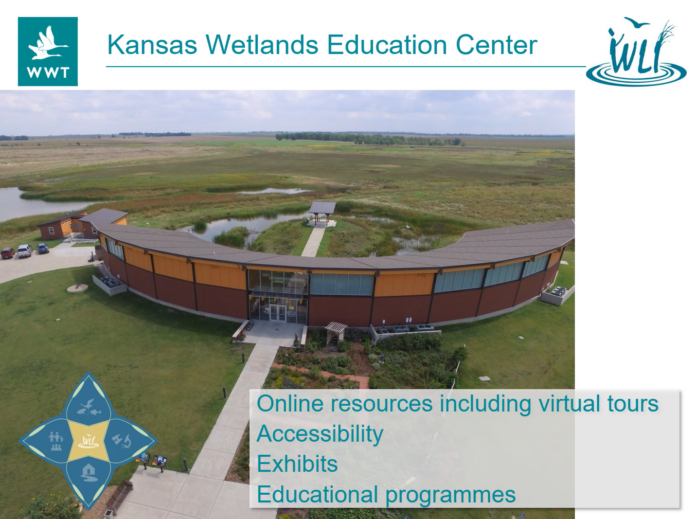
Kansas Wetlands Education Center has been recognized as one of the world’s best wetland visitor centers. Their success was announced at the Conference of the global Wetlands Convention, known as Ramsar COP14, underway in Geneva, Switzerland.
The Star Wetland Centre Award is a new initiative to recognize best practices in eco-tourism and education at wetlands. It is coordinated by Wetland Link International (WLI), a support network for staff and volunteers at 300 wetland visitor centers.
Kansas Wetlands Education Center is one of 23 centers worldwide, and one of only 2 in the United States, that have been selected by an international panel of experienced wetlands professionals.
“It’s an honor for the Kansas Wetlands Education Center to be  included in a list of other awesome wetlands centers internationally,” says Curtis Wolf, Director of the Kansas Wetlands Education Center.
“While our wetland center is only a small dot on the map, we are encouraged to know we are contributing to a larger shared goal of educating people across the world about nature, conservation, and appreciation of our natural resources.”
“The judges were particularly struck by the high-quality programming,” says Chris Rostron, the Head of WLI and leader of the Star awards process.
“Kansas Wetland Education Center accommodates very wide visitation thanks to good disabled access and audio tours, along with a strong online offering including 360-degree virtual tours and the ‘watcha doing rob’ video series.
The Stars have been awarded to 23 wetland visitor centers around the world at a ceremony at the 14th Meeting of the Conference of the Contracting Parties to the Ramsar Convention on Wetlands (Ramsar COP14).
About Kansas Wetlands Education Center
Opening in April 2009, The Kansas Wetlands Education Center (KWEC) is dedicated to educating the public about wetland communities, their importance, and the need for conservation and restoration, with emphasis on Cheyenne Bottoms and Quivira National Wildlife Refuge. They accomplish this through interactive exhibits and interpretation, educational programs, outreach, and fostering partnerships with stakeholders.
Representing the goals of a number of partnering agencies, including Fort Hays State University, the Kansas Department of Wildlife and Parks, and The Nature Conservancy, the KWEC has a multifaceted mission: Provide visitors with an informative and educational experience. Serve as an educational resource for schools, teachers, and other groups interested in conservation and eco-tourism. Inform visitors of the economic impact of Cheyenne Bottoms to the local and state economy.
Cheyenne Bottoms is a Ramsar Convention designated Wetland of International Importance and a globally important stopover for thousands of migratory shorebirds and waterfowl; the site also supports other threatened or endangered birds during nesting, staging, or wintering periods. It is a Western Hemispheric Shorebird Reserve Network site of hemispheric importance to shorebirds. Cheyenne Bottoms is made up of the Kansas Department of Wildlife, Parks Cheyenne Bottoms Wildlife Area (19,857 acres), and The Nature Conservancy’s Cheyenne Bottoms Preserve (7,848 acres).
About Wetland Link International
Wetland Link International (WLI) is a global network of wetland education centers. We define a wetland education center as “any wetland where there is interaction between people and wildlife and CEPA (communications, education and public awareness) activity occurs in support of wetland conservation aims.”
WLI is supported by two staff based at the Wildfowl and Wetlands Trust (WWT) at Slimbridge, UK, and a strong regional presence in Asia led by the Ramsar Regional Centre – East Asia. These staff, plus occasional volunteers, share news, opportunities, and requests on behalf of the network by email, Facebook, and Twitter. The emails include two newsletters per year, prepared as PDFs to facilitate printing. We also produce three members’ webinars each year.
Contact Chris Rostron, Head of WLI, [email protected]

AG Derek Schmidt announces settlement with Google over location tracking practices

0

TOPEKA – Kansas Derek Schmidt today (November 14, 2022) announced a settlement with Google over its location tracking practices related to account settings, resulting in an agreement by the internet search provider to alter its business practices to safeguard personal identification information of consumers.

The agreement is related to Google’s location data as it pertains to its digital advertising business. States raised concerns about consumer privacy and potential violation of privacy laws. The multistate settlement between Google, Kansas and 39 other states will result in Google paying $391.5 million to the states, of which $5.9 million will be received by Kansas.

Google uses the personal and behavioral data it collects to build detailed user profiles and target ads on behalf of its advertising customers. Location data is among the most sensitive and valuable personal information Google collects. Even a limited amount of location data can expose a person’s identity and routines and can be used to infer personal details.

The settlement requires Google to be more transparent with consumers about its practices. Google must:

  • Show additional information to users whenever they turn a location-related account setting “on” or “off.”
  • Make key information about location tracking more prominent for users.
  • Give users detailed information about the types of location data Google collects and how it’s used at an enhanced “Location Technologies” webpage.

The settlement also limits Google’s use and storage of certain types of location information and requires Google account controls to be more user-friendly.