Wednesday, March 25, 2026
Home Blog Page 936

Ima Lame Brain

0

You know how some women lovingly refer to their husbands as darling, dear, honey bunch or creampuff? My wife uses none of those sappy or corny sentiments because she’s much too honest to engage in such mushyness. No sir. Instead she refers to me as imbecile, fool, ignoramus or el stupido. All those sincere romantic sentiments hurt my feelings but I think the worst thing she’s ever called was lame-brain. But in her defense, as the following example will illustrate, it is a well deserved pet name.

For some reason I receive market cards from auction markets all across the country and I was really baffled by one that listed in its upcoming schedule of events a “Special Lame Sale”. I was perplexed because I know there are rules about sending lame animals to an auction market. The strict rules were written primarily because too many dairy cows who’d spent way too much time on concrete and could barely walk were being hauled to market. So I naturally assumed that if an auction market was having a “Special Lame Sale” the market would be inundated with gimpy dairy cows in such numbers that they’d have to sell seven night and days straight to get through all the crippled cows. Not just because of the sheer volume but gimps tend to walk v-e-r-y s-l-o-w.

I think the auction market should give a trophy to the consignor of the dairy cow that came the farthest. But I did wonder why any auction market on earth would subject itself to intense scrutiny by placard-bearing, fake-blood splattered PETA members from Hollywood?

I showed the market card to my wife to see if she could make any sense of it and she looked at me like I had the brains of a sea anemone and the IQ of a bag of charcoal. “You idiot,” she lovingly said, “someone just made a mistake and instead of typing a “b” they hit the “e” so instead of a “Special Lame Sale” it should be a “Special Lamb Sale.”

“Oh,” I feebly replied.

I’m not criticizing or making fun of some overworked employee at an auction market because I’ve made so many similar mistakes in my career that if I had a dollar for every wrong key I’ve hit I’d be in the Forbes 400. And I can easily see how it could have been far worse. For example, if the typist had hit the “p” instead of the “b” they could have been flooded with antique dealers wanting to sell their old non-working lamps of every kind imaginable.

If it would have been a Special Cow Sale one wrong keystroke could have resulted in the sale of “Cops” or “Cons” and good luck to the pen riders trying to sort them out. Since the “r” and the “u” are kept apart by only by two keys on the keyboard I can see how a “Special Horse Sale” could easily become a “Special House Sale”. Then you’d have every homeowner in the country consigning to your “House Sale” who has a variable-rate interest loan and just had their monthly payment doubled. If you thought finding cow buyers was tough try finding a home buyer these days.

As bad as the “lame” error was it still doesn’t compare to the worst “OOPS” I’ve ever seen that appeared in a livestock newspaper nearly three decades ago. The caption under one photo said the image was of the “1983-84 Texas Junior Brahma Queen.” The only problem was it was a picture of a Brahma cow. Making matters worse on the same page was an ad with the photo of the cute young Brahma Queen only the copy read, “She will sell June 9, 1984. Just one of the outstanding females we will be offering in our upcoming production sale. She presently weighs 1,085 pounds, is a daughter of SP Jose and sells bred.”

I bet the poor Brahma Queen still gets harassed about it.

So to whoever typed, “Special Lame Sale” I hope you don’t feel too bad because it could have been a lot worse. And I hope you are able to find another job soon.

Still, I worry about the auction market having enough pen space for all those hobbled Holsteins showing up on sale day.
www.LeePittsbooks.com

Vilsack praises climate-smart program that he says will benefit farmers

0

As reported in High Plains Journal the U.S. Department of Agriculture is investing up to $2.8 billion in 70 selected projects under the first pool of Partnerships for Climate-Smart Commodities, in an announcement made Sept. 15 by Agriculture Secretary Tom Vilsack at River Falls, Wisconsin, as he touted the initiative.

Truterra LLC, Minneapolis, Minnesota, the sustainability business of Land O’Lakes, Arden Hills, Minnesota, was the recipient of a $90 million in funding and is the only project that reaches a national scale. President Tom Ryan with Truterra LLC, and Land O’Lakes President and CEO Beth Ford made brief remarks. Ford called the partnership “visionary and forward thinking

Vilsack said farmers and ranchers face many challenges as a result of climate changes from drought, derechos, floods and forest fires. Farmers and ranchers take stewardship seriously, and the program will benefit them by providing expanded markets and revenue streams while allowing them to continue to produce food for U.S. and global consumers.

The federal monies will be leveraged with nonfederal funds and work with more than 50 universities, which will help advance, educate, monitor, measure, report and verify results.

A statement from Truterra said for farmers the project would mean:

• Increased agronomic support delivered through the network of project partners and ag retailers;

• Access and guidance to existing public funding opportunities to ease financial burden of increasing and adding on-farm practices changes; and

• Strengthened verification of and data-entry support for climate-smart practice changes on commodity crops to enable participation in ecosystem services markets such as Truterra’s carbon market.

The project will use initial funding from USDA—and eventually self-funding through the sale of climate-smart commodities and ecosystem credits—to provide farmers and ranchers a fuller package of infrastructure and cost-sharing resources to help them transition to climate-smart practices, according to Truterra.

It comes at a time when consumers in the U.S. and around the world are wanting to know how their food is produced and they can be armed with the knowledge that harmful emissions are being reduced, Vilsack said. He says about 50 million metric tons of carbon dioxide will be sequestered, which will be the equivalent of removing more than 10 million gasoline-powered vehicles over the road for one year.

It will reach 50,000 farmers and cover 20 million to 25 million acres of land with practices such as cover crops, no-till and nutrient management.

According to the USDA, South Dakota State University will take the lead on a project to create market opportunities for beef producers who use climate-smart agriculture, grazing and land management practices and help them manage data to improve decision making and meet market demand for commodity markets. The Dairy Farmers of America will serve as a partner for connecting on-farm greenhouse gas reduction with low-carbon dairy market opportunity. DFA will use its cooperative business model to ensure collective financial benefits are captured at the farm to create self-sustaining circular economy model.

A partnership with Oregon Climate Trust will address the need to expand and recover the nation’s forests while balancing the demand for wood products. It recognizes the increasing need for forests to serve as carbon reservoirs.

The USDA is also evaluating project proposals for a second Partnerships for Climate-Smart Commodities funding pool, which includes funding requests from $250,000 to $5 million that will emphasize small and/or underserved producers. Funding will be announced later this fall.

Other major announcements included a Houston, Texas, company, Arva Intelligence, which had three proposals selected for the USDA’s new initiative to fund sustainability and climate solutions in agriculture. Arva will work with USA Rice Federation, Winrock International Institute for Agriculture Development and Global Clean Energy Holdings in these projects.

Arva will be providing its cloud-based, machine learning-enabled software to collect data and validate on-farm regenerative practices undertaken by participants. Use of the Arva platform will support the initiative to create value-added marketing opportunities for these farmers’ commodities by providing a robust and validated data set that supports farmer activities. This dataset will provide integrity and assurance, leading to de-risked carbon intensity and sustainability claims on which CPG and other buyers can depend. Here is a summary of the projects:

• Rice Stewardship for Climate-Smart Commodities, $80 million funding ceiling. This project will build climate-smart rice markets and work to reduce methane emissions in rice production through the adoption of alternate wetting and drying, furrow irrigation, and other climate-smart practices and support underserved producers by improving critical infrastructure necessary to implement climate-smart practices in the future.

• Growing Value for Producers, $20 million funding ceiling. This project will create and pilot-test a farmer-friendly system that builds capacity with institutions interacting with a range of producers, including underserved producers, to support adoption of climate- smart practices and interact with commodity buyers in climate-smart markets.

• Climate-Smart Camelina, $30 million funding ceiling. This large-scale pilot project aims to measure and validate the climate-smart advantages of camelina sativa in both rotational and winter cover crop production systems and build associate climate-smart biofuels markets. The project will accelerate farmer adoption of camelina as a nonfood crop grown on idle acres to produce more plant-based feedstock for renewable biofuels and chemicals with low carbon intensity and no land-use change while increasing carbon capture in the soil.

Funding questioned

House Agriculture Committee Vice Chair Glenn “GT” Thompson, R-PA, questioned the funding mechanism for the climate investment, which taps into the Commodity Credit Corporation.

“The Biden administration is unilaterally spending billions of dollars without congressional input. While I am sure there worthy projects, USDA is abusing the authorities of the Commodity Credit Corporation to stand up a ‘pilot program’ while ignoring the significant issues facing farmers and ranchers,” Thompson said. “It’s as though Secretary Vilsack is intent on having Congress once again limit his ability to use the CCC.”

Lovina Remembers Baby Marilyn

0

Lovina’s Amish Kitchen
Lovina Eitcher,
Old Order Amish
Cook, Wife &
Mother of Eight


Thirteen years ago today—September 14—sister Emma and Jacob were blessed with a daughter Marilyn. She died eight and a half months later, leaving heartbroken parents and siblings. We were so close to her—how hard it was to go tell Jacob and Emma’s children and my own in school that day that their little sister/cousin had gone to be with Jesus. Often through the years, when we have seen girls her age, we wonder how Marilyn would look at that age. But it was God’s will. From the sidelines, though, I know how Emma and Jacob hurt. Such an angel! Emma was still breastfeeding her, and her arms felt so empty. Marilyn’s stay on earth was short, but she received lots of love in that time. Emma miscarried twins a few years later but wasn’t able to have more children. She is blessed with two girls and three boys. She misses her dear husband, Jacob.
We found our 18 1/2-year-old horse Ginger dead in the field one morning. Ginger put in a lot of miles pulling our family through the years. We have her daughter Midnight for our main horse. Joe trained Ginger and Midnight. Son Benjamin has her half sister Beauty for his horse.
Ginger was born six days after we moved to Michigan. Her mother, Itty Bit, was also a good horse. It’s always hard to part with a horse that has been around a long time, and you grow attached to them. She was a leader in our group of horses, so they all looked a little lost for awhile.
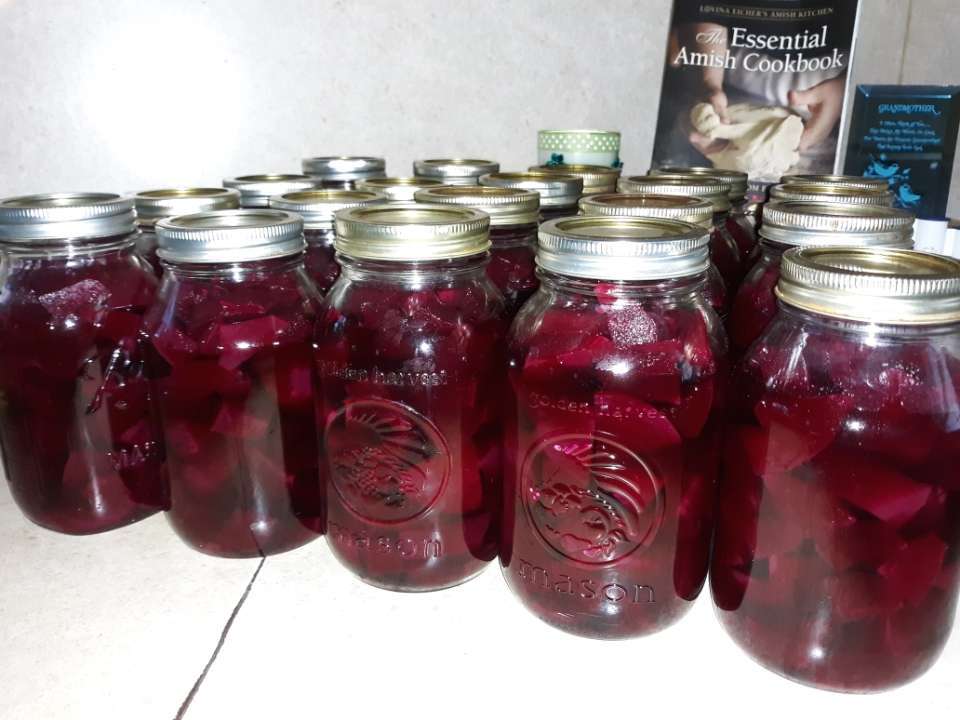
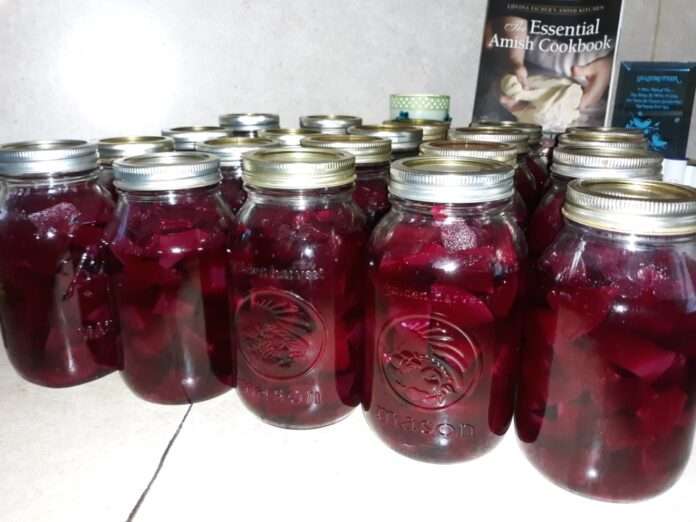
Our garden is all cleared out and ready to till. The garden beds still have tomatoes, green peppers, sweet banana peppers, Serrano peppers, and cucumbers. We plan to can Serrano peppers today, along with more pickles. We canned twenty quarts of pickled red beets on Monday—ten quarts for us and ten for Dustin and Loretta. We serve these red beets at our church lunches when we host the services.
Niece Emma and Menno are hosting church on Sunday, at which we will be having council meeting (preparatory services for communion). Lunch is usually served during the services, as the service lasts until early afternoon. A couple dozen people at a time will go in to eat until everyone has eaten. Tomorrow my daughter and I have plans to go assist Emma with whatever she needs help with for church services on Sunday.
Saturday evening we went to daughter Elizabeth and Tim’s house for Abigail’s birthday supper. She was excited to have everyone come for her sixth birthday. Elizabeth made cupcakes and had six candles for her to blow out. Supper menu was grilled hamburgers (along with all the add-ons such as lettuce, tomatoes, etc.), potatoes (cooked on the grill), cupcakes, cookies, and ice cream. We played games after supper.
Granddaughter Jennifer (Susan’s daughter) started school this week. She seems to like it. Abigail (Elizabeth’s daughter) said she’ll take care of Jennifer if she’s scared. Abigail, Jennifer, and Kaitlyn (Ervin’s daughter) all seem to be enjoying school.
Yesterday I attended a Tupperware party hosted by daughter Verena’s friend Laura. She’s a neighbor to Susan and Verena. I took our horse Midnight and our buggy to the party. Afterwards I went to daughter Susan’s house for a few hours. I wanted to be there when Kaitlyn and Jennifer came home from school. Abigail had been dropped off already. Isaiah (Ervin’s son), 4, said he goes to school, too. When they asked him what his teacher’s name is, he said Jesus. He sees the others going to school and wants to go, too.
Ervin (Susan’s friend) is now a homeowner here in Michigan. He bought the farm around the corner from Susan’s house, around a half mile from there. Next month will probably be busy, getting his things all packed again and moved to his new place. This will be so much easier for Susan and Verena to watch the children while he’s at work.
I’ll share the recipe for pickled red beets for those interested in canning.
God’s blessings to all!

Pickled Red Beets

10 quarts raw beets
5 cups white vinegar
12 cups water
6 cups sugar
4 teaspoons salt

Boil beets until tender, 10–15 minutes, then drain, peel, and cut into chunks. Mix together vinegar, water, sugar, and salt. Pour brine over beets and cook for 10 minutes. Put in jars and seal. Process in a boiling-water bath canner according to USDA guidelines suggested by your local extension office or the National Center for Home Preservation website.
This recipe makes a brine for 10 quarts of beets. If the vinegar is strong, you may adjust the brine ratio to 1 cup of vinegar to every 3 cups of water.

Insight: This Old Farmhouse

1

Jackie Mundt
Pratt County farmer and rancher


Over the past decade or two, farmhouse décor has been an in vogue style of interior design. It makes me chuckle when I think about people who don’t live on a farm trying to create clean and pretty spaces through white wash, distressed paint and vintage hardware. Real farmhouses are rarely as desirable as this style is made out to be.
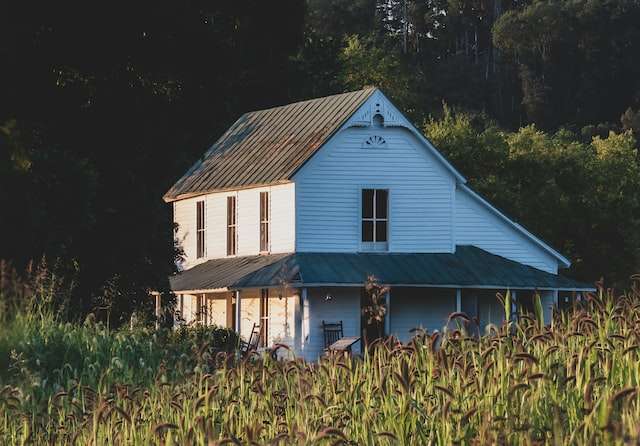
I live in a real farm house and can guarantee my house won’t be featured  on HGTV anytime soon. I honestly don’t think there is anything in my house that resembles the farmhouse style. However, the character that inspired designers to want to recreate the functional, no frills feel of country living, can be seen in many places in this old farmhouse.
Every house has its own story. Our house’s story began as a kit house made by Sears and Roebuck that was delivered by train and assembled by its owner. We don’t know the exact year the house was delivered but estimate it was likely around the 1920s.
The house was built just a few yards from the original homestead, which was still standing until about a decade ago and could fit in our kitchen. I can imagine the excitement and pride that must have been felt when this model was selected. It was a statement of perseverance and success to move from a house that was merely shelter to what was likely the equivalent of a mansion for the time.
The trade-off of our house’s cool story is it was built by farmers not professional carpenters. The house is sturdy and functional, even though it has lots of little imperfections that are a product of the original DIYers.
The house has seen a lot of lifestyle change in the last century: the installation of indoor plumbing, electrification and the move from wood stoves and chimneys to a furnace and air conditioning. Some of the remnants of these eras can still be seen in things like a few push button light switches or knob and tube lights from the original electrification, which have been preserved as novelties.
We have also seen glimpses of the interests and taste of former home owners as we have worked to make the house our own. While tearing out outdated carpeting to take advantage of the original hardwood floors, we found decorative room mats that were in style during the time of construction.
Each time we discover a new detail in the house, it’s like the house is telling the story of generations that have lived here before.
Though each family who has called this house their home has been unique, they all share some things in common. The kitchen has prepared many meals for families who work the land. The floors have been tracked with mud and dirt more times than they have been clean. The rooms have played host to moments of joy, hope, and love that hopefully outweighed the times of worry and grief. The bay windows provided protection for the extreme Kansas weather that has often been a blessing and a curse.
Our house is worn and imperfect because it is a place where life has been lived. Character like that can’t be replicated for a home good store. This house will never be as pretty as homes designed to look like the farmhouse style, and that’s OK with me. I am happy to live in this old farmhouse.
“Insight” is a weekly column published by Kansas Farm Bureau, the state’s largest farm organization whose mission is to strengthen agriculture and the lives of Kansans through advocacy, education and service.

Stagecoaches Only Went Short Distances In Cold Weather

0

Frank J. Buchman
Columnist

“It must have been awfully cold riding across the country in a stagecoach.”
That’s true, but Jon Mixon, who’s done considerable stagecoach research, said, “Stagecoaches were for traveling short distances.”
The fact was that if weather was “freezing,” passengers didn’t travel very far or didn’t travel at all, he added.
Stagecoach passengers usually only rode to a relatively close destination “This would be a matter of hours or perhaps just a day,” Mixon said.
“With few exceptions, the stagecoach itself and the horses were deemed more valuable than the passengers,” according to Mixon.
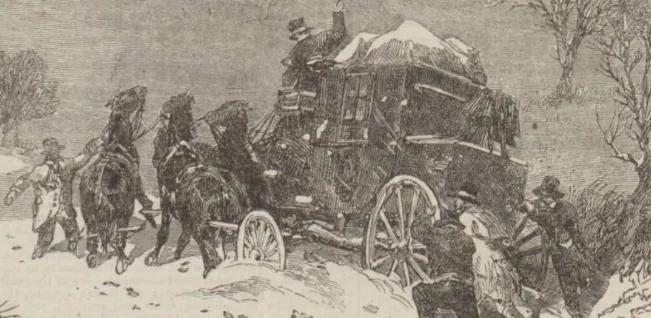
The stagecoach would not travel far in subzero temperatures if it indeed traveled at all that day. “The weather could cause the horses to overexert themselves and die,” Mixon said.
Dead horses do not make a successful business. “Fewer horses meant that travel was going to take longer,” Mixon pointed out.
If the weather was too cold for the horses, the stagecoach didn’t travel. “If it did, the passengers probably regretted that they took that coach on that day,” Mixon said.
The Old West was not known for its racial progressiveness, Mixon emphasized. “If a racial minority took a stagecoach, they would have to sit on the roof of the stagecoach,” he said.
Blankets were available as were buffalo hides “However traveling outside in inclement weather is always going to be unpleasant, regardless how ‘bundled up’ you are,” Mixon recognized.
While heaters were employed for short distances, fire dangers made them likely used for wealthier or more vulnerable passengers.
Additionally, carrying fuel for heaters reduced the amounts of cargo and passengers that could be taken. “There was always a weight limit for the stagecoach as well as for the horses,” Mixon said.