
If it wasn’t so serious, it would be funny. I’m talking about how politicians play what I call “the great phony numbers game.” They toss around “governmental numbers” as carelessly as carefree 3-year-olds toss around Lego blocks.
Let me explain. The number “million” has essentially disappeared from the government lexicon. “Million” has been replaced by “Billion,” and
“Billion” is rapidly being replaced by “Trillion.”
Presidents, senators, congressman and congresswomen, Federal Reserve chairman, treasury secretaries, esteemed economists, journalists, and candidates of all stripes all seriously use the above numbers casually — like they expect the average Joe Blow to believe them.
I recently read an article, “Game Over For The Fed,” penned by some observant feller named Nick Giambruno, that lays out the premise for the phony numbers game pretty succinctly. Here’s the crux of what he wrote;
“A trillion dollars is a massive, almost unfathomable number. The human brain has trouble understanding something so huge. If you earned $1 per second, it would take 11 days to make a million dollars. If you earned $1 per second, it would take 31 and a half years to make a billion dollars. And if you earned $1 per second, it would take 31,688 years to make a trillion dollars. So that’s how enormous a trillion is. When politicians carelessly spend and print money measured in the trillions, you are in dangerous territory. And that is precisely what the Federal Reserve and the central banking system have enabled the U.S. government to do. It took over 227 years to print its first $6 trillion. In just a matter of months recently, the U.S. government printed more than $6 trillion. During that period, the U.S. money supply increased by a whopping 41%. In short, the Fed’s actions amounted to the biggest monetary explosion that has ever occurred in the U.S. The truth is that inflation is out of control, and nothing can stop it. The U.S. federal government has the biggest debt in the history of the world. And it’s continuing to grow at a rapid, unstoppable pace. Today, the U.S. debt has gone parabolic and is over $30 trillion.”
Now, I didn’t bother to check Mr. Giambruno’s math or statistics. I took him at his word. But, regardless, he made a salient point that no current political or economic discussion even comes close to the expressing the enormity and reality of dealing with trillions of dollars of federal debt — with every dollar of that debt growing inexorably, and unseen, through compound interest rates.
I digressed from my normal aggie base and wandered into the quagmire of politics and economics because every bit of debt and “the great phony numbers game” have a direct impact on U.S. agriculture and every farmer and rancher.
I won’t even throw out a possible solution to “The Great Phony Numbers Game.” But, I know, beyond a shadow of doubt, how we got ourselves into this debt morass. We, The People, elected into office every single one of the politicians who’ve, for decades, taken us blindly down this dead-end debt trail.
***
Shifting from the serious to the inane, here are some “facts and observations” that at least have a tangential, and hopefully humorous, relationship to agriculture.
With the NFL and college football seasons kicked off by the time you read this column, did you know that it takes at least 3,000 bovine hides to manufacture the footballs for a year’s supply of NFL footballs?
And, did you know, the weight of the world’s termites is significantly larger than the weight of all the world’s humans? (I’m trying my best to get humans back in the weight race.)
Do you know that are 178 sesame seeds on the average sesame seed hamburger bun?
Did you know that, pound for pound, a hamburger costs more than a new car?
Did you know it’s possible to lead a cow upstairs, but not downstairs (don’t know who proved this one)?
Did you know that 10% of the Russian government’s income comes from the sale of vodka? Perhaps this statistic explains a lot of things.
Have you ever wondered why your bank charges you a fee for “insufficient funds” on money it knows you no longer have?
Have you ever considered how come you drive your vehicle over underpasses and under overpasses?
Have you ever wondered why vegetarians, who think folks should never eat animals, have never protested that animals are made of meat?
If you’re into esoteric thinking, have you ever considered what “time” is? Well, “time” is what keeps everything from happening simultaneously. But, consider this, too: Time is the best teacher, but it kills all of its students.
In spite of protests about prayers in schools, the odds are good that prayer will continue in public schools as long as tests are given to students.
Just for safety’s sake, whenever you do a good deed. Get a receipt — just in case Heaven is like the Internal Revenue Service.
***
Words of wisdom for the week: “Every mechanical device is doomed to eventual failure — usually at the most inopportune, most expensive time.” Have a good ‘un.
The Great Phony Numbers Game
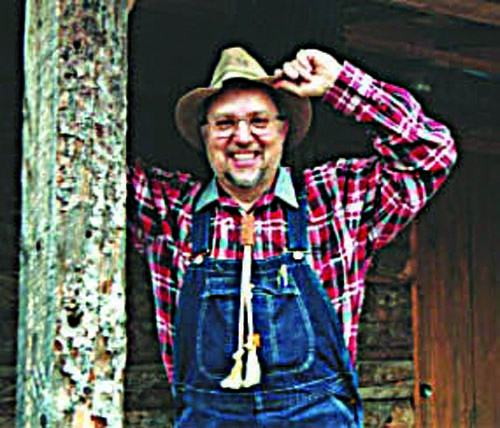
REMEMBERING MIKE ALFERS

I remember the first time I met Mike. Shortly after Hospice House opened I donated a display case for the little quilts. Family members had been making little quilts to hang on the walls of Hospice when it was in the hospital in memory of their loved one that Hospice had taken care of.
So when Hospice built their own building I had a friend who was a carpenter build the quilt display case for me. With the help of Penwell Gable and the glass company in Hutchinson the large case was built and hung on the wall in the family room of Hospice House. It has glass doors so the little quilts would stay clean and the staff could change the quilts out.
Mike came to Hospice house the day the display case was hung. I am not sure how he knew about it and when it was going to be hung in the family room but he took the pictures of it when it was finally on the wall. Then when he was ready to leave with his photographer, he told me he wanted me to write an article about Lady and her therapy work and the display case. Lady was the first licensed therapy dog in Reno County and the first one to visit patients in the Hutchinson hospital and a Hospice facility in Kansas.
I told him I had never done any writing and he said I could do it. He said I should just tell the readers about Lady and her therapy work. So I sat down at the computer and wrote a short story about Lady and our work and he printed it. When I sent it to him I thought, well that is that and I won’t have to do that again.
Next thing I knew I had an email from him asking me to start writing articles or stories for him. I argued with him and told him I had never written for a publication. That didn’t get far with him and he kept telling me to write a story for him that he could put in the paper. That started 21 years of writing for the paper and over 150 stories.
Then I wrote a book about my home town of Mullinville and published it. It is the history of the town from the first day until the time I wrote the book. I would never have even thought about doing that without Mike pushing me to write more and more.
He never made any changes to any of my stories and not to any of the men’s articles who write for the paper. He believed in the freedom of speech for a writer and their work. If there was a mistake it was my fault and I learned from that and didn’t make the same mistake again and he molded a better writer by letting me learn the hard way. He never told me or the other writers for the paper what we could or could not write about for the paper.
I have been the only woman writer for the paper for quite a few years. One lady writes about recipes and cooking but after Doris (who wrote nostalgia before me) retired it has just been me twice a month. Very few editors/owners of a newspaper would turn an untested writer loose the first time they asked for a story but Mike did.
I don’t think over the 21 years that I wrote for him that he ever suggested that I change something or that he thought it was something that would upset people. And he was right, I never had anyone email and tell me that a story was not politically correct or they didn’t like it. But I always had emails from readers that had connected with a story or those that just enjoyed the story.
I sure miss Mike and I am sure the other writers for the paper do too. He was a great mentor to the few that were lucky to be hired to write for him and the Rural Messenger. I certainly enjoyed working for Mike. To contact Sandy: [email protected]
New mural honors local farmers and community of Haven

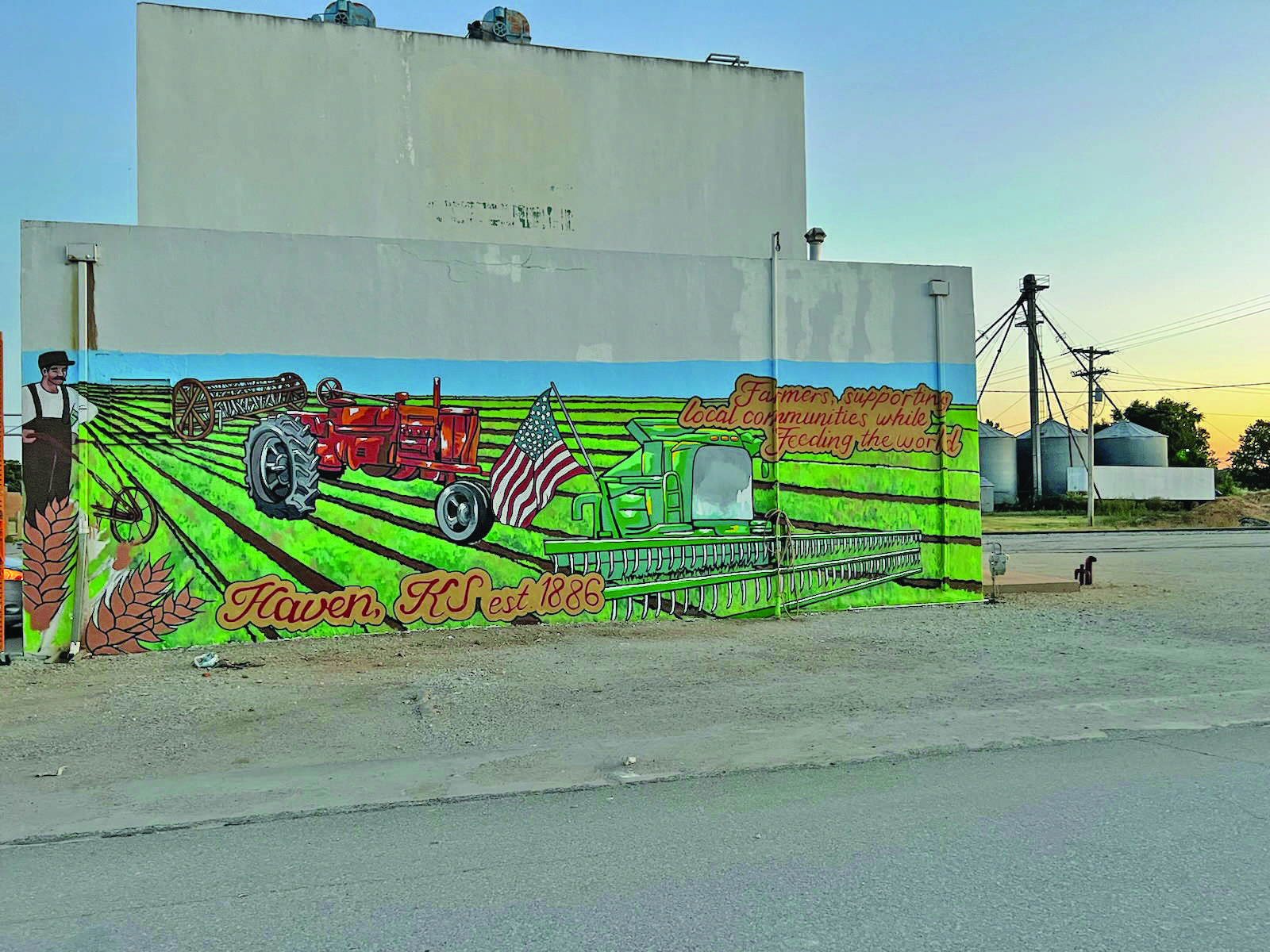
Downtown Haven now features a new mural that pays homage to our local farmers and farming community. It depicts the farming methods used in 1886, when Haven was founded, and carries through to mid-century methods, and finally to our modern-day methods of farming.
The quote on the upper right side of the mural sums it all up…Farmers, supporting local communities while feeding the world!
The mural artist is Heather Byers from Wichita. She was chosen because of her enormous talent and the fact that she has a different style than that of Brady Scott, who was the amazing artist of the Veterans mural located on the south side of the Hardware Haven building. Our goal is to create great murals using a variety of styles.
Two major fundraisers were held over the year were a Chili feed and raffle held in January, along with a hamburger feed during the Haven city-wide garage sales. This mural could not have been possible without the support of the following and we wish to thank them…
Erik Lange and the Mid-Kansas Co-op staff
Ken Brown and Haven Steel
Haven Chamber of Commerce
Iron Gates Insurance
Haven LaCadena Club
James and Charlene Schlickau
Ronnie and Tami Smith
And last but certainly not least thank you to all our friends and family who contributed and supported our fundraisers.
The Legend of El Diablo
Sometimes oil field workers and cowboys get along, sometimes they don’t. I’ve played both roles and have come to the conclusion that the degree to which they get along is dependent on whether the cattleman is receiving royalty checks.
In addition to working at a gas station pumping gas, washing windows, inflating tires and fixing flats, I worked three summers in the oilfields to pay my way through college. I’ve mentioned previously that after I got my animal science degree I took a job as a cowboy making $650 per month which was $200 less than what I was getting in the oilfields as a roustabout with no college degree. Both sides of my family worked in the oilfields so it was easy for me to get a job paying $5.25 per hour when the minimum wage was $1.25. It was a good job, I learned a lot and I met some interesting characters, like Buster who owned the ranch that surrounded the oilfield where I worked. Buster was an old, single, miserable cuss who drank a lot and raised roping steers out of the worst cows I’ve ever seen. Buster had good reason to be mad at oilfield workers because the same oil company that leased the land where I worked also had a lease on Buster’s land only they never drilled on it. Which meant Buster was getting no royalty payments while his next door neighbor was cruising the world in his yacht with his beautiful 24 year old girlfriend.
Buster told everyone that the reason the oil company had not drilled on his land was because they were using directional drilling to drill under his land and get all Buster’s oil for free. I wouldn’t put it past them but in the oil company’s defense the field where I worked consisted of a couple hundred shallow wells that were drilled before directional drilling was even invented. I’d say on average the wells produced about 30 barrels every day since 1889.
The oilfield where I worked was not conducive to running cattle because it was almost straight up and down, had no water, and was rockier than my boss man’s marriage. And there wasn’t enough feed to keep a goat alive. That’s why it seemed odd during my first summer to see this mysterious bull appear out of the fog and then disappear after terrorizing the place. I only saw the bull they called El Diablo (The Devil) once and I can tell you he was a huge monster with horns that were wider than a Sherman tank and twice as deadly. The pumpers who checked the wells every day were refusing to exit their pickups for fear of being shish-kabobbed by the mysterious El Diablo. And these were not sissy men, but guys who regularly engaged in barroom fisticuffs and squashed rattlesnakes with pieces of drill pipe.
By the time I arrived on the scene El Diablo had already put a big dent in the boss man’s Lincoln Continental, had knocked over several stands that held 55 gallon drums filled with vile chemicals and made a mess of the pipe farm where El Diablo liked to hang out. After every episode the boss would phone Buster to come and get his bull but Buster insisted the bull wasn’t his, but who else could El Diablo belong to, there wasn’t another cattle ranch within 30 miles?
During my second summer Buster came into the doghouse where we ate lunch and played cards and gave us all the evil eye. “Where’s your boss?” he demanded.
We all pointed to the office door and Buster barged into the office and demanded to know if the boss had seen El Diablo lately? “I haven’t seen him but why should you care Buster, I thought you said he wasn’t your bull?”
“He’s not,” said Buster who was just trying to avoid paying for all the damage El Diablo did.
The boss told Buster, “You might ask the guys in the doghouse but I haven’t seen him.”
So Buster demanded to know if any of us peons had seen El Diablo recently. “Now that you mention it,” said Bob, a former Golden Gloves champion who weighed 250 and was six feet five, “we haven’t seen him. But would you like a piece of jerky? I made it myself.”
www.LeePittsbooks.com
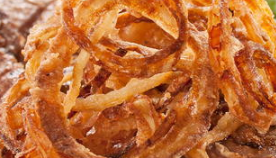
Onion Strings
Serves: 3
Cooking Time: 10 minutes
- 1 cup all-purpose flour
- 1 1/2 teaspoon salt
- 1/2 teaspoon black pepper
- 1 cup vegetable oil
- 1 large onion, thinly sliced and separated into rings
What To Do:
- In a medium bowl, combine flour, salt, and pepper; mix well.
- In a large skillet, heat oil over medium-high heat. Place onion rings in flour, coat well, then carefully place in hot oil.
- Fry onions 6 to 8 minutes, or until golden. Drain on a paper towel-lined plate, and serve immediately.
Notes:
- These Onion Strings are yummy as is, but you can sprinkle them with salt before serving, if you’d like.
- Use these to fancy up a juicy steak, top off a chef’s salad (instead of croutons), or however else you like!
