
“If you can’t ride a good horse, ride a gray horse.”
Apparently, that’s an old saying harassing those who stand out from other cowboys when riding a gray horse.
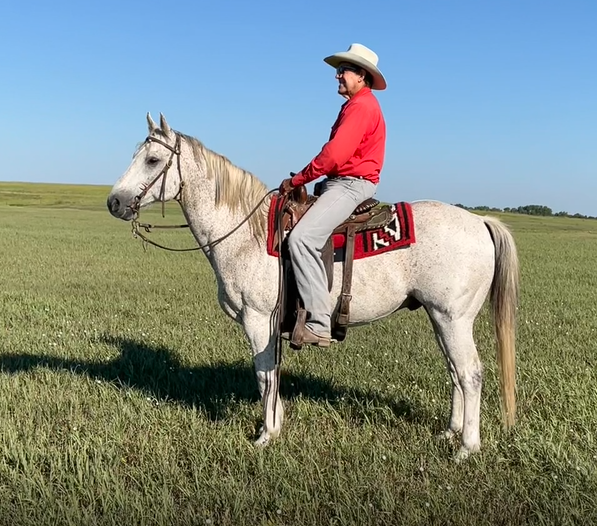
Actually, the quote hadn’t been heard personally until riding the gray gelding BB Zanes Hallelujah at the sale barn. The remark can become offensive when the horse really is a “good” horse.
Still, opinions about the quality or usefulness of a horse are widely varied. A horse that is appreciated by one cowboy, sometimes doesn’t appeal to another cowboy, and gets certain criticism.
That’s the way it is with this gray horse. The ranch manager blatantly declares: “That horse is no good.” Yet, he uses Hallelujah regularly for cattle counting and checking water gaps.
However, the old horse, formerly serving as one of the ranch broodmare service stallions, fits the manager’s dad just perfectly.
The son’s contention is that Hallelujah “doesn’t pay any attention to cows, won’t work cattle period.”
That may be the case, but that doesn’t mean he’s “no good.” The gelding is “safe” for an old wannabe cowboy to roundup Flint Hills cattle.
Mounting him on a cold morning in the dark, the gelding doesn’t have any buck or meanness. Hallelujah takes care of himself and rider in the steepest, roughest, rockiest native pasture.
There’s not a wide running creek or muddy waterhole that he won’t cross without any hesitation. Often horses resist going through water or jump over even the smallest puddle.
Admittedly, the gelding doesn’t “neck rein” very good, being “hard-necked,” resistant when turning. Yet, he goes when spurred and works just fine gathering two section pastures.
Likewise, the gray horse likes driving sale barn cattle paying no attention to cattle bawling, loudspeaker, or noisy hollering workers.
Noteworthy, Hallelujah, featuring two ranch-owned stallions in his pedigree, was ranch raised and trained. Before surgery, he sired more than 100 foals, several which became top using horses.
Gray horses dominate ranch pastures from breeding mares to gray stallions. because gray colts generally sold for more money.
Many gray horses appear white when they mature, yet a “gray horse” is definitely different from a “white horse.”
Reminded of Revelation 19:12: “Then I saw Heaven open wide, and oh a white horse and its rider.” Still, it might have been a gray horse turned white?
+++ALLELUIA++
XVI–34–8-21-2022
Gray Horse Is ‘Good’
‘Famous’ Bass Fiddle From Ozark Opry To Be On Display In Missouri Capital
Bass fiddle of Lee Mace, “Grandfather of Country Music in Missouri,” is being displayed at the Missouri State Capitol Museum.
“Honoring my uncle Lee Mace, music trailblazer, the instrument will be at the Missouri statehouse,” said Dave Webb, Stillwell, Kansas.
“Opening ceremonies in Jefferson City, Missouri, are Thursday, Aug. 25, at 1 o’clock, with the public invited,” Webb welcomed.
The Key bass fiddle, one of less than 50 such instruments, was constructed in 1938, bass fiddle registry indicates.
Whereabouts of the bass fiddle from 1938 to 1951 are unknown. However, Lee Mace was stationed in France, awaiting deployment to Korea, when he saw the bass fiddle in a dump. It had a broken neck and needed repairs.
Mace’s Army buddy, Jim, from working in his father’s cabinet shop at Stafford, Kansas, indicated he could repair the instrument.
“Lee found a baseball bat and his friend fashioned a new neck for the bass fiddle and made additional repairs,” Webb said.
Lee Mace had grown up in a musical home and his mother was an accomplished fiddle player. She taught him how to note the fiddle and the basics of music.
Transferring those early music lessons to the bass fiddle, Lee Mace soon formed a band doing USO shows.
One such show for the GI’s as noted in a letter home had attendance of more than 5,000. It was the only band called back for encores.
Upon discharge from the Army, Mace brought the bass fiddle home with him to Missouri.
Lee Mace was born in a small town of 74 people on a farm near Brumley, Missouri, just 10 miles from the Lake of the Ozarks.
“As a youngster, Lee remembered going with his family to a friend’s home for musical get togethers,” Webb said. “Everyone picked, sang, and had a grand time.”
Lee Mace and his wife Joyce were among the first Grand Ole Opry square dancers traveling from coast-to-coast dancing.
“In 1953, they stopped living out of suitcases and settled down at the Lake of the Ozarks,” Webb said. “They knew that there was a lot of old-time country traditions and flavor that they wanted to preserve.”
The musical couple started the Ozark Opry renting a building near the Bagnell Dam.
“It would hold around 200 guests if some brought their own chairs,” Webb said. “They got several entertainers from nearby to also perform and began putting on shows two nights a week. Soon, it was up to three shows a week, and later four.
“Lee and Joyce Mace are actually credited with starting the first live nightly family show in America. Today we call that the popular Branson-style entertainment,” according to Webb.
In 1957, the Maces built a new Ozark Opry auditorium that grew to 1,100 seating capacity. Show season ran from mid-April to mid-October.
The Ozark Opry was also on KRCG and KMOS television in a half-hour show every Thursday evening, “It ranked fourth in the Nielson ratings around the Columbia, Missouri, area,” Webb said.
Lee Mace was killed in a plane crash in 1985, but his wife Joyce continued the show for more than 20 years.
“The bass fiddle was used on the first shows and was on stage for the final show,” Webb pointed out.
At the time of the show’s closer, the bass fiddle was gifted to Dave Webb and displayed in his home. For a while, it was on loan for display at the Ozark Opry Museum in the old Opry building.
“We have donated this ‘famous’ bass fiddle to the Missouri State Capitol Museum so everybody can see it,” Webb said.
CUTLINE
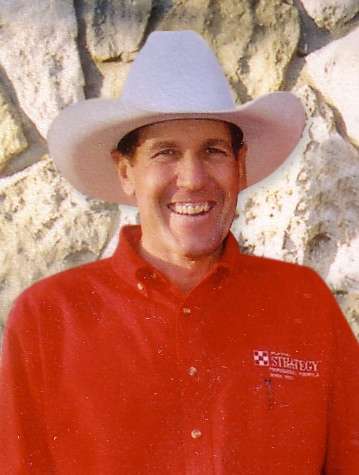
Lee Mace’s trademark was playing a ‘rousing, slapping, free-wheeling bass fiddle’ at his Ozark Opry.
Lee and Joyce Mace hosted the Ozark Opry with four nightly shows a week.
Police work
During one week in early August the Lindsborg Police Department took scores of calls and responded to 45 of them. Outlines of the summons show the sketch of life in a country town, its afflictions and tribulations, how officers are called to help resolve them. Consider:
A parole officer was looking for a person on supervised release ( the missing person was found in custody in Saline County). A store manager had been receiving obscene phone calls. Assisting a sheriff’s deputy serving an order for protection from abuse. At Casey’s, helping someone start a car. Writing warnings (reminders) for parking violations near Bethany College.
Officers delivered ice for water coolers at the annual Car Show in Swensson Park. They helped a citizen locked out of the family home. On I-135 south of Lindsborg an officer helped a sheriff’s deputy with a motorist who did not speak English. A lost wallet was returned to the owner. An alarm – smoke in a residence – brought police, fire trucks and an ambulance.
Multiple misdials of 911. Trespass complaints, dogs on the loose, neighbors bickering, burglar alarms (no burglars), complaints of erratic driving, transients who need help, welfare checks on elderly persons living alone, trash in the street. A call to settle an unruly patient in the hospital emergency room. At night, patrolling neighborhoods, the business districts, the parks.
The police are on a primary mission to help people have better lives. I have watched them help people locked out of their cars, or who need to change a tire.
Lindsborg’s officers often double as detectives. Burglaries and thefts are investigated, stolen property tracked. They are on notice, working with other agencies: fugitives on the loose, stolen vehicles en route, phone scams in the works, internet frauds surging, missing persons, runaway youngsters – for a few examples.
*
Lindsborg Police Chief Mike Davis succeeded Tim Berggren, who retired in 2019 after more than 30 years with the department. Davis is a 28-year veteran of police work in greater Los Angeles. He is an Army veteran (1980s), a former Orange County (Calif.) sheriff’s deputy and later an officer with the Whittier Police. He retired there as a captain in 2019 and moved to Lindsborg to be near his children and a grandson.
Davis has a degree in Business Administration and an MBA. He supervises seven officers, and is also Public Safety Director over the fire department and ambulance service. He once said that police work in a rural community is not boring, it’s “it’s doing good.” It seems that his mission is to make each day one without sirens.
Officer Terry Reed leads the department’s “Blue Santa” program to raise money to buy fine Christmas gifts for needy children. The police have a list. They deliver the gifts in uniform and wearing a blue Santa hat.
Not long ago a department tally found more than 20 cops living in Lindsborg – McPherson and Saline County Sheriff’s deputies, Highway Patrol Troopers, Lindsborg and Salina police officers. Their work is dangerous, often thankless, sometimes rewarding.
*
A campaign here to defund the police would not go well. Nor would calls to dismantle the Highway Patrol, FBI or the Secret Service. Politicians from the right and left have commanded attention and collected millions in votes and dollars with crusades against law enforcement. These are often politicians with something to hide, someone to goad, or an audience to swindle. Law and order is for the other guy, they say, not for me.
The angry speeder, the red-handed shoplifter, the hands-up thief and the shady politician have been bleating for decades to drag public safety into the political arena. To be sure, there are bad cops, even criminal ones. Campaigns to make these exceptions the rule are a fraud. Laws and their enforcement are for the police and the courts, not a circus of grifters.
*
Years ago, when protests and riots against the Vietnam War and the police were rampant in America, I was having coffee in downtown Oberlin with Howard Kessinger, editor of the Herald, the local newspaper. The police chief walked in.
“Hello, Pig,” Kessinger said.
“Howard, you commie,” the chief said. He smiled and joined us. We had an amiable chat. Howard and the chief were friends, their greetings a put-on mostly to startle the unaware, like me.
I doubt that Kansans on the whole would want the police – local, state or federal – off the budget and out of their lives. Talk of it, with its Gestapo-baiting and thug-naming, is dangerous and delusional. Try finding a helpful politician next time a loved one goes missing, or the car dies.
Compassionate Friends meeting scheduled for Reno County
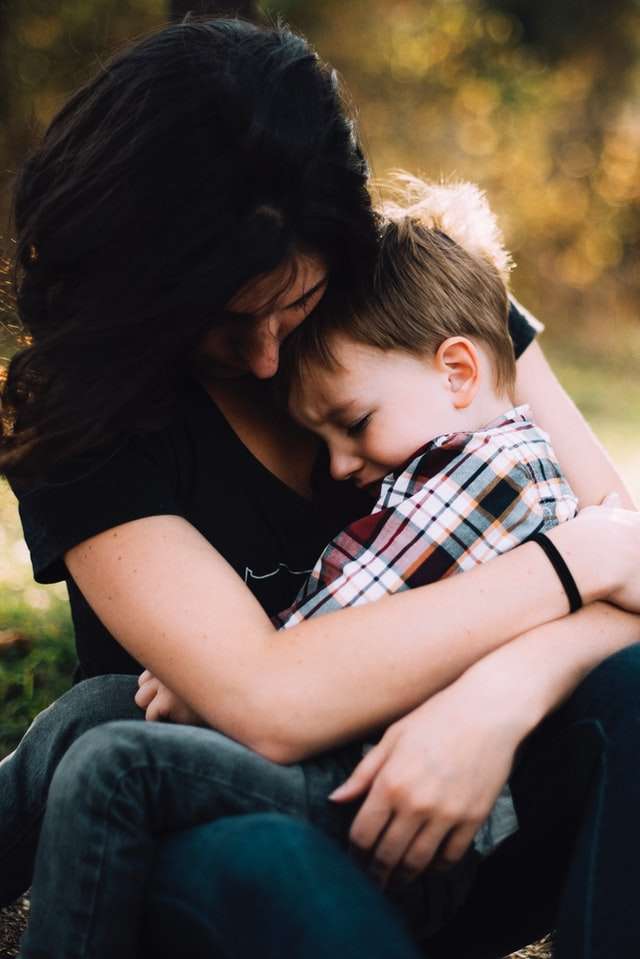
“The death of a child or grandchild is an event that shakes us to the core. It doesn’t matter the age of our child, whether it’s 1, 11, 21 or 51. We are not supposed to have to bury our children. Unfortunately, this happens every day. We feel lost & like no one else understands. We don’t know what to do or how we can possibly keep on moving forward. But there are people who do understand.
The Compassionate Friends (TCF) is a support group started in the 1970s that now has over 600 chapters in all 50 states. Chapters are made up of nothing but parents, grandparents & siblings of children who have died. These people who understand the death of a child, are there to help others on this very difficult journey.
TCF had a Reno county chapter until a few years ago. It closed down as did the Salina chapter. Unfortunately, that leaves only three chapters in the entire state of Kansas; Wichita, Topeka & Harvey County (Newton). Chapter leaders in Newton are working to create an outreach by bringing monthly meetings to other areas. The first outreach is in Hutchinson.
The first meeting is scheduled for Saturday, Sept 10 at 10:00 am in the Hutchinson Library. There is no cost & you can just show up. Organizers would appreciate a “head count” but it is not necessary.
Cheryl McCart, Harvey County Chapter Leader said, “We hope that parents, grandparents & siblings in Hutchinson & surrounding areas who have experienced the loss of a child & are struggling, will come to this meeting. It is hard to make that first step to come to a support group, but this is a safe, private place with people who truly understand.”
McCart says right now they plan to offer monthly meetings in Hutchinson, if there is a need, and potentially to look at other communities if necessary. “People do not have to walk this difficult journey alone. We are there for them.”
For more information about the September 10 meeting or to RSVP, please call 316-249-3779 or for information about TCF in general visit the website at www.compassionatefriends.org
Governor Laura Kelly Announces $24.8 Million for Improvements to Flint Hills Trail
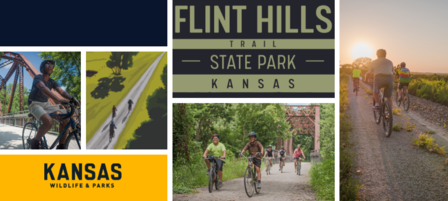
Governor Laura Kelly and the Kansas Department of Wildlife and Parks today announced that Kansas is the recipient of a $24.8 million federal grant, made possible by the U.S. Department of Transportation’s “Rebuilding American Infrastructure with Sustainability and Equity” (RAISE) program.
In May, Governor Kelly wrote to the U.S. Secretary of Transportation in support of the Kansas Department of Wildlife and Park’s application for funding to expand the Flint Hills Trail – the longest trail in Kansas and the eighth-longest rail-trail in the United States.
“No other trail connects more communities, cultures, and landscapes in our state than Flint Hills Trail State Park,” said Governor Laura Kelly. “I’m thrilled the RAISE grant selection committee recognized its value to Kansas, and that the 19 rural communities located along the trail will benefit from this project to make the trail safer and more accessible for public recreation.”
RAISE grants are designed to “help urban and rural communities move forward on projects that modernize roads, bridges, transit, rail, ports, and intermodal transportation” while focusing on safety, accessibility, affordability, and sustainability. On August 11, 2022, the U.S. Department of Transportation announced that Kansas State Parks would be awarded $24,821,705 in grant funding for Flint Hills Trail State Park.
A 2021 economic impact study conducted by Wichita State University’s Center for Economic Development and Business Research determined that Flint Hills Trail State Park provides more than $1.8 million in economic impact to the communities through which it passes. Linda Lanterman, Director of Kansas State Parks, believes that number will be surpassed in the near future.
“Flint Hills Trail State Park has already brought new businesses to Ottawa, and we expect completion of the trail will provide the same benefits to the communities the trail will soon reach,” said Lanterman. “Having now secured this RAISE grant, I’m confident Flint Hills Trail will become a prime destination not only for Kansans but for trail enthusiasts across the nation.”
Organized into six phases, the Flint Hills Trail RAISE grant project will make infrastructure improvements on 40.5 miles of the trail, including opening 27 miles of the trail, from Council Grove to Herington.
“Flint Hills Trail State Park presents a remarkable opportunity for exercise, nature-viewing, and tourism in some of Kansas’ most beautiful areas,” said Brad Loveless, Secretary for the Kansas Department of Wildlife and Parks. “Thanks to this grant, and the amazing partnerships formed since the trail’s inception – especially those with trail volunteers and cooperating landowners and neighbors – we’re now closer to completing Flint Hills Trail.”
The grant awarded for Flint Hills Trail State Park will be specifically invested in drainage improvements, pipes, culverts, bridges, base improvements, limestone surfacing, fences and gates, bollards, safety improvements and signage. This will open the full length of the Flint Hills Trail’s 118 miles, making it part of 186 miles of directly connected trails in eastern Kansas.
“We’ve been actively developing Flint Hills Trail since 2014, making improvements as funds were available,” said Jeffrey Bender, Regional Supervisor for Kansas State Parks and co-author of the grant application. “Despite the immense amount of work still ahead of us, we’re extremely proud of our accomplishments to date, including obtaining the U.S. Department of Interior’s ‘National Recreation Trail’ designation in 2020 and receiving the Federal Highway Administration’s ‘Environmental Excellence Award’ in 2022. Being awarded this RAISE grant is just further proof of this trail’s regional and national significance.”
Bender added, “This grant award wouldn’t have been possible without the efforts of Kansas State Parks staff, the 12 towns along the trail, landowners, volunteers, Kansas Department of Transportation and National Park Service. We’re extremely grateful for their support.”
To learn more about Flint Hills Trail State Park, visit https://ksoutdoors.com/State-Parks/Locations/Flint-Hills-Trail.
For more information on the RAISE program, including the complete list of awardees for 2022, visit https://www.transportation.gov/briefing-room/biden-harris-administration-announces-funding-166-projects-modernize-transportation.
