Monday, January 19, 2026
Home Blog Page 118

Day 9, Kansas Wheat Harvest Report

0

Contact: Marsha Boswell, [email protected]

For audio version, visit kswheat.com.

This is day 9 of the Kansas Wheat Harvest Reports, brought to you by the Kansas Wheat Commission, Kansas Association of Wheat Growers, Kansas Grain and Feed Association and the Kansas Cooperative Council.


Kansas wheat farmers have been facing a challenging wheat harvest due to persistent rains on mature wheat. While test weights have suffered because of this, the 2025 crop has shown stronger yields than the past three drought-stricken years.


Officially, the Kansas wheat harvest is 82 percent complete, behind 90 percent complete last year but ahead of 77 percent average, according to the USDA’s National Agricultural Statistics Service crop progress report for the week ending July 6, 2025.


Josh Debes, a wheat farmer in northern Barton County, is among those still navigating the final stretch of harvest. Rainfall over the past week has forced Debes to chase dry fields across the county in hopes of finishing before another rain delay sets in. His wheat crop, already stressed by drought and a high incidence of wheat streak mosaic virus, is now facing quality declines due to the rain.


“We started with test weights at 60 pounds per bushel on our better fields,” Debes said. “But test weights have dropped since the wheat has been rained on.” Equally stressful has been a constant stream of equipment breakdowns that have kept one or both combines out of fields when Mother Nature has opened up a window for cutting.


Despite the setbacks, Debes expects to harvest more bushels this year than in either of the past two years, when extreme drought nearly wiped out his wheat entirely. “Morale is low, but at least we’ve got bushels to sell to cover the costs of getting this fall’s sorghum crop in the ground,” he added.


Jeff Boyd, CEO of Garden City Coop, reported that wheat harvest in their trade territory is 90 to 95 percent complete. Rains over the holiday weekend have slowed progress, and it may be another two days before combines can roll again in Finney County. Recent storms have also caused lodging in some fields.


Harvest began June 14 at their Hooker, Oklahoma, location. Boyd noted that test weights are averaging around 59 pounds per bushel, and protein levels are coming in at 11.8 percent. Overall, Boyd expects an average to above-average crop in terms of total bushels, with quality landing around average. Yields have ranged widely from the 30s to the 80s, with some of the strongest wheat coming from Finney and Lane counties. Yields have tended to decrease further north. The wheat streak mosaic virus complex has impacted yields and test weights in certain areas, while unusually high humidity has caused threshing issues with some varieties.


In Atchison County, Jay Armstrong wrapped up his Soft Red Winter wheat harvest on July 2 with a farm-wide average of 119 bushels per acre. Only 4.2% of wheat grown in Kansas is SRW, according to USDA/NASS’s winter wheat variety survey for 2025. While Armstrong reported good — but not exceptional — quality and test weights, the biggest challenge this season was getting the crop out between frequent rain delays. His harvested acres have already been planted to double crop soybeans.


The 2025 Harvest Report is brought to you by the Kansas Wheat Commission, Kansas Association of Wheat Growers, Kansas Grain and Feed Association and the Kansas Cooperative Council. To follow along with harvest updates on social media, use #wheatharvest25. Tag us at @kansaswheat to share your harvest story and photos.


###

As if the squash bug wasn’t problem enough

0

As if the squash bug wasn’t problem enough don’t forget about the vine borer. Squash vine borers are the larvae of a clear-winged moth whose size, shape and flying habit are somewhat akin to wasps for which they are often mistaken. Squash vine borers overwinter as larvae or pupae in cocoons buried in the soil. in Kansas, adult moths emerge in the late spring (probably about mid-June) at a time coinciding with the establishment of pumpkins. Eggs are deposited singly on the underside of the vines and are often concentrated at the base of the plants. Larvae bore into the stems where they tunnel and feed. Matured larvae exit stems and then burrow into the soil, where most prepare their overwintering cocoons (there may be a partial second generation in Kansas depending upon current year conditions).


Due to extensive disruption of conducting tissues, plants often wilt and die. The presence of holes in plant stems, and an accompanying ooze, signal the presence of squash vine borers. Large white worms with brown heads can be seen if stems are cut open. Squash vine borer populations vary from location to location, thus being of a major concern in some areas but inconsequential in others. Insecticidal controls must be implemented before larvae bore into plants.

Preventive treatments are best for control attempts. Start to apply insecticides when the vines begin to run. Chemicals used for borer control in gardens are rotenone, permethrin (Eight Vegetable, Fruit & Flower Concentrate; Hi-Yield Garden & Farm Insect Control, Green Thumb Multipurpose Garden and Pet Dust) and bifenthrin (Hi-Yield Bug Blaster Bifenthrin). Continue on a 7- to 10-day reapplication schedule for 3 to 5 weeks. If plants wilt, look for the presence of holes and ooze. If the borer is found, the stem can be slit and the borer removed and destroyed. If the plant is not dead, cover the damaged area with soil and keep the soil moist.


Insect Removal Technicians

0

As we walked up the sidewalk and across the patio at my grandson’s house the other night we had to watch our footing as the ground practically moved beneath our feet. Dozens of tiny toads the size of quarters hopped in every direction with each step. An adult toad the size of a peach, probably dad or grandpa, perched at the top of the porch. We usually have multitudes of toads at the Gilliland ranch every summer, tumbling from beneath the tomato plants or leaping from under the lilacs. This year though, oddly enough our place seems to be “toad deficient.” I miss the little blighters as they are nature’s ground crew for insect control.

Toad… the name itself conjures up visions of witches adding eyes of newts and wings of bats to a bubbling caldron of potion, or a derogatory remark about a person’s physical appearance. They’re fat and pudgy, their blotchy skin is covered with lumps and warts, their spring mating call sounds like a poor lost calf calling for its mother and they pee on anyone attempting to pick them up. You gotta’ love em’! Their saving grace comes in the form of a voracious appetite for insects.

A few years back during a particularly wet spell like that of late, I spoke with Wildlife Diversity Coordinator for the state of Kansas, Ken Brunson, about the myriad of tiny toads that were literally everywhere that year. Just when I thought life was as simple as a toad, was a toad, was a toad, Ken informed me that toads have names too. Ken said that 95% of the toads seen in Kansas are either Woodhouse’s Toads, or Great Plains Toads. Eastern Kansas also has some American toads and Spadefoot toads. Ken linked that year’s abundance of tiny toads to the abundance of standing water in places where there hadn’t been water for ages, and the flood waters forced many from their homes near the streams and swamps where they hatched, and sent them scrambling for higher ground.

Whatever their clan, all toads begin their life as jelly covered strands of eggs laid in the shallows of swamps, streams and ponds. In about one week the eggs hatch into tadpoles. Next, hind legs begin to grow, then front legs, then lungs replace the gills, the tail is absorbed into the body, and finally, two to three weeks after hatching, the youngsters hop out onto dry land. Woodhouse and Great Plains toads both grow to be three to five inches long when fully mature.

Although not particularly athletic, toads are efficient predators and do have a ravenous appetite for insects. Research suggests that a toad is capable of eating two-thirds its body weight in insects daily. Worms of all kinds seem to be favorites as they’re probably easier to catch (and I’m sure more filling!) A study done on Great Plains toads in Oklahoma found that because of their fondness for dining on over-wintering cutworms, these toads were estimated to be worth twenty-five dollars apiece per year to the agriculture industry there. Their taste for bugs can easily be seen in their droppings. The black cigar shaped droppings found in driveways and on sidewalks this time of year are in fact toad poo. When they have acres of yards, gardens and fields to potty in, I’ll never understand why they feel the need to go on the sidewalk or in the driveway (the least they could do is cart it away when they leave.) Next time you see some, take a stick and poke it apart; you’ll see it’s comprised entirely of undigested bug parts like legs and wings.

Contrary to the old-wives tale, handling a toad does not cause warts. The warts on their skin and the glands behind their eyes do however produce a toxin capable of making you sick if accidentally ingested. You’ve witnessed this toxin at work if you have ever seen your dog frothing and foaming at the mouth after playing with a toad in the yard.

With that in mind, I guess my advice to you concerning toads would be three-fold. 1) If you suddenly find your dog foaming and frothing at the mouth, don’t shoot it, it probably just licked a toad; 2) Don’t lick a toad yourself, and 3) ALWAYS hold a toad way out in front of you with both hands or you’re liable to get your shoes wet. So whenever a fat pudgy toad surprises you in the garden or flower bed, tip your hat to them and thank them for the insect removal service they provide. Continue to Explore Kansas Outdoors!

Steve can be contacted by email at [email protected].

Turkey or Chicken Burgers

0

Eating cleaner, that’s what you’ll find as the focus in this weeks column. From a personal standpoint this is how I enjoy food the most. What does eating ‘clean’ mean to me? As little fat content as possible, low carbo fillers, and keeping the cooking process as healthy as you can. I lost about 40 lbs one summer just by following these guidelines, and I felt terrific. Many dietary needs are the result of changes within our bodies through the years. For example; I had my gallbladder removed somewhere around the age of 41 or 42. Following the procedure I realized it’s not in my best interest to indulge in fatty foods, as I always pay the piper. Many illnesses will require that we adapt different eating styles. If we don’t it can be a very uncomfortable journey.

Our son, Phillip and his fiancée, Paige, have no immediate health issues, however; they are making every endeavor to put good foods into their bodies. They didn’t grow up in my era where we canned everything or raised our own meats. The end result will multiply in many facets of their lives. Of course, like anyone, they are going to enjoy a beautiful Thanksgiving Dinner, and if they’re like me perhaps a bit of misery afterwards. But the important thing is they return to their ‘style’ of clean eating.

Turkey burgers have become a feat for many over the years. Yes, they are more expensive than a typical hamburger. Because they lack fat, it’s difficult to keep them together in the skillet or the grill. This recipe will provide you with several tips that will aid in holding the burger together during the cooking process. As always, my biggest tip is to make several at once, and freeze the remaining. Not just because you want to have them ready to cook, but because they actually cook better frozen!

For many years (before marriage) I spent at least a month of every summer in Colorado, coming home a mere 12-24 hours before I reported back to teaching. I was addicted to the lifestyle of exercise and healthy eating. One ‘Pub’ had half price burger nite every Tuesday night. I remember we would head that way every Tuesday evening at 5pm to beat the crowds. What I loved about the place was how many different burgers were on the menu: Beef, Buffalo, Turkey, Elk or Venison, Veggie and one or two more. My favorite became the Buffalo burger. Oh yes, they also had either ostrich or emu. Why was the bison my favorite? Flavor and low fat content, I felt better after eating a buffalo burger. Also of note was at that time, there was no difference in cost for the choice of burger meat.

I hope you’ll give these burgers a try. They will have good flavor and you’ll love the fact that cooking them frozen is best! Have an awesome weekend, Simply Yours, The Covered Dish.

Fresh Turkey Burgers

1 small onion, finely minced

1 small red pepper or 5 mini peppers, finely minced

½ teaspoon garlic powder

½ cup Parmesan cheese

½ teaspoon dry thyme

1 teaspoon smoked paprika

1 egg

1 pound, ground turkey

Mix all ingredients forming 4-7 turkey burgers. After mixing place the burgers in the deep freeze for at least 20 minutes before grilling. This will aid in keeping the burgers bound. Remember to grill on one side and then flip only once.

Ground turkey comes in a variety of blends. If the turkey is 100% white meat the ground burger just doesn’t want to stick. If you can request a turkey blend, get one that will combine both white and dark meat blend, which will help tremendously with the binding. If you still experience troubles with binding consider adding 1-2 tablespoons of panko.

If you want to grill the burgers I have these tips:

1. Freeze the burgers about 20 minutes before they go on the grill.

2. Spray each side of the burger with an organic vegetable spray before placing them on the grill.

3. Flip the burgers only one time, and do not press them.

4. Remember this meat blend will not shrink after cooking.

5. Usually I can get 7 patties with this recipe.

Consider changing out any of my spices and using your choice of ingredients. Instead of Parmesan grab some kick with pepper jack. “IF” you have to add panko for more bind

consider the panko first and bread crumbs as 2nd choice. Panko has less additives than the bread crumbs.

It takes a little patience with turkey burgers, but once you get started with them, it’s hard to go back to beef!

Veterinarian warns of grass awns

0

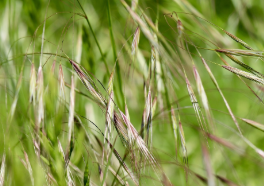
As temperatures soar during the “dog days of summer,” Dr. John Austin with Hutchinson Small Animal Hospital is reminding pet owners that heat isn’t the only seasonal hazard to watch for. Local yards, ditches, and trails are full of plants like wild oats, cheatgrass, and foxtails — and they pose a bigger threat than you might think.

“These seeds, which a lot of people call ‘foxtails’ or ‘wild oats,’ are designed by nature to spread by sticking to animals,” said Dr. Austin. “The problem is, they don’t just stick — they burrow in.”

He says his clinic frequently treats pets for embedded seeds lodged in their paws, ears, or even eyes. Dogs with longer or curly fur, such as doodle breeds, are especially vulnerable.

Barbed and Burrowing

The trouble comes from the seeds’ barbed tips, which work like tiny fishhooks. As dogs walk through tall grass, the seeds catch in their fur and can then pierce the skin. Once embedded, they can create painful abscesses that sometimes travel up the leg.

“About half the time, we’re able to sedate the pet and carefully remove the seed before it causes more damage,” Dr. Austin said. “But if it breaks apart or deteriorates inside, it can keep migrating and lead to repeated infections.”

Common spots to check? Between the paw pads, up between the toes, under the third eyelid, and deep inside the ears.

Prevention Is Key

Dr. Austin recommends simple steps to help avoid this summer nuisance:

  1. Shave Their Feet: For breeds with long or curly hair, like doodles, keeping the fur trimmed short from the ankle down is crucial. “That way, there’s nothing for those seeds to cling to,” he said.
  2. Inspect After Outings: If your dog runs through tall grass or ditches, give them a quick once-over when you get home. “Look for excessive licking or chewing, especially between the toes,” he advised.
  3. Keep Yards Trimmed: Mowing or trimming tall grasses can help limit your dog’s exposure to these pesky plants.

When to Call the Vet

If your pet is persistently licking a paw, shaking its head, or pawing at its eyes, it could be more than just an itch. “These seeds can go places you’d never expect,” Dr. Austin warned. “They can even penetrate behind the eyelid or deep inside the ear canal, and they won’t come out on their own.”

If removal is needed, sedation may be required for the safety of both the animal and the vet team.