Friday, January 16, 2026
Home Blog Page 83

Pause and Get Perspective on Current Record Cattle Prices

0

Sometimes memories can be short, and it is good to take a moment to take stock of where we have been and how we got to where we are today. Current cattle prices have risen faster and gone further than many market analysts thought possible over the last two years.  This increase in prices has been across all classes of livestock including fed cattle, weigh-up cows, feeder cattle, calves, and impacting bred cows and bulls as well.

Iowa State University annually publishes the Historical Cattle Prices document that shows average prices paid for different classes of cattle over the last 20 years by month and an average for each respective year. This market report shows prices paid for cattle in the state of Iowa as well as breaking utility cow prices from the Joplin Regional Stockyards in Missouri.  These market prices would be comparable to prices paid in Nebraska for similar classes of cattle of like kind and quality.

Looking at the report issued in March of this year; it reveals the following:

  • Live choice steers averaged $187.92 in 2024, up almost $80 per cwt from the $108.51 per cwt average paid in 2020 when COVID-19 was having the most impact.
  • The average price for breaking and utility cows doubled during that same time frame, going from an average of $60.05 per cwt in 2020 to $123.92 per cwt in 2024.
  • Medium and large framed steers weighing 700-800 lbs. averaged $141.92 per cwt in 2020 and increased to $263.43 per cwt in 2024.
  • Steer calves weighing 500-600 lbs. averaged $163.45 per cwt in 2020, increasing to $314.65 per cwt in 2024, just shy of doubling in price over the four-year period.

Prices over the first seven months of 2025 have trended solidly up across the board compared to a year ago for all classes of cattle. Because prices have continued to increase for all sectors, profits will generally be realized by cow-calf producers, stocker-yearling operators and cattle feeders in 2025. Historically, when prices have gone up like this in the past and cow-calf producers began to experience sustained levels of profit, they begin moving towards increasing calf supplies through retaining heifers for breeding if forage is available. With the widespread rains relieving drought this late spring and summer across the heart of the leading cow-calf producing states, it seems likely that cow herd building through the retaining of heifers will soon be underway; if it is not already.

Consider Price Risk Management at Record Highs

When prices are at profitable levels, have been going up and are going higher, there is the temptation to do nothing from a price risk management standpoint.  Frequently folks who spent money on price protection or forward contracted cattle, just to see the price go roaring higher, find themselves questioning if using price protection is prudent when they are feeling the recent disappointment of having left “money on the table.” This is where pausing and looking back historically at what has occurred with prices in the past can bring perspective. When prices increased dramatically in previous times, resulting in periods of exceptional profitability, those seasons have been followed by times of significant price decline. How soon and how far prices will fall is unknown. However, cattle are still a commodity, and the prices paid for a commodity, over time historically, have generally moved towards breakeven.

A marketing plan with price risk management as a component of that would seem prudent under current market conditions.  For those thrilled with current prices, forward contracting calves or feeder cattle is an opportunity to lock in the current market for this year’s production. For others, protecting a profit by using tools such as Livestock Risk Protection insurance or put options to protect a floor price based on the futures price, allows a producer to protect from significant market declines nationally while leaving the opportunity for the market to move to the upside and benefit from price increases.

How much profit are you expecting to make per head this fall on a weaned calf or on a yearling with current futures prices? Would you be willing to spend $30 per head to protect a $300 profit? Would you be willing to spend $50 per head to protect a $500 profit? Doing nothing from a price risk management standpoint is in fact doing something! It is in a sense stating that you are willing to accept all the risks and the consequences of whatever the market does between now and your expected date of cattle marketing.

Black swan events that drastically impact market prices can and do occur. Historically, the profit levels that can currently be protected under expected market conditions for calves and yearling prices this fall are extremely rare events. Is protecting a profit at current cattle prices something you can afford not to do?

Article by Aaron Berger, Nebraska Extension, Livestock Educator

Managing Cows with Limited Perennial Pasture – A Producer Perspective

0

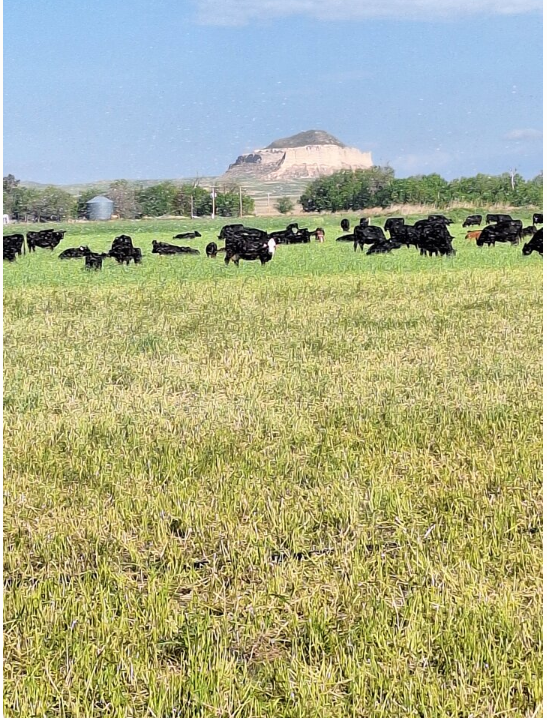
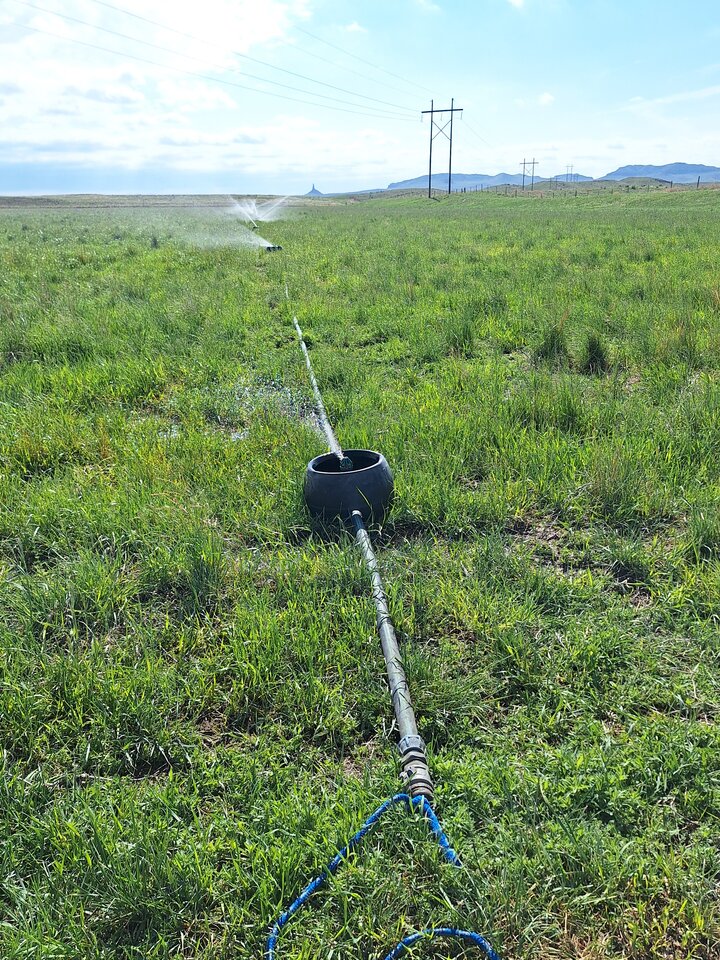
By interseeding annual grass into established alfalfa fields and applying water with a K-line irrigation system, Jerry Weekes has developed a system for maintaining cows on limited perennial acres. Jerry Weekes has spent a lifetime in the cattle industry. Most recently, Jerry sold the local sale barn he owned for 27 years, in the Nebraska Panhandle, but continues to develop innovative approaches to the cattle industry. Intensive grazing management is not a new concept and is certainly not new to Jerry Weekes who was first introduced to the Allan Savory school of grazing management many years ago in South Dakota.

Today Jerry Weekes buys bred cows in January and February, winters them on dormant grass with protein supplementation, then grazes the pairs on the triticale interseeded alfalfa mix using an intense rotation system.  By purchasing short term cows, weaning the calves, and selling the cows in July and August, he avoids dealing with bulls, and takes advantage of the seasonal peak in the cull cow market. He can then use the regrowth from the intensive grazing system to grow the weaned calves.

Irrigation system

By using the water from the irrigation ditch, which comes from the North Platte River, he increases the regrowth in the forages previously grazed. Dividing up the 110 acres into 10-acre tracts, he is able to maintain about 150 cow-calf pairs during the growing season. Because the forage is lush and vegetative much of the time, Jerry is adamant about feeding a mineral package with an ionophore in it to the cows. This helps control digestive issues that might be an issue with high-quality forage. Additionally, he makes sure the calves all get vaccinated against clostridial diseases before being moved to the high-quality pastures.

This intensive grazing rotational system on irrigated pasture allows him to capture more value per taxable acre of land than perennial pasture land would. Additionally, the cost of procuring enough perennial pasture to support the same number of pairs is not currently economically feasible for many producers. Being creative in the face of limited perennial acres has paid off for Jerry Weekes.

https://beef.unl.edu/managing-cows-limited-perennial-pasture-producer-perspective/?utm_source=ActiveCampaign&utm_medium=email&utm_content=BeefWatch%3A%20August%202025&utm_campaign=BeefWatch%3A%20August%202025

Just a Bit of Bark and Banter: Embracing the Season Ahead

0


Jennifer Long
Columnist

Cooler mornings, football games, mums at the store—Fall is sneaking in early this year, and I’m here for it. Read more in this week’s column!
There’s something unmistakable about the first cool breeze of late August. Even before the calendar declares it, Fall makes its presence known. The days grow a little shorter, the air feels a little crisper, and suddenly routines begin to shift.
At my house, that change means the “Fab Four”—my four loyal pups—are enjoying longer walks and more time lounging on the back patio. They seem to sense the change as much as we do, happily taking in the fresh air that comes with cooler evenings.
Autumn also brings familiar comforts that never fail to delight. Starbucks has unveiled its Fall menu, shelves are lined with candles in warm seasonal scents, and yes—Gilmore Girls has already found its way back onto the TV. These small rituals, as ordinary as they may be, carry with them the cozy charm of the season.
Signs of Fall are everywhere. School is back in session, calendars are filling with football games and community events, and garden centers are bursting with the vibrant colors of mums. Each marker serves as a reminder that a new season is upon us—a season that invites both energy and reflection.
What I love most about Fall is not just the crisp mornings or the turning leaves, but the sense of renewal it brings. Much like Spring, Autumn offers us a fresh start, wrapped in the comfort of familiar traditions. It is a time to embrace both the bustle of new schedules and the slower pace of evenings spent enjoying the simple things.
Even if the calendar hasn’t caught up yet, Fall is here—and I, for one, am ready to welcome it.

Icebox Lemon Pie

0

We really have to stop meeting like this. Once again, I’m in my kitchen nook with a cup of decaf in my hand. Reflecting a bit on the past week, and the expectations for the next. Realizing the days of Icebox Lemon Pie are quickly concluding, as the big round pumpkin closes the dog days of summer. I’m ready to return to my screened-in porch with a good book and a bit of downtime.

I felt the icebox pie might be a refreshing finale for our Labor Day weekend. Before the cinnamon and apples storm into play. This past weekend I made a refreshing shrimp pasta salad for both our home and our sons. For the first time I can ever remember my spouse, Ervin, didn’t care for the recipe. First, there was no recipe! It was simply roasted red peppers, green onions, black olives, spinach and a few sugar snap peas. All added to garlic sauteed shrimp, pasta and a basil enhanced Italian dressing. That’s where I ‘think’ I lost Ervin. There are a couple things he is not fond of, which I am, and that’s lots of fresh herbs in cooking. I’m sad he missed out but the rest of us had no problem enjoying the salad.

A quick tip for you from the shrimp pasta salad. I only had about 3/4 of a cup of Italian dressing left, I reached into the frig for a quick basil enhancer to add to the dressing. It didn’t increase the amount, but it did the flavor, which went ‘pop’. I shot about 2 tablespoons of the fresh ground basil into the Italian Dressing, blending it smooth with a few quick shakes. Because I was short on dressing I also rubbed my pasta with olive oil after a cold rinse and drain, it worked perfect.

Actually; my recipe for the lemon pie would have been a nice partner with the shrimp salad. Usually I do a traditional fresh made graham cracker crust for the dessert. However; if you flip to page 187 in my 2nd cookbook there is an easy peezy pretzel crust you might like to try against the lemon. I’ll include it at the bottom of the lemon box pie directions.

School has started, it’s once again time for new beginnings, fresh starts and interesting routines. When you are tempted to be overwhelmed look at your expectations for the day and remove ‘something’, to make the day more stress free. Make breakfast for supper, Grab a roasted hen from the grocer for dinner, bring back the grilled cheese and tomato soup. Lighten the load, read a book and take time for self. Ladies especially; remember good ole’ stress shows, it can age us faster than any a wrinkle ! Enough said let’s look at the pie! Simply Yours, The Covered Dish.


Icebox Lemon Pie

1 can (14 oz.) sweetened condensed milk

2 (8 ounce pkgs.) softened cream cheese

1/3 cup fresh squeezed lemon juice

2 teaspoons lemon zest

½ of an 8 ounce container of whipped cream or

1 ½ cups fresh whipped cream with ¼ cup of sugar added

2 drops yellow food coloring, if desired

Crust

1 ½ cups finely crumbled graham crackers

2-3 tablespoons granulated sugar

4 tablespoons melted butter

Prepare crust in a standard 9 inch pie pan. Bake at 350 degrees for 10-15 minutes and allow to cool. While the crust is cooling, soften the cream cheese and begin to blend it with the sweet condensed milk. When the mixture is quite smooth, add remaining ingredients except for the whipped cream. Make sure there are no lumps in the blend. With a rubber spatula turn in the whipped cream. Spoon this into the cooled graham cracker crust. There should be enough to give your pie a mounded ‘peak’ look, so it’s not flat!

Refrigerate for at least 7-8 hours, or it could also be frozen. If you freeze the dish be sure and set it out a bit before serving to soften for cutting. Put a dollop of whipping cream on at serving time, lemon zest, or a wedge of lemon with mint. If you’re needed dessert for more than 8 people double the recipe and make it inside a 9 x 13 pan.

Pretzel crust

1 ¼ cups finely crumbled pretzels, good quality

¼ cup white granulated sugar

¼ cup melted butter

Prepare just like you would the graham cracker crust

Horticulture 2025 Newsletter No. 15

0
KSU horticulture

GARDEN TO-DO
Avoid fertilizing ornamentals now so they harden off before winter
Take cuttings from cold-sensitive annuals to root for wintering indoors. See: https://kansashealthyyards.org/all-videos/video/cuttings-to-grow-inside-for-winter
Turn compost pile and add water when dry

Light pruning of shrubs and trees where 10% or less of the plant is removed can be done any time of year. Heavier pruning should be done in the spring.

Fertilize strawberry bed for added flower bud development and larger crop next year.
Too late to spray for bagworms but can pull them off and dispose of them if practical.

VEGETABLES
Cover Crops for the Off-Season
Cover crops are grown for many benefits including to improve soil quality, reduce weeds and erosion and sometimes to promote the garden ecosystem by providing food sources for pollinators. They are typically not grown for their harvest as the primary benefit.
The best cover crop for your garden depends on the purpose, planting time and planned method of terminating the crop.

Small grains such as wheat should be seeded from mid-September to late October at a rate of 3/4 to 1 pound of seed per 1,000 square feet. Spring oats can also be seeded until mid-September but the rate should be 2 to 4 pounds per 1,000 square feet. Spring oats will die back in the winter and can be tilled under in the spring. Daikon radishes are another good cover crop because the large taproot penetrates the hardpan. After the radishes die back in the winter, the loosened soil is better able to retain water.

Hairy vetch, alfalfa and sweet clover are legumes which means they fix nitrogen. Seed these cover crops at a rate of ¼ to ½ pound of seed per 1,000 square feet of garden. Hairy vetch and alfalfa can be seeded from mid-August to late September while sweet clover should be seeded only until early-September. Visit the Kansas Garden Guide for more cover crop recommendations for home gardeners.

FLOWERS
Spring-Flowering Shrubs
Spring-flowering shrubs typically establish buds for next year in August and September. Avoid pruning these shrubs now as it will negatively affect next year’s bloom. Water, as needed, this time of year to support the plants’ new growth.

Examples of spring-flowering shrubs include Forsythia, Flowering Quince, Almond, Beautybush, Deutzia, Pyracantha, Lilac, Mock Orange, Cotoneaster, Weigela, Viburnum and Witch hazel.

Dividing Peonies
If your peonies didn’t bloom as expected this year it’s possible they need to be divided. Peonies don’t require dividing often, but doing so periodically can promote healthier plants. You also get the benefit of increasing your plant collection.

Cut stems just above the soil surface. Dig up the entire root system and remove the soil from the roots. Divide the root clump into small sections using a sharp knife. Each section should have three to five buds and healthy roots. Sections with fewer buds will take longer to bloom.

Choose a planting location that receives sunlight for at least half of the day. Dig a hole large enough that the roots and buds will be covered by one to two-inches of soil. Plants buried too deep may not flower. Backfill and water thoroughly. Space dwarf peonies at least two-feet apart and standard peonies four-feet apart.

It may take a couple of years for the divided plants to return to full bloom productivity. Kansas’ winters have periods of freezing and thawing which can uproot plants. Protect newly divided peonies, by covering them with a layer of straw, leaves or compost after the soil freezes.

PESTS
Fall Armyworms
Though often found in agricultural crops, fall armyworms can be present in certain turfgrass species and we’ve had a few reports of them recently.

Description: Young larvae are ½ to ¾ inches long. Mature larvae can reach 1½ inches long. Fall armyworms can be identified by the inverted “Y” on top of the dark head. Adult moths are ½ inch long. The two front wings are brown-grey. Males have more dark markings than females.

Life Cycle: As a tropical insect, fall armyworms are not able to overwinter in Kansas limiting them to 2-4 generations each year. Moths migrate to their seasonal home and lay hundreds of eggs in clusters. Larvae hatch and begin feeding. Once established, new generations can occur every 23-25 days.

Damage: Larvae feed on grass blades. Heavy infestations will occasionally chew the blades to the crown. Though the damage may be unsightly it does not typically kill the grass. Regrowth of the turfgrass can be expedited with rain and/or irrigation.

To read more about fall armyworm and control options access our publication from the Horticulture Resource Center: Fall Armyworm.

Learn more from K-State Entomology: Fall Armyworm.

TURF
Reading Grass Seed Labels
Before planting grass seed pay close attention to the percentages on the label. Depending on the seed quality, you could be planting weeds along with the desired grass.

Check the percentage of weed seed listed. This will tell you how much weed you will be introducing if you plant this seed mix. For example, if this number is 0.5% weed seed, approximately 12 to 16 weeds will be planted per square foot. If it is less than 0.01% weed seed that is good but 0% is best.

Check “Other Crop” on the label as well and choose a grass seed with a low percentage. “Other Crop” includes any species grown intentionally such as turfgrasses and pasture grasses. Some species of grassy weeds fit into this category and legally do not have to be named when they’re included in a mix if they constitute less than 5% of the contents.

“Other Crop” can also include more desirable species that will not significantly impact your lawn. Without knowing what is included it’s best to choose a seed where this number is as close to zero as possible. Quality seed typically has 0.01% “Other Crop” or less.

Fall Lawn Tips
September is the best time to seed cool-season grasses.

Seeding New Lawns
Use good quality, certified seed; avoid seed with significant levels of “weed” and “other crop.” (See last week’s newsletter – #33 – for an explanation of these terms.)
Use recommended seeding rates and distribute well. Seeding at a rate higher than recommended can cause issues with disease and environmental stress.

Good seed to soil contact is critical! Aeration prior to seeding is one way to promote this. Topdressing and raking to cover seed are some other methods of enhancing seed to soil contact. Thatch build-up will hinder seed to soil contact. See core-aerating below is thatch is a problem in your lawn.

Light, frequent irrigation is necessary the first few weeks after planting and may be required several times daily depending upon weather. Soil should remain moist but not waterlogged.

Minimize traffic on the area until seedlings are ready to be mowed. Begin mowing once seedlings reach 3-4 inches tall.

Overseeding an Existing Lawn
Prior to planting, mow the area low (1 to 1-1/2 inches) to reduce competition with seedlings and help improve seed contact with soil.
Apply fertilizer based on soil test results or use starter fertilizer at rate recommended on the bag.

Water light, but often keeping soil moist but not waterlogged.
Fertilize cool-season grasses.
Use a quick-release source of nitrogen.
Apply 1 to 1-1/2 pounds of actual nitrogen per 1,000 square feet.

Core-aerating
Removes cores of soil to relieve compaction, speed up thatch decomposition and improve water, nutrient and oxygen movement in soil.
Soil should be moist but not saturated.
Holes should be 2-3 inches apart and 2.5 to 3 inches deep.
Cores can be left on the surface and will break down naturally

MISCELLANEOUS
Composting: What to Add
The most efficient compost has the right combination of carbon (browns) and nitrogen (greens) ingredients. Examples of browns include dried items such as leaves, twigs, straw, wood chips and sawdust. It is best to chop up the dried materials to expedite decomposition.

Examples of greens are coffee grounds, egg shells, fruit/vegetable scraps and fresh plant parts. Manure from farm-type animals (cows, sheep, etc.) is another green waste that can be added. Pet waste should not be used in compost.

Layer the compost pile alternating between six to eight inches of brown waste and two to three inches of green waste until the pile reaches three to five feet tall. You can wet down each layer of “browns” as you build the pile. This combination of materials creates an ideal environment for microorganisms that promote decomposing.
Should I Compost My Tomato Plants?

There are some common problems that occur with tomatoes which can easily spread to next year’s garden if the compost heap does not reach adequate temperatures for a long enough period of time to kill the spores. A compost pile that is not properly balanced with the amount of greens and browns and/or one that is not maintained to promote air circulation will not decompose as quickly. If compost is used before it is fully decomposed, diseases can easily spread to the plants it is supposed to be supporting.

If you suspect, or know, your current plants are harboring a disease, it is safest to destroy them when they have finished producing, rather than composting them.

QUESTION of the WEEK
What’s happening to the bark on my tree?
We are finding bark pieces on the ground beneath a mature tree in our yard. There are sections on the branches where the bark is stripped away. Any ideas what is causing this?

This looks like damage caused by squirrels. This kind of damage can sometimes cause girdling resulting in branch die-back. For recommendations, contact your local extension agent or read our KSRE Publication: Squirrel Damage to Trees

Contributors:
Cynthia Domenghini, Horticulture Instructor
K-State Turfgrass Blog
K-State Extension Entomology
K-State Wildlife and Outdoor Enterprise Management

Division of Horticulture
1712 Claflin, 2021 Throckmorton
Manhattan, KS 66506
(785) 532-6173

For questions or further information, contact: [email protected] OR [email protected]
This newsletter is also available on the World Wide Web at:
http://hnr.k-state.edu/extension/info-center/newsletters/index.html

The web version includes color images that illustrate subjects discussed. To subscribe to this newsletter electronically, send an e-mail message to [email protected] or [email protected] listing your e-mail address in the message.
Brand names appearing in this newsletter are for product identification purposes only. No endorsement is intended, nor is criticism implied of similar products not mentioned.
K-State Research and Extension is committed to making its services, activities and programs accessible to all participants. If you have special requirements due to a physical, vision or hearing disability, or a dietary restriction please contact Extension Horticulture at (785) 532-6173.


Cynthia Domenghini, Ph.D.
Instructor, Horticulture and Natural Resources
Kansas State University
[email protected]