
Monday, January 19, 2026
Home Blog Page 4678

Cougars wear down Pure Prep Academy in 103-52 victory

0

The talent and depth of the Barton Community College men’s basketball team took its toll Saturday night on the undermanned Pure Prep Academy team as the Cougars ran away with a 103-52 victory.  Barton never trailed in the contest building an eighteen point halftime advantage then outscoring Pure Prep by twenty-three in second half action in cruising to the win.  Barton will join their women counterparts in making a trip to Dodge City next weekend for the Conq Classic. Barton will again play Fort Scott Community College, who they defeated 97-76 to open the season, at 3:00 p.m. Friday at the Civic Center before taking on No. 19 ranked State Fair Community College at the same start time on Saturday.  

Kenny Enoch followed his season opening seventeen points to lead the Cougars with eighteen while just missing a double-double performance with a team high nine rebounds.  Christian Smith came off the bench to knock down 5-of-8 three-pointers to score fifteen points as the Cougars hit 10-of-25 from behind the arc for the game.  Jalin Barnes added fourteen points with Khalil Gracey‘s ten points and eight rebounds coming off the bench. 

After scoring twenty points on Friday, Deon Baldwin led two Pure Prep players in double digits with fifteen and dished out a team high four assists.  Mario Manuel, who scored eleven the previous night, scored twelve and again led the team with seven rebounds.

Dodge City Community College moved to 2-0 on the season pulling away from Fort Scott Community College 69-43 in the earlier men’s Classic game.  For the second consecutive game George Brock came off the bench to lead the Conquistadors with fourteen points as four players reached double figures.   Payton Pervier recorded his first double-double of the season scoring twelve and grabbing ten rebounds while rejecting four shots.  LaDamion Keys scored eleven points and nine rebounds coming off the bend while Jaylen Tucker added ten with eight rebounds. Brett O’Neill again led Dodge City in assists dishing out four.

Will Harrington was the lone Greyhound to reach double figures scoring twenty while also recording a double-double grabbing ten rebounds.

Carbon monoxide dectectors should be replaced every five years

0

Eileen Yager, Communications Officer, Extension & Ag Information, University of Missouri

Homeowners may be surprised to learn that they need to replace the carbon monoxide detector they bought just a few years ago.

“Carbon monoxide detectors are only good for about five years,” said Michael Goldschmidt, a housing and environmental design specialist with University of Missouri Extension.

The arrival of cooler weather brings increased risk for carbon monoxide poisoning as people kick on natural gas and propane furnaces. “One of the most common areas where carbon monoxide occurs is the furnace and the flue,” Goldschmidt said.

Detectors use an electrochemical element to measure the carbon monoxide levels in the air, he said.

“After five years, the carbon monoxide detector can function improperly,” he said. “It could ring when there isn’t a high level of carbon monoxide or not ring when carbon monoxide levels are high.”

Carbon monoxide poisoning symptoms include headaches, tightness of chest, dizziness, fatigue, confusion and breathing difficulties. Severe exposure to carbon monoxide can cause brain damage and death, Goldschmidt said.

Unintentional carbon dioxide poisoning results in about 2,100 deaths per year, according to researchers at the U.S. Centers for Disease Control, who believe more than half of those deaths could be prevented with carbon monoxide detectors.

Gas furnaces, as well as gas-powered water heaters, stoves and other appliances, generate small amounts of carbon monoxide as a byproduct of combustion.

“If they are not working properly, they will produce large amounts” of the odorless, colorless gas, he said. “We recommend that you get the furnace checked every year.”

To learn more about installing and testing carbon monoxide detectors, view the full version of this article at http://missourifamilies.org/features/housingarticles/housing7.htm

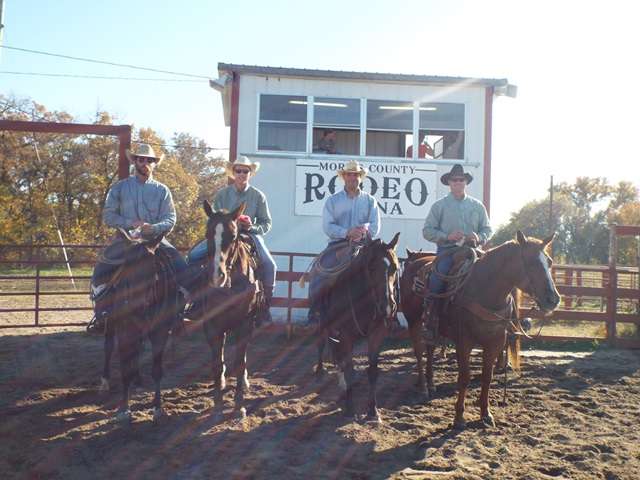
Thomas K. Reed Memorial Ranch Rodeo Champions

0
Photo from Tammie Reed

The Chase County Lonesome Pine Ranch team of Frank Coirier, Jess Coirier, Chris Potter, Troy Higgs and Bud Higgs won the annual Thomas K. Reed Memorial Ranch Rodeo at Council Grove. In memory of Thomas K. Reed, a ranch rodeo participant and enthusiast who lost his life in a ranch horse accident, the competition benefited the Fallen Cowboys Church. Top Hand Award went to Jess Coirier from the champion team. Second place team honors were received by the group representing McGhee Cattle Company from Anderson County, and third place honors were collected by Keith Cattle Company of Lyon County.

Legal issues, family dynamics are part of upcoming farm succession conferences

0
kksu
K-State Research and Extension, Candice Shoemaker

Five conferences are planned in Kansas communities in early 2015.

MANHATTAN, Kan. – Dennis Metz admits it. He was resistant to some of the changes his sons wanted to make on the family’s dairy and crop farm near Wellington, Kansas.

In the late 1990s, Metz was growing crops and milking cows two times a day and thought it was a tried and true way of running a dairy farm. His sons, Dan and Jay came home from college and wanted to try milking three times a day – and to grow cotton – not a crop typically associated with Kansas, especially then. Thinking about how much time and money had been spent on his sons’ education and about how he’d watched other family members struggle as one generation took over the business from another, Dennis relented. The family not only milked three times a day successfully for years until they left the dairy business, but also started growing cotton, which they still do today, along with other crops. Dan and Jay have taken over the day-to-day operations of the farm with their dad’s blessing and support.

The day sons or daughters announce they’d like to take over the family farm or ranch can be a proud one, but can also be fraught with communication challenges, legal pitfalls and differing expectations.

To help Kansas farmers and ranchers with the succession process, K-State Research and Extension and Kansas Agricultural Mediation Services are teaming up with other agencies to offer five “Planning for Farm & Ranch Succession” http://www.ksre.ksu.edu/kams conferences around the state. The meetings are supported by a grant from the North Central Extension Risk Management Education Center, part of the U.S. Department of Agriculture’s National Institute of Food and Agriculture.

Meeting dates and locations include:

  • Jan. 5 – Allen Community College – Iola;
  • Jan. 10 – Pratt Community College – Pratt;
  • Jan. 16 – Kansas Farm Bureau Plaza – Manhattan;
  • Jan. 17 – Flint Hills Technical College – Emporia; and
  • March 3 – K-State Agricultural Research Center – Hays.

The conferences are part of a larger effort to develop a comprehensive succession education and service program, said Forrest Buhler, attorney with Kansas Agricultural Mediation Services. A succession planning website is being developed which will include archived webinars, videos and other educational materials available to the public.

More information, including online registration, is available at http://www.ksre.ksu.edu/kams or by calling 1-800-432-8222. The cost at each location is $60 per person for the first family member to register, and $40 per person for all other family members.

As for Dennis Metz and his wife, Marilyn, they’re enjoying activities with their grandchildren, including following one grandson’s budding bluegrass music career.

Story by: Mary Lou Peter

ATTRA pub helps orchards weather harsh conditions

0

Wheat or corn growers can decide from year to year whether to plant a little late or plant a little early or plant a different variety. But fruit growers can be locked in for decades once they’ve made a decision.

And in what seems to be a time of weather extremes – ranging from long-term droughts to “500-year floods” in back-to-back years – planning can be even more difficult.

A new ATTRA publication, “Climate Change and Perennial Fruit and Nut Production: Investing in Resilience in Uncertain Times,” can help farmers develop strategies for building resilience into their operations.

Because of its long-lived nature, including two, three, or more years of plant growth before bearing a crop, perennial fruit and nut production requires a long-term commitment from farmers. Many fruit and nut crops do not provide a return on investment until several years after planting.

So if bloom times, frost dates, chilling hours, plant stress, disease incidence, and insect pressure become less predictable, growers of perennial fruit and nut crops will find it increasingly difficult to stay in business.

“Climate Change and Perennial Fruit and Nut Production: Investing in Resilience in Uncertain Times” explores the challenges to perennial fruit and nut production and discusses steps growers can take to build resilience into their farming operations through diversification, water stewardship, and soil building, as well as technology, information, and policy.

The publication, and ATTRA’s other resources, are available on the ATTRA website at www.attra.ncat.org.

ATTRA—National Sustainable Agriculture Information Service—was developed and is maintained  through a cooperative agreement with the USDA’s Rural Business-Cooperative Service  by the National Center for Appropriate Technology, a nonprofit organization headquartered in Butte, Montana.

ATTRA has been the nation’s leading resource for information on sustainable agriculture since 1987, covering a wide range of topics, including reducing pesticide use on cropland, promoting food safety in sustainable production systems, reducing farm energy use and costs, enriching soils with the use of cover crops, and providing technical assistance in the growing areas of local farmers markets and urban gardening.

In addition to hundreds of sustainable-agriculture publications, ATTRA’s other popular offerings include a free sustainable-agriculture telephone helpline and the “Ask an Ag Expert” feature on the home page.  It has an archive of webinars and videos generated by NCAT and partnering organizations.

ATTRA also maintains numerous popular databases, including sustainable-agriculture internships and apprenticeships, and is a source for the day’s agriculture news, among other features.