
Thursday, January 22, 2026
Home Blog Page 157

Governor Kelly Updates Declaration of Drought Emergency, Warnings, and Watches for Kansas Counties

0

Governor Laura Kelly has signed a proclamation approving updated drought declarations for Kansas counties.

“Drought conditions have persisted across Kansas through the winter and spring, and we must respond accordingly,” Governor Laura Kelly said. “As we head into the summer months, where we typically see drier conditions, I urge Kansans to consider their water usage and take extra care to prevent wildfires.”

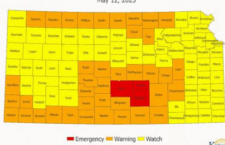
The drought declaration placed three counties into emergency status, 39 counties into warning status, and 63 counties into watch status. This action was recommended by Connie Owen, Director of the Kansas Water Office and Chair of the Governor’s Drought Response Team. Precipitation totals have varied widely across Kansas in recent weeks, with some eastern and southeastern counties receiving heavy rainfall that temporarily improved surface moisture, while central and western regions continue to experience worsening drought conditions. Despite these isolated rains, much of the state remains below average for cumulative precipitation, with ongoing deficits in soil moisture and declining streamflows.

“While we’ve seen precipitation in various regions of the state this spring, the long-term effects of drought have prevented improvements in the overall conditions,” said Connie OwenDirector of the Kansas Water Office and Chair of the Governor’s Drought Response Team. “The Governor’s Drought Response Team will continue to monitor the drought conditions across Kansas and make recommendations to Governor Kelly as conditions change.”

Through an interagency agreement between the Kansas Water Office, the Kansas Department of Wildlife and Parks, and the Kansas Division of Emergency Management, counties in the emergency stage are eligible for emergency water use from certain state fishing lakes and some federal reservoirs.
Individuals and communities must contact the Kansas Water Office for a water supply request before withdrawing water from lakes. These requests will, in turn, be referred to the appropriate office to obtain the necessary permits to withdraw the requested water.

This proclamation shall remain in effect for those counties identified until rescinded by a proclamation ending the declaration or revising the drought stage status of the affected counties.

Effective immediately, the proclamation:

  • Declares a Drought Emergency, Warning, or Watch for the counties as identified below;
  • Authorizes and directs all agencies under the jurisdiction of the governor to implement the appropriate watch, warning, or emergency-level drought response actions assigned in the Operations Plan of the Governor’s Drought Response Team.

The Governor’s Drought Response Team will continue to watch the situation closely and work to minimize the negative drought-induced effects on Kansans. Kansans are encouraged to report drought-related conditions and impacts in their region through the Condition Monitoring Observer Reports (CMOR) system.

For more detailed information about current conditions, visit the Climate and Drought webpage on the Kansas Water Office website at kwo.ks.gov.

County Drought Stage Declarations:

Drought Emergency: Harvey, Reno, Sedgwick.

 Drought Warning: Barber, Barton, Butler, Chase, Clark, Clay, Cloud, Comanche, Cowley, Decatur, Edwards, Grant, Greenwood, Hamilton, Harper, Jewell, Kingman, Kiowa, Lyon, McPherson, Marion, Marshall, Meade, Morton, Norton, Pawnee, Phillips, Pratt, Rawlins, Republic, Rice, Rush, Seward, Smith, Stafford, Stanton, Stevens, Sumner, Washington.

Drought Watch: Allen, Anderson, Atchison, Bourbon, Brown, Chautauqua, Cherokee, Cheyenne, Coffey, Crawford, Dickinson, Doniphan, Douglas, Elk, Ellis, Ellsworth, Finney, Ford, Franklin, Geary, Gove, Graham, Gray, Greeley, Haskell, Hodgeman, Jackson, Jefferson, Johnson, Kearny, Labette, Lane, Leavenworth, Lincoln, Linn, Logan, Miami, Mitchell, Montgomery, Morris, Nemaha, Neosho, Ness, Osage, Osborne, Ottawa, Pottawatomie, Riley, Rooks, Russell, Saline, Scott, Shawnee, Sheridan, Sherman, Thomas, Trego, Wabaunsee, Wallace, Wichita, Wilson, Woodson, Wyandotte.

Home alone for the summer: Is your child ready?

0

Parents considering allowing their child to stay home alone this summer may have visions of “Home Alone” protagonist Kevin McCallister fighting off the Wet Bandits or getting into other mischief. With the end of the school year approaching, it’s crunch time for parents to make summer plans for their children.

There is no magic age for a child to stay home alone during the summer, said Lisa HamblinOklahoma State University Extension family and consumer sciences educator in Oklahoma County.

“A good rule of thumb is age 12, but parents need to look more at maturity,” she said. “Look at their level of maturity, responsibility and independence. Some may be ready at 12 years old, but other children may not. Being home all day is much different than a couple of hours after school or while a parent runs errands.”

Hamblin said signs of maturity include getting themselves up in the morning and ready for school, finishing homework and completing chores with little parental prodding.

Although parents might welcome the thought of no summer child care expenses, it’s important to talk with children to make sure that staying home alone is something they want to do.

“Sometimes, a child may be anxious at the thought of staying home alone while their parents are at work,” she said. “If the anxiety is too much, consider waiting until next summer, or look into alternatives.”

Hamblin offers some suggestions to help prepare a child to stay at home:

  • Parents should work up to leaving their child home alone all day. Do some test runs during the weekend for a few hours at a time.
  • Role-play. Go through different scenarios such as someone knocking on the door, a storm rolling in, the electricity going out or the child getting hurt. Have a plan in place for each scenario.
  • Discuss house rules. Can the child have friends over to play? Is the child allowed to ride their bike to the park, a friend’s house or to the store? Consider a tracking app on the child’s phone to know where they are.
  • Talk about kitchen safety and what appliances the child can use. Plan meals and snacks that are easy to prepare. A fun weekend activity could be preparing healthy snacks for the weekdays.
  • Have a list of emergency contacts on the refrigerator. Discuss the different types of emergencies that may arise and what could require a call to a neighbor or 911.

If the older child is responsible for younger siblings, that adds an extra layer to the summer equation. Taking care of younger children requires additional training. County OSU Extension offices or other organizations may offer a babysitting class to teach older children skills needed to look after younger children safely.

“It’s important to find things to help fill up their day. Simple chores such as emptying the dishwasher, taking out the trash and even light housekeeping will give them something to do,” Hamblin said. “Establish rules about how much television and computer time will be allowed. Be sure to have parental controls set on the computer, tablet or phone.”

“Staying home alone definitely depends on the maturity of the child,” said Tracy Stevens, who started letting her daughter stay home in the summer at age 12. “We discussed the house rules and expectations ahead of time, and we felt comfortable with our decision. The skills and confidence she developed staying home by herself for a few summers will help her this summer as she cares for a couple of neighborhood kids.”

Hamblin also suggests checking into what day camps are available in the area. Various organizations host programs for different ages. Also, find out what summer programs are available through the public library or the county OSU Extension office. Most library offerings are free. Coordinate with other parents to share transportation responsibilities.

“Summer care isn’t a one-size-fits-all for every family, and what works for one family may not work for another,” she said. “Talk with your child and involve them in the decision-making process to help make the summer as safe and fun as possible.”

‘Adapt or die’: Farmers in western Kansas consider alternative crops to save water

0

Western Kansas is running out of the water needed to fuel irrigated agriculture. Why is it so hard for farmers to switch to alternative crops?

GRAY COUNTY, Kansas — In dry western Kansas, the sound of artificial rain spraying from center pivot irrigation sprinklers fills the spaces between the small towns.

Irrigation has turned this region into a productive agricultural powerhouse, churning out millions of bushels of grain.

Heath Koehn farms with his dad near Montezuma over the Ogallala aquifer that supplies farmers with irrigation and communities with drinking water. He knows that changes are coming to the way they farm.

“Changes are going to have to be made with that aquifer. It’s like adapt or die,” Koehn said.

A lot of farmers in the area feel the same way. The underground water supply that used to be plentiful is running dry fast. Some areas might only have a couple of decades left at current pumping rates.

In order to maintain life in western Kansas, farmers are contemplating pivoting to crops that use less water.

Koehn decided for the first time to grow something he’s never grown before: canola. He grew this instead of wheat due to wheat prices being so low. 

“I’ve got some limited irrigation. I wanted to diversify and not just have all my eggs in one basket,” Koehn said.

That change might sound minor, but it’s a herculean task. The major systems that make up the complicated agriculture web are all built around irrigated commodity crops like corn, wheat and soybeans.

Growing anything else is rare because it comes with more risk and no guaranteed crop insurance or local buyers.

Koehn’s farm is an example of southwest Kansas farmers looking to the future and trying new crops to save water and prepare for western Kansas to become more parched.

What can we do?

The main problem lies within the crops that farmers grow. Traditional crops like corn and soybeans require a lot of water. The Kansas Geological Survey that monitors the underground water in the state estimates that 70% of the aquifer will be gone in 50 years.

Statewide, the amount of water pumped from underground and sprayed onto crops averages out to more than 2 billion gallons per day.

But Kansas State University has studied different crops that require less water and could be viable options in western Kansas.

Logan Simon, agronomist for K-State Research and Extension, said the western Kansas environment requires greater creativity from those in agriculture.

“All of the crops that we’re looking at here are going to be providing some sort of benefit in the form of a reduction in the water required,” Simon said.

Earlier this year, Simon hosted alternative crop schools around western Kansas, offering information on what options farmers have. The standout choices are canola, cotton, camelina and cowpeas, which include black-eyed peas.

These crops not only require less water, but they can be harvested with equipment farmers already have and fit the same uses. Almost all commodities grown in western Kansas are for cattle feed or biofuels.

“The idea is not necessarily to replace all of these things, but provide alternatives to just build a more robust system,” Simon said.

A canola crushing plant opened last year in northwest Kansas giving a new market to farmers.

Canola compared to a crop like corn needs about 40% less water.

Not only does this save dwindling water supplies but it diversifies how farmers make their money. Instead of just one industry like livestock feed, a farmer can sell their products to multiple industries. The crops can be used for human consumption, biofuels or making textiles.

The problem with alternative crops

Alternative crops sound like they can solve all the water problems on the frontier. But so far, farmers aren’t giving up their acres of corn and wheat for peas and canola.

That’s because farming at the end of the day is a business. Farmers need to plant what will turn a profit.

“Imagine that you just couldn’t make a salary this year,” ag economist for Iowa State University Chad Hart said.

In the current agricultural system, commodity crops like corn and soybeans are the most economically efficient, despite their water inefficiencies. Farmers really don’t have much of a choice if they want to make money.

“You have to be willing to accept more risk to establish that alternative crop, because there aren’t these built in mechanisms that we usually have,” Hart said.

The agriculture system is built to avoid risk. Crop insurance, government subsidies and bank loans are all built around corn and other traditional commodity crops, not the possible alternatives.

Southwest Kansas is one of the most profitable regions in the state because of irrigated agriculture from the aquifer.

Corn profits can range to $160 per acre, while canola in a good year can hit $150 per acre.

But corn has a stable market and is heavily supported by crop insurance. With a crop like corn, a farmer in southwest Kansas might lose more water, but at least they can guarantee some income if there’s a drought or hailstorm. And they know that the local feedlots, grain elevators and ethanol plants will gladly buy their corn.

The same cannot be said for a cowpeas or canola.

“Just because you grow it doesn’t mean you’ll have customers,” Hart said. “Farmers have to spend more time thinking about how to market that crop.”

And local communities do not want to stop irrigating altogether. Irrigation brings in more money to farms, and to all the things the farm touches. The local grain elevators, the feedlots, the truck drivers and the meatpacking plants.

How did we get here

Congress first authorized federal crop insurance in the 1930s to help agriculture recover from the Dust Bowl.

It started as a way to compensate farmers if a natural disaster struck and ruined their crop yields, which farmers still need today.

But it also makes it harder for farmers to practice water efficient farming. For example, if for whatever reason an irrigated crop fails, farmers aren’t allowed to stop irrigating the failed crop because they need to prove they weren’t at fault for the crop failure. These “Good farming practices” are standards that guide crop insurance payments.

And crop insurance and subsidies are no small thing.

In 2025, government payments are projected to make up 23% of the total net farm income, a significant increase from 8-9% annually between 2022 and 2024.

According to Iowa State Research Extension, approximately 90% of acres growing corn and soybeans were insured using federal Revenue Protection programs.

Not only does this protect the farm’s physical crops, but also all but guarantees a farmer will be paid even if the price for these commodities dip.

In 2024, the U.S. paid farmers over $2 billion to grow corn through the Emergency Commodity Assistance Program.

Times are changing 

But farmers don’t want to only depend on crop insurance, they want to grow successful crops.

Alex Millershaski, a farmer in Gray County, has seen a massive change over the years when it comes to how much water his land can produce.

“We used to have twenty-something wells on the farm, and we’re only pumping four now,” Millershaski said.

Millershaski is still skeptical of growing alternative crops, but having less water available is making him consider trying something different.

He has seen some neighbors try canola and cotton. And he thinks next year he will give canola a try in place of his usual wheat crop.

Canola doubled in acres planted last year in Kansas to 3000. And while cotton is expected to see a decline across the U.S., Kansas is expected to see almost a 13% increase.

Processors in western Kansas, like 21st Century Bean, make cowpeas more viable. They buy and process wholesale beans for human consumption.

All those factors make Millershaski open to look at the options.

“Do you want to try something different? And it’s sometimes just that simple,” Millershaski said.

Calen Moore covers western Kansas for High Plains Public Radio and the Kansas News Service. You can email him at [email protected].

Lovina Loved Meeting Some More of Her Readers

0

Lovina’s Amish Kitchen
Lovina Eitcher,
Old Order Amish
Cook, Wife &
Mother of Eight

This is Monday morning and we have entered the month of May. I need to wash laundry today and so far it doesn’t look too nice outside weatherwise. I am hoping the rain holds off until I get the clothes all dried. Yesterday was a rainy day. 

Verena left Tuesday evening and came home last night (Sunday). She traveled with Daniel Ray’s family to Iowa, an eight-hour drive, for his cousin’s wedding. She was glad to be able to meet a lot of his relatives such as his grandparents, uncles, aunts, cousins, etc. I am glad she was able to go but I really missed her here at home. 

Friday morning my friend Ruth came to pick up my husband Joe and I. Then we stopped to pick up son Joseph and Grace. We traveled to Ruth’s house, around 2 hours, then she made a delicious lunch for us. We then headed for Kankakee Illinois Public Library. I signed books from three to five pm. Thanks to all the readers who came to meet me and support me. I hope you enjoy your cookbooks. Sometimes I feel like giving up writing this column each week. Then I talk to you wonderful readers and all the encouragement you give me. It makes it all worth my time and effort to write each week. I must also thank Ruth for making this all possible. She was a great hostess and we really did enjoy our stay at her house. I could never repay her for all she has done for us. God bless her kind heart. I was really glad I could see some of her grandchildren again. My how they have grown. Such a beautiful family she has. 

Saturday we all went to Crown Point, Indiana to sign cookbooks from nine am to three pm with Shipshewana on the Road. There were over two hundred vendors and it was an interesting day. This was located at the fairground. I was happy Joseph and Grace were along to help out. We met many wonderful readers and also some we had met already. A reader even traveled five hours from Ohio. Bless her heart!

Yesterday was the funeral of Joe’s 89-year-old Aunt Christine from Salem Indiana. We were unable to go to the viewing/visitation or funeral. Now, this morning we received news of Joe’s uncle Joe’s death. Uncle Joe is 90 and married to Joe’s mother’s oldest sister Maryann. She isn’t in the best of health either, she is also 90. Joe and Maryann lived beside Joe’s family when he was growing up. They have many memories of living there. 

Plans were to attend the wedding of Devon, son-in-law Ervin’s brother, and Karen in Nappanee on Thursday. If the funeral ends up being Thursday we will probably go there instead. Joe and Maryann live in the Berne Indiana community, 2 hours from here. They have eleven children and spouses and many grandchildren and great grandchildren. 

Tomorrow morning daughter Susan will leave her three youngest boys Ryan, Curtis, and Ervin Jr here while she goes to help prepare food for the wedding in Nappanee. 

Friday daughter Elizabeth will leave her two youngest daughters Allison and Andrea here while she goes with Abigail and Timothy (TJ) on a field trip. Daughter Susan is also planning to go along on this field trip with Kaitlyn, Jennifer, and Isaiah but her husband Ervin will be home to watch the boys.

Son Benjamin mowed our grass for the first time this year. We still have some yard clean up to do yet from the recent storms. We have six and a half weeks left before Verena and Daniel Ray’s wedding day. The time will go faster than we want it to. I need to get started on the grocery list and we need to get the rest of the invitations sent.

I will share the recipe for zucchini bars this week.

On Mother’s Day, we lift up everyone who loves with a mother’s heart – those who are mothers, those who long to be, those who have lost, and those who nurture others with compassion and grace.  We honor and celebrate all of you!

God’s blessings! 


ZUCCHINI BARS

1 ¾ cup all-purpose flour

1 ½ teaspoon baking powder 

¾ cup butter 

½ cup sugar 

½ cup brown sugar, packed

2 eggs

1 teaspoon vanilla 

2 cups shredded zucchini 

¾ chopped walnuts, optional 


Grease a 15x10x1 inch pan. Set aside. 

In a small mixing bowl, stir together flour and baking powder. Set aside.

In a large mixing bowl mix butter and sugars, beat until fluffy, add eggs and vanilla and beat well. Stir in flour mixture. stir in zucchini and nuts. Spread evenly in the prepared pan. Bake in a 350-degree oven for about 30 minutes or until a toothpick inserted near the center comes out clean. Cool completely in a pan on a wire rack. 

Drizzle cinnamon frosting. Cut into bars. Makes 36 bars.   


CINNAMON FROSTING

In a large bowl beat till smooth:

2 cups sifted powdered sugar 

2 tablespoons milk

2 tablespoons butter, melted

1 teaspoon ground cinnamon 

1 teaspoon vanilla


Lovina’s Amish Kitchen is written by Lovina Eicher, Old Order Amish writer, cook, wife, and mother of eight. Her three cookbooks, The Cherished Table, The Essential Amish Cookbook, and Amish Family Recipes, are available wherever books are sold. Readers can write to Eicher at Lovina’s Amish Kitchen, PO Box 234, Sturgis, MI 49091 (please include a self-addressed stamped envelope for a reply); or email Questionsforlovina@gmail.com and your message will be passed on to her to read. She does not personally respond to emails.


NOTES TO EDITORS: text=860words; end material=80 words 

Contact: [email protected] or 708-466-0471

Research and Extension offices team up to host tractor safety training

0

KINGMAN, Kan. — K-State Research and Extension offices in Kingman, Pratt and Reno counties, in cooperation with Kingman and Reno County Farm Bureau organizations, will once again offer “Tractor Safety” training for area youth.

The course, federally required for youth ages 14 and 15 who plan to work for someone other than a parent or grandparent, will be held Tuesday, May 27, at the Livingstons Community Building, 1830 N. Main St., in Kingman.

Organizers emphasize the importance of the training, noting that farmers who hire youth without proper certification could face stiff penalties. Safety remains a top priority as many teens embark on what will be their first job experiences.

Due to updated U.S. Department of Labor requirements, the training now includes expanded practicum hours totaling 24 hours. To receive certification, participants must complete all online quizzes, worksheets and video assignments; attend the full in-person session on May 27; and complete six hours of tractor and implement training with a parent or employer.

Registration, along with a $15 fee, is due by Thursday, May 16. Sponsorships may be available to county residents; youth are encouraged to contact their local Extension office for more information and to begin online coursework early.

or more details or to register, contact the Kingman, Pratt or Reno County Extension offices:
Kingman County Extension Office 620-532-5131 or [email protected]
Pratt County Extension Office 620-672-6121 or [email protected]
Reno County Extension Office 620-662-2371 or [email protected]