Saturday, January 24, 2026
Home Blog Page 190

Lettuce Eat Local: Tahini Fits To A T

0

Amanda Miller
Columnist
Lettuce Eat Local

Many years ago, I formulated a personal food-compatibility theory: give me any food, and either — if not both — peanut butter or black pepper could go with it. (Or chocolate, but that’s a given.)

It might not be a match made in heaven every time, and the food might not be actually enhanced by the addition, but it could still work. You try it — salmon (pepper), marshmallows (peanut butter), celery (either). Something like mangos could still seem a little tricky, until I think of any Asian-style coleslaw with mangos and peppery peanut dressing, and there we are. 

You have to really like pepper and peanut butter for the hypothesis to ring true, of course, but if you’ve noticed my email address or seen me unscrew the top of the pepper shaker at a meal, you can guess how I feel. 

I still maintain my theory’s reliability, although I have to admit with only a slight cringe that my devotion to peanut butter has shifted to a different nutty spread in the past years…hello tahini. Tahini, though it tastes nutty, is not made from nuts, but rather from sesame seeds. The seeds are hulled, lightly toasted, and ground into a creamy, thickly pourable paste. It’s earthy, savory, toasty, and somehow addictively appealing to me. 

Brands definitely differ in quality, and if you’ve had a not-so-good experience, I completely understand. Some tahinis I’ve sampled can have a pasty mouthfeel, or can leave you with a bitter aftertaste. Many are unsalted, and like many good things in life, seriously benefits from a proper addition of salt (I typically stir some right into my whole jar, and then garnish whatever I’m eating with more coarse salt). 

But good tahini, mmm, it speaks my language. Maybe it’s the sign of some sort of nutritional deficiency or mental unsteadiness, but often if I get the thought of tahini in my head, it’s very hard to shake; I will put it into or with or on anything, including simply a spoon. Tahini is my new peanut butter.

Add it to the title of any recipe, and I suddenly want to make that. A quick search on my Pinterest serves as an illustration of my appreciation of this sesame paste, with pages of pins on anything from dijon tahini dressing and roasted vegetable tahini curry to tahini date milkshakes and sriracha tahini fudge. It’s so distinct and yet so versatile; I want it in all the ways.

I liken my response to tahini-related stimuli as to the contagion of yawns. Some people are particularly susceptible to catching a yawn when they see someone else yawning, and I have it so bad that even typing this I’ve had to yawn multiple times. I’ve heard it said that there is a positive correlation between empathy and yawning contagion, and I try very hard to be empathetic — and apparently I am also tahini-pathetic, without trying at all. I see tahini; I need tahini. 

Great, now I’m afraid I’ve done something very unhelpful to myself. Now I have to yawn when I think about tahini. Now pardon me while I go *yawn* get a snack….

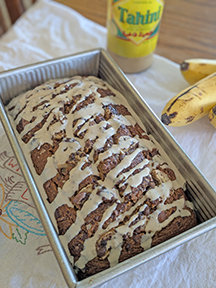
Tahini Banana Bread 

How appropriate — I didn’t think about it until just now, but I literally did replace the original recipe’s peanut butter with tahini here. This is a good starter recipe for those of you newer to tahini, as you can taste it but it isn’t overpowering at all; plus it’s very different from hummus, which is the most common American experience with tahini. Spread slices with more tahini, of course, or cream cheese.

Prep tips: bake in muffin cups if you prefer, reducing the baking time to about 20 minutes. 

½ cup tahini, plus more

12 oz [1 ½ cups] mashed extra-ripe bananas (about 4)

¼ cup ricotta or sour cream

¼ cup local honey

2 eggs

a good splash vanilla

1 ½ cups (freshly-ground) whole wheat flour

1 ½ teaspoons baking soda

½ teaspoon salt

4 oz chopped chocolate of choice

Toss the tahini, bananas, ricotta, honey, eggs, and vanilla into a blender, and process until smooth. Add remaining ingredients and pulse until combined. Transfer to a buttered bread loaf pan, and bake at 350° for 45-60 minutes, until edges are pulling away from sides and center is just set. Finish with a good drizzle of tahini (and some coarse salt if tahini is unsalted).
Preparation for 2025 Kansas Spring Turkey Season

0

Well, March is about to show us whether she will go out like a lion or a lamb, which means the 2025 Kansas spring wild turkey season is in the “wings” (you see what I did there?) If you haven’t already, now is the time to begin preparations. Check out your camo, which seems to shrink each year as you get older. Camouflage is important in hunting most everything, but is probably most important when hunting wild turkeys, as they have eyesight like no other, and can spot suspicious movement from an unbelievable distance.

I’ve never been much of a “purist” in anything I do, but especially not when hunting wild turkeys. The guys that make the videos and sell the calls and other turkey hunting gear often park themselves against a tree next to a clearing. They put their decoy directly in front of them in the clearing and attempt to call the birds into the decoy in the clearing. That makes for really good videos, but doesn’t work for me, as I can’t hold still enough or be quiet enough, long enough to make it work. It was either adapt to my weaknesses or go “turkeyless.” So, I have learned to set myself in some cover along the route I hope the turkeys will travel and put the decoy in front of me but well off to one side or the other, which draws the gobbler’s attention away from me as they hone in on the decoy. This amounts to more of an ambush, but has harvested me more turkeys that trying to be something I’m just not. Also, if morning hunting, be careful NOT to set up too close to their roost, and choose a spot where you can come-and-go without being seen.

Also take your shotgun out and shoot a few shells through it so you know just where it is shooting. That sounds funny, since after all, you are using a shotgun, but trust me when I say, turkeys can be missed. Shells recommended for turkey hunting contain big BB’s so there are way fewer of them in a shell, and they can only wound a turkey all miss altogether because you are shooting at the neck and head, which are relatively small targets. The rule of thumb I have read, is to aim at the point on a turkey’s neck where the feathers begin, that should put BB’s in its head as well as its neck and kill the bird cleanly.

Turkey calling is another contentious subject, especially to the more purist hunters. In my opinion, its good and helpful to study and learn basic turkey calling techniques, but don’t let fear of making the wrong sounds keep you from hunting. While its good to know enough so you are not screaming out bad things about a gobbler’s mother, I feel its much more important to be camouflaged correctly at the right location, be quiet, be still and have confidence in your shooting than it is to be a champion turkey caller.

There you have it as KS spring turkey season is almost here. Turkey numbers in some parts of the state have been on the decline the last few years, but good turkey hunting can still be found. So, get your permit and take a friend or a kid turkey hunting this year. It’s a great way to introduce someone to hunting and to Explore Kansas Outdoors.

Steve can be emailed at [email protected].

Good fire plan goes wrong

0
Thayne Cozart
Milo Yield

Now’s the time of the year when farmers and ranchers in the Flint Hills burn their native tallgrass rangelands.

It’s a necessary smoky task because fire as a necessity if the prairies are to remain productive. Done correctly and timely, the annual burn kills invasive trees like the eastern redcedar and other undesirables like sumac and buckbrush.

The prairies respond to fire by immediately growing back tender green shoots of grasses and forbs that cattle eat like candy and gain weight like crazy. Native Americans knew the value of fire, too, and burned areas near their camps to entice the buffalo to come and graze. Green grass wuz like Door Dash — bringing food to their door.

And, when enuf mature eastern redcedars are burned and killed, rather rapidly the native tall grasses return and the natural springs start running again. Cedar trees are nasty water wasters. The huge wildfire in northern Oklahoma and southern Kansas a couple of decades ago are living testimonial to the restorative value of fire.

Prairie fires can be easy or hard, simple or downright deadly, as recent fires across the Great Plains have demonstrated. Wildfires are terribly hard to control, and dangerous. By contrast, controlled fires, done correctly, have good crew, appropriate equipment, and the crew follows a comprehensive plan.

However, like everything else in life, prairie fires can be humorous, too. Here’s a Flint Hills’ fire story that yields a great mental home video.

The setting wuz Chase County in the middle of the Flint Hills. It wuz in the days before drip torches were being used to start fires. Just plain ol’ sulfur matches were mostly used for fire starters.

The fire crew wuz a motley bunch, who ranged from bowlegged old cowboys with decades of experience with prairie fires, down to young, boisterous whipper-snappers eager to earn their stripes. There were folks in pickup trucks with water tanks and pumps, on tractors with blades and front-end loaders, and a few on horseback.

Several smaller pastures had already been burned and the young’uns were getting impatient. So, one of the rowdy young bucks a horseback volunteered to start the burn in a novel way from his horse. The crew said, “Well, have at it!”

So, the lad retrieved a worn out rubber tire from a pickup, tied a wire around it, tied his rope to the wire, dripped some oil on the tire, and set it on fire.

When the tire wuz burning, the rambunctious rider hopped on his horse, gave a loud “yee-haw,” applied the spurs, and headed off at a gallop along the fence where the plan wuz to start the fire line.

The beginning wuz good. The tire dragging along behind the horse wuz starting the fire line picture perfect. But, then the whole she-bang went haywire. As the horse and rider headed downhill on the first steep slope, the tire got to rolling on its tread and picking up speed. It quickly came hard on the heels of the horse and that started a prairie-fire train wreck.

The horse shied and bucked to evade the burning tire and shed its young rider into the rocks, then headed off pell-mell — erratically zig-zagging around the pasture, spreading fire willy-nilly with every bounce.

The rider quickly put himself safely upwind of the fire and dejectedly headed on foot back to the start, where he knew full well what wuz coming. As he drifted head down into the crowd, he wuz met with every sort of Bronx cheer. “Sure ‘nuf getting the fire started.” “Great idea. You need to patent it.” “What’s your horse’s name again, Flame?” And, so on.

The fire ended up just fine. The crew changed plans and easily contained it. The horse returned unhurt, but with no tire attached.

I guess it wuz examples like this story that brought about the drip torch.

***

Last evening Nevah and I watched the 100th anniversary of the Grand Ole Opry on TV. It wuz a great three-hour show because we both love country/western music.

Current artists saluted Country Hall of Fame members, past and present, by singing the hall of famers’ biggest and most memorable hits. Parts of the show got downright emotional for me and brought a tear to my eye, especially the part involving Randy Travis. Plus, with most country/western songs you can understand the lyrics and they usually tell a story of some kind. That gets a big thumbs-up from me.

The only thing about the anniversary Opry show that I would fault is that not a word wuz mentioned about Mighty Merle Haggard. Seriously, how could he be left out? He’s my all-time favorite C/W singer.

***

I need to explain a needed correction from last week’s column about drilling into the Earth’s hot core to generate electricity. I wrote that the hole needs to be dug with lasers down 12-13 miles.

I should have written twelve to thirteen miles, because when 12-13 miles appeared on paper, the hyphen disappeared and it came out 1213 miles. That’s a difference of about 1200 miles, and it way deeper than the new drilling method can go. Sorry ’bout that.

***

Personal words of wisdom for this week: “Time reveals all and heals all, but it usually behind leaves a scar or scab.”

“Pneumonia Vaccine Saves Lives”

0

Over one hundred years ago, the gold mining industry of South Africa had a problem: too many workers were dying from pneumonia. They turned to Dr. Almorth Wright, a British physician who had successfully created a vaccine against typhoid fever that saved countless lives of British soldiers in World War I and other wars. Wright and his colleagues developed an inoculation of killed pneumococci bacteria which resulted in a substantial reduction of cases of pneumonia and death in the miners.

Pneumonia is an infection in the lungs that causes inflammation and accumulation of fluid or pus, making it difficult to breathe. Pneumonia can be caused by viruses, bacteria, and fungi. Risk factors for pneumonia include old age, young children, smoking, lung diseases such as chronic obstructive pulmonary disease and asthma, other chronic medical conditions, poor air quality, and more.

Antibiotics have been revolutionary in treating bacterial pneumonia, decreasing the rates of death substantially. Unfortunately, antibiotics do not treat viruses, and early use of antibiotics in the course of a virus will not decrease the risk of pneumonia. If someone has cold symptoms, rest, fluids, time, and an expectorant like guaifenesin can be helpful. If symptoms get worse with the return or persistence of fevers, worsening cough, shortness of breath, or chest pain, please seek medical attention.

Vaccines for pneumonia, influenza, haemophilus influenzae (Hib), and respiratory syncytial virus (RSV) have significantly decreased the rates of pneumonia. The pneumonia vaccine is now recommended for infants and young children, all adults over 50 years of age and those with certain chronic medical conditions. The Centers for Disease Control and Prevention (CDC) lowered the age recommendation from 65 to 50 in October 2024 since adults aged 50+ are 6.4x more likely than younger adults to get pneumococcal pneumonia.

The pneumonia vaccine has changed and updated through the years with the types of bacteria that are targeted. If you have already received a pneumonia vaccine, depending on what you have received and if it has been several years or if you have chronic medical conditions, you may want to talk to your healthcare provider about getting a new pneumonia vaccine.

Prevention is the best way to fight disease. To prevent pneumonia, it is helpful to wash your hands, do not smoke, consider vaccination, and help keep your immune system strong by getting good sleep, exercising, and eating healthy.

Andrew Ellsworth, MD. is part of The Prairie Doc® team of physicians and currently practices Family Medicine at Avera Medical Group in Brookings, South Dakota. Follow The Prairie Doc® at www.prairiedoc.org, Facebook, Instagram, YouTube and Threads. Prairie Doc Programming includes On Call with the Prairie Doc®, a medical Q&A show (most Thursdays at 7pm streaming on Facebook), 2 podcasts, and a Radio program (on SDPB), providing health information based on science, built on trust.

KU News: Experts in language promotion, structural biology and extinction receive KU Research Achievement Awards

0

From the Office of Public Affairs | http://www.news.ku.edu

Contact: Vince Munoz, 785-864-2254, [email protected]

Experts in language promotion, structural biology and extinction receive KU Research Achievement Awards
LAWRENCE — University of Kansas researchers expanding knowledge of language acquisition, protein structures and extinction have received this year’s Steven F. Warren Research Achievement Award and the KU Research Staff & Postdoctoral Achievement Awards.


The annual awards recognize outstanding unclassified academic staff, unclassified professional staff and postdoctoral fellows whose research significantly influenced their fields and expanded intellectual or societal insights. This year’s recipients:


Kathryn Bigelow, associate research professor, Juniper Gardens Children’s Project, Steven F. Warren Research Achievement Award

Scott Lovell, director, Protein Structure and X-Ray Crystallography Laboratory, Research Staff Achievement Award

James Saulsbury, postdoctoral researcher, KU Biodiversity Institute & Natural History Museum and ecology & evolutionary biology, Postdoctoral Achievement Award.

The three will be recognized at a ceremony this spring along with recipients of other major KU research awards.


The Office of Research established the Steven F. Warren Research Achievement Award in 2006 to honor unclassified academic staff researchers. Winners receive $10,000 in research funds. The KU Research Staff & Postdoctoral Achievement Awards were established in 2018, with honorees receiving $5,000 for approved research or professional development activities.


Kathryn Bigelow

Bigelow is an associate research professor at the Juniper Gardens Children’s Project, a community-based translational research center under the KU Life Span Institute. Her work focuses on developing and evaluating technology and practices that support children’s language skills and social-emotional development.


Her efforts touch numerous disciplines, which is evident by the wide range of agencies that have funded her work. Bigelow has received grants from the U.S. Department of Education, the National Science Foundation and the Centers for Disease Control & Prevention. She has also been funded by state governments and private foundations. Bigelow has been a principal investigator or co-PI on 20 projects and has published over 40 articles, co-edited three books and is the lead author on the Teaching Pyramid Infant-Toddler Observation Scale (TPITOS), one of the few tools that measures the quality of classroom environments as they relate to social-emotional development.


Bigelow is committed to translating her research into practice. While TPITOS is primarily aimed at educators, Bigelow has developed tools that can be employed easily by parents and caregivers. One tool is called Promoting Communication Tools for Advancing Language in Kids, an intervention that supports parents and caregivers in their interactions with infants and toddlers.


Another tool co-created by Bigelow is Talk Around Town. This mobile app uses the GPS on a parent or caregiver’s phone to deliver location-specific prompts with ways to increase language-learning opportunities for infants and toddlers.


Bigelow earned a bachelor’s degree in psychology from California State University and a doctorate from the University of Kansas.


Scott Lovell

Lovell is the director of the Protein Structure and X-Ray Crystallography Laboratory, which is a core lab that determines the three-dimensional structures of proteins for academic and private-sector researchers. He has been the director since 2008.


Lovell’s collaborative mindset has led to a highly prolific career. He has contributed to the work of more than 100 different researchers and experimentally determined over 700 protein structures during the past 15 years. Lovell has written more than 100 peer-reviewed publications and served as either a co-investigator or principal investigator on 13 different federally funded projects totaling over $6 million.


One example of Lovell’s collaborations includes a 12-year partnership with William Groutas, distinguished professor of chemistry & biochemistry at Wichita State University, and Kyeong-Ok Chang, professor in the Department of Veterinary Medicine at Kansas State University. Together they have used structural biology to guide the design of inhibitors that target proteins called proteases, which are a key component in viral propagation. Identifying how inhibitors interact with proteases has helped develop potential antiviral treatments for diseases, such as noroviruses and coronaviruses.


Beyond directly helping colleagues with their work, Lovell has contributed to the education of future scientists. He has trained more than 20 postdoctoral researchers and 60 graduate students on X-ray crystallography and protein analysis.


Lovell earned a bachelor’s degree in chemistry from the University of Nebraska at Omaha and a doctorate in organic chemistry from Purdue University, West Lafayette, Indiana.


James Saulsbury

Saulsbury is a postdoctoral researcher in the KU Biodiversity Institute & Natural History Museum and the Department of Ecology & Evolutionary Biology. His work sheds light on how species adapt or succumb to extinction, especially in the context of environmental change.


Saulsbury is an early career researcher whose published work in the field of paleobiology include contributions on topics such as the evolution of skeletons in marine invertebrates, long-term changes in the global center of species diversity, reconstructions of the biology and ecology of extinct animals, and the population dynamics leading to extinction. Saulsbury’s research contributions have also earned him a position as associate editor of Paleobiology, an esteemed peer-reviewed publication, as well as invitations to speak at institutions such as the Smithsonian Natural History Museum.


While scientists typically evaluate patterns in the fossil record at the level of species, Saulsbury’s recent work attempts to go deeper by explaining and predicting paleontological phenomena from processes affecting populations of individuals. He recently led a study, published in the Proceedings of the National Academy of Sciences, in which he showed younger species are more likely to go extinct. While it was previously thought this would only be possible if there were intrinsic differences in species’ ability to resist extinction, Saulsbury showed how it happens through simple population dynamics: Species originate at low abundance and either go extinct or become abundant enough to resist future extinction.


In addition to research, Saulsbury also helps educate the next generation of scientists. He has taught several biology courses and started a new journal club in the Department of Ecology & Evolutionary Biology, which helps graduate students stay up-to-date on the most recent findings in their fields.


Saulsbury earned a bachelor’s degree in integrative biology from the University of California, Berkeley, and a doctorate in earth & environmental sciences from the University of Michigan, Ann Arbor.


-30-


————————————————————————


KU News Service

1450 Jayhawk Blvd.

Lawrence KS 66045

[email protected]

http://www.news.ku.edu


Erinn Barcomb-Peterson, director of news and media relations, [email protected]


Today’s News is a free service from the Office of Public Affairs