Rhubarb is a perennial vegetable native to Asia. The leaf stalks are used for jellies, sauces and pies.
One of the biggest concerns with growing rhubarb is crown rot. Begin with healthy, disease-free plants, and plant in well-drained or mounded soil.
Use mulch around plants to minimize weeds, but monitor for signs of slugs and snails.
Plant rhubarb crowns from mid-March through early April. Wait to divide existing plants until they are at least three years old and make sure each division has a large “eye” or bud. Plants will decrease productivity if not divided after growing for five to ten years. Dig a shallow trench and bury each plant so the bud is ½ to 1-inch below the soil surface. Space plants two to three feet apart. Gently pack the soil over the plants.
During the first year of growth rhubarb should not be harvested. A few stalks can be harvested during the second year. This will allow plants to become well-established and highly productive. The harvest window lasts about eight weeks.
If seed stalks develop, break them off right away to direct energy to the crown and roots.
Rhubarb leaves contain oxalic acid which can cause sores on the mouth if eaten. The stalks are the only edible part of the plant. K-State Research and Extension Rhubarb
Mid-March to April is planting time for spring potatoes. Begin with disease-free tubers from a reputable source. Potatoes from the grocery store may not produce a large yield compared with certified seed potatoes.
Early maturing varieties, especially in southern Kansas, are best so tuber development is complete prior to the summer heat. Cut the tubers into 1 ½ to 2-ounce pieces, “seeds”, and store in a warm, humid location for two to three days. This time allows the cut to heal and prevents rot.
Plant the seeds in fertile, well-drained soil when it reaches at least 45 degrees F. Seeds should be planted two inches deep and spaced 12 inches apart in rows 3 feet apart. Potatoes require regular watering.
Practice crop rotation by avoiding planting in an area where tomatoes, peppers, eggplant, potatoes or tomatillos have been planted in the past three to four years.
As potatoes develop along the main stem protruding from the seed, pull loose soil up, or apply straw mulch, over the potatoes. This will prevent them from being sunburned. They will be ready for harvest when the vines are about half dead
This Saturday will be a day filled with free gardening information for homeowners and gardeners. has been scheduled for March 8. The Hutchinson Horticulture Club’s “A Gathering for Gardners” will be held at Our Redeemer Lutheran Church. Which is located at 407 East Twelfth Street
It will be at Our Redeemer Lutheran Church at 407 E. 12th, just west of the Kansas Cosmosphere in Hutchinson. After missing two years because of COVID-19, the club resumed having this annual event in 2023.
If not for those two years, this would be the 36th year for this event. Doors open at 8:30 a.m. with the morning session beginning at 9 a.m.
The first topic is “Backyard Chickens”by Patrick Bergkamp, Reno County agriculture and natural resources agent with K-State Research and Extension. Since eggs are so expensive, this might be a project to contemplate. He will cover what a person should consider before purchasing chickens and starting this type of endeavor.
At 10 a.m., the topic “The Sweet Slice of Summer: Growing Tomatoes” in Kansas will be presented by Jason Graves, horticulture Extension agent for Central Kansas District with K-State Research and Extension. This presentation will cover essential tips for cultivating healthy plants, selecting top-performing varieties, and growing tomatoes for maximum flavor. His presentation is for beginners and seasoned gardeners.
The final presentation for the morning begins at 11 o’clock. Calla Edwards, Butler County horticulture agent with K-State Research and Extension, will present “Sedums and other Succulents.”Sedums are known for using less water. In the past few years, the availability of various varieties of sedums and other succulents has increased dramatically. She will share photos of some of her favorites and give suggestions for their use in the landscape.
The afternoon programs will resume at 1 p.m. with Mike DeRee, sales representative for Ball Seed Company, presenting “The Best Annual and Perennial Plants.” He will be looking back through the years and reviewing those plants that have proven themselves as true winners to consider as potential additions to your gardens.
At 2:15 p.m., Kevin Nelson, a master gardener from Douglas County, will address “Gardening as We Age.” This presentation will make the case for the benefits of gardening and will encourage gardeners to continue well into the golden years. He’ll give examples of how to change beds, look at plant choices and tools so a seasoned gardener can still do the most with the space he or she has and the desire to do so.
There will be no charge to attend any of the “gathering for gardeners” programs although registration at the door is requested. Door prize drawings will be conducted throughout the day. This schedule is designed so individuals may attend any or all of the topics.
Although there are not any cases in the area, the Reno County Health Department wants to emphasize the need to be prepared as measles cases and outbreaks have increased in the United States over the past few years. Currently, there is an outbreak in western Texas which has spread into New Mexico, totaling over 120 cases so far. Almost all of the cases have been among unvaccinated children or those who had not received a second vaccination. There has been one child who has died.
Measles is one of the most contagious infectious diseases in the world that can lead to both hospitalization and death. Though symptoms typically include high fever, cough, red eyes, and rash, complications can include ear infections, pneumonia, and acute encephalitis (swelling of the brain).
Per the Kansas Department of Health and Environment (KDHE), only 89% of kindergarteners in Reno County had received 2 doses of the MMR vaccine for the 2023-2024 school year, which is below the target level. According to the Centers for Disease Control and Prevention (CDC), at least 95% of the population needs to be vaccinated for measles or have immunity to the virus to prevent outbreaks and protect vulnerable individuals. With this in mind, the Reno County Health Department is committed to educating the community and promoting measures to strengthen overall immunity and reduce the risk of an outbreak like the one in Texas.
Children should receive 2 doses of the MMR vaccine to be fully protected, one at 12 to 15 months old and the second at 4 to 6 years old. There is a catch-up vaccination schedule if you know your child is unvaccinated or behind on vaccinations. Children between 6 and 11 months old can receive one MMR dose if they are traveling internationally or to an area where there is a known outbreak but will need to receive 2 doses on or after their first birthday. If you were born before 1957 then you are considered to be immune to measles, but if you work in high-risk settings, such as in healthcare, you should consider getting vaccinated. If you received a measles vaccine from 1963-1967, you should check the type of vaccine you received. You may need to receive 1 or 2 more doses to be fully protected. Also, if you have a serious illness that lowers your immune system, such as TB, HIV, or cancer, you should discuss with your doctor your immunity status to measles and if you need additional vaccinations.
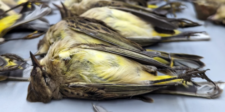
These are some of the approximately 1,000 birds that slammed into McCormick Place in Chicago on Oct. 5, 2023. That was a night and morning when especially high numbers of birds were migrating along Lake Michigan. The building’s windows have since been treated with a film that makes them visible to birds. Very few birds have hit the windows since then.
An ornithologist spent four decades tracking 40,000 bird deaths at a single building. His records paved the way to better scientific and public understanding.
In 1978, David Willard was working at the Field Museum in Chicago when he found out that birds kept slamming into the city’s lakeside convention center.
He began checking around McCormick Place for dead birds, and soon realized the extent of the problem. Over the next 40 years, Willard and his colleagues found 40,000 of them at that site.
“It’s not a building that I think anybody – when it was built – would predict would be a major bird killer,” said Willard, noting that it isn’t a skyscraper. “But it is right on the lake and has a massive amount of glass.”
Migrating birds tended to strike the lakeside building overnight or in the early morning each spring and fall. As they flew along Lake Michigan, the building’s lights drew them in.
The Field Museum’s careful documentation of the situation decade after decade increased scientific understanding and public concern. It helped pave the way for treating McCormick’s windows with a film that makes them visible to birds. That recent change may spare many thousands of the creatures in coming decades.
“In the past, we would watch them fly straight into the window and drop,” said Willard, now retired from his position as manager of the museum’s bird collection. But after the film was installed last summer, “we’d watch them fly in and veer” safely away.
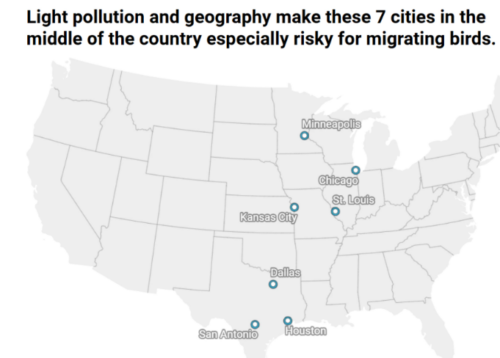
Cities in the middle of the continent, such as Chicago, Kansas City and Dallas, take a heavy toll on migrating birds. For birds, these population centers pose endless hazards right along one of the most important migration corridors on the planet.
But the more scientists learn, the clearer it becomes that options exist to make buildings safer. Those options include reducing light pollution and helping birds see windows as solid surfaces.
Andrew Farnsworth, a visiting scientist at the Cornell Lab of Ornithology, said the efficacy of these options makes solving bird collisions less daunting than many other environmental calamities.
“This one is a pretty easy one,” he said, “in the sense that there are very specific kinds of actions that lead to conservation successes.”
The role of artificial light
The stakes are high for making buildings safer. Scientists believe building collisions in the U.S. alone kill 1 billion birds annually.
“It’s almost unfathomable,” Farnsworth said. “That’s like a bird every 30 seconds.”
Fatalities rise during migration. Most species fly under the cover of darkness. In recent decades, it has become clear that artificial light confuses them.
When a group of scientists crunched the Field Museum’s detailed records of the collisions at McCormick Place, it revealed a telling pattern.
When all of the center’s windows were lit, bird deaths rose tenfold compared to when just half of the windows were lit, Willard and his co-authors wrote in a 2021 study published in the Proceedings of the National Academy of Sciences.
In other words, buildings can be made safer in cases where it’s possible to cut their brightness by closing curtains or turning off unneeded indoor bulbs and facade lighting.
Light pollution poses particular dangers wherever large numbers of birds must pass.
Seven of the U.S.’ top 10 riskiest cities for migrating birds each spring are in the middle of the country, according to a 2019 study published in Frontiers in Ecology and the Environment.
From south to north, these are San Antonio, Houston, Dallas, St. Louis, Kansas City, Chicago and Minneapolis.
The explanation? These cities are situated along a vital migration corridor, said Farnsworth, a co-author on this study and the one about McCormick.
“There is an incredible tailwind scenario because of the way the Gulf of Mexico is positioned,” he said, “and the Rocky Mountains creating these low-level jet streams that are basically like southerly winds blowing from the south that are super supportive.”
On some heavy migration nights, hundreds of millions of birds take advantage of the mid-continent’s winds to move along this route. This journey has served their kind well for millennia, but today they face cityscapes that pose new hazards they didn’t evolve to handle.
Daytime versus nighttime collisions
The North American bird population has shrunk by a quarter over the past half century, scientists estimate. Building collisions are a key reason. (Others include habitat loss, climate change and the decline of insects, for example.)
These fatalities can happen at night or during the day.
Light pollution is the key driver of nighttime deaths, luring birds toward human-made structures.
Daytime collisions often happen because birds see sky or trees reflected in windows or because they spot greenery on the other side of the glass. They then fly toward the glass, unaware that it is a solid surface.
In recent years, a number of high-profile tragedies have drawn attention to the dangers of buildings and glass for birds.
On May 4, 2017, about 400 migrating birds slammed into a single office building in Galveston, Texas. The company that occupied it decided to turn off any unneeded lights, such as facade lighting, during migration season.
A growing Lights Out Texas movement calls on building owners and homeowners to turn off unneeded lights overnight – 11 p.m. to 6 a.m. – during peak migration. Two dozen Texas cities and counties have pledged their help.
Lights Out programs exist in other states, too, and in Canada. A fledgling project called Lights Out Heartland is attracting partners in Missouri, Kansas and neighboring states, including Johnson County Community College, Washington University, the St. Louis Public Library and the Kansas City Zoo.
On Oct. 5, 2023, about 1,000 birds hit McCormick Place. The incident – the worst that Willard has ever recorded at McCormick – prompted the metropolitan agency that operates the building to install the dotted film that now makes the windows visible to birds.
The film cost $1.2 million. Two crews alternated on morning and evening shifts for three months to apply the film to two football fields’ worth of windows.
Last fall marked the first migration season with the treated windows. Field Museum folks typically find hundreds of birds each fall. Last fall, they found just 18 had slammed into the treated windows.
Next they will study whether the trend – a 95% decrease in fatalities – holds up during this spring’s migration.
Separately, some scientists, conservation groups and bird advocates have signed an open letter to the U.S. Green Building Council, asking it to incorporate bird safety into LEED certification – a widely used rating system for designing green buildings.
Farnsworth, at Cornell, said people don’t need to own office buildings or even live in the middle of a bustling downtown to stop birds from hitting human-made structures.
“The notion that the problem is just in cities is wrong,” he said. “Your kitchen window, your living room window, your glass door – whatever it is. When you walk outside and you find a dead bird beneath glass, you can address that.”
That could mean turning off unneeded lights outside your house or drawing the kitchen curtains closed at night. It could also mean making glass visible to birds.
He recommended visiting the American Bird Conservancy website to learn more. Some of the options include window screens, subtle vertical cords, translucent tape stripes and the kind of dotted film used at McCormick.