Monday, January 26, 2026
Home Blog Page 218

How did the Kansas City Chiefs get their name? A fake tribe, a fan contest and Lamar Hunt.

0
Kansas City Chiefs’ third consecutive Super Bowl appearance, the team name, logo, and some problematic fan customs like the “tomahawk chop” are once again being broadcast worldwide. But where did it all start, and how did the team avoid becoming the Kansas City Texans?

If things had gone differently, Kansas City football fans could have been rooting for the Kansas City Texans.

Other ideas on the table? The Kansas City Mules, the Kansas City Stars or — how about the Kansas City Royals, only as a football team?

As the Chiefs have entered dynasty status with more presence on the international stage, local apparel companies have made products featuring made-up mascot names like the Villains or the Chefs.

The origin of the Kansas City Chiefs moniker goes back to 1963, a decision connected to the region’s Native American heritage, a boisterous mayor, a fan-driven newspaper contest, and Lamar Hunt — the man also credited with naming the Super Bowl.

“He loved everything about sports: the competition, the pageantry,” says writer Michael MacCambridge, author of “America’s Game: The Epic Story of How Pro Football Captured a Nation” and “’69 Chiefs: A Team, a Season and the Birth of Modern Kansas City.”

Hunt was the son of a very rich oil man and played football himself.

“He was shy by nature. The place where he found refuge was sport,” says MacCambridge.

In 1960, Hunt started the American Football League and ran the Dallas Texans, one of three pro football teams in the state at the time. Within two years, he realized this was too much competition, and he began casting a net for places to relocate.

Many city leaders saw this as a huge opportunity, and heard Hunt was scouting in places like New Orleans.

“At one point the mayor of Kansas City, H. Roe Bartle, learned that Lamar had been in Atlanta, scouting that out,” says MacCambridge. “He flew directly to Dallas and sat down with Lamar in his office and said, ‘Please consider Kansas City.’”

Mayor Bartle made a compelling case to Hunt: There were no other pro football teams in the area, and the business community would support the team by promising to sell a certain number of tickets.

So Hunt announced he’d move the team to Kansas City.

What’s in a nickname?

Bartle was as big as a linebacker and loved cigars. He was also a lawyer, philanthropist, and had been a leader for the Boy Scouts, where he landed his nickname “the Chief.” Bartle was not Native, but claimed to be inducted into an Arapaho tribe and said he was given the name “Chief Lone Bear.”

It’s just one of the many things Gaylene Crouser takes issue with about him.

“He was the founder of the Tribe of Mic-O-Say, which is not an actual federally-recognized tribe of American Indians,” says Crouser, executive director of the Kansas City Indian Center. “It’s a made up tribe.”

Crouser is a citizen of the Standing Rock Sioux Tribe, Hunkpapa and Oglala, and also a member of the group Not In Our Honor, which has called for decades for the Chiefs to change their name.

The Mic-O-Say group, which still exists in Missouri today, claims on their website they blend aspects of American Indian heritage with the ideals of scouting.

The state of Missouri’s history with Native American tribes is another point of pain for Crouser. The state violently discriminated against tribal people, forced them to relocate, and did not allow them to speak their languages or practice their customs.

“It adds insult,” says Crouser. “The whole fact that not only are you bastardizing our culture, you are doing it in a state that didn’t want us to be here.”

It’s not clear if, at the time, concerns like Crouser’s ever made it to owner Lamar Hunt, the ultimate decision maker. At first, Hunt was set on keeping the name the Texans.

“He felt it was intrinsic to the team’s identity,” says MacCambridge.

Hunt was eventually swayed, and announced a “Rename the Dallas Texans contest” in the Kansas City Star, which received more than 4,000 submissions and more than 1,000 ideas.

If Hunt had gone with the most popular entry, Kansas City fans would be cheering for the Mules.

Instead, he landed on the Chiefs for a few reasons, according to the Kansas City Call: to honor the region’s Native American heritage, because of Bartle’s nickname, and because it was classy, short and would look good in a headline.

Hunt was also the idea-man behind the Chiefs’ red and gold team colors, which were his second choice. (His first choice was Columbia blue and white.) Inspired by the look of the San Francisco 49ers helmets, Hunt created the arrowhead logo with the intertwined letters K and C.

Moving forward and scaling back

Another, more problematic, early Chiefs logo showed a cartoon Native American character in full headdress running across a map of the Kansas City region. The team eventually got rid of that one and, over the decades, have scaled back on other offensive logos and imagery.

But fan practices like the “tomahawk chop,” which started in the 1990s, continue to be a point of frustration for activists calling for change.

The chop and chant got started at Florida State University football games, then the Atlanta Braves baseball team adopted it. Eventually, it was performed at a Chiefs game by a Northwest Missouri State University marching band, and it caught on with fans.

“It’s just unacceptable in this day and age,” says Crouser. “And frankly, Kansas City deserves better than that.”

Twenty years ago, the American Psychological Association released a recommendation that all Native American imagery and mascots in sports should be changed. As a response, sports organizations and teams at all levels have scaled back or completely changed their mascots and logos.

In 2020, the Chiefs organization announced they would ban headdresses and face paint inside Arrowhead Stadium. In 2021, they retired Warpaint, a horse mascot that would run around the field after touchdowns.

Team leaders have said they want to honor Native American heritage of the region, and they formed an American Indian Community Working Group to “promote an awareness and understanding of Native cultures and tribes,” according to their website.

While no real plans for a name change are on the docket, MacCambridge, a lifelong fan, has an idea to throw in the hat.

“I would have no problem being the Kansas City Wolves,” he says.

Crouser offers a different thought, which plays into the original history of the naming of the team.

“Maybe they should, again, do a contest and see where people are with it,” she suggests.

A few years back, the alt-weekly magazine The Pitch asked Kansas Citians for their ideas — from Kansas City Crowns to the Reds.

And who doesn’t get inspired by some of the spin-off schwag fans have taken upon themselves to create — especially those “Chefs” shirts, which are an homage to that original Snickers commercial of the ‘90s.

If there’s one thing to learn from the past, it’s that things like names and trends aren’t set in stone. They can evolve and change.

This episode of A People’s History of Kansas City was reported by Suzanne Hogan, and produced by Suzanne Hogan and Olivia Hewitt, with editing by Luke X. Martin and Mackenzie Martin. 

 

Can Pine Needles Cause Abortions in Cows?

0

Can pine needles cause abortions in cows?  The short answer is “yes.”

Pine needle abortion can cause significant losses for producers, but simple strategies can reduce the risk. Check and repair fences around ponderosa pine trees to prevent losses in your herd, especially during the second and third trimesters.  By excluding pregnant cows, you can avoid devastating losses.

Here are two real-life examples of producers who experienced premature calf losses.

Example 1: The Prairie Blizzard. The four lone pine trees were all that remained from the pioneers who tried to settle on the prairie.  During a recent blizzard that dropped over a foot of snow, it took several days for ranchers to reach their pregnant cows with hay.  With drifts underfoot, the cows were tall enough to reach up and eat the pine needles out of the trees during the blizzard.  A week later, half the cows prematurely lost their calves.

Example 2: The Old Farmstead. A neighbor purchased an old farmstead, which included a pasture where a shelterbelt of trees surrounded the buildings- pine and cottonwood trees.  The buildings and wire fence that kept the cows out of the old shelterbelt had fallen down in disrepair, so the neighbor pulled the fence.  His bred heifers ran there that winter, and more out of curiosity, nibbled on the pine needles.  Several heifers aborted that winter.

Both producers lost calves to pine needle abortions, as the cows and heifers “slinked” or calved too early, and the fetuses died.

Why do pine needles cause abortions in cows?

Since the 1920’s, cattlemen wondered if ponderosa pine needles were causing abortions in their herds. In the 1980’s to 1990’s, researchers were able to determine that ponderosa pine needles did indeed cause abortions in pregnant beef cows.

Compounds in the Pinus ponderosa (or ponderosa pine tree) needles interferes with blood flow to the uterus and fetus, leading to premature births or fetal death.

Both green or dried needles from ponderosa pine trees, if ingested by pregnant cows, can be harmful. Cows would need to eat 3-5 pounds of needles for several days to trigger an abortion.  The later the trimester, the more susceptible cows are to “pine needle abortions.”  The third trimester, especially the last 30-60 days, can cause more abortions than early in the pregnancy.  Low temperatures also seemed to increase pine needle consumption.

What animals are not affected by eating pine needles?

Cows that are not pregnant, steers, and bulls are not affected if needles are ingested, as well as pregnant elk, sheep, or goats.

How to prevent pine needle abortions

What are solutions to avoid pine needle abortion?  The simplest solution is to fence out ponderosa pine trees so that cattle cannot reach the needles to ingest them.

Another strategy is to adjust the calving season, so cows are calving in the summer or late fall, when they are less likely to eat pine needles in their second or third trimester.

Kansas’ Water Problem: Changing minds, changing practices

0

All the snow this winter has helped improve the drought conditions across Kansas. But it’s just the proverbial drop in the bucket of what we need to make sure we’ll still have drinking water for our kids and grandkids, especially in parts of Western Kansas.

The governor and leading Republicans have said securing the state’s water future is a top priority this year. But some say there’s one practice holding up the process.

Drought Conditions

Miller Drilling has stayed busy this last year. One could almost say, too busy. KAKE News caught up with them one day as they were drilling a new well in Hutchinson.

“Basically, they don’t have any water,” said Adam Miller.

It’s a refrain this Central Kansas company has been hearing for years.

“We had a major drought back in 2011 and ’12, and the groundwater never really recovered from that,” he said.

It’s only gotten louder and more persistent recently.

“I think probably since about August, probably a third of our wells have been emergency jobs here. People are flat running out of water,” said Ez Miller. “Forty-nine years since I started drilling, it’s probably about as bad as I’ve ever seen it.”

Retired farmer and current state lawmaker, Joe Seiwert of Pretty Prairie knows exactly what the Millers are talking about. He’s had to re-drill the well for his home multiple times, deeper every time.

“If you can’t get water, what’s your house going to be worth? Who’s going to buy it?” Seiwert asked.

It’s just one of many concerns he has about the falling water levels in Reno County, where his home is.

“Some places, we might have been able to get by with a 30 or 40-foot well, and some of those now we’re going down close to 200 feet,” Adam Miller said.

A recent survey in Wichita showed the top priority Wichitans want the City Council to work on this next year is drinking water.

“We’re still in drought, and obviously worried about going into Phase 3 of drought which could have a huge impact on our economy and our community,” Councilwoman Becky Tuttle said during a recent council workshop.

So it might surprise you to learn, that drinking water isn’t the biggest use of water in Kansas, a state where agriculture runs so much.

Agriculture and Irrigation

“About 83-84% of the water use in the state of Kansas is for irrigation,” said Earl Lewis, director of the Department of Agriculture’s Division of Water Resources. “It is by far our biggest user, and it is primarily the reason that we’re seeing water levels decline in some of those areas.”

It’s an effect Seiwert says he’s seen on his land.

“That river was a huge river,” he said, pointing to what’s now a nearly dry river bed that leads through his land to Cheney Reservoir. “When I was a kid. Grew up in our backyard. You could hardly walk across it, because it was 16-18 inches deep. Now it’s three or four inches deep.”

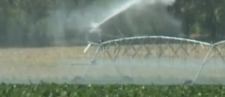
When asked what he thinks has changed, he said, “The 1200 and some irrigation circles in Reno County along the rivers, you know, pulling out a million gallons a day.”

The State’s Fault

He says it’s not the irrigators who are at fault, though, but the State of Kansas.

“It’s not the farmer’s fault. He cannot pump that water without that permit. I can’t put in a well without a permit,” Seiwert said.

Then he repeated himself, “It’s not the farmer’s fault. He is doing what he has to do to keep his water permit. You know? He’s kind of between a rock and a hard spot, too.”

Use it or Lose it

It’s a policy Seiwert refers to as “Use it or Lose it.” If an irrigator doesn’t use all the water their permit allows in a given year, they lose their permit.

It’s a policy Lewis says doesn’t really exist anymore.

“That’s always out there, but it’s really more most, for the most part, myth, in fact,” Lewis said.

That’s because of a 2012 change in the law that allows irrigators to get what’s called a Multi-Year Flex Account, where they get a five-year allocation of water with no limits on what they can use in any one particular year, as long as they don’t exceed the five year total.

“People tend to save about 15% just by having that flexibility,” said Rep. Jim Minnix, R Scott City.

Minnix is the Chair of the Kansas House Committee on Water and a farmer who uses irrigation wells.

“From an economic standpoint, it makes all kinds of sense. If we’re in an extreme drought and someone has already planted corn and invested thousands of dollars an acre in their crop out there…and you want to save your crop, it’d be nice to be able to water it. And then given the next year, if you have more rainfall, higher than average, be able to save some.”

Minnix says his committee is working on adding more flexibility to those accounts. He adds there are also fines in place for people who over-irrigate or wastewater.

“Those have been on the books for many, many years. There’s a mentality of irrigators out there, a small percentage of them, want to pump as much as possible in a given year, whether they need to or not, just to have a high historical pumping usage rate in case they get a 25% cut…from the State of Kansas. That mentality is antiquated,” he said.

Seiwert, who also serves on the Water Committee, says the accounts are a step in the right direction, but not enough. Not yet.

“(When irrigators turn the water on,) we’re pumping a third of the Mississippi every day,” he said. “When they’re using it.”

The Governor’s Take

So while KAKE News was at the Statehouse in January, Senior Political Reporter Pilar Pedraza asked the governor if there was any talk of dropping the water allocations entirely from the permitting process.

“There is talk particularly, use it and lose it. That’s such a dumb thing, so dumb, wherever it is,” Gov. Laura Kelly, D Kansas, said. “That whole use it or lose it has always been bad policy, so we are having conversations with that.”

Lewis pointed out a lot of the issues surrounding water use today came from decisions made generations ago.

“These decisions that led us to this point where we have a declining water situation really were public policy decisions going clear back to the 1950s,” he said.

The question is, will a Republican supermajority get along well enough with a Democratic governor to make changes that could upset some Kansans?

“You have a lot of people who have a lot of skin in that game,” Kelly said. “So it’s sensitive.”

Politics at the Door

But it’s something lawmakers say they’re making progress on.

Minnix said the state has made great advances since 2021, adding that last year the Water Committee got lawmakers to increase funding to water programs in Kansas, programs like loans to small cities that need financial help to upgrade their water systems.

“You heard earlier, $350 million in requests for a… $19 million fund,” said Minnix. “There’s that much demand, even in our small municipals out there to upgrade their water systems, drinking water or wastewater.”

As he spoke to committee members during their first meeting of the 2025 Legislative Session, he asked them to leave their political differences at the committee room door.

“‘I’m asking you, as committee members, to come in this door, leave the Republican/Democrat stuff outside, leave the…rural and urban, everything,” Minnix said. “When we come in here, we’re…working on policy to improve the water situation here in the State of Kansas.”

After the meeting, Minnix said part of the challenge in the committee is educating people with antiquated ideas about water usage.

“The people that are still practicing (use it or lose it) don’t realize what has happened in the last 20 years,” he said. “It’s an antiquated thought pattern and we need to educate them that they’re not helping themselves as much as they think they are.”

“It’s a cultural shift as much as anything,” Lewis agreed, “Getting people to understand they can use less water and still be productive in their farm.”

As reported on KAKE News

Lettuce Eat Local: an Xtra special recipe

0

Amanda Miller
Columnist
Lettuce Eat Local

Let’s pretend it was on purpose. I could have specifically bypassed it for multiple reasons: I thought maybe procrastinating would make it easier; or I wanted to skip it to see if anyone was paying attention; or I liked the idea of adding an extra, bonus recipe at the end.

Or should I say, an eXtra recipe…did you notice that I completely skipped writing about the letter X? And definitely not purposefully, even though the logic would be there if I had. I didn’t even notice my mistake until a friend mentioned it. I had gotten so distracted by the what-I-thought was such a timely focus on yogurt after teaching a class on it that I had gone straight to Y and was already brainstorming Z, without ever considering X.

There are, however, 26 letters in the alphabet, and ignoring one doesn’t mean it disappears. I was afraid I might forget a letter at some point in my journey through them, but I was so close to the end that I let down my guard. Kind of like the photo album I made last year, wherein I apparently got so distracted by November and the appearance and subsequent glut of pictures of our precious Kiah, that I completely missed making pages for September and October. Oops. 

Fortunately, I can fix this alphabetical mistake a little less awkwardly — although finding an X to write a recipe on isn’t the easiest; the classic X is for Xylophone doesn’t work so well here. But we can go eXtracurricular, with a not-for-eating recipe featuring Xylitol: homemade toothpaste. 

Like most words that begin this way, the x sounds like a z; don’t say “ks” or “ex” at the beginning of xylitol. It is a derivative of birch bark, and is often used as an alternative to sugar. While it tastes sweet, xylitol doesn’t cause blood sugar spikes and is less caloric, and instead of contributing to tooth issues, it may actually help protect against dental cavities. It’s quite commonly used in chewing gum, and can also be found in things like medications and oral hygiene products. 

I haven’t used xylitol much in baking or as a sugar substitute, but my son goes through so much gum, I’m very glad if it can help his teeth instead of hurt them. Trust me, he needs all the help he can get; I would rather not discuss how many cavities he has. Kiah is an overachiever and is working on getting her last tooth or two; while she seems way too young to go to the dentist, I hear the earlier kids get teeth the worse they are likely to be, and Benson’s track record isn’t making me feel optimistic. I know bad teeth can be somewhat genetically predisposed, and while he skipped my brown eyes, he apparently inherited my teeth.

Fortunately, both kids also inherited my seemingly paradoxical love for good dental hygiene. I brush and floss multiple times a day, but even I can’t hold a candle to Benson’s and Kiah’s love for toothbrushes. They each have several brushes of their own, and you never know where you’ll find one or more lying about the house. (Toothbrushes, not kids.) Round-handled ones, suction-cup-base ones, battery-powered ones, you name it. It’s a battle every bedtime not to get them to brush their teeth but rather for Kiah not to freak out about needing to use everyone else’s toothbrushes. 

I made homemade toothpaste before kids anyway, but especially since they don’t spit well, I didn’t want them ingesting commercial toothpaste. 

Making toothpaste might seem really “eXtra,” but trust me, it’s so easy. Definitely easier than trying to safely get my kids out of the dental aisle without them grabbing handfuls of new toothbrushes. 


Homemade Xylitol Toothpaste

I’m not a dentist, so of course I should include the disclaimer that I can’t technically vouch for this product’s effectiveness. But I checked with the hygienist and she said it was good stuff, and we sure like how it tastes and feels. I often add some bentonite clay to my mix, hence the grayish color, but that’s totally optional. I could barely get a picture because my kids kept trying to grab all the toothbrushes! We use this in the mornings and “regular” toothpaste at night. 

Prep tips: the texture of this paste varies with the temperature — the coconut oil is more or less solid as it fluctuates. 

⅓ cup baking soda

⅓ cup unrefined coconut oil

2 tablespoons xylitol, to taste

10 drops peppermint essential oil, to taste

Mix-smash all ingredients together until homogenous (I use a spoon and rubber spatula). Taste a smidge and adjust, remembering it’s not meant to be eaten but you do want it to be pleasantly minty and not off-puttingly bitter. Store in a tight-lidded container and use a small spoon to scoop out what you need to brush.