Monday, January 26, 2026
Home Blog Page 219

Gruesome aggie humor

0

At the Old Geezer Gang’s morning coffee gathering, the conversation topics entail the full gamut of “stuff” — from local history and events, to politics, to jokes, to pointed repartee, to discussions about our inevitable aches and pains, and even to our inevitable impending mortality.

Some of the jokes told are too risqué to repeat in my column. Others are gruesome, but still humorous. The following is one of those gruesomely humorous stories.

***

Back in the 1950s, an old tenant farmer went to his eternal reward. His bereaved widow did the best she could afford to make her deceased hubby presentable for the visitation and funeral — she purchased a new pair of overalls to dress him in and a pine coffin to bury him in.

During the evening visitation, the funeral director overheard the widow lamenting that she wished her hubby could have been buried in a nice suit, rather than overalls. So, with discretion he whispered in her ear “don’t worry about it. He’ll look nice tomorrow.”

So, the next day at the funeral, sure enuf, the old farmer lay resplendent in a fancy blue suit in his pine coffin. All the funeral attendees commented about how nice he looked in repose. And, that’s the way he went into the grave.

After the funeral, the widow sidled up to the funeral director and said, “I can’t thank you enough for all the cost and effort you must have gone to get the blue suit on my husband.”

The funeral director replied, “Oh, it wasn’t all that much trouble. I had a wealthy deceased in the back room dressed in the blue suit, and he has no family, and he is going to be cremated. So, I just switched heads.”

***

Chew on this: I read a story that claimed a dog’s life — even if that means joyfully and endlessly chasing squirrels or retrieving sticks — is more meaningful than a dog owner’s life. That claim comes from Mark Rowlands, a professor at the University of Miami.

He claims that, “A dog loves his life with everything he has because it is all he has.” It’s a philosophical message on how we humans can live a more fulfilling life inspired by the unselfish joy dogs experience — even in repetitive tasks such as chasing a ball. The lesson to be learned from dogs in the professor’s deep dive is the love of life and the action a dog experiences in his uncomplicated life.

The author interprets meaning in life as authentic happiness and that the lives of dogs are typically more meaningful and filled with more love than the lives of humans because they are not burdened by personal reflection, self-doubt, and have only one life to live.
I have no idea if the professor is correct that dogs love their lives more than people, but I will say that dogs are almost always happy and that’s not a bad way to be.
***
I never thought I’d see the day when eggs were so scarce and valuable that they’d be the target of thieves, but they are now. Police are scrambling to identify the thieves who poached about 100,000 organic eggs from a Pennsylvania egg producer. The current street value of the eggs wuz estimated at $40,000. Investigators say Pete & Gerry’s Organic Eggs was victimized when one of its distribution trailers was burglarized. Police are looking for the thieves who might be trying to fence 8,333 dozen eggs.
***
Speaking of the high price of eggs. Last week, I gave reasons why governmental “Aggie Executive Orders” won’t work to bring down egg prices. However, common sense inventions could help if they make hens more efficient when squeezing out an egg.
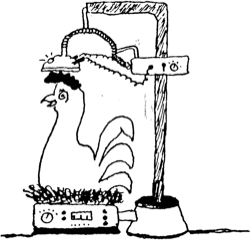
Faithful readers will recall that I long-ago I invented a device that does improve egg-laying efficiency. It’s called the Hi-Volt Egg-O-Matic and here’s how it works.
First off, a hen getting ready to lay an egg really is in no hurry to get her job done. After she selects a nest, she relaxes for a goodly time span, then the takes her own sweet time to gently squeeze her egg out, then she inefficiently wastes several minutes cackling about her achievement. All the while, she is preventing another hen from laying an egg in the same nest.
Well, the Hi-Volt Egg-O-Matic solves that problem once and for all. It’s a nest that is electrified in a manner that when a hen settles down to lay an egg, an electrified “comb-cap” descends upon her head and completes an electrical circuit.
In that brief moment, the electrified nest shocks the shell out of the hen and she leaves the nest, allowing another hen to follow her. I’ve pictured the Egg-O-Matic. I expect sales of it to increase dramatically immediately and help lower egg prices.

Popeye and Testosterone Replacement

0

A few (or more) years ago, Popeye the Sailor Man was an inspirational cartoon character. When needed, the superhero would quickly swallow some spinach and become strong, able to pack a punch that would defeat any evil villain.

Nowadays, TV and internet commercials are encouraging men to consider testosterone replacement as the way to become stronger. While they are quick to tout the benefits, the risks are important and should not be ignored.

Testosterone is the hormone in men that is produced from the testicles. It helps in sexual development in men, libido, erections, sperm production, muscle mass, and bone growth. It counteracts fat mass, stimulates red blood cell production, and plays a role in cognition and mood.

If a man has low testosterone (hypogonadism), determined by at least two early morning fasting blood draws, and they have symptoms of low testosterone, then it is reasonable to consider testosterone replacement therapy. Signs and symptoms of hypogonadism include low libido, decreased erections, loss of body hair, low bone mineral density, gynecomastia (breast development), and small testes.

Symptoms such as fatigue, depression, reduced muscle strength, increased fat mass, and low blood counts can be caused by a wide variety of factors, and should not be reasons alone to consider testosterone replacement.

The best way to increase one’s testosterone is through good old diet and exercise. Studies have shown exercise, strength training, and weight loss all help to increase testosterone levels, oftentimes more than testosterone replacement does. Fat produces a hormone called leptin, which counteracts testosterone. Thus, losing fat and gaining muscle naturally increase one’s testosterone. Meanwhile, a healthy diet and exercise often boost energy, mood, and overall health.

The most effective method for testosterone replacement is by injection. There are also topical gels and patches. Any over the counter supplement that claims to boost testosterone is misleading and unlikely to have any significant effect on testosterone levels.

Risks of testosterone replacement include prostate cancer, heart attacks, strokes, blood clots, acne, breast enlargement, sleep apnea, aggression, and can contribute to an enlarged prostate, which can cause urinary frequency or even urinary obstruction. While natural testosterone stimulates sperm production, testosterone replacement decreases sperm counts, decreases fertility, decreases testicular size, and decreases natural testosterone production.

Testosterone levels naturally decrease as men get older. While some may advertise testosterone as a “fountain of youth,” the benefits are limited in this scenario and the risks increase as men get older. Popeye had the right idea. Putting in the work, and eating some spinach, is likely the better long-term plan.

Andrew Ellsworth, MD. is part of The Prairie Doc® team of physicians and currently practices Family Medicine at Avera Medical Group in Brookings, South Dakota. Follow The Prairie Doc® at www.prairiedoc.org, Facebook, Instagram, YouTube and Threads. Prairie Doc Programming includes On Call with the Prairie Doc®, a medical Q&A show (most Thursdays at 7pm streaming on Facebook), 2 podcasts, and a Radio program (on SDPB), providing health information based on science, built on trust.

Horticulture 2025 Newsletter No. 02

0
KSU horticulture

1712 Claflin, 2021 Throckmorton Plant Science Center
Manhattan, KS 66506 (785) 532-6173

ANNOUNCEMENTS:
Final Countdown!
Horticulture Newsletter Needs Assessment
This is the final month for the Horticulture Newsletter feedback survey. Follow the link below to complete a brief survey. All responses are anonymous. Thank you!
Horticulture Newsletter Needs Assessment

K-State Garden Hour Wednesday, February 5, 2025 12:00 PM – 1:00 PM
Register to attend this free webinar here:
https://hnr.k-state.edu/extension/consumer-horticulture/garden-hour/

Drip irrigation is an effective, easy-to-install and widely available method for enhancing landscapes while conserving water. It delivers water directly to the root zone, achieving over 90% efficiency compared with 50-70% for traditional sprinklers. Join Gregg Eyestone, Riley County Horticulture Agent, to explore water conservation practices and learn more about the benefits of drip irrigation.

Garden Spotlight
In 2024 we began a new feature called the “Garden Spotlight”. We highlighted multiple Kansas gardeners sharing their creative strategies for successful gardening as well as what led them to become a gardener. We know how important it is to learn from each other’s experiences so we’d like to continue offering this feature in 2025. Please consider sharing your garden story with us.

Here’s what it takes:
Email [email protected] with the subject: Garden Spotlight to let us know you’d like to feature your garden in an upcoming newsletter
We will respond to you with a list of questions for you to answer at your convenience.
As we turn your responses into a newsletter story we will send more questions to you, as needed, for clarification.
We will ask for photos to include along with the story.
We will send a draft of the story to you for final approval prior to publishing.
Your story will be published in one of the newsletters bringing joy and motivation to all who read it.
VIDEO OF THE WEEK:
Sowing Success: Research-Based Gardening for Beginners
(K-State Garden Hour January, 2025)

Whether you are a new or experienced gardener our essential guide to growing vegetables is a useful resource.

GARDEN CALENDAR
Start seeds indoors: Cabbage, Broccoli, Cauliflower, Lettuce
Prune fruit trees between Mid-February through March
FRUIT
Planning on Planting Fruit Trees?
Fruit trees are susceptible to many diseases and pests. Take the time to do some planning and give your trees that best chance of success saving you time and money.

Fruit trees require plenty of space in full sun with well-drained soil. Some varieties of trees require multiple plants for pollination while others are self-fruitful.

Here is a guide from K-State Research and Extension for Planning your Fruit Garden.

Small- and Tree- Fruit Cultivars, is another great resource that provides information about types of fruits to consider including their harvest timing, size and pollination requirements.

FLOWERS
Sharing the Love – Valentine’s Day Flowers
If you’re like much of America, you’re preparing to either give or receive a bouquet of roses. Here are some care tips to get the longest-lasting arrangement.
Roses often come in a plastic sleeve which retains moisture. The sleeve should be removed after purchase.
Cut 1½ to 2 inches of each stem with a clean, sharp knife or flower snips. Uncut stems cannot efficiently absorb water needed by the flower to open fully. (Current research suggests that cutting stems under water is not necessary.)
Remove any leaves that will be underwater once stems are arranged in the vase.
Follow directions on flower food packet to mix the right amount of cold water to food ratio into the vase. Flowers need to be nourished. Professional flower food generally contains three ingredients:
Carbohydrate – (sugar) nutritional source
Acidifying agent – lowers the solution pH and improves water uptake
Microbiocides- reduces microbial growth
Arrange freshly cut stems into the vase.
Check the water level daily, repeat steps 2-5 every 2-3 days so flowers last as long as possible. Keep flowers away extreme cold, heat, direct sunlight and sources of ethylene gas (fruits and vegetables). (Irina Sheshukova)

DISEASES/PESTS
Fungus Gnats on Houseplants
Have you noticed tiny insects flying around your home or office? Fungus gnats are common household pests that are quite annoying. Here are some ways to keep them in check.
Water houseplants only as needed rather than on a regular schedule to avoid oversaturating plants and attracting fungus gnat.
Dump water out of the saucer once it drains so plants are not in standing water.
If fungus gnats are already present in your plants, allow the soil to dry at least through the upper three-inches.
For extreme cases, repot the plant in fresh soilless media. Remove as much soil as possible from the plant roots to eradicate the eggs and larvae of the gnats.
Scale Insects
Varying in size and host, scale insects cause damage by sucking sap from plants. Their damage is not restricted to just trees and shrubs. They can devastate crops of herbaceous ornamentals as well. The time for investigating plants for scale is here and early detection is the best way to prevent crop damage.

Many scale varieties have white, tan or brown shell-like coverings that are round or oval in shape. They can blend into the bark so close inspection is necessary. If signs of scale are found, a dormant oil can be used as long as the plant is in dormancy and the temperature is above 40 degrees F. Dormant oils are beneficial because they can combat a wide range of life stages for scale insects. They are less detrimental to beneficial insects because of the application timing and are less toxic than chemical controls. Read more about the use of dormant oils from K-State Extension Entomology.

Here are some resources to check out for more information about specific scale insect varieties and their hosts.
Euonymus Scale
Magnolia Scale
Pine Needle Scale
San Jose Scale

MISCELLANEOUS
Wildlife Management Podcast
Are you looking for a new podcast to follow? Are you wondering what to do about beavers, armadillos or moles?

K-State Research and Extension Specialists, Drew Ricketts and Joe Gerken, have a podcast and YouTube channel that provides Kansans with science-based wildlife management information. New timely recordings are added regularly and you can view the archive anytime.

KSRE Wildlife Management (YouTube Channel)
Fins, Fur and Feathers (Podcast)
QUESTION of the WEEK
Planting Spring-Flowering Bulbs…Still?
I have a bag of tulip and daffodil bulbs in my basement. I meant to plant them last fall but time got away from me. Should I plant them now or wait until next fall?
If the bulbs are still firm, they should be planted now to avoid rotting. They may not bloom this spring, but at least they weren’t wasted. Another option is to force the bulbs to bloom indoors.

Plant them in containers and keep them chilled for the required time which depends on the variety. Then move the containers to a bright room to promote blooming.

For those of you who did get your bulbs planted last fall here are some tips to get the most out of the bloom season.
Deadhead blooms as they fade to prevent seed development and allow bulbs to store more energy for future blooms.
Leaves should be left intact until they die back naturally to allow them to store energy in the bulb.
If leaves emerge from the soil early don’t be too concerned. When freezing temps return the leaves may develop some brown tips but the plants should be fine. If buds emerge you can cover them gently with mulch.

Contributors:
Cynthia Domenghini, Instructor and Horticulture Extension Specialist
Irina Sheshukova, Instructor and Floral Design Extension Specialist
Raymond Cloyd, Professor of Entomology (photos of scale)
Kansas Garden Guide

Division of Horticulture
1712 Claflin, 2021 Throckmorton
Manhattan, KS 66506
(785) 532-6173

For questions or further information, contact your local extension agency.
This newsletter is also available on the World Wide Web at:
http://hnr.k-state.edu/extension/info-center/newsletters/index.html

The web version includes color images that illustrate subjects discussed. To subscribe to this newsletter electronically, send an e-mail message to [email protected] listing your e-mail address in the message.
Brand names appearing in this newsletter are for product identification purposes only. No endorsement is intended, nor is criticism implied of similar products not mentioned.
K-State Research and Extension is committed to making its services, activities and programs accessible to all participants. If you have special requirements due to a physical, vision or hearing disability, or a dietary restriction please contact Extension Horticulture at (785) 532-6173.


Cynthia Domenghini, Ph.D.
Instructor; Horticulture Extension Specialist
Department of Horticulture and Natural Resources
Kansas State University
1712 Claflin Rd.
Manhattan, KS 66503
785-340-3013
[email protected]

‘Recipe for Love’ Strawberry Crepes

0

So; I’m not sharing my new soup recipe this week. It came out just fine, but I’m not sure it displays the quality I like to share, so it is on hold a bit longer. Instead I’d like to focus a little on our upcoming Valentine’s Celebration, tips & ideas to make it a joy for the cook and the recipients.

I’m actually doing a dinner for the event this year. There were a number of reasons why I decided to host a Valentine function. Probably the biggest was my desires for quality and cost. By the time the Valentine dinner is wrapped the bank account will still be in tact, the dinner crowds will have been left behind and the quality of the evening will have soared.

As I always point out ‘simplicity’ is your friend for a comfortable-stress free night of entertaining. Everything on the menu does not have to be made from scratch. In fact, I highly recommend it not be. I recently found a local who sells delicious sour dough (mine is dormant at the moment) and I plan on picking up her bread for my dinner.

You don’t have to make the dessert, it could be purchased from another local individual.

Make as many things in advance that you can. Table decor should be done ahead of time. (I made mine last week.) The fewer do’s for the dinner night the better. Beverages can be ahead of time with small garnishes made in advance. This is a night for real napkins, DO NOT use paper napkins! Strategically place candles around the home, and if weather allows have the fire going. Plan the music while you’re driving to work one morning. Have ‘fresh’ cozy blankets in the living room for dessert and coffee. Also make the bathroom a little special with a fresh flower or candle.

The meal can be as simple as spaghetti, salad and bread or as elaborate as steak and seafood. I’ve chosen shrimp and grits as my

entree with an elaborate salad and bread. For dessert I’m serving 2-3 presentations. One being this week’s feature strawberry crepes. Everything about crepes can be made ahead of time. Be sure and pull out a special plate for the dessert. I use clear glass dessert plates which shows off the dessert nicely.

While many reach for heavier Valentine desserts like cheesecake, (Which can also be made in advance.) heavy chocolates and the like I prefer a lighter approach to the closure of a meal. Don’t think I’d turn down the cheesecake, not happening, Under no circumstances do you use Valentine’s Day or any other dinner party as an experimenting ground for new dishes. This is a time for signature dishes, and no big surprises. Oh boy, I’m going against the grain here, as my shrimp dish will be a bit new, which is why we are having it for just the 2 of us ahead of the dinner party.

This dessert is not difficult, you can make the crepe shells, it just takes time ahead of the event. I’ll be making mine at least a week to 2 weeks ahead of the event; then putting them in the freezer. The filling can also be made 4-5 days before the event, adding the fresh fruit at the end. Let’s get rolling on Strawberry Crepes! Simply yours, The Covered Dish.

Basic Crepe Batter

2/3 cup unsifted flour

2 eggs, lightly beaten

3 tablespoons, cooled, melted butter

1/8 teaspoon salt

1 cup milk or light cream

Oil of choice for cooking the crepe shell

Mix all batter ingredients together with only ½ cup of the milk. Use a submersible blender or small mixer, as ingredients need to be very smooth. After blended well add the remaining ½ cup of milk. Refrigerate overnight or for at least 3 hours. Slowly heat up a 7 inch skillet brushing with the oil of choice. Usually it take me close to 3 tablespoons to cover the bottom of the skillet, lifting and turning to cover. Use medium heat, when lightly brown lift with tongs to turn, browning other side. Remove to cool. Stack with parchment paper or

wax paper between each shell. Should yield a dozen shells.

Cream Filling

8 ounces softened cream cheesecake

1 cup sour cream

6 ounces strawberry yogurt

1 teaspoon vanilla

½ cup powdered sugar

1 tablespoon grenadine

Blend all ingredients until smooth.

3 cups fresh strawberries for fill and for garnishing

Hold back strawberries with stems in tact, for the top garnish.

You will fill the crepe with a row of cream and then layer on a few sliced berries, before rolling and placing on the serving plate. Squirt a little of the filling over the top with an angle cut strawberry, sprinkle with powdered sugar and serve. Other additions could be chocolate, whipped cream, mint leaves, etc.

Yep, ‘A Recipe for Love’.

Our Home on the Prairie

0

If you were anything like me as a kid you probably disliked growing up and living in
“flat, boring” Kansas. As a kid full of  imagination at the possibility of exotic places, my mind was always wandering to the ideas of mountains, oceans, and great tall rainforests. That being said, it’s important to remember that we too come from a place full of wonder and amazement.

While the Great Plains may not look like much to outside eyes, it’s important to remember how our homeland was. We are prairie folk, and the land we come from is home to miles and miles of grassland, agriculture, and the most unpredictable weather patterns in North America. With this past week being Kansas’s 164th birthday, I’d say it’s high time we pay it a little bit more attention.

Starting off with the history of the prairie land. In a time before our grandparent’s
grandparents, the great plains were home to miles and miles worth of natural prairie land.
Occasionally, a tree-dotted the landscape, but for the most part, open grassland was the way of this land. Upon this grassland, we all are well aware of the millions and millions of American Bison that roamed the untamed land. Wind swept through this sea of green completely unobstructed, reaching incredible speeds that we don’t really get with modern wind blocks. That being said, the incredible wind is no foreign concept to us prairie folk.

Additionally, something that people don’t often know about our home is the fact that grass fires were a very natural and vital part of our ecosystem. In ancient times, there were no firefighters to put out said fires, so the ecology of the land adapted to replant itself over and over again, regardless of what setbacks it feels. A trait that is shared by the people of this land.

This land shapes how we feel about our home, but I would venture to say that it also
shapes the way we are as people. The people of the Plains are hardy and have the ability to stick it out in the midst of great struggles, much like the ability of the prairie to survive and come back year after year of fires. We’re hardworking and can weather even the hardest storms. In the prairie, we get the weather of all other lands, and as such, we experience some of the most diverse forms of stormy and clear days. Yet, despite all of that, we’re still here, just as the grassland from years past remained ever-present.

In today’s world, it’s hard to observe the natural prairie. Only 4% of the Great Plains
remains from years past, with a loss of 2.5 million acres of prairie land alone in 2015 and 2016. These natural grassland areas are primarily lost to agricultural expansion, as well as complete disregard for prairie life in general. Instead of cultivating the natural, plentiful plants and grasses of the prairie, we continually plant exotic species such as fescue grass in our lawns, and what for? Foreign grasses and plants may look nice during the fall season, but require incredible amounts of water and force the destruction of natural grassland ecosystems. If you’d like to know more about sustainable planting and lawn use in the Great Plains, please see Dyck Arboretum in Hesston, Kansas.

Overall, we should be proud of the land that we’ve all grown up on and lived off of for
generations. We are prairie folk, and the land we come from is home to miles and miles of grassland, agriculture and the most unpredictable weather patterns in North America. And there is pride in being able to call this place home.