Wednesday, January 28, 2026
Home Blog Page 241

Skating? Try living on thin ice

0

At a glance: Kansas State University fisheries and aquatics specialist Joe Gerken shares how some warm-blooded wildlife sustain themselves during cold temperatures.

More information: Joe Gerken, 785-532-1418, [email protected]

By Jacob Klaudt, K-State Research and Extension news service

MANHATTAN, Kan. – When most elements in nature get colder and freeze, they usually get denser in composition. However, as water approaches its freezing point of 32 degrees Fahrenheit, it transitions from liquid water to solid ice and becomes less dense.

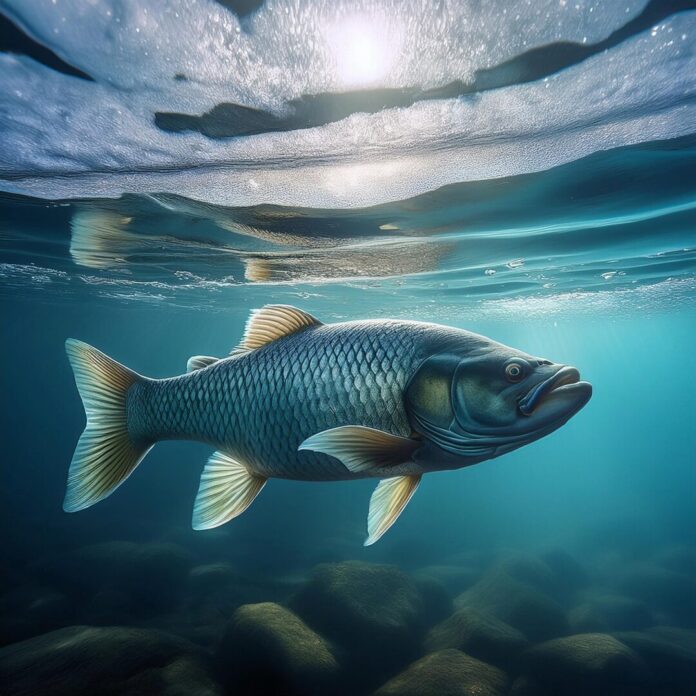
This feature allows ice to float up and warmer water to plunge deeper – a key feature permitting aquatic life to live beneath water in its frozen state.

Freezing conditions and ice have impacts beyond habitat, though, said Kansas State University fisheries and aquatics extension specialist Joe Gerken, noting that many species have uniquely adapted to survive frigid weather.

“In the winter, the densest water is going to be warmer and sit below the ice, so we’re going to start seeing fish that want to be at greater depths,” he said. “Salamanders and turtles are going to tend to go down to the benthos, or the bottom of a pond or stream, and thrive in those deeper habitats.”

Yet, if whole bodies of water freeze, so will fish, according to Gerken. In Kansas, fish have no choice but to seek warmer refuge in deeper habitats, but in places like Antarctica, some aquatic species have evolved to meet the challenges their harsh environment provides.

“There’s a group of fish called the notothenioids that live in saltwater, which can get subfreezing,” Gerken said. “These fish have antifreeze proteins in their blood, which keeps their bodies from turning to ice.”

Besides fish, reptiles and amphibians also have tactics for fighting against the freeze. Specifically, these animals enter a state called brumation – one similar to the process of hibernation observed in mammals.

“We see the amount of oxygen that these animals use decrease to almost nothing,” Gerken said. “Ice can start to form over surfaces of their bodies, and species like to hide underneath mud and bury themselves; they just hang out there and do nothing – not even eat.”

While breathing slows in turtles, it doesn’t completely stop, Gerken said.

“They practice cloacal breathing,” he said. “They put their tails up in the air where their cloaca is, and they breathe. Normally, that’s where waste comes out.”

Cloacal breathing and brumation end when warmer temperatures return with spring days and more daylight.

“Those things trigger these animals to wake up and come out of this situation,” Gerken said. “The animals then start feeding because they’ve used up a lot of their fat reserves. Then they’re going to jump right into breeding season.”

Warmer days in January and February can trick species into exiting brumation earlier than desired.

“You might see them climb up out of a log and try to warm up a little bit,” Gerken said. “Then as soon as those temperatures start to drop again, they say, ‘Hey, I don’t want to be around this and go back to their little hiding spot’ and reenter that dormancy stage.”

He added: “It’s not like it’s they are either entirely in it or out of it; they can peek in and out from time to time.”

According to Gerken, this back and forth can cause confusion about animal activity during brumation.

“They’re still fully alive,” he said. “They’re still moving; they get up and occasionally move from one side of their den to another.”

More information about animals and their winter habits is available online through K-State Extension Wildlife Management.

Related: Fins, Furs, and Feathers podcast | KSRE Wildlife YouTube | Gone Fishin’: Colder months signal new opportunity for anglers in Kansas
Venison or Bologna?

0
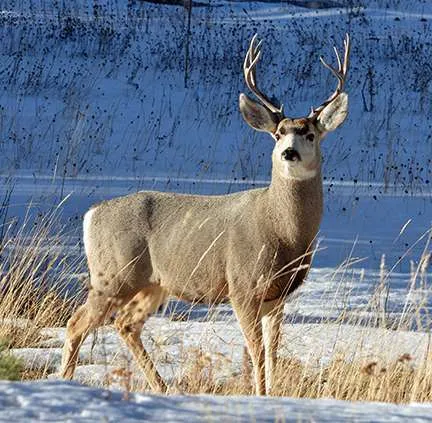
Photo by Steve Adams

As I left our deer blind this morning ahead of the approaching winter storm, the windows of my pickup were already icing over, and my driveway was so slick already, I nearly feel on my butt when I stepped out of the truck at home. That should have answered the nagging question “Did I stay long enough in the blind?” Yet here I sit, a little guy on my shoulder whispering in my ear “What a looser; you should have stayed loooonger!”

This has been a different and exasperating deer season for many hunters in my area. Several local hunters have come away without harvesting deer, as the deer just don’t appear to be here. The moon was full or bright for much of the regular firearm’s season, raising the excuse that the deer were simply moving at night. That coupled with the unseasonably mild weather, makes that theory more than plausible. But an avid deer hunter nearby told me he has seen fewer pictures on his cameras this year than any year he can remember. The 3 years of drought that has plagued our state might also be a factor, as drought affects fawn survival and forces deer to drink from stagnant water holes which foster diseases like Blue Tongue.

Around here, it always seems the nearer the river, the more deer there are. With that in mind, I was given the chance to hunt from a friends raised blind close to the river. He had gotten a buck there opening morning, but for the next several days, I saw a total of two small bucks. The owner even sat with me one morning this week during antlerless season as a second set of eyes, and we saw nothing. The farmer just across the fence had counted 17 in the field well after dark one night as he worked in the field, again, lending credence to the theory that the deer were moving at night. But this morning ahead of the storm, a 13-year-old girl got her first deer from that blind, which happened to be the only deer they saw.

Volumes have been written instructing deer hunters how to have a successful deer season, but try as I might, I can’t find anything consoling those of us who failed to harvest a deer this year, or instructing us how to cope for the next twelve months. So besides giving you the names of the local psychiatrists and advising you to just go out and buy half a hog, I’ll try to offer some advice as coming from a deer hunter who’s been down that “empty freezer” road more than once.

First and foremost, you know how I feel about the term “unsuccessful” as it relates to any hunting trip or outdoor adventure. I live by the cliché that a bad day in the woods is still better than a good day at work or most other places for that matter. I have to remind myself that watching the owl silently land in the tree in front of our blind, or hearing the wailing howls of coyotes help make the morning anything but “unsuccessful.” Failure to harvest a deer doesn’t necessarily mean you did something wrong. If you missed an easy shot or spooked the deer by being seen, smelled or heard, yes, that was your mistake. But things beyond our control affect deer harvests also.

So, here’s my advice to all deer hunters who didn’t connect this year. First, figure out how to correct mistakes that might have cost you your venison, this can include spending time at the range if you missed an easy shot. Secondly, get permission to hunt more property. One cannot have too many places to hunt deer; it’s like having too much

money! The more ground you can hunt, the better the odds of finding deer under any circumstance. Last, and certainly not least, spend time in the field or woods with your binoculars. I grew up hunting Ohio whitetails with a group of guys that included a couple seasoned deer hunters. When deer season ended, it became a tradition to ask each other “Well, are you eating venison or bologna?” Pre-season scouting can often mean the difference between venison and bologna for the next twelve months.

Now that I’ve finished this week’s contribution, please excuse me while I get to work on recipes for my new cookbook, 101 Ways to Cook Bologna…Continue to Explore Kansas Outdoors.

Steve can be contacted by email at [email protected].

Long-ago New Year’s Eve

0
Thayne Cozart
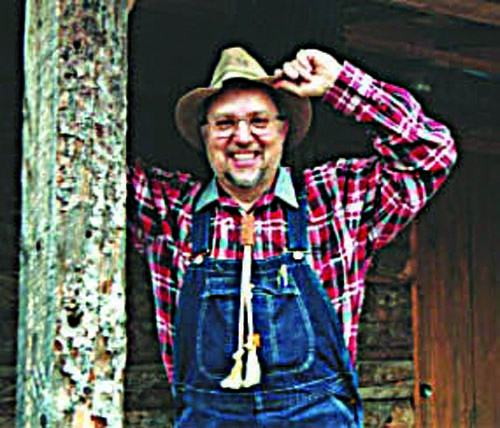
Milo Yield

New Year’s Eve, 2025, has come and gone and I hope you survived the celebration. When I started contemplating New Year’s Eve happenings from the past, I recalled a story I heard not long ago about a good ol’ rural fellow who had a part-time job as the night manager of a commercial bus station in a Kansas county seat town.

The story as told to me is this: This fellow, ol’ Tip D. Flask, liked to hit the bottle. On a New Year’s Eve back in the 1970s, Tip and a younger co-worker, Aiden A. Bett, ended their shift at the bus station after midnight with the task of cleaning the station and closing up for the night.

As told, ol’ Tip began hitting the bottle well before midnight and when the new year rang in, he wuz soused. When they locked the door to the station, Aiden saw clearly that Tip had no bizness driving to his home 15 miles away.

So, Aiden insisted that he drive Tip home. He helped the woozy, wobbly-legged Tip into Aiden’s car and off they went. Apparently, Tip wuz a happy drunk and he sang songs and slurred stories all the way home.

When they arrived at Tip’s home around 2 a.m., Aiden saw a clear problem. Tip’s wife wuz standing on the front porch with her arms crossed. Her stance gave every evidence that she wuz not a happy camper.

Not wanting to get in the middle of a family feud, Aiden unloaded Tip from the car, headed him in the right direction, and then sped away. Once he did that, his conscience kicked in and he told himself, “that’s no way to leave a good friend.”

So, Aiden turned around and went back to Tip’s home with the goal of helping his inebriated friend into the house. When he pulled up next to the Tip’s front yard, he saw Tip on his hands and knees on the lawn with his angry wife standing over him giving him the riot act.

Aiden apologized to Tip’s wife and offered to help get Tip into his bed. The wife agreed that would be helpful.

But, when Aiden tried to lift Tip to a standing position, Tip looked up at him, grinned big, and yelled out, “Don’t stand me up. I’ve got a good grip on the grass so I won’t fall off the lawn.”

At that clever impromptu quip, everyone started laughing — including Tip’s wife. Eventually, they got Tip to bed and everyone survived. But, the story persists.

***

When it came to New Year’s Eve celebrations in my youth, I wuz not a choir boy. One true story, illustrates my lack of common sense and responsibility.

On the New Year’s Eve of my senior year in high school, my pappy, Czar E. Yield, took Mom and headed to her sister’s home in Springfield, Mo. He entrusted me with all the farm choirs, including milking our dozen or so milk cows.

Rather than rein-in my new year’s celebration, I went at it whole hog, I connived an older friend to poach me a bottle of the hard stuff before I went to a dance.

I’ll shorten this story to this. New Year morning I wuz so hung-over that I could not properly milk or feed the cows. That evening, I finally got all the chores caught up, but I think ol’ Czar knew the truth behind the shortage of milk in the milk cans.

But, he never accused me of anything. Perhaps, from his callow-youth, he had a few “best forgotten” new year’s story or two in his past.

***

OK, let’s get serious for part of this column. Economists seem to agree that massive tariffs on many imported goods and services into the U.S. — as promised by soon-to-be-president Donald Trump –will wreak havoc on the national economy. The reason — they say the tariffs will negatively skew global trade and ultimately raise prices for American consumers.

As has been historically true in the U.S., the collected tariff monies will flow into the federal treasury for use as the government sees fit.

I can’t see how the tariffs will restore balanced trade or enhance reciprocal trade. I think they will invite retaliation by affected nations and companies.

Perhaps the goal of U.S. trade policy should be “balance of trade,” not free trade. Balance of trade would work thusly: Rather than having the collected tariff monies go directly into the U.S. treasury, the collected tariffs are automatically deposited at a U.S. bank into a “trade escrow account” in the foreign trade entity’s name.

The deposited tariff money would collect interest payments until the foreign entity redeems its escrow funds by purchasing a like dollar amount of any goods or services from the U.S.

The foreign trade entity would forfeit its escrow funds to the U.S. federal government only if it fails to make a reciprocal trade within one-year of the escrow establishment.

The way I see this “balance of trade” system, the trade books end up balanced and U.S. labor rates, manufacturing standards, and living standards are safe-guarded.

In the long run, maybe it would help lift global standards of living. However, I’m not holding my breath for it to happen. I seriously doubt that Elon Musk reads my column.

***

Going into the new year and a new administration, here are words of wisdom uttered by Founding Father Benjamin Franklin.

They are: ” They who can give up essential liberty to obtain a little temporary safety, deserve neither liberty nor safety.”

Have a good ‘un.

Seafood Casserole

0

Felt it was most appropriate to share a Midwest seafood recipe for this new year, since my family has been living on nothing but seafood for the last 6 days. We landed back in the Ozarks Saturday night, after a very soggy return, from Gulf Shores, Alabama. Thank goodness the big rains waited until the day we came home! We enjoyed several seafood dinners including those at our condo. We were sharing our favorite meals and the one we had at the condo, on Christmas Eve, seemed to tie with Felix’s in Southeast Mobile, right by the USS Alabama Battleship.

We had so much ‘stuff’ in our Santa Fe, I was unable to get the mini Christmas tree in with the luggage I could have used it, it felt odd being away from home on Christmas. Living in the holiday mecca of Branson/Branson West, we take all the lights, decor and spirit for granted. I would make this trip again, in the ‘off’ season, with no hesitation.

Enjoying seafood in the Midwest takes some trial and error in order to render a quality seafood dinner. First; let’s hit upon the fact that most shrimp is frozen before it ever returns to the docks. It’s a form of flash freezing, which freezes each shrimp individually. Even the fish at local fish markets have been flash frozen. Here at home, I like to boil and peel my shrimp. Why? Because the flavor is better quality, and….I also will be able to make my own seafood stock with the shells. If you are making a seafood chowder, gumbo, etc., you will adore the flavor the shrimp shells bring to your recipes.

When you boil shrimp remove them from the stockpot the minute they lift to the top of the water. Also consider doing this process the day before the seafood dinner, so the smell is out of the house, or do it very early that day.

There are lots of whitefish in the Gulf of Mexico, one that was introduced to me, but not eaten was ‘trigger fish’. The owner of the seafood shop told us it was her favorite whitefish. They usually sold for 8.– a filet. Somewhere between 19000 and 26000 people are involved in the fishing industry in the states bordering the Gulf of Mexico.

When we went to Panama City a couple of years ago there were few seafood shops, nothing like Gulf Shores, they were on about every corner. I remember them telling us in Panama City most of their shrimp came from the Gulf Shores area. If you haven’t experienced smoked Tuna Spread it’s on about every appetizer menu. This year I took a rather large serving of smoked salmon, with us, so we refrained from paying for ‘small’ bowls at the restaurants. We found a local restaurant with the best hush puppies ever.

We sampled lots of Gumbo and tried our first bowl of ‘swamp’ soup. Oh and we had turtle soup, I ate it, but probably won’t eat it a second time.

I’m planning a nice New Year’s dinner, and I’ll be serving the seafood casserole. The consistency of the recipe should be like a stuffing or dressing. Bake it in a deeper dish

pan too. I usually use shrimp and crab in mine, but there have been a few times where I’ve added quality whitefish or scallops. Make your celery and onion visible, not too small. What else am I serving for New Year’s Eve dinner? Pork Loin, onion pie, seafood casserole, a fresh vegetable and a salad . Dessert, is still up in the air. It may be a cookie and fudge tray, or something more unique in the dessert department. This year I have been craving many of my family holiday dishes. No, I haven’t made them all, because it would be overkill and ‘way’ too much food! But I’ve certainly spent a great deal of time reminiscing over them.

I hope 2025 opens new doors and opportunities for each of you. It’s the perfect time for new beginnings and adventures. Godspeed, The Covered Dish, Debbie.

Seafood Casserole

1 (6-7 oz.) can of lump crabmeat

1 lb. Pink shrimp, large, broken into chunks

7 ounces fresh sauteed mushrooms

3 stalks of celery, diced

1 medium onion, diced

1 can cream of shrimp soup

8-10 saltine crackers, crumbled

1 box of turkey or chicken stuffing

1 egg, lightly whisked

salt and pepper to taste

1 cup of Parmesan cheese shredded or Italian blend

clam juice or the broth from cooking the shrimp, added to mixture to achieve

dressing consistency

A few small pats of butter over the top.

Other fresh herbs could be added or dried spices. Thyme, parsley, herbs De Provence, paprika are all possible added spices.

In the original setting of this recipe I did not per-saute the celery, onion and mushrooms. Now I think I would, using olive oil. Mix all ingredients together and bake in an 8 x 8 greased baking pan. Put small pats of butter on the top before baking.

New year, new laws: These five bipartisan Kansas laws take effect in 2025

0

The start of a new year is also ushering in the start of new laws going into effect in Kansas.

While it is far more common for new laws to take effect on July 1 following legislative sessions in the spring — there were 101 new laws from the 2024 legislative session that went into effect July 1 — there are a handful of laws taking effect Jan. 1, 2025.

Here are five of those new laws, all of which were bipartisan when they were passed by the Legislature and signed by the governor.

Kansas food sales tax cut

Grocery shoppers will pay less sales tax starting Jan. 1, when the state sales tax on food is full eliminated.

House Bill 2106, which was passed in 2022, has gradually reduced the state’s 6.5% sales tax as applied to grocery food. Under the law, the state rate hits 0% on Jan. 1, 2025. Local sales taxes still apply.

Pay raise for Kansas lawmakers

Legislators are getting a big pay raise starting in January with the new legislative session thanks to Senate Bill 229, which was passed in 2023.

While Kansas lawmakers didn’t technically give themselves a pay raise, they did set up a mechanism where a commission would decided on a pay raise unless the Legislature took action to stop it, which it didn’t.

The starting base salary for the 165 lawmakers is now $43,000 a year, with more for leadership, extra compensation for meetings outside of session and a subsistence allowance to cover expenses.

While comparison with prior compensation are imperfect and estimates vary, the new base salary is nearly double the previous compensation.

New specialty license plates

Senate Bill 359 authorizes several new distinctive license plates that Kansas drivers can pick from. While the law technically went into effect on July 1, the new license plates weren’t allowed to be issued until Jan. 1.

The new license plates are for the Topeka Zoo, Sedgwick County Zoo, Kansas City Chiefs, Kansas City Royals, Sporting Kansas City, Kansas City Current, Support the Troops and First City of Kansas.

Restricted driving privileges

Senate Bill 500, which deals with restricted driving privileges, takes effect Jan. 1.

The new law is intended to prevent drivers who can’t afford to immediately pay a ticket for a traffic infraction from having their driver’s license suspended.

Under the old law, an unpaid ticket could lead to a suspension after 30 days, while the new law allows for a restriction instead so that Kansans can still drive to work, school or church as they pay off the fine.

Money transmission oversight

House Bill 2560 updates several state financial laws. That includes provisions effective Jan. 1 related to money transmission and oversight by the Kansas Office of the State Bank Commissioner.

Other provisions went into effect on July 1, such as updates to the banking code, allowing children in foster care to get bank accounts without a cosigner and establishing state regulation of earned wage access services that provide employers and employees with pay-on-demand instead of waiting for pay day.

As reported in the Topeka Capital Journal