Friday, January 30, 2026
Home Blog Page 280

It’s Fall Y’all Kansans

0

Fall has officially arrived. That means, changing leaves, changing focucs, and changing into sweaters. I always look forward to the Autumn season for its incomparable ability to provide community/family growing experiences. Pumpkin patches, fall festivals, harvest celebrations, and so many more community festivities happen during this time to make it one of the most memorable times of the year. That being said, it’s very possible that you may not be in the loop about all of the fun festivities coming your way. Let’s take a look at several fun weekend excursions you and your family could certainly try out this Fall season.

First of all, starting with several events from my neck of the woods. Taste of Newton is an annual celebration that showcases the town’s unique ability to provide entertainment, festivities, and more food than you would think possible. If you’ve never been to the railroad town you should certainly give it a try, and this October 3rd, you will be able to say that you did. If you’re not free till the weekend, not to worry, the local institution of Bethel College is there to give you Bethel’s annual Fall Fest. Just north of there, the small town of Goessel has its new Harvest Days festival. The whole weekend is an action-packed event of music, games, and more.

Later on in October, the city of Emporia Kansas has their phone rendition of Dia de los Muertos, or the “Day of the Dead”. A colorful festival that shows off some multicultural experiences and unique cultural traditions. The event will feature food trucks, vendors, music, and dancing.

There are some cities for whom a single weekend every year is not enough. Hutchinson and Dodge City are a couple of these. Hutchinson with their traditional monthly Third Thursday event, brings the town alive with festivities, community building, and music galore. In a similar way, Dodge City brings its own monthly gathering called Final Fridays. Great Bend also brings a similar event to the table, with their Fridays on Forest (Street). The people of the Town gather every single Friday until October 25th to come together and celebrate. Perhaps visiting one of these regularly occurring gatherings suits your fancy?

If large community events aren’t really your style, try visiting a pumpkin patch in the area. Most everybody knows of P & M Pumpkin Ranch, one of the most famous around. But did you know that there’s also numerous pumpkin patches in area surrounding the Wichita location? Cedar Creek Farm, Marietta Farm, and Applejack Pumpkin Patch are just a couple of those that have come up online. Meadowlark Orchard and Cidery near Rose Hill also offer a lovely day trip out in the countryside.

Overall, I wanted to take some time to show you exactly how many incredible opportunities there are around you to understand and be a part of the community. There are so many options for us to celebrate this year and the past summer and spring of 2024. And ultimately, to celebrate the harvest, for what are we more than people who love simple living? With that being said take some time to appreciate the people around you, and to appreciate our world. Taking time to attend these community events, to celebrate the harvest of the year and the hard work of farmers who made it happen is truly a joy.
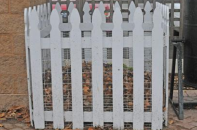

Compost Pile Maintenance

0

Decomposition in the compost pile slows down as the weather gets cooler. Avoid turning the pile during this time of year since the inside of the pile is warmer and turning it to the outside will cool down the entire pile. The freezing and thawing that often takes place
through the winter is actually beneficial for decomposition.

If you choose to add food waste to the compost pile through the winter months, recognize it will not decompose as quickly and could attract pests. You can prevent this by covering any scraps with a layer of dried leaves or bury them into the heap.

Keep the compost pile moist to promote decomposition. The pile should not be waterlogged
however because this restricts oxygen and causes rotting. The edges of the pile will dry out first and a light sprinkling of water may be sufficient if there has been no precipitation.

Wrap Trees to Prevent Sunscald and Frost Cracking

0

Sunscald affects young trees with thin, smooth bark. It is most common in late winter on the southwest side of the trunk. Exposure to sunlight and warm temperatures during the day heats up the tissues causing them to lose their dormancy. After sunset, when the temperature drops, these cells freeze and die. The result is large, irregular wounded sections of the bark on this side of the trunk.

Frost cracks are long splits in the trunk or stems. They are caused by old wounds and drastic changes in temperature heating and cooling the outer and inner layers of bark at
different rates.

Tree wraps can be used during the winter to protect young trees from weather-related injury. Wraps can be purchased for this purpose and should be light-colored with some elasticity. The trunk should be wrapped starting at the base of the tree upward and stopping just below the lowest branches. This is only seasonal protection for trees during their first few years of establishment. Remove the wrap in the spring and never staple the wrap onto the trunk.

Colorado State University Extension has a helpful publication with the proper steps for
wrapping a tree for winter protection: Wrapping Trees for Winter. You can also read
more at our KSRE publication: Sunscald on Trees.

Winterizing Roses

0

Although most shrub roses are hardy through Kansas winters, many hybrid teas and other modern varieties require protection. It is important to winterize roses AFTER several hard frosts have occurred, but BEFORE the ground freezes. Winterizing too early keeps the stems warm and moist which promotes. Winterizing too late risks damaging the sensitive graft union where the rootstalk attaches to the above ground growth.

Clean up plant debris in the area surrounding the roses to prevent diseases from
overwintering. Mound soil or compost eight to ten inches high around each rose plant.
Bring in new soil for this instead of displacing soil from the area around the roses to
avoid exposing and damaging the roots.

Once the ground has frozen, add a 4-inch layer of straw, leaves, wood chips or other
mulch over the mound and cover with a layer of soil to hold it in place. This will help
protect the plants from the cold but also prevent early budding during warm winter and
early spring days. As the mulch settles during winter you may need to add more.

Prune canes to 36-inches and remove weak or thin canes. Tie the remaining canes
together loosely to keep them secure during windy weather. If the canes are allowed to
whip in the wind it can cause damage to the crown and disturb the soil.

When the ground thaws in the spring remove the mulch and soil from the base of the
plant to return the soil level to normal.

Lettuce Eat Local: Time for a Yittle Yime Pie

0

Amanda Miller
Columnist
Lettuce Eat Local

I guess I hope that at some point Benson grows out of it. But for now, I adore the way his “L”s slide into “Y”s, his “W”s are often “V”s, and his “R”s are typically completely elided. Is there anything sweeter than a three-year-old little boy with a little lisp? Or should I say, anything sveeter than a thee-year-old yittle boy with a yittle yisthp? 

Yeah, I can see that not being as endearing in college. 

Even in pre-preschool, or whatever it is that we could call our random working in a Pre-K activity book, those speech patterns are precious but not super helpful. Benson recognizes all his letters and is making progress on remembering what sound each one makes, but the way he says a few is fundamentally different than the way they should be. Which, to be fair, it’s English, so it’s already ridiculously confusing, and there is probably some irregular rule that makes his pronunciation accurate in some cases. 

“Here’s a duh-duh-duh desk. Does that start with D?” “Yes! And yes, here’s a duh-duh-duh dorilla!” Phonics are tough. 

Sometimes he can physically say the word the right way, but he’s so used to calling it something else that he’ll sound it out simultaneously correctly and inaccurately. One of our favorite pages from Dr. Seuss’s ABCs book is “many mumbling mice making midnight music, mighty nice,” and Benson mmms his way straight into parsing out mmmate-mmmole — his preferred breakfast food that you might know as oatmeal.

L is particularly difficult so far, since he is clearly using his deductive skills when he says that yemon, yeyyow, and yadybug all start with Y. When he says them, they do. I’ve been noticing more this week when Benson says L words, since I knew it was time to write an L-focused article. My favorite example is when he randomly started lilting “Away in a Manger” on the way to town, because while it’s decisively too early for Christmas songs, I could yisten to him sing about the yittle yord Jesus all day long. 

L is a little difficult to write a food article on, too, even if you can pronounce it properly. I thought about doing something with lamb…but that’s as far as I got. Lychee is a little too hard to get, lobster is too expensive, lollipops are too much sugar. I did just make (tender)loin this week, but most of you don’t have as easy access to that kind of beef. Lasagna would have been a great choice, as would have linguini or lentils, but of course I didn’t think of those until I cheated and googled “foods that start with an L.” 

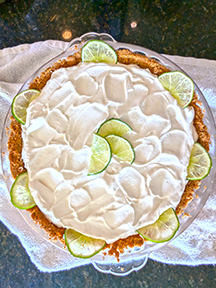
I was also mostly distracted by the obvious two — lemon and lime. Just as Benson has a complicated relationship with Ls, I have a complicated relationship with citrusy Ls. I love them in water, and essentially nowhere else. I wrote about lemon cake not all that long ago, so I figured we should go with lime this time; I recently made a key lime pie for, incidentally, the same lemon-cake friend. I’m happy to admit I was pleasantly surprised upon sampling the filling (because I literally cannot cook without tasting), that it wasn’t terrible. In fact, if it weren’t for someone else, I think I could almost have eaten a piece. 

Or at least, a yittle bit of one.


Key Yime Pie

Although I try to either create all my recipes or at least modify others’, it’s hard to do with key lime pie since the ingredients are so simple and that classic taste hinges on those. Hence, this is a very normal pie. You might be less disappointed in “normal” than I am, and honestly, it was good enough that I was only a yittle sad…and mostly because it’s quite difficult to sneak a piece out of a pie. 

Prep tips: I haven’t done a side-by-side of key lime versus “regular”/Persian lime juice, but it seems key limes are more tart and floral. You should be able to find a bottle of key lime juice even when/if you can’t find fresh key limes.

3 egg yolks

1 [14-oz] can sweetened condensed milk

4 oz key lime juice 

2 limes (either type); 1 zested and 1 sliced in very thin rounds

½ t cream of tartar

a graham cracker pie crust, baked

whipped cream

Beat egg yolks until they lighten in color; mix in sweetened condensed milk. Whisk in lime juice, lime zest, and cream of tartar. Pour into crust; bake at 325° until set, 10-15 minutes. Chill thoroughly, then top with plenty of whipped cream and garnish with the lime slices.