

Lettuce Eat Local: Now This Is My Jam
Amanda Miller
Columnist
Lettuce Eat Local
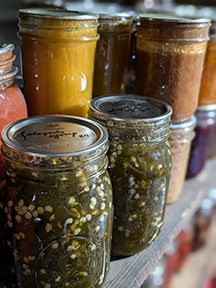
Jellies, jams, marmalades, preserves and conserves; the list goes on and on. There are all sorts of terms to describe all sorts of different sweet fruit preparations intended for all sorts of different usages. I enjoy making pretty little jars of these things, and those different colors always look so cute and satisfying sitting on the wooden shelves in the fruit cellar.
The problem is that that’s about all they do: sit and look nice, year after year. We’re just not a jam-eating family. The occasional peanut butter and jelly sandwich barely accounts for enough consumption to legitimate even having a jar open in the fridge, and often I end up having to pitch the last dregs.
The one type of jam that at least I personally am more prone to use is something with a little edge, a spicy zing to it (intentionally, from the addition of hot peppers, not because it’s too old…). Raspberry jalapeño, blackberry habanero, I’ll take it. I was thinking about this as I was picking all the peppers on the predicted last frost-free date of the year, which actually was the last day before a frost and thereby necessitated a combing through of the garden for anything I wanted to save. I didn’t really want the hot peppers, because they were too hot, and I was having a hard time even giving them away.
A vision of the jalapeño jelly sitting on the shelves downstairs came to mind as I carried in my pepper loot. I call it jelly, but it’s more like jam, and actually it’s more like syrup. It failed to set up — but on purpose this time.
A friend and I had made some a couple years back, and I was disappointed to find that something had gone amiss in our pectin process (you may have noticed I am not always the most precise recipe-er…that may or may not have something to do with it) and while the flavor was sweet-spicy delicious, it was thin and runny. My friend, however, was not disappointed. She thought it was perfect that way, raving about the jam-syrup, and so now we make it together that way on purpose.
Something that started off as a bug became a feature; something that seemed like a problem turned out to be an advantage. This got me looking around and asking a question I first heard on a podcast. “Is this a bug, or a feature?” I’m not a whiny person, but this simple perspective shift is working on my eyesight.
Suddenly the oatmeal smashed into Kiah’s hair was a sweet cinnamon aroma to breathe in as I laid her down in her crib. Picking her back up shortly thereafter because she prefers to only sleep while touching me was less annoying when I told myself it was a feature of her personality, one that allows the two of us a treasure trove of snuggles.
The living room is perpetually covered in intermittent mountains of toys, since Benson needs “all the small things” to make his heifer feed piles; I don’t need to feel guilty about how messy it can get, because it’s a precious feature of having a 3-year-old who can lose himself in creative play.
It is a bummer that the frost came when my tomato plants were covered in hundreds of cherry tomatoes, but maybe it’s also a timely advantage of the season since we have to let go of the garden at some point — and it pairs well with a feature of the dilapidated chicken coop that allows the door to keep blowing open in these strong winds, just in time for the hens to go enjoy all those tomatoes that froze. I was tempted to complain when explaining to Benson why our windows were all frosted over on that cold morning, but stopped myself when thinking perhaps gorgeous ice crystals and icy privacy screens are actually a feature of poorly insulated windows.
So is it a bug, or a feature, that all these jalapeños I picked are too spicy? I guess it depends on how you look at it.
Chunky Jalapeño Syrup
I’m not sure that this is the best title for the product, yet I have to call it something. This non-jammy jam is the perfect thing for a non-jammy fam, since it doesn’t follow the typical routes of jelly usage. While it does work oddly deliciously with peanut butter, it pairs better with cream cheese & crackers, drizzled in a grilled cheese sandwich, or spooned alongside ham or lamb.
Prep tips: there is no positive “feature” of not using gloves to work with this many hot peppers. Trust me on this one and just put them on.
½ pound jalapeños (or other chiles)
1 pound bell peppers (any color)
1 cup white vinegar
1 cup apple cider vinegar
4-6 cups white sugar
1 package pectin
Cut stems off peppers and cut into chunks; blend in a food processor with vinegars until finely minced. Bring to a boil along with sugar and pectin in a large saucepan; simmer for 10 minutes (don’t breathe in too deeply). Ladle into half-pint jars, lid, and either water-bath process for 10 minutes, or let cool and refrigerate to eat/give away.
Who You Gonna’ Call

About this time each year we begin to hear and read stories that all center on the illegal taking of Kansas wildlife. Whether it’s Bald Eagles being shot, outfitters being investigated for assisting their clients in illegally taking and transporting game or numerous game law violations intentionally and knowingly committed by people mistakenly calling themselves hunters, it all amounts to theft from those of us who attempt to abide by all the game rules and regulations of our state.
Kansas is divided into 105 counties and currently a drastic shortage of natural resource officers (NRO’s) are saddled with the intense responsibility of patrolling all those counties, making Kansas wildlife some of the least protected in America. Each year those NRO’s check tens of thousands of hunters and fishermen in the field and about 96% of them are found to be law-abiding. Unfortunately, many non-hunters associate ethical hunters with the small percentage who are not.
Kansas Dept. of Wildlife, Parks and Tourism has an excellent tool to help fight wildlife crimes called Operation Game Thief. It’s a toll-free telephone hotline, 1-877-426-3843 that can be accessed anytime of the day or night, any day of the year. Callers are given the choice to remain anonymous and each call is immediately relayed to the natural resource officer nearest the violation. Examples of activities that can be reported over the game thief hotline are road hunting, trespassing, littering, vandalism, drinking while hunting, taking more game than allowed by law, using illegal equipment, hunting out of season or taking wildlife for which there is no legal season.
Two important rules to remember when observing illegal wildlife related activities are;
· Never confront the suspects you observe committing these crimes, (meaning you must refrain from marching them to the nearest police station at gunpoint like Clint Eastwood.)
· Be observant and be prepared to provide as much information as possible about what you observe, such as detailed descriptions of the people and vehicles including license plate numbers, and location and time of the incident. My wife also reminds me that everyone these days has a cell phone with a camera at their fingertips, making it easy to help document what you see.
Calls to Operation Game Thief have resulted in arrest and convictions on violations from vandalism to deer poaching and everything in between. Drug operations have even been uncovered as a result of calls to this number. Perhaps the worst result of wildlife related crimes is the damage caused to the image of those of us who attempt to abide by all the wildlife rules and regulations. I refuse to be categorized with those who call themselves “hunters” but refuse to abide by the rules. If they insist on being known as “hunters” then perhaps the rest of us should find a different term for what we enjoy. Remember, Operation Game Thief, 1 877-426-3843. Continue to Explore Kansas Outdoors!
Steve can be contacted by email at [email protected]
Judging
These days it seems easy for folks to be judgmental. And being judgmental is usually considered to be a bad thing. And, it can be. But judging can also be a useful thing, and even a fun or humorous thing.
I make that statement from personal experience. During my long years as an ag journalist, public speaker, and humor columnist, I’ve had many opportunities to serve as a judge. I’ll discuss a few of my judging experiences.
My most unusual judging opportunity wuz probably judging the first (and, maybe, only) chicken flying contest in Roosterville, Mo. . This wuz back in the 1970s or 1980s when I had an on-going give-and-take verbal relationship going with Dale Summers, better known as The Afternoon Bozo on WHB country radio station in Kansas City. After one of our on-air conversations, the Bozo asked if I’d be one of the judges of the chicken flying contest in Roosterville, MO. The station wuz doing a remote broadcast from the contest. Without a second thought, I accepted.
Roosterville is an unincorporated community north of Liberty, Mo. When I went to judge the contest, Nevah and I took the kids and made a vacation weekend out of the adventure.
I can’t recall the details of the contest, but I remember it drew a big crowd and had around 60 chickens entered. Let me explain the rules of a chicken flying contest. Only domestic chickens are eligible. The owner of a chicken puts his or her fowl into a mailbox mounted 10-feet high at one end of a long outdoor arena. If the chicken doesn’t fly when the mailbox is open, the owner pushes the chicken out of mailbox with a rubber plumber’s friend.
Volunteers mark when the chicken’s flight lands and measure the flight. The winner is simple. The chicken that flys the longest distance is the winner and gets the prize money.
I can’t recall the winning chicken or its distance, but I do remember we judges had a bit of a controversy. That’s because one entry — and Old English Game Hen — left the mailbox like a hen pheasant and flew out of sight out of the arena. After a brief confab, we judges disqualified the Old English because we couldn’t measure its flight.
***
What I’d rate the second most unusual judging experience wuz being a judge at the first annual World Calf-Fry Cooking Competition in Vinita, Okla. The two other judges with me were the Lt. Governor of Oklahoma and a beautiful young Miss Oklahoma. I can’t recall either of their names, but I do remember that Miss Oklahoma wuz a city gal and didn’t really understand that she wuz going to judge for the best-cooked bovine testicles. But, even though she wuz a bit queasy tasting the entries, she wuz a good sport about it and did her job.
In the contest, teams of four cookers entered, just like in a BBQ contest. Team members wore matching outfits and cooked calf-fries according to their own original recipes.
The event wuz great fun. The winner received a handsome carved walnut mantlepiece of a giant bull scrotum. In the queen contest, the winner wuz declared The Belle of the Ball.
Like I said, some of my judging jobs contained an element of humor.
***
My other judging jobs down through the years were more down-to-earth. I wuz a judge of a Dairy Princess Contest in Arnett, Okla., on the day that Martin Luther King was assassinated, which certainly put a damper on the mood of that event. Plus, we judges had to disqualify one entrant because she didn’t meet all the criteria for being a dairy princess.
I’ve also judged 4-H Club Share-the-Fun contests and county fair photography exhibits.
I also judged several regional Brittany bird dog field trials in Kansas and Iowa, but I really never felt comfortable judging those contests. Picking the winner was too subjective and not cut-and-dried enuf for my liking.
***
I read this week an online article that might be interesting for crop farmers and veggie and flower gardeners, Some researchers at Northern Arizona University believe that playing some kinds of music for plants will help them grow better. They say the plants don’t actually “hear” the music, but “feel” the mechanical energy vibrations from certain sound frequency.
To me, it sounds like another aggie research boondoggle. But, I hope the researchers are right. Who knows, the veggies in my garden might grower faster, taller and be tastier if I play them songs from a playlist of hot licks from The Hag Mighty Merle, the Possum, Tom T. Hall, Porter, Garth and The Judds.
Music surely would be cheaper than fertilizer, especially since I already have a big country music library.
***
Ever wonder how Wall Street got named in the New York City financial district? I read that back in the horse and buggy days the rich folks lived on Manhattan Island and pigs roamed the nearby grain fields freely. Pigs didn’t smell any better back in those days, and the rich folks tired of the smell and built a wall to keep the pig from sharing their high lifestyle.
You guessed it. They named the street Wall Street and it serves about the same function today as it did back in the 1800s.
***
Also, ever wonder how the term Uncle Sam started? Up until I read this, I didn’t, but here goes. Apparently, during the War of 1812, a pork packer named Uncle Sam Wilson shipped barrels and barrels of pork to troops in the army. The barrels were stamped U.S. Troops. As military joking goes, soon troops started saying U.S. meant Uncle Sam- Eventually, the words got to represent the U.S. government.
***
I’ve a coffee sharing friend, ol’ Dub L. Dee, who not long ago brought a fancy, expensive vinyl electric recliner chair. Dub loves his new chair so much that he recently told us, “I’ve finally found my vinyl resting place.”
***
Time for words of wisdom for the week: Here’s they are: “Since the election is right ahead of us, there’s a tussle about validating ballots. It seems rather simple to me: Require an ID, citizens only, don’t vote more than once, be alive. And, since by law, every bill of U.S. money must have a serial numbers. Why can’t every ballot have a serial number, too?”
Have a good ‘un.
“Prairie Doc or Prairie Bot?”

Artificial Intelligence or A.I. has gone from Science Fiction to a reality. This technology continues to evolve and find new applications in the world, including the world of medicine. With any new advancement, there are pros and cons to be considered when implementing it into regular use, especially in medicine.
In 2023 the Journal of Medical Internet Research published an article where they had ChatGPT take 2 of the 3 USMLE exams. Step 1 is taken by third year medical students and all physicians must pass all three tests in order to become licensed as a physician. The program was given 4 different practice tests and scored between 44 to 64.4% correct. Over 60% is considered a passing score. The headlines read that ChatGPT passes medical boards.
While this headline was shocking, reading the article gives more nuances to that declaration. There were three different AI programs used, and only one had a passing score for one of the four sample tests, the easiest step 1. When the exams themselves were broken down, the AI was able to answer the “easy” questions with the greatest accuracy. Questions were graded on a score from 1 (easy) to 5 (difficult). However, it was unable to answer any of the level 5 questions. When the program was given a “hint”, the performance increased to 22% correct of the level 5 questions. Students taking the test do not get hints.
For this article I decided to ask Chat GPT to list “5 ways AI will improve the practice of medicine in the next 5 years” and “5 ways AI may harm the practice of medicine in the next 5 years.” Here is what the program came up with.
Here are the 5 ways ChatGPT thought AI could improve the practice of medicine
1) Improved diagnostics and early detection
2) Personalized treatment plans
3) Efficient administrative workflows
4) Virtual health assistants and remote monitoring
5) Drug discovery and development
Here are the 5 ways ChatGPT thought AI could worsen the practice of medicine
1) Over-reliance on AI
2) Bias in algorithms
3) Privacy and data security risks
4) Job displacement and role redefinition
5) Increasing costs for AI implementation
AI is a tool that can be used. Like any tool in medicine, it needs to be tested for safety, accuracy, and effectiveness before widespread implementation. While ChatGPT could easily write this entire article for me in a matter of seconds, it would not be providing you with the personal connection or with the level of reverence and responsibility that each Prairie Doc feels. We take our motto to provide you with health information that is based in science and built on trust very seriously. We will watch as this technology develops and advances. We embrace progress while holding fast to our prairie roots of connection and community. You do not need to worry about Prairie Doc being replaced by Prairie Bot.
Jill Kruse, D.O. is part of The Prairie Doc® team of physicians and currently practices as a hospitalist in Brookings, South Dakota. Follow The Prairie Doc® at www.prairiedoc.org and on Facebook, Instagram, and Threads featuring On Call with the Prairie Doc®, a medical Q&A show (most Thursdays at 7pm on streaming on Facebook), 2 podcasts, and a Radio program (on SDPB), providing health information based on science, built on trust for 23 Seasons.
