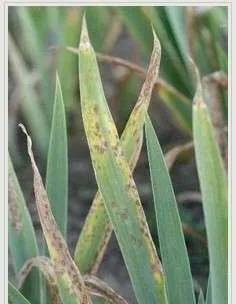
Removing debris from iris plantings is important to
help minimize problems. Iris borer eggs and iris leaf
spot survive in plant debris through the winter.
By removing debris from the garden, you are reducing
the spread of these problems the following growing
season.
Healthy iris leaves can be left intact; they do not
need to be cut back.
Wichita, KAN. – After six weeks of competition, the Kansas Manufacturing Council (KMC) on Wednesday announced the Atom Pop corn popper is the winner of the 2024 Coolest Thing Made In Kansas – People’s Choice .
“The KMC is excited to celebrate QuinCraft Production’s Atom Pop corn popper as the 2024 Coolest Thing Made in Kansas, said KMC Executive Director Brandie McPherson. “Thank you to everyone who nominated and voted for their favorite Kansas-made products. It once again has been a fun competition,”
McPherson said the KMC launched the Coolest Thing competition in 2020 to highlight the important role the manufacturing industry plays in the Kansas economy and as a way to promote the manufacturing industry and to raise awareness about the many cool products made in our state.
Presented by Forvis Mazars, the competition kicked off in August with 16 products in the bracket-style tournament. The products competed in two rounds of head-to-head match-ups with the product with the most votes moving to the next round. The final round put the final four Kansas-made products up against one another. The final four were:
Disc Tree Cutter by CVR Manufacturing, Galesburg.
Handy Hook Firefighter by Helten Panacea, LLC, Garden Plain.
Air Navigation Aid Systems by Indra Air Traffic, Inc., Overland Park.
Atom Pop Corn Popper by QuinCraft Production, Bushton.
Kansans cast nearly than 30,000 votes during the tournament and final round of voting.
Manufactured in Bushton by QuinCraft Production, the Atom Pop is a stove top popcorn popper. It makes 2 1/2 quarts of popped corn. The conical shape and aluminum bowl allow the popcorn to be popped without stirring or shaking.
Popped kernels are pushed up away from the heat and the aluminum dissipates the heat so the corn does not burn. It is as convenient as microwave popcorn and is healthier without the additives.
The winner of the 2024 Coolest Thing Made in Kansas – People’s Choice was announced during the KMC’s annual Kansas Manufacturing Summit held at the Hyatt Regency Hotel in Wichita.
There are nearly 2,500 manufacturers in Kansas, employing more than 160,000 people with an average annual compensation of $79,722. Manufacturing produces more than $26.7 billion in output annually, 15% of the total output in the state. Manufacturing helps drive the state’s economy with more than $9.93 billion in annual manufactured good exports to markets such as Canada, Mexico, and Japan.
Rural Kansas families with elementary school-aged children have a free opportunity to get assistance adopting lifelong healthy habits via a new study led by the University of Kansas Medical Center.
Known as iAmHealthy Parents First, the study is the first randomized controlled trial in the world designed to examine the effectiveness of an integrated healthy lifestyle program for adults and children. It provides virtual coaching and education to parents and their elementary school children on nutrition, physical activity and behavioral skills for sustainable weight management.
“So many family health programs focus solely on children, but we know parents are tremendously influential role models,” said Christie Befort, Ph.D., professor of population health at KU School of Medicine and associate director of cancer prevention and control for The University of Kansas Cancer Center.
“By first equipping parents with skills for themselves and then transitioning to a family-based program, we aim to set the entire household up for success,” said Befort, who is co-principal investigator on the trial.
The program targets rural areas, which have higher rates of excess weight and more challenges in accessing healthy foods and physical activity programs than their urban counterparts and are thus at higher risk for cardiovascular disease, diabetes and various cancers. Investigators in the study have partnered with 16 school districts across the state to promote the program, including Ulysses USD 214; Girard USD 248; Renwick USD 267; Beloit USD 273; Nickerson/South Hutchinson USD 309; Onaga USD 322; Rock Creek USD 323; Phillipsburg USD 325; Jefferson West USD 340; South Gray Schools USD 371; Newton USD 373; Morris County USD 417; Skyline Schools USD 438; Rural Vista USD 481; Galena USD 499 and Oswego USD 504.
T
The nine-month program starts by offering parents healthy lifestyle education before involving children in joint sessions. All meetings are held virtually, making it accessible for busy rural families. Those who qualify and complete the program receive up to $225, plus two free fitness trackers and a smart scale to keep.
Mandy Fincham of Beloit recently completed the iAmHealthy Parents First program with her fifth-grade son, Wake. “The instructors were so supportive, and now having conversations about health is just part of our everyday life as a family,” she said.
To be eligible, families must have a parent who is interested in learning strategies for healthy nutrition and physical activity and a child of elementary-school age (from first through fifth grades) who. The parent and child also must have elevated weight status and commit to attending online meetings.
“Parents of young children have unique barriers during the phase of life when raising children and managing numerous activities are the primary driver of daily lifestyle routines,” said Befort. “But this phase of life is also a great opportunity to prioritize health lifestyles, rather than postponing that priority until the children are older. Preventing the onset of chronic disease for them and their children is the driving factor.”
Davis and Befort aim to enroll 300 rural Kansas families in the study. “Focusing on parents first provides a solid foundation for the whole family’s journey,” said Ann M. Davis, Ph.D., MPH, co-principal investigator for the study and director of the Center for Children’s Healthy Lifestyles & Nutrition at KU Medical Center and Children’s Mercy. “We’re excited to help more local families get on the path to better health.”
The study is funded by the National Institutes of Health. Enrollment is open now for the Fall 2024 program. Visit www.iAmHealthyParentsFirst.org or call/text (833) 544-7433 to learn more.
Anyone interested in signing up to participate in the iAmHealthy Parents First study should contact the study team by calling 913-588-2040, texting 833-544-7433 or sending an email to iAmHealthyParentsFirst@kumc.edu.
Photo: Mandy Fincham and her son, Wake, from Beloit, Kansas.
Conservationists and cattle ranchers are working together to restore grassland for the lesser prairie chicken. The bird used to roam Kansas, but has lost most of its habitat to crop production.
ASHLAND, Kansas — In the remaining grasslands in Kansas lives the lesser prairie chicken, a stocky, quail-like bird that used to roam the Great Plains. They once fed, nested, danced and mated in the vast grasslands that covered the middle of the country.
There used to be many birds making their unique cackling boom noises. That was before people transformed the prairie to produce food and make energy. Now the remaining prairie chickens are dispersed and disconnected.
The prairie chicken doesn’t have the historical prominence connecting it to the Plains that buffalo and pronghorn enjoy. It’s a less-visible animal that relies on the dwindling grasslands.
A conservation bank company and ranchers in southern Kansas are working to reverse that. They are combining business and conservation to create prairie chicken conservation credits that pay for restoring habitat and benefit the cattle ranchers that own the land.
Conservation group Common Ground Capital has made deals with ranchers across several southern Plains states, including Kansas. As part of one of those deals, Gardiner Ranch near Ashland has started the process of clearing out invasive salt cedars to restore the natural prairie.
The program is using something similar to the system of buying and selling carbon credits, but they’re chicken habitat credits. Companies pay for the lesser prairie chicken credits so they continue developing in other prairie chicken habitats. Common Ground Capital makes a profit selling these credits, and uses that money to pay ranchers to restore and maintain the habitat the prairie chickens need.
Afterward, Common Ground Capital is responsible for the long-term management plan to fund the conservation of the prairie chickens. The conservation plan is approved by the United States Fish and Wildlife Service.
These long-term agreements with cattle ranchers are a way to not only conserve the prairie chicken, but also the grassland the ranchers need for cattle.
Wayne Walker, founder of Common Ground Capital, looks out on hundreds of acres of restored prairie.
“That’s what it all used to look like,” he said looking at acres of repaired grasslands where invasive trees had been removed. “These are some of the last remaining native grasslands in Kansas.”
The lesser prairie chicken used to populate the Plains in the hundreds of thousands. But due to habitat loss, invasive species like the salt cedars in western Kansas and grassland converted to cropland, their population has dwindled to about 26,000. That’s about the same as the number of people in Dodge City but scattered across the entire southern Plains.
A critical piece of this program is trying to reconnect the scattered bird populations.
“We’ve got to reconnect habitat to bring back prairies in strategic ways, so that prairie chickens can have more habitat to populate on,” Walker said.
The strategy of Walker’s company is to pay ranchers to restore grassland, then sell conservation credits to companies who are causing damage to lesser prairie chicken habitat elsewhere.
It’s a way for companies to offset their impact on a threatened species or ecosystem, while continuing development in parts of the bird’s range.
Prairie birds like the lesser prairie chicken have an aversion to anything vertical. It’s their natural instinct to avoid predators like hawks that hide in trees.
That means the birds don’t really like wind turbines, and the conservation credits are appealing to companies building wind turbines in other parts of the prairie chicken’s habitat.
Walker said this process may not be the most popular with environmentalists because there is compromise, but it’s a way to jumpstart conservation by combining industry and business with conservation efforts.
Common Ground Capital sells conservation credits to mostly renewable energy companies in Kansas and Colorado, for $2,500 per acre. That is how they are able to pay ranchers for conservation efforts like removing invasive trees to make habitat better for the birds.
On the Gardiner Ranch, Dillon Hilton stood on a bridge, one side covered with salt cedars, the other expansive grassland. This land was burned by the Starbuck wildfire in 2017, which cleared out a lot of invasive species and stopped at the bridge.
Hilton, who also works as a volunteer firefighter, said he remembers driving down the bridge on the ranch going 60 miles per hour, and the fire keeping up with him.
“It was devastating,” Hilton said. “We lost cattle, fences, structures.”
But if there was a bright side, he said it would be how much prairie the fire restored. The invasive trees were wiped out by the fire, but the grassland easily recovered.
And the grassland ecosystem is shriveling up with it. Grasslands also benefit the climate by sucking up the carbon in the air and storing it underground.
But the grasslands that remain are owned by ranchers like Mark Gardiner, owner of the Gardiner Ranch, which supplies cattle to National beef in Dodge City and Liberal.
“When I was first approached by Wayne, I told him, ‘you do know (the prairie chickens) are because of us not in spite of us,’” Gardiner said.
His 46,000 acres not only support the conservation of the lesser prairie chicken, but also his cattle, which supports his ranching lifestyle.
“If we don’t feed the world the ecosystem won’t make it, and any ecosystem you lose you don’t get it back,” Gardiner said.
Biologist and grassland conservationist Stephanie Manes said that to keep both humans and the birds thriving together, the prairies need to be maintained.
Invasive species like salt cedars have overtaken the grassland and have pushed out the prairie chicken, along with native grasses. It’s not good for the ecosystem or the soil. She said they came from Europe, most likely brought by white settlers to use as windbreaks and landscape decoration.
It’s a tough plant that is perennial and can come back from a lot of damage
“That is why the roller chopping and herbicide treatment to actually kill the plant is so essential,” Manes said. “But that’s very expensive.”
That’s where a program like this one is helpful. It provides financial power to ranchers to get rid of trees they already wanted out of their ranchland.
The roller chopper with Hilton and his team mows down the salt cedars. They then spray with herbicide and routinely use prescribed burns.
So far, the program has been able to conserve 75,000 acres of grassland for the lesser prairie chicken. The goal is to continue the program and in ten years conserve 1 million acres, and hopefully see the lesser prairie chicken population bounce back from 26,000 to 67,000.
Last year, something that would help the conservation group was the federal relisting of the lesser prairie chicken as endangered. This gave the bird extra protection, but was met with a lot of pushback.
The oil and gas industry, cattle industry and state attorneys general from Kansas, Oklahoma and Texas filed lawsuits against the listing.
Common Ground Capital’s lawyers predict the court case should wrap up early in 2025.
Holding his horse, Mark Gardiner said that he’s grown up with the lesser prairie chickens all his life. They represent a healthy prairie that he has made a life and career out of.
“We are thankful to keep this ecosystem, because humans are part of that system too,” Gardiner said.
Calen Moore covers western Kansas for High Plains Public Radio and the Kansas News Service. You can email him at [email protected].
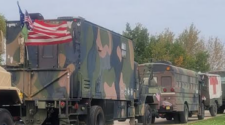
A convoy of historic military vehicles is less than a week from traveling through Southeast Kansas. The Military Vehicle Preservation Association: History In Motion convoy is traveling old Jefferson Highway from the Canadian line to New Orleans. The route mostly follows US-69 through Kansas. The convoy will be in Fort Scott on October 13, then will come through the Arma-Pittsburg-West Mineral area October 14-15. It will continue on to Joplin from there.
These vehicles will be on display at multiple locations.
On Monday, October 14, there will be a public viewing at the Franklin Community Park in Franklin from around 11 a.m. to 2:30 p.m. This viewing is hosted by Miners Hall Museum.
Also on Monday, October 14, there will be a public viewing at the Crawford County Historical Museum in Pittsburg from around 3 p.m. to 5:30 p.m.
Then, on Tuesday, October 15, a public viewing will be held at Big Brutus near West Mineral from around 3 p.m. until 5 p.m. Please note, due to the convoy Big Brutus is allowing free admission beginning at 3 p.m.
You can follow the progress of the convoy at Facebook.com/MVPAConvoy.