

FROM THE GRAVEL CROSSROADS OF AMERICA’S HEARTLAND, ACROSS 5-STATES, TO BACK HOME TO KANSAS
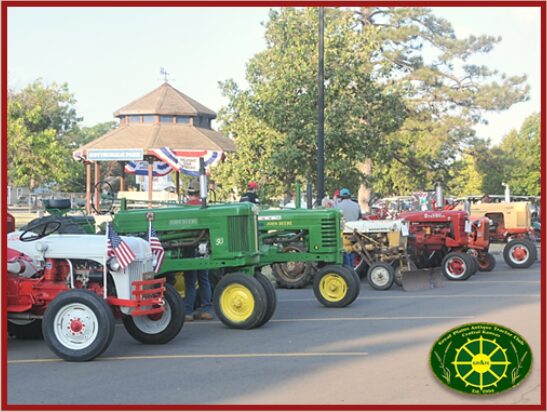
– Michael Hinton, Owner | CEO of TalkingTractors.com, along with an accomplished
group of Kansas businesses, organizations, and individuals, were honored Thursday, October 03, 2024, during the Kansas Department of Commerce’s 2024 To The Stars: Kansas Business Awards ceremony at the Great Bend Convention and Visitors
Bureau. The event recognized the outstanding contributions to the state’s economy and communities.
Hinton was bestowed a Merit Award in the category of Welcome Back – Entrepreneurs and businesspeople who once left Kansas but have returned home to make a mark in the Sunflower State. Born in Newton, KS, and growing up in rural Harvey County; Hinton and his family had relocated to 5-U.S. States over the span of the last 25-years for his career, before moving back home to Kansas (briefly in 2015 and permanently in 2020). TalkingTractors.com was launched in January 2024 and has quickly become Nationally recognized for Antique Tractor Preservation Day, an Ag Heritage celebration that Hinton founded.
A record 346 businesses, organizations, and individuals were nominated in nine categories for this year’s To the Stars: Kansas Business Awards. A total of 53 Merit Awards and 45 Regional Awards were presented at the event. In an October 03, 2024,
Kansas Office of the Governor Media Release, Governor Laura Kelly said, “By honoring and showcasing their accomplishments, we aim to inspire other businesses to keep reaching for new opportunities across our state.”
Lieutenant Governor and Secretary of Commerce David Toland added, “Each of the nominees play a critical role in the new era of Kansas we are creating —they are truly the pillars of our success and more than worthy of being celebrated.”
“I cannot imagine a better life than being born a Kansan, raised a Kansan, and calling Kansas home, stated Michael Hinton, adding, “This award further speaks to my passion for preserving America’s heritage farm machinery for future generations, and bringing continued awareness to our state’s renowned agricultural heritage.”
Lettuce Eat Local: As sweet as honey…because it is honey

Amanda Miller
Columnist
Lettuce Eat Local
Though honeybees are very small insects, the numbers in facts about them seem impossibly large. For example, there can be 50,000 bees in an average beehive; bees’ wings beat around 11,400 times a minute; a queen bee can lay upwards of 1500 eggs in a day. The USDA says that honeybees pollinate over 130 types of vegetables, fruits, and nuts, facilitating the production of about $15 billion worth of crops every single year.
Another mindblowing fact is that it takes approximately 1200 bees flying a total of 60,000 miles and visiting over two million flowers to get enough nectar to make a pound of honey. A corollary trivia tidbit is that worker bees live about 6 weeks, and each one will only produce somewhere between 1/12 and ½ teaspoon of honey in its lifetime. (I keep finding different actual numbers for some of these stats, but the points remain: it’s a lot, or a very little.)
Suddenly it makes a lot of sense why honey isn’t the cheapest sweetener on the market. I often buy local honey by the gallon, since by another amazing reality it doesn’t go bad, and that purchase can come with a little sticker shock — until I think of the millions of bees whose lives’ work went into our consumption.
Not because of price, but because of our desire to be semi-self-sustainable, Brian and I would love to have our own honeybee hives. But since we are both allergic to beestings, and we don’t want our sting:life ratio to match bees’ 1:1, it seems like a hobby better left to others. Brian has found several hives in various fields and alerted beekeeper friends of ours, so we are not unintroduced to hyperlocal honey. Local raw honey is supposed to help with seasonal allergies (as well as a whole smorgasbord of other potential health benefits), helping your body acclimate to the area pollens, so I’ll consider our consumption of it a medical practice.
Fortunately, we know that Benson isn’t similarly allergic to bees, since last year he had no reaction when he got stung by one that was also (wisely) investigating our waste chocolate feedpile. My favorite part of that story is that, in his two-year-old diction, he would tell us how Papa and Eeyore were with him. We figured out he meant Leroy, but the nickname may forever stick.
And perhaps it’s partially our fault since we play an audio storytelling of Winnie the Pooh for Benson every night — “My favorite thing is me coming to visit you, and then you ask, ‘How about a small smackerel of honey?’ ” — but I think Benson would brave the odds even if he were allergic. That boy can sense the honey jar being pulled out of the cupboard from anywhere in the house. (He literally grabbed the honey and ran away with it while I was trying to take the picture.) “I just need a yittle yick on my finger!”
To be fair, is there much that isn’t improved with a smidgen of honey? Even just add the word and it instantly sounds better: honey whipped cream, honey mustard, honey glazed salmon, honey grahams, honey bread, honey barbeque, honey roasted carrots…basically everything except honey badger. Drizzle it on everything from oatmeal to cheese to avocado toast, and your life will be better.
Like Proverbs 16:34 says, “Kind words are like honey — sweet to the soul and healthy for the body,” so let’s have lots of both.
There are so many honey-focused recipes we do that I could share for this H is for Honey article, and I was stuck between this and a hot honey chile butter I also just made. But that one was too easy (you can see the ingredients in the name…) and this dressing is an awesome addition to autumn salads. It’s thick, creamy, sweet but not too sweet, and pairs beautifully with all the fall things like butternut squash, apples, kale, etc, although it’s also getting used around here as a dunk for our cherry tomatoes that are finally ripening.
Prep tips: I’m not typically a brand follower, but I’m getting to be a big fan of Duke’s mayonnaise. Maybe it’s just because I’m a Southerner at heart, or maybe it is better.
2 cups mayo
1 ¼ cup dijon
⅓ – ½ cup local honey
¼ cup apple cider vinegar
dash cayenne
salt to taste
Blend or whisk all ingredients until smooth. Season to your tastes.
Wheat Scoop: No Small Factor: Producers should consider coleoptile length when deciding when and how deep to plant wheat

For audio version, visit kswheat.com.
Producers have a lot to consider when deciding when to start planting wheat — moisture, soil temperature, Hessian fly-free dates and more. Based on research from Kansas State University, another one of these considerations may appear small, at least physically, but could have a big impact come harvest — coleoptile length.
When a wheat seed germinates, one of the first structures to emerge from the seed after the seminal roots is the coleoptile. This plant part is a rigid protective structure that covers the emerging shoot of a wheat plant. As the wheat plant develops, this covering continues to elongate as the young seedling pushes through the soil until it breaks the surface and reaches sunlight. Then, the coleoptile stops growing and the first true leaf emerges through it.
However, if a wheat seed is planted too deep or into the wrong soil conditions, the coleoptile may not be able to break through the soil, leading to a variety of compounding issues for wheat stand establishment. In this case, when the coleoptile is unable to emerge, the first true leaf may emerge underneath the soil’s surface. Then, the leaf takes on an accordion-like appearance, the wheat plant typically becomes yellow and eventually the plant dies. Even if the plant survives, it has limited access to nutrients and sunlight and will result in lower yields.
So how do producers prevent this situation? First, according to a recent Wheat Rx publication by K-State Research and Extension, wheat should never be planted deeper than the coleoptile length of the wheat variety. In dryland environments like western Kansas, producers often “dust in” their wheat or plant into dry soil and rely on deeper subsoil moisture, requiring deeper planting depths. To succeed in this common scenario, farmers should select wheat varieties with longer coleoptile lengths that will help the wheat plant make it from the deeper planting to the soil surface.
An additional consideration is soil temperature. Planting wheat too early into warm soil temperatures can further reduce the coleoptile length. Some varieties will not germinate when soil temperatures are greater than 85°F and coleoptile length can be reduced by as much as 60 percent in higher temperatures. K-State recommends that if producers choose to plant in warmer soil temperatures, plant at a shallower depth (3/4 to 1 inch deep), even if moisture is absent in the top layers of soil. Planting wheat deep (greater than 2 inches) increases the risk of poor emergence and unacceptable stands.
By understanding the temperature sensitivity and coleoptile length of their selected wheat varieties, producers have one more tool to help them decide when to plant and how deep to promote better wheat stand establishment.
View the full list of ratings for coleoptile length for Kansas wheat varieties and find other recommendations based on the latest K-State research at kswheat.com/wheatrx. Wheat Rx is a series of Extension publications and other educational outreach materials designed to address key management areas of hard winter wheat. These publications contain recent data based on novel research funded in part by wheat farmers through the Kansas Wheat Commission’s two-cent wheat assessment.
###
Written by Julia Debes for Kansas Wheat
KU News: $500K Kansas Department of Commerce grant helps bolster KU startup ecosystem
From the Office of Public Affairs | http://www.news.ku.edu
Headlines
Kansas Department of Commerce grant helps bolster KU startup ecosystem
LAWRENCE — University researchers who develop new technologies face a number of hurdles in getting those innovations from the lab to the market. A $500,000 Forging Opportunities for Research, Growth & Entrepreneurship (FORGE) grant from the Kansas Department of Commerce will help KU create software, infrastructure and financial mechanisms needed to bridge the gap between academia and industry, growing the state’s economy while enhancing the university’s teaching and research missions.
Campanile area upgrades improve access, aesthetic and functionality
LAWRENCE — As the fall semester begins, a refreshed vision of the Campanile area is starting to take shape. Construction crews over the summer have replaced aging pavement in the plaza area and surrounding sidewalks and stairways. Stone repairs and upgrades to the electric panel and service entry will begin in the fall, as well as new landscaping efforts. The repaved walkways have improved ADA accessibility around the Campanile, and added lights to the north will increase nighttime visibility in the area.
KU faculty honored with 2024 College Awards
LAWRENCE — Faculty contributions in research, teaching and mentoring were recognized this spring with a series of awards from the College of Liberal Arts & Sciences at the University of Kansas. The prizes acknowledge outstanding professors for commitment to advising and teaching to undergraduate and graduate students, as well as innovation in research.
Full stories below.
————————————————————————
Contact: Vince Munoz, Office of Research, 785-864-2254, [email protected], @ResearchAtKU
Kansas Department of Commerce grant helps bolster KU startup ecosystem
LAWRENCE — University researchers who develop new technologies face a number of hurdles in getting those innovations from the lab to the market. A $500,000 Forging Opportunities for Research, Growth & Entrepreneurship (FORGE) grant from the Kansas Department of Commerce will help KU create software, infrastructure and financial mechanisms needed to bridge the gap between academia and industry, growing the state’s economy while enhancing the university’s teaching and research missions.
“With this support from the Kansas Department of Commerce, we will be able to develop fundamental building blocks that assist established companies in accessing KU resources while also developing an infrastructure that supports KU startups in their entrepreneurial journey,” said Tricia Bergman, associate vice chancellor for economic development.
Some companies proactively seek to partner with university researchers but don’t know who in the university to contact to get started. KU staff will use some of the FORGE grant to develop a Jayhawk Front-Door Chatbot that company representatives and economic development professionals can use to understand what resources the university has and who within KU might be able to provide assistance. The chatbot is a large language model software that employs natural-language-processing techniques to quickly search many KU websites for answers to a prospective partner’s question.
“The chatbot will be especially beneficial as we consider expertise across all of our campuses,” Bergman said. “For example, suppose someone is interested in understanding if we could help them with material testing capabilities or in identifying a resource that works in air purification. The answers to these questions are not straightforward unless you know exactly where to go. The chatbot will be helpful in providing initial options that we can quickly and efficiently discuss with the industry partner.”
The grant will also support the construction of an international launchpad at KU Innovation Park. This 2,000-square-foot space will house a research laboratory and offices for international firms interested in being close to KU to access its research expertise and resources. Construction on the Park’s next phase of development, including the launchpad, is expected to begin in 2025.
“Establishing an international launchpad at KU Innovation Park will enable companies from around the world to seamlessly tap into resources and knowledge at the university,” said Adam Courtney, CEO of KU Innovation Park. “This space will lower the barriers for international companies to start and grow a presence quickly in Kansas, creating new collaborations and economic growth.”
Nurturing innovation
In addition to software and research space, the FORGE grant will support financial mechanisms that will help KU nurture the development of new innovations more fully before they are spun out into a Kansas startup company. The Rock Chalk Ready Fund will provide four to six, $35,000 pre-company grants to “de-risk” the technology or business model of a potential startup working with KU intellectual property. De-risking means identifying critical milestones that will increase the likelihood of forming a sustainable startup company. Examples of potential milestones could include creating prototypes, collecting key data, performing a regulatory analysis or other activities that demonstrate the viability of a technology or business opportunity. Master of Business Administration students at KU will participate as part of each pre-company team to provide support from a market and business perspective.
An additional Rock Chalk Raise Fund will provide a smaller pool of $20,000 for early startups to travel to out-of-state conferences or investor meetings. This second fund will provide the startup an opportunity to validate its idea with potential customers and reach new audiences.
“We’re appreciative to the state for supporting us through FORGE and helping KU develop new models to advance innovation arising from research at both Lawrence and the medical center,” said Cliff Michaels, executive director of the KU Center for Technology Commercialization. “The goal is multifold — to move opportunities closer to ‘go, no-go’ decision points and, when possible, also better position those opportunities for whatever their next steps might be.”
Recipients of either fund, as well as others across KU, will be eligible to participate in a two-day boot camp that walks them through the process of applying for the Small Business Innovation Research (SBIR) or Small Business Technology Transfer (STTR) program. SBIR and STTR are equity-free funding opportunities provided by the U.S. Small Business Administration. Participants will also receive group and individual coaching as they work through the grant applications. The SBIR and STTR boot camp coaching are similar to other training programs offered to help KU researchers earn federal grants, returning tax dollars to the state.
Stimulating investment
The final initiative supported by the FORGE grant will be the creation of an angel network to encourage alumni, parents, friends and others engaged with the university to invest in KU-affiliated opportunities. According to a University of Michigan study, the Midwest and Great Lakes regions account for only 7% of all venture capital deals. The membership-based angel network allows KU startups to regularly present their plans to prospective investors, improving their access to capital. The goal is to host an initial launch event in 2024 with 25 to 35 investors and four to five angel investment-ready companies.
“The angel network will engage the extensive alumni community and provide opportunities to invest during the critical early stage for KU-affiliated startups,” Courtney said. “This will accelerate innovation and bring vital capital into the community, strengthening the entrepreneurial ecosystem.”
The administration of the initiatives is through the KU Office of Economic Development and is spread across several departments and university affiliates. KU Innovation Park will lead the development and implementation of the international launchpad, SBIR/STTR boot camp and angel investor network. The KU Center for Technology Commercialization will spearhead the Rock Chalk Ready and Rock Chalk Raise Funds. KU Analytics, Institutional Research & Effectiveness will develop the chatbot, and KU Marketing will create a web portal that both internal and external stakeholders may leverage to more efficiently identify resources and expertise.
Taken together, each element of FORGE activities creates a holistic, streamlined ecosystem that supports a growth trajectory for technology and startups. For example, a proposal supported by the Rock Chalk Ready or Raise Fund may go on to win an SBIR grant after completing the SBIR/STTR Bootcamp. That new startup may then present its more realized business plan to the angel network and external venture capital opportunities needed to begin selling products. Startups may not follow this path exactly — the featured resources combine to provide a road map with opportunities to “hop on or off,” depending on technology or startup maturity. Additionally, for companies that may be interested in licensing or further developing technology, the Jayhawk Chatbot will provide rapid visibility into existing KU technologies.
“The FORGE grant through the Kansas Department of Commerce enables KU to develop tools, processes and new resources that will help to drive economic growth for both existing companies as well as new startups,” Bergman said.
-30-
————————————————————————
The official university account for X (formerly Twitter) is @UnivOfKansas.
Follow @KUnews for KU News Service stories, discoveries and experts.
————————————————————————
Contact: Savannah Rattanavong, Office of the Provost, 785-864-6402, [email protected], @KUProvost
Campanile area upgrades improve access, aesthetic and functionality
LAWRENCE — As the fall semester begins, a refreshed vision of the Campanile area is starting to take shape.
Construction crews over the summer have replaced aging pavement in the plaza area and surrounding sidewalks and stairways. Stone repairs and upgrades to the electric panel and service entry will begin in the fall, as well as new landscaping efforts.
The repaved walkways have improved ADA accessibility around the Campanile, and added lights to the north will increase nighttime visibility in the area.
Alli Gerth, landscape architect and project manager, said the team has worked with KU Endowment to preserve the legacy of the 74-year-old World War II memorial during the project.
“We wanted to make sure that it’s honoring the memorial and honoring the original intent of the Campanile while also upgrading it to modern needs,” she said.
Monte Soukup, KU Endowment’s senior vice president of property, initially brought the project to KU Facilities Planning & Development to honor Dale Seuferling’s retirement as president of KU Endowment.
“When Dale announced his retirement, we knew people would want to honor his many years of service in a way that was meaningful to him,” Soukup said. “The project to improve landscaping around the Campanile fit this bill perfectly.
“It involves beautifying campus and creating a space that is accessible to all — something that mirrors what we do at KU Endowment, which includes, among other things, providing beautiful facilities and scholarships that make higher education accessible.”
One of the major visual changes to the area includes an ADA-compliant plaza seating wall north of the Campanile. With the seating facing in toward the tower, Gerth said it can serve as an ideal backdrop for campus photos, and trimmed shrubbery and trees will also offer a better view overlooking the stadium. The seat wall incorporates the dedication plaques from previously donated benches, which were aging and needed to be replaced.
“We tried to keep multiple uses in mind when designing this project,” Gerth said. “It’s an area that you can use during any day of the year as just a nice, contemplative space on quieter days, but during ceremonies and activities it also remains an icon and photo opportunity while still honoring the memorial.”
Once the weather cools, the landscaping crew will encircle the tower with low-maintenance native plantings. To incorporate year-round color, workers will also add cherry trees on the south side of the tower for spring blooms and Shumard oaks to the north along the sidewalks to the stadium for vibrant hues of orange and red in the fall.
With the changes underway and the remaining work to soon follow, Mark Reiske, director of Facilities Planning & Development, said he hopes the KU community will take advantage of the renovated space.
“It will be in the memories of those who will pass through it for years to come. The space will be many things to many people, but most importantly, it will be there for all that want to enjoy it,” he said.
Public access to the Campanile is limited during the construction period.
The project is funded through gifts made in Seuferling’s honor and the university’s Education Building Funds.
The last major renovation of the Campanile and grounds was completed in 1996. Constructed in 1950 and standing 120 feet tall, the Campanile honors 277 KU alumni, students, faculty and staff who died in World War II. The carillon has 53 bells, which chime on the quarter hour and hour. Since the Class of 1950, KU graduates have participated in the tradition of walking through the bell tower and down the Hill at commencement.
-30-
————————————————————————
Don’t miss new episodes of “When Experts Attack!,”
a KU News Service podcast hosted by Kansas Public Radio.
https://kansaspublicradio.org/podcast/when-experts-attack
————————————————————————
Contact: Heather Anderson, College of Liberal Arts & Sciences, 785-864-3667, [email protected]
KU faculty honored with 2024 College Awards
LAWRENCE — Faculty contributions in research, teaching and mentoring were recognized this spring with a series of awards from the College of Liberal Arts & Sciences at the University of Kansas. The prizes acknowledge outstanding professors for commitment to advising and teaching to undergraduate and graduate students, as well as innovation in research.
Byron A. Alexander Graduate Mentor Award
The Byron A. Alexander Graduate Mentor Award has been given to faculty in the College since 1993. Winners have helped graduate students make the most of their experience and opportunities at KU. Recipients receive an $850-$1,500 prize.
Beth Bailey, Foundation Distinguished Professor of History, director of the Center for Military, War, and Society Studies.
John C. Wright Graduate Mentor Award
The John C. Wright Graduate Mentor Award has been given to faculty in the College since 2002. Winners have helped graduate students make the most of their experience and opportunities at KU. Recipients receive an $850-$1,500 prize.
Ward Lyles, associate professor of public affairs & administration, urban planning program.
J. Michael Young Academic Advisor Award
The J. Michael Young Academic Advisor Award honors exceptional commitment to undergraduate advising. Students nominate the professors for enhancing their experience at KU through the advising relationship. The honor comes with a $1,000 award.
Shahnaz Parsaeian, associate professor of economics.
J.D. Smith, senior academic adviser.
Grant K. Goodman Undergraduate Mentor Award
The Grant K. Goodman Undergraduate Mentor Award recognizes faculty who are selfless with their time and experience and continue to have lasting mentoring relationships with students long after they leave the classroom. Winners receive a $1,500 award.
Mark Landau, professor of psychology.
Funds for the awards are managed by KU Endowment, the independent nonprofit foundation serving as the official fundraising and fund-management organization for KU. Founded in 1891, KU Endowment was the first foundation of its kind at a U.S. public university.
The College is the heart of KU, educating the most students, producing the most research and collaborating with nearly every entity at KU. The College is home to more than 50 departments, programs and centers, as well as the School of the Arts and School of Public Affairs & Administration.
-30-
————————————————————————
KU News Service
1450 Jayhawk Blvd.
Lawrence KS 66045
http://www.news.ku.edu
Erinn Barcomb-Peterson, director of news and media relations, [email protected]
Today’s News is a free service from the Office of Public Affairs
