Sunday, February 1, 2026
Home Blog Page 306

How to keep invasive fish from jumping dam, infesting Kansas River near Topeka

0

Kansas wildlife officials have an idea for how to stop an invasive fish known for its jumping ability from leaping over a Lawrence dam and swimming upstream toward Topeka, further infesting the Kansas River.

This fish can jump. Social media has several videos, like one earlier this month that went viral on TikTok showing a carp jumping into a boat in Kentucky, hitting children.

Those invasive carp are also in Kansas, where their jumping ability enables them to pass dams, especially during floods. To prevent them from infesting more waterways, like the Kansas River around Topeka, experts are turning to a simple solution: grates.

Chris Steffen is the aquatic invasive species coordinator at the Emporia office of the Kansas Department of Wildlife and Parks. He gave the Wildlife and Parks Commission an update on invasive carp at a meeting last month.

Two carp species in particular, bighead and silver, have made it to the Kansas River. Those species are among the fish referred to as invasive carp that used to be referred to as Asian carp.

“The silver carp is the one you’ll see on YouTube or other places where people are riding around on skis or whatever behind a boat, and these carp are jumping,” Steffen said. “They’re able to jump up to maybe 10 feet in the air when spooked by a boat.”

The fish are filter feeders.

“They open their mouth, they swim around with their mouth open and eat all the small stuff in the water,” Steffen said. “The plankton, the zooplankton, phytoplankton. Surprisingly long lived, and they can grow to really incredible sizes, and they’re also capable of these really large, quick movements. Typically those are during high flow events.”

Native fish populations have declined in areas where invasive carp have moved in.

The Kansas River is infested with invasive carp between Lawrence and the Missouri River. Also infested are the Missouri River in northeast Kansas and part of the Neosho River in Labette County in southeast Kansas.

“Everything that doesn’t have a dam that’s attached to the Missouri River basin has these silver and bighead carp,” Steffen said.

But having a dam isn’t enough, as high water events have allowed the jumping carp to pass the barrier. That was the case with flooding in 1993, after which isolated fish were collected farther upstream from Lawrence, around Manhattan and Junction City.

Upstream 15 miles from the Missouri River is the WaterOne Dam in Wyandotte County, just east of the Interstate 435 Bridge.

“The carp, most of the time, cannot get over this barrier,” Steffen said.

However, Steffen referred to that dam as “semi-passable” because the fish can get over the barrier during high water events — which have happened occasionally in recent years.

Farther up the river is the Bowersock Dam in Lawrence — the only hydropower facility in the state.

Steffen called it “a much more formidable barrier to carp movement.”

Still, the carp can get past it during especially high water events, like in 1993, and KDWP has concerns about the dam’s north powerhouse. Installing bars, referred to as a headbanger, are a simple and low-tech solution.

“It’s just basically grates that hang out over the water that when those carp try to jump up into that structure, they literally just bounce off that grate,” Steffen said. “It’s really slick. It’s kind of self-cleaning. It’s got an angle to it, so any debris that comes in there just kind of pushes off the side.”

As of the Aug. 29 meeting, KDWP had already completed a structural analysis but was waiting on grant funds before getting to work on engineering and installation.

Invasive carp were the subject of a rebranding campaign intended to increase human consumption.

They’re also good bait for catfish, Steffen said.

Meanwhile, the infested 15-mile section of the river east of the WaterOne Dam is popular for fishing, according to a 2022 KDWP angler survey. That has the agency looking at a snagging opportunity.

Wildlife and Parks staff are proposing year-round snagging — but with harvest limited to only carp, and other fish would have to be released — in the Kansas River downstream from the WaterOne Dam. Steffen said carp are overly abundant there, but snagging them is technically illegal for now.

“Because they would be helping us out getting rid of carp that we don’t want in the river there, we’re not proposing any sort of special permit,” Steffen said. “This would be allowed on your standard fishing license.”

There’d be no possession limit, because, “The more carp we can get out, the better.”

Meanwhile, KDWP is going to use grant funding from the U.S. Fish and Wildlife Service to work on removing carp from the area between the WaterOne Dam at Edwardsville and the Bowersock Dam at Lawrence.

As reported in the Topeka Capital Journal

Want to avoid the DMV? Kansas government’s iKan platform adds another service

0

The state government is making it easier for Kansas drivers to update their vehicle’s address.

The Kansas Department of Revenue announced Wednesday that the digital platform iKan is getting a new feature allowing drivers to update their vehicle’s address online instead of going to a DMV office in-person.

“Our goal with iKan has always been to make vehicle and driver services readily available to all Kansans,” said David Harper, the KDOR vehicles division director, in a statement. “This new feature is a significant step towards that vision, allowing us to better serve Kansans and improving the customer experience by reducing the need for in-office visits.”

The Revenue Department encourages residents to create an iKan account, if they haven’t already, to speed up renewals and other processes.

The state introduced iKan in 2018 to consolidate routine services from multiple agencies into an online platform. The system can be used for renewing driver’s licenses and vehicle registrations, among other services. The Revenue Department said nearly half of Kansans have registered with iKan.

“The Kansas Department of Revenue is always looking for ways to improve their service offerings through iKan, and we are excited to continue our partnership,” said Katie Beth DeSchepper, general manager of DMV for PayIt. “The enhancements we’ve made to the user experience and the addition of vehicle address changes directly result from collaboration with Kansas and user feedback we’ve received. These updates also make it easier for us to deploy new services in the future, which will ultimately make the iKan experience even better.”

As reported in the Topeka Capital Jouranl

Lettuce Eat Local: Please Don’t Give This Fish Sauce An “F”

0

Amanda Miller
Columnist
Lettuce Eat Local

It was obvious there was something very fishy going on. It was back during that first fall of Covid, and I had initially thought my blinding headache and body pains were just another lovely effect of pregnancy. I was literally in the middle of cutting an onion, though, when my sense of smell disappeared — poof! 

It was oddly disorienting to slowly come to the realization that I could no longer smell that sharp allium pungency, almost like the sudden change down to four senses put my body into an alternate dimension. I brought the other half of the onion up to my face, and while my eyes still burned, my nose had no messages for me. 

I needed no further confirmation of the situation, but a few nights later, I put my non-functioning olfactory organs to one of the strongest tests I could imagine: fish sauce. I do a lot of baking and cooking, and we live on a dairy farm, so there were constantly chances for me to realize it if my sense of smell had decided to return. But those seemed like at least somewhat nebulous tests; some foods just don’t have strong aromas, and while it’s horrifyingly obvious to many visitors, by now my nostrils are quite accustomed to the lingering dairy air (“the smell of money,” according to some; just poo to the rest of us).

[Spoiler: my nose did get back to working, as evidenced by the fact that I ironically had to stop right there upon catching a different kind of “money” whiff as my daughter crawled onto me.]

But even stronger than 400 adjacent cows and more evocative than freshly baked bread is the smell, and I do mean smell, of fish sauce. If you’re not familiar with this Southeast Asian umami bomb, the name gives it away: it is sauce made from fish. However, as one bon appétit article put it, “you don’t just smack a fish around and out plops a bottle of fish sauce.” There is a lot of fermentation, perhaps years of it, that needs to happen before anchovies and salt in barrels turn into that funky, savory, incomparable liquid some of us know and love. 

It’s that something-something that takes especially Thai dishes up to the next level, but it’s certainly not an ingredient you overdo or consume on its own. Long-fermented fish juices sounds terrible — and might smell even worse. 

Unless, of course, you can’t smell, which I confirmed beyond a shadow of doubt that pad thai night when I brought my face down to the bowl of rice vinegar, brown sugar, and an epic amount of fish sauce. I breathed in deeply, or as deeply as my still-scared-of-the-smell lungs could allow, and caught nary even a trace of fishiness. You might think that was a blessing in disguise in this instance, but no smell means essentially no taste either, so it was very disappointing all around. 

But, as aforementioned, my sense of smell did return after about two months. My sorrow, however, over missing that fish saucy pad thai lingers, much like the aroma of fish sauce will if you ever spill it anywhere. So if you want something that smells a little fishy, but not quite so pungently, try my “fish sauce” recipe — no fermenting barrels required. 


Sauce for Fish

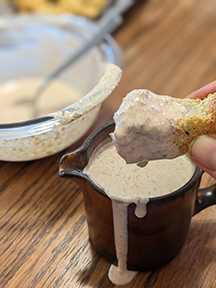
Though real fish sauce’s ingredient list is simple (anchovies, salt, maybe water and sugar), it is certainly not a simple process and I do not ever intend to even consider making my own. That said, a homemade remoulade-style sauce for fish is so much better than bottled tartar sauce. This one comes together in seconds and has just the right balance of creamy, tangy, and briny. 

½ cup mayo

½ cup plain yogurt

2 tablespoons capers, chopped, with a little splash of brine

½ tablespoon paprika

½ – 1 tablespoon prepared horseradish

Creole seasoning (I use Tony Chachere’s), to taste

splash of lemon juice

bit of hot sauce/cayenne, to taste

Stir together all ingredients; taste and adjust if necessary. Serve chilled with lots of versions of fish, from fried catfish to baked trout to tuna salad, and even the occasional steamed, raw, or slaw-ed vegetable.