

Lettuce Eat Local: All the oppor-corn-ities
Amanda Miller
Columnist
Lettuce Eat Local
I suppose they came just in time, those top two teeth to match the bottom two she already had. Kiah had been working long and hard on popping her upper incisors through, her gums clearly swollen and uncomfortable.
It took a couple weeks of rough days and nights, a good reminder that our lives would be very different currently if our baby weren’t such a remarkably happy one most of the time. It just made me sad — and tired, so tired — to see her so sad, knowing she must be miserable. I can only think of one other time before this bout of hardship that I wasn’t able to soothe her and calm her down, so this much desperate sobbing was about enough to break my heart.
Let’s assume that was the worst of it, and that her dental development will be a breeze from here on out. And while she can’t understand it, I feel her struggles were validated by the fabulous timing: because now she has working chompers and it’s sweet corn season.
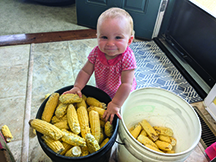
Kiah had already been devoting all the enthusiasm her 18-pound self could muster to voraciously gnawing on corn on the cob. You don’t know real strength until you try to wrest a corn cob out of my daughter’s tiny hands and their death grip on her prey.
Forget teething toys, this girl’s got sweet corn.
She got that second top tooth peeking out just in time for her wildest dream to come true — two buckets of sweet corn, temporarily left at her disposal.
She must have a sixth sense (silk sense?), because if there were an Olympic crawl-and-stand event, Kiah would have qualified on her way to the corn. As per usual, I was in the middle of way too many things to start the corn process right away, so I just shook my head and let the girl go for it.
I bet she was busy for almost an hour, which is incredible for that tiny attention span. Here I thought the things to do with sweet corn were to clean it, cook it, eat it; maybe cut it off the cob and put it in something or freeze it for later. I look hungrily at every sweet corn recipe that comes my way this time of year, going on all sorts of tangents in my brain for what deliciousness I could make: extra corny cornbread with corn-steeped honeyed whipped cream, spicy Southern corn pudding, ooey-gooey Korean corn cheese, all the possible mash-ups of Mexican street corn. (See, I’m doing it again; once I start thinking sweet corn, I can’t stop.)
But even with all those possibilities, Kiah showed me an entire other realm of oppor-corn-ities. Why limit our creativity to just how we can eat sweet corn, silly us. What about all the other ways we can use it — you can throw it, “sort” it and transfer it from place to place, smack it on the side of the bucket and squirt corn juice everywhere, mop the floor with it, see how thoroughly you can crush and spread kernels around, gnaw on the ends and sides and anywhere you can fit your four little teeth, the list goes on and on. I grew up with carpet in the kitchen and let’s just say we’d have to rip it up and start over if that would be the case here.
Fortunately, it’s laminate, and we live on a farm so it always needs to be mopped anyway. I know just what to give Kiah to distract her while I mop….
Everlasting Corn Salsa
Even with all this world of possibilities, I find myself coming back again and again to corn salsa. It’s everlasting because it has always been one of our top choices and will always be, and also because of its aforementioned effect on our floor. This salsa is of course ideal for tortilla chips (especially the lime ones) and any taco-adjacent dish, but don’t stop there: on a salad (or as a salad itself), sprinkled on a pizza, stirred into pasta. Make extra (if that’s a thing) and freeze a batch for later!
Prep tips: it’s very important to me that you don’t overcook the corn — keep it tasting fresh.
a couple ears of sweet corn, cleaned
juice and zest from a lime
as much cilantro as you want
a small red onion, roasted and minced
a drizzle of local honey
a hot pepper or two of choice, roasted and minced
salt and pepper
Put the corn in a saucepan, cover just so with water, and bring to a boil. Turn off the heat, and let sit for 5 minutes. Remove corn cobs from water, and set on a cutting board. Once cool enough to handle, cut off the kernels. Add remaining ingredients to taste and chill.
A One Man Ban

I suppose you heard that Amazon founder Jeff Bezos made a commitment to give 30 million dollars over a five year period to North Carolina State for research into manufacturing fake meat. For Bezos the 30 million is like a $20 bill to you and me because his wealth is currently estimated by Forbes to be $215 BILLION, which would rank him as the second richest human on earth. This is even after he gave his wife of 25 years, MacKenzie Bezos, $38 BILLION in Amazon stock in a divorce settlement.
For some reason Bezos has a beef with beef and he seems to hate cowboys. Maybe it’s because when he worked on his grandparents’ ranch in Cotulla, Texas, early in his life the rough and tumble cowboys did not play nice with the dweeb. At 5’7” Bezos does not appear to be someone who’d strike fear in the heart of your average cowboy.
The computer geek previously established the Bezos Earth Fund which is the largest philanthropic commitment ever to fight climate change and protect nature. The fund will supposedly disburse $10 billion by 2030 to make the world more sustainable and “create a future in which everyone can thrive.”
Everyone except cattlemen, of course.
Because of his support for fake beef I am announcing that I will never do business with Amazon EVER again. Nor will I be a passenger on his space tourism venture, Blue Origin. Folks who get Amazon packages daily from the U.S. Post Office might think my boycott will create a real hardship for me but I don’t buy a dozen things per year on the Internet and less than half would be courtesy of Amazon. I prefer to buy direct and I don’t need a middle man who wants to see fake beef replace the real thing. For the past 50 years my career has centered around the beef business and I don’t need to enrich someone who wants to put me out of business.
You might think my boycott of Amazon will have little effect on Mr. Bezos but I’m warning him that several of my boycotts in the past have put many huge companies out of business. For example, I pulled my money out of Washington Mutual and Indy Mac Bank and both firms declared bankruptcy shortly thereafter. Other companies I’ve boycotted include Enron, Lehman Brothers, Silicone National Bank, Bed Bath and Beyond, World Com, and Toys R Us, and we all know what happened to them, don’t we? I stopped buying underwear and Craftsman tools from Sears when they started making everything in China and my boycott bankrupted them too.
Another rich guy who’s investing heavily in fake beef is Bill Gates and he now owns the most farmland of anybody in America at 269,000 acres. I started boycotting Gates several years ago when an airline gave me a free Windows based computer which I tried and then quickly gave to someone I didn’t like. When I began my boycott Gates was the richest man in the world but since the beginning of my boycott Forbes says Gates has fallen all the way down to the number eight spot at $135 billion.
Poor guy.
These rich dudes shouldn’t question the power of my previous boycotts. When I switched to Wranglers it almost devastated Levi’s. I stopped buying Chicken Soup books when they stopped printing my columns and sure enough, they went bankrupt too. Closer to home, in the cattle business I never bought or sold a hoof from Eastern Livestock, Easterday or Millenkamp and all three crashed, fired and burned. So did the Tattooed Chef when I swore to never get a tattoo or to do anything in the kitchen. Chrysler declared bankruptcy years ago and that was probably because I only bought Oldsmobiles but then Olds went out of business when I switched to Buicks.
I’ve also never bought a single thing from Starbucks or Wal Mart and I’m considering boycotting Costco because they recently hiked the price for admission. I am presently boycotting Russia, dental implants and TicTok. Whatever that is.
If anyone sees Jeff Bezos please warn him that because of his support of the fake meat industry, and my resulting boycott, he’ll soon be homeless, panhandling on some street corner and begging for my forgiveness.
KU News: New book reveals how roads and vehicles transformed colonial societies across Africa

From the Office of Public Affairs | http://www.news.ku.edu
Headlines
New book reveals how roads and vehicles transformed colonial societies across Africa
LAWRENCE — A new book from a University of Kansas history professor uncovers how vehicles and the roads they traveled upon began to transform colonial societies across Africa — but rarely in the manner Europeans expected. “This book makes an important point about the way imperialism worked between the late 19th century through World War II, but it also has a lot to say about how we see these dynamics in the 21st century as well,” author Andrew Denning said.
Author shows importance of framing in disability policy discussions
LAWRENCE — Sean Kamperman won’t go so far as to say that framing an argument is half the battle. But a new paper by the University of Kansas English professor published in the journal Written Communication argues that certain key words, topic shifts and other framing maneuvers can serve to “amplify marginalized voices in public debates.”
Full stories below.
————————————————————————
Contact: Jon Niccum, KU News Service, 785-864-7633, [email protected]
New book reveals how roads and vehicles transformed colonial societies across Africa
LAWRENCE — Shakespeare wrote, “Kingdoms are clay.” But a new book suggests kingdoms are actually more asphalt.
“European empires of the 20th century were in many ways defined by their projects of motorization and road construction. Through these, colonial officials hoped to develop more efficient ways to exploit and control lands and peoples,” said Andrew Denning, associate professor of history at the University of Kansas.
His latest book. “Automotive Empire: How Cars and Roads Fueled European Colonialism in Africa,” uncovers how vehicles and the roads they traveled upon began to transform colonial societies across Africa … but rarely in the manner Europeans expected. It’s published by Cornell University Press.
When Britain, France, Italy, Germany, Belgium and Portugal started colonizing Africa, they faced a shared “transport problem.” They believed roads would radiate commerce and political dominion, but the colossal scale of Africa introduced challenges.
“These countries encountered a continent that’s far larger than Europe, and they only had a few thousand European officials on the ground to administer their colonies,” Denning said. “So they’re trying to overcome this transport problem to develop and exploit the various kinds of resources — human resources, natural resources — that they desired on the continent, while also connecting their economies and administrations to African settlements.”
Motor vehicles traveling on roads became the solution. Roads were cheaper and easier to construct than railroads and weren’t hampered by the environmental limitations of rivers.
“Roads can really vary in terms of technological complexity. They can be simple: dirt, gravel or packed mud that require little technical input in terms of machinery. Yet they can also be incredibly modern, necessitating heavy input of capital and engineering expertise,” Denning said.
“Oftentimes, we found imperial regimes trying to do this on the cheap. They took what had been paths for porters or animals and tried to quickly retrofit them into something that could be used by automobiles.”
Denning considers the automobile as the representative epitome of 20th century modern society.
“This ‘Fordist’ form of mass consumerism and mass production was pivotal,” he said. “Putting colonialism and the automobile together provoked such interesting issues and questions about who automobiles served and what roles they could play. Motor vehicles really helped to define how empires worked.”
The so-called “scramble for Africa” produced a checkerboard of different European colonies beginning in the 1880s. European powers claimed large swaths of territory through technological advantages including firearms and steamships, among other things.
“This was also a moment of competition between imperial powers in which they realized that if they didn’t claim as much territory as possible as quickly as possible, they might get boxed out,” Denning said. “Suddenly, they’ve claimed all of these lands — which are essentially parceled out on maps in Europe — with very little knowledge of what’s there.”
How did the Indigenous peoples react to such a scramble?
“It’s obviously a matter of hubris to make these claims. Africa is a massive continent, and the Europeans did this under the imagination that these were largely empty lands,” he said. “Indigenous peoples of Africa had all kinds of responses. Many engaged militarily. The Italians were latecomers to the scramble, and when they attempted to conquer Ethiopia in 1896, they lost.”
A KU faculty member since 2015, Denning focuses on 20th century European imperial history. He is also the director of KU’s Museum Studies Program. His previous book, “The Interwar World” (Routledge, 2023), focuses on the turbulent period of 1918-1939.
“The thing that has tied my work together in the last decade is an interest in mobility — how people move, why they move and the ways this mobility is more than just a means to an end. The ways people move really come to affect the way history develops,” he said.
Denning stressed that contemporary society assumes forms of technological and infrastructural development will naturally accrue benefits to states and regimes that control them. However, despite the power and wealth of these developers, what often happens instead is the ground-level people who use roads, ports and railroads affect and frequently undermine a lot of their plans.
“This book makes an important point about the way imperialism worked between the late 19th century through World War II, but it also has a lot to say about how we see these dynamics in the 21st century as well,” Denning said.
“It teaches us about how investments are made and how economic development is fostered by states, while revealing some of the unforeseen consequences those states deal with after they’ve made these investments.”
-30-
————————————————————————
Don’t miss new episodes of “When Experts Attack!,”
a KU News Service podcast hosted by Kansas Public Radio.
https://kansaspublicradio.org/podcast/when-experts-attack
————————————————————————
Contact: Rick Hellman, KU News Service, 785-864-8852, [email protected], @RickHellman
Author shows importance of framing in disability policy discussions
LAWRENCE — Sean Kamperman won’t go so far as to say that framing an argument is half the battle. But a new paper by the University of Kansas researcher argues that certain key words, topic shifts and other framing maneuvers can serve to “amplify marginalized voices in public debates.”
His findings “show the importance of having a strategy when you enter these types of conversations and of being prepared to hold your ground rhetorically,” said the assistant professor of English. “You can get knocked off your framing quickly.”
That’s true for anyone, but especially for those among and/or advocating for people with intellectual disabilities — be it autism, Down syndrome or anything else.
The article, titled “Gateways and Anchor Points: The Use of Frames to Amplify Marginalized Voices in Disability Policy Deliberations,” was published in the most recent edition of the journal Written Communication.
Kamperman became interested in the self-advocacy movement some years ago, and the article focuses on interactions between members of that community and elected officials as the citizens petitioned the government in Kamperman’s former home state, Ohio, to expand education and transportation services.
Kamperman writes of attending meetings and observing interactions between disability advocates and a group of elected officials and bureaucrats in a “town hall” setting.
His observations, he writes, are guided by classical rhetorical theory of stasis.
“That holds that there are several fundamental standpoints one can take in a debate,” Kamperman said. “For instance, one stasis, or state, is the question of jurisdiction. Who is responsible for fixing the problem? Another is the question of definition. Who gets to define the existence and scope of the problem? Disagreements are often the result of two sides proceeding from different standpoints.
“I give the example in the paper of a mom who comes to a meeting with her legislators and says her daughter is not getting the services she has been promised. The legislator replies with something like, ‘These bureaucracies are terrible, but you just have to work within the system.’ He is shifting the question from who has responsibility to fix the problem to defining the problem as normal and expected. So shifting between staseis is one way of reframing issues — in this case, dodging responsibility.”
Kamperman cites as effective one self-advocate who punctured legislators’ demand for proof of the job — acquiring effectiveness of a postsecondary education program by showing why the data they sought was unavailable.
“That created a gateway, a frame shift, an opening to shift the discussion from one about employment to one about equity, education and self-actualization,” Kamperman said.
Also effective, Kamperman writes, is when advocates bring their lived experiences to the room. That’s the anchor point of the article’s title.
“By bringing that intimate knowledge to the table, if they are savvy, these advocates can swing the conversation,” Kamperman said.
Kamperman admitted his findings showing the importance of quick thinking, fluency and even oratory in public policy settings works against the self-advocacy movement’s goal of empowering those with intellectual disabilities — who may not be fluent — to speak for themselves.
“It’s a dilemma for the self-advocacy movement,” he said. “It’s why self-advocates with both political literacy and lived experience of disability are so important to these discussions.”
-30-
————————————————————————
KU News Service
1450 Jayhawk Blvd.
Lawrence KS 66045
Phone: 785-864-3256
Fax: 785-864-3339
http://www.news.ku.edu
Erinn Barcomb-Peterson, director of news and media relations, [email protected]
Today’s News is a free service from the Office of Public Affairs
“If your happy and you know it clap your hands”

If you’re happy and you know it clap your hands.” A song familiar to all of us. However, how familiar is the awareness of our body clues of feeling happy to all of us to truly know it”? Recognizing body clues and sensations to aid in the next steps of labeling emotions is the first key skill in emotional intelligence. Unfortunately, these are not skills we are taught.
Mental health development across the lifespan is as vital as physical and cognitive development. Understanding the biology of our nervous system, the sensations and body clues linked to emotions, and the outcomes of attending to these sensations and body clues, allows us to increase wanted outcomes within our lives. There is a growing trend towards normalizing the practice of developing mental health skills among adults, mirroring the emphasis long placed on physical and academic education. This shift recognizes that mental well-being is integral to overall health and productivity in adulthood. Initiatives promoting mindfulness, stress management, and emotional resilience are gaining traction in workplaces and community settings. Employers are offering resources such as mental health days, counseling services, and workshops on mental health topics. By prioritizing mental health alongside professional development, organizations aim to create healthier, more productive environments where individuals can thrive personally and professionally. This holistic approach acknowledges that mental health skills are essential for navigating the complexities of adult life and achieving long-term well-being.
Dr. Mark Brackett, from Yale University, is renowned for his work on emotional intelligence and the role of emotions in learning, decision-making, and overall well-being. Brackett’s research and teachings focus on how sensations in the body signal emotional states and how acknowledging these feelings can enhance emotional regulation and decision-making. He emphasizes the significance of recognizing comfort levels as a crucial aspect of emotional awareness, suggesting that attunement to one’s emotional comfort can lead to better self-regulation and improved interpersonal interactions.
Practicing these skills is as simple as getting curious about what is happening within our body and noticing if our body is comfortable or uncomfortable. Regularly check in with yourself throughout the day to assess your emotional sensations. Ask yourself how you’re feeling and whether any discomfort or stress is present. Get curious about yourself.
Developing emotional awareness and comfort with these skills is a gradual process that requires patience, self-compassion, and consistency. Be gentle with yourself and celebrate small improvements along the way. By incorporating these practices into your routine, you can cultivate greater emotional awareness, understand your comfort levels more deeply, and create more outcomes you desire to have. You will also truly be able to live the song, If you’re happy and you know it clap your hands.”
Nikki Eining is a private independent practice licensed social worker who serves as the Statewide Pediatric Mental Health Care Access Program Coordinator for The USD Center for Disabilities and Owner of Grace Grit Growth Counseling LLC in Brookings, SD. Nikki brings a diverse set of experiences and passions spending over 18 years working in the mental health field. Her previous experience has focused on supporting youth and families in office, school, and community settings without outpatient behavioral health services and prevention programming. She has professional experience in clinical mental health, education, research design, non-profit, program development, and trauma-informed care practices.
Nikki is passionate about trauma and healing-informed practices, the power of protective factors and collaboration across communities to help decrease barriers for youth and families. Nikki is a Theraplay Level 1, 2 and Group trained therapist, SAPST trained prevention provider, and an ACE Interface Certified educator. Follow The Prairie
Doc® at www.prairiedoc.org and on Facebook and instagram featuring On Call with the Prairie Doc® a medical Q&A show celebrating its 22nd season of health information based on science, built on trust, streaming live on Facebook most Thursdays at 7 p.m. central.
