Tuesday, January 27, 2026
Home Blog Page 205

Fiesta Corn

0

Sometimes when you’re planning a Tex-Mex dinner it’s difficult to come up with unique sides besides a standard green salad or a cup of tortilla soup. The Fiesta corn dish is not only easy to prepare, but it’s full of robust flavors and colors for both the plate and palate. Sometimes it’s hard to pull together sides for the Mexican themed meal, this one will reap positive comments and make you glad you tried something new.

I know a few die-hard corn fans who would sit down to the corn dish ‘cold’! I would lay low on too much fresh cilantro because either you love it or you hate the herb! Your family genes have a lot to do with whether you enjoy this spice or not. The properties of cilantro rank high with physical benefits. I would certainly enjoy it, but my husband would not appreciate the move. Our son, Phillip, obviously got his passion for cilantro from me.

This week saw us busy with lots of community involvements and enjoying the warmer temperatures. I’m teaching again as I volunteered to instruct basic floral design, at the ‘Senior Fair’ being held at the Catholic Church in Kimberling City. Thursday, March 6, 2025, 10am-3pm. Lots of presenters and a wonderful complimentary lunch.

I’m trying not to get too excited about winter being over. However it does make you want to start studying seed catalogs, making summer plans and bringing out the Easter bunnies. Look for easy ways to update the home as we start to think, ‘SPRING’. Vibrant pastels, cheerful table runners, bird statuary, bunnies, forsythia branches, tulips. Moving a few pieces of furniture around can give you a fresh lift. Shake out the rugs, wash all the couch blankets, and get things organized so you are truly ready for the seasonal changes. St. Patrick’s Day is arriving first, good time to plan a nice simple beef stew dinner and invite a few friends over. Throw in a side salad and biscuits and the menu is done! I’ve even ordered some new mint green flowers for the dining table. I’ll remove the red quilt & striped table topper on my dining room table and replace it

with a green and creme table runner. Oh, then there’s the new yellow tulips I purchased in the ‘fall’, for this spring. Well; I’d best get going on all this seasonal decor work, which means another tip: Purchase for next year’s holiday right after it concludes in order to save on the following season.

Now let’s grab the Fiesta Corn recipe. Simply yours, The Covered Dish.

Fiesta Corn

Gather a large sauté pan.

2-3 tablespoons olive oil

1 small zucchini, finely diced

½ of a red pepper, finely diced

½ -1 cup finely diced red onion

2 cans (15 oz. each) yellow corn, drained

¼ teaspoon chili powder

1 12/ teaspoons cumin

1 teaspoon salt

Cilantro to taste, chopped fine.

Sauté zucchini, pepper and onion in olive oil, when tender introduce the drained corn. Continue cooking until the corn is hot, add the chili powder, cumin and salt. Just before serving sprinkle in chopped cilantro and stir to heat. If you want to grab a couple pats of butter as you are moving it into a warmed bowl, (Water in bowl, heat in microwave, remove water, dry and fill.) that might be a nice added touch. Also you can put a small bowl of pre-chopped ‘additional’ cilantro for those who desire more.

Feel free to modify, I like different types of chili powder, especially chipotle. Sometimes I’ll use both white and yellow corn. Frozen corn is OK, but thaw it first or you will bring in too much water to the dish. For the true spice hounds sit a bottle of hot sauce on the table.

Harvey County Home and Garden Show

0

One of the purposes of the Harvey County Home and Garden Show is providing an opportunity to learn! Each year we have eleven lawn and garden seminars for the citizens of Harvey County and surrounding area co come and learn from one or all of the programs. This year if you are interested in learning how to grow mushrooms, plants with indoor blooms or weather this is the place for you. March 22 and 23 are the dates and it is held at the Dyck Arboretum in Hesston.


Saturday: March 22, 2025

9:00 am Growing Culinary Mushrooms in Your Backyard

Pam Paulsen, Horticulture Agent Reno Co

10:00 am How to Avoid Getting Bitten by Ticks

Dr. Raymond Cloyd, Extension Entomologist, Kansas State University

11:00 am How to Avoid Getting Bit by Mosquitos

Dr. Raymond Cloyd, Extension Entomologist, Kansas State University

1:00 pm Birdscaping

Katie Schmidt, Dyck Arboretum Horticulturist

2:00 pm Tai Chi for Beginners

Abby Vaughn, Nutrition, Food Safety, and Health Agent Harvey County

3:00 pm From State Bird to Yard Bird

Gregg Friesen, Local Birding Enthusiast

4:00 pm The Right Way to Take Care of Your Fescue Lawn!

Scott Eckert, Horticulture Agent, Harvey County


Sunday: March 23

1:00 pm Indoor Blooms

Calla Edwards, Horticulture Agent Butler Co

2:00 pm Kansas Weather and You

Jake Dunne, Morning Meteorologist, KWCH 12

3:00 pm Humming Along

Chuck Otte, Bird Expert, Former Ag Agent, Geary County

4:00 pm Flower Gardening for Beauty & Biodiversity

Jason Graves, Horticulture Agent Central KS District


Don’t forget there is a free kids activity and door prizes as well. The cost is just one dollar but kids 12 and under are free!

KU News: Research yields eco-friendly way to separate, recycle refrigerants tied to climate crisis

0

From the Office of Public Affairs | http://www.news.ku.edu

Headlines

Contact: Brendan Lynch, KU News Service, 785-864-8855, [email protected]

Research yields eco-friendly way to separate, recycle refrigerants tied to climate crisis


LAWRENCE — A scholarly report in the journal Science Advances from researchers at the University of Kansas shows a new eco-friendly method for separating the chemicals found in common refrigerants for easier recycling at industrial scale.

“The motivation of this work is to enable separation of highly complex gaseous refrigerant mixtures,” said lead author Abby Harder’s, who performed the research as a KU doctoral student in the research group of co-author Mark Shiflett, Foundation Distinguished Professor of Chemical and Petroleum Engineering. “This effort has been driven by climate legislation phasing out certain hydrofluorocarbon (HFC) refrigerants.”

The paper’s key innovation uses membranes — amorphous fluorinated polymers, to be specific — that efficiently isolate complex refrigerant mixtures. Other separation methods, like distillation, are less effective because of the complex composition of the mixtures. Harders said the membranes are fabricated to allow some gases to pass through while restricting others — resulting in effective purification.

To demonstrate the technology could scale to industrial viability, the team — including many associated with KU’s Wonderful Institute for Sustainable Engineering — developed a custom-coating process to create submicron coatings on the membrane’s porous supports, creating composite hollow fibers. The results show a functional prototype, proving the technology’s usefulness to firms engaged in refrigerant recovery and reuse.

Harder’s cited international agreements and legislation like the Kigali Amendment to the Montreal Protocol and the American Innovation and Manufacturing Act that will phase out HFC production as the ultimate solution to atmospheric warming from refrigerants. In the meantime, however, solutions for dealing responsibly with complex gases in existing equipment destined for landfills around the world are badly needed, she said.

For example, according to the U.S. Environmental Protection Agency, HFC-134a, the most common refrigerant used in MVAC systems today, is a “potent greenhouse gas with a global warming potential that is 1,430 times that of CO2.”

Harder’s said economically viable solutions for recycling the heat-trapping gases will keep more of them from release into Earth’s atmosphere.

“A large percentage of refrigerant today is not recovered — it’s simply vented into the atmosphere,” she said. “Much of this occurs when equipment is decommissioned. In some cases, recovering refrigerant may not seem worthwhile, or those responsible for recovery may not recognize its value. Additionally, if refrigerant is not fully evacuated, it can end up in landfills, where it eventually leaks into the atmosphere. Approximately 90% of refrigerant leakage occurs at the end of a system’s life.”

The KU researcher said she hopes the method she largely devised in her time at KU could help bridge the gap ahead of the next generation of refrigerants.

“To increase reusability and allow for the extraction and recycling of HFC refrigerants from end-of-life units, it’s essential to separate them effectively so they can be purified and reintroduced into the market,” she said. “However, no existing industrial technology can currently achieve this. These refrigerants form complex mixtures that cannot be separated using traditional heat-driven methods like distillation.”

Today, Harder’s works as a chemical engineer and head of research and development with Lawrence-based Icorium Engineering, a startup that emerged from the Shiflett Research Group situated in KU’s Innovation Park. While Icorium focuses on separation of refrigerants using ionic liquids, the new method demonstrated in Harder’s paper offers a new tool to the industry.

“Part of Abby’s Ph.D. research at KU is now being translated into the startup company,” said Shiflett, who co-founded Icorium and now serves as its chief science officer. “Abby also has a fascinating education journey. She earned her undergraduate degrees in chemistry and mathematics at Bethel College in central Kansas, participated in an NSF-sponsored Research Experience for Undergraduates during 2019 in my lab and then came to KU for her Ph.D. in chemical engineering. She was an amazing student, receiving the Chancellor’s Doctoral Fellowship for her doctoral research and graduating with a 4.0 GPA at the top of her class. She’s published 10 papers and is a co-inventor on a patent application. Needless to say, I’m very proud of her and her research and journey.”

Harder’s and Shiflett’s co-authors on the paper were Luke Wallisch, Michael Lundin and Ed Atchison of the Wonderful Institute for Sustainable Engineering at KU, Chloe Le of California Polytechnic State University, Gabrielle Zaher of the University of Washington, and Whitney White of Warren, New Jersey-based Chromis Technologies.

For Harder’s, whose generation will face yet more severe challenges from a warming climate, the chance to bring her engineering expertise to fight the climate crisis has personal meaning.

“I feel like I’m doing work that not only will impact me or future kids I might have, but something that can hopefully impact a lot of people’s lives,” she said. “That’s something that really helps me stay motivated, not get burnt out, because what I’m doing will hopefully continue to be well received by policymakers and have industrial value. Eventually, we’ll have full-scale commercial use so that it can actually do what it’s intended to do and make the impact that we want it to make.”

-30-

————————————————————————


KU News Service

1450 Jayhawk Blvd.

Lawrence KS 66045

[email protected]

http://www.news.ku.edu


Erinn Barcomb-Peterson, director of news and media relations, [email protected]


Today’s News is a free service from the Office of Public Affairs


Alf Landon

0
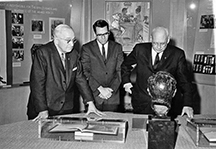
From left to right: former President Harry S. Truman, John C. Landon, and former Kansas Governor Alf Landon at the United Nations Table on exhibit in the Truman Library.

Richard Shank
Columnist

Alf Landon by Richard Shank 


With the chaos and confusion so common with American politics these days

made me wonder what would Kansas’ legendary governor and presidential candidate Alf Landon be thinking about these times.  

Landon was elected Kansas governor in 1932 and re-elected two years later, the only Republican governor in the nation to achieve that distinction in a time when America was dealing with a crisis dubbed the “Great Depression.” 

Alf Landon cut his teeth in politics in 1912 when he supported the third party campaign of Teddy Roosevelt who made a valiant effort to recapture the Presidency under the banner of the Bull Moose Party. Twenty years later, Landon, a wealthy Independence, Kansas oil man, won the first of two terms as Governor. 

As America dealt with the worst economic downturn in the country’s history and Kansas endured what has become known as the Dust Bowl, Landon gained national prominence, in 1934, by balancing the state’s budget. He was lauded as the only Governor in the nation who could make that claim. 

The national news media took note and suggested he should consider a run for the Presidency, and on September 8, 1935, Landon tossed his hat into the ring. 

Defeating Franklin Roosevelt, the incumbent, would be no small task but the Governor of Kansas was more than willing to try. 

Landon ventured east in the spring of 1936, winning the Massachusetts and New Jersey primaries, no small accomplishment for a Midwestern governor, as his chances for the Republican nomination soared. 

The GOP met in Cleveland for its convention in June 1936, where Landon swamped his main challenger Idaho Senator William Borah by a vote of 984 to 19. 

A study of Landon’s 1936 campaign for president is living proof that political movements and polling have changed much during the past nine decades of American political life. 

The fall campaign would produce its share of stories worth repeating. 

As the campaign got underway, it was obvious that Roosevelt’s New Deal was on trial and, in particular, a new law called “Social Security” was slated to go into effect the following year. 

Landon and Roosevelt crisscrossed the country by train. In the week preceding the election, the Kansas Governor was feted with a ticker tape parade through New York City as millions turned out to see the Kansas Governor waving to the crowds as he was driven down Times Square. 

A new phenomenon called “polling” entered the political arena that year and created humorous stories still told in American political circles. 

Literary Digest, a respected publication of its time, mailed a postcard to its 10 million subscribers asking readers to state their preference. When 57 percent returned postcards in favor of Landon, Literary Digest went to print stating, without question, Landon was on his way to a landslide victory. After all, the publication’s editors accurately claimed they had never been wrong before in previous postcard polls, but failed to consider that a majority of its readers were registered Republicans. 

Then, Maine, during that era voted in September instead of November gave the Republicans big majorities, which added more credibility to the expression “As Maine goes, so goes the nation.”

On the other hand, George Gallup polled a cross section of 50,000 voters nationwide and raised more than a few eyebrows when he reported Roosevelt just might be on his way to a big win. 


Election Day, November 3, 1936, told the story as Roosevelt was swept back into office, winning 46 states including Kansas. Although Landon is remembered as a popular and progressive Governor, voters in his home state had a great affection for Roosevelt, whose policies were starting to bring the country back from the brink of economic disaster. 

Roosevelt topped Landon among Kansas voters by a vote of 464,520 to 397,727. 

Landon carried two states—Main and Vermont, which prompted Democratic power broker James Farley to boast that “As goes Maine, so goes Vermont.” 

Landon, the perfect gentleman, took the landslide loss in stride and stayed true to his pledge to never seek office again. Always a man with a great sense of humor, he named his two horses Maine and Vermont after the two states that were loyal to him in his campaign for the nation’s highest office. 

It has been reported he and Roosevelt were friends and remained so even after a long campaign. Roosevelt was known to call Landon seeking his advice and council on issues affecting the Mid-West. 

Landon survived the 1936 campaign by 51 years, living to age 100 before his death in 1987 and would see his daughter Nancy elected United States Senator in 1978. He would continue his business ventures until late in his life and would be sought for comments by reporters from throughout the world. President Reagan stopped to visit him in his Topeka home several days before his 100th birthday. 

In 1966, he lent his name to a lecture series named in his honor at Kansas State University, and soon thereafter was selected as an Adjunct Professor at the school. 

In a 1970 interview with the Kansas City Star, Landon was candid about his life. When asked if he regretted not running for the Senate in 1938 as he was encouraged to do. “I just like Kansas people and the Kansas climate,” Landon said. “I like my surroundings. And, it is near my business. I am still in the oil business. I have some wells in Greenwood County.” 

When the reporter Ivan Goldman asked if he was concerned about what would happen when he was gone, the former governor laughed and said, “I’ve drilled too many dry holes to worry about that.” 

In a lecture to a class at Kansas State, a young student posed a question to Landon, “What was it like to run for President?” 

Landon, looking more poker faced than usual, thought for a moment and said, “When you are running for President, you meet a lot of people that you will never forget and others you want to forget right away.” 


Former President Harry Truman (left) is photographed giving a tour of his presidential library in Independence, Missouri to Alf Landon (right).  Pictured in the middle is Landon’s son Jack. Date of photo is unknown.

“I’m Gonna Get a Rabbit…”

0

JUST A LITTLE LIGHT


“I’m Gonna Get a Rabbit…”


By Dawn Phelps


Samuel Timothy Elliott, my oldest grandson, was born in 1997 about nine years before my first husband Ralph Thorn died.  Ralph doted on Sam, and Sam loved to ride our lawn mower with Ralph, always with the blade turned off.


During Sam’s early years, we lived in the country, and there were usually several rabbits leisurely sitting around in our yard in the grass, appearing to feel safe and secure at the place that we lovingly had named Thornberry Acres.  


When Sam was about three or four years old, he and his Grandpa Ralph would talk about goin’ hunting to “get a rabbit” with Sam’s BB gun.  I would hear from talking about getting “hasenpfeffer,” which means “supper.”


And more than likely, even if Sam would have hit a rabbit with a BB gun, it would not have killed one.  Perhaps it was, like the old saying goes, more about the “thrill of the hunt” with Grandpa.  


But there was a problem—when Sam stepped out the door armed with his BB gun, to Sam’s disappointment, the rabbits would scurry. 


But Sam’s dream of getting “hasenpfeffer” continued.  And from time to time, I’d see Sam head out the back door with his BB gun and a look of determination!


When he was seven years old, I found a note that Sam had written in one of my spiral steno-pads.  It made me chuckle, and I saved it.  I wrote Sam’s age on the back of the note.  Sam would have been seven years old at the time—2004.


Sam had written the note phonetically, spelling the words how they sounded.  It said:


“Tomorrow I take actshen.  I plan to get 2 maby even 3.”


Some years later, I again found the same note.  It really brought back some memories—of Thornberry Acres, my husband Ralph, and our wonderful years living in the country.  


Sam and his Grandpa Ralph never shot a rabbit with Sam’s BB gun.  But a few years later, Sam and a cousin did shoot a rabbit with a pellet gun.  And Sam cried and told us, “I didn’t mean to kill it.”  


That little boy is now almost 28 years old and is over six feet tall.  He still has his black hair, and eyes are so dark-brown that you cannot see his pupils.  He is still tender-hearted.  


Sam grew up in Wales and now lives in Springfield, Missouri.  He works hard.  He is a brilliant, talented, handsome, goal-oriented man.  He knows how to roast coffee and has sold articles to international coffee magazines.  


Many times, throughout the last couple of decades, I have thought of Sam’s note.  And if you think about it, maybe that’s when Sam began setting goals for his life.  


His note includes steps for goal setting.  When: “tomorrow.”  Action verbs: “take action.”  What he was planning:  to get “rabbits.”  How many: “2 maby even 3.” 


Sam had succinctly written his goal on paper with a few words.  His goal was clear and to the point!  


I think I may have learned a little from Sam’s note myself.  Even at my age, I still make lists of projects I want to accomplish.  And like Sam, I put my goals on paper—long-term goals, short-term, and frequently daily goals.


At my age, I feel like I am racing against the clock.  Obstacles have hindered my progress.  But I still doggedly keep on trying, like Sam heading out the back door with a determined look and a BB gun in his hand.


Most mornings, when I sit down with a hot cup of coffee, I scribble down what I want to accomplish that day.  Sometimes I only write a few words.


Do I accomplish all my goals?  No, because things pop up that take up my time, many which are beyond my control, but are still important.  And life must be lived, so I live life and keep on trying.  


Many mornings I say to Tom, “Well, today I’m going to get two rabbits, maybe even three.”  And sometimes I must hunt down more “rabbits” than I had planned on!


So why not write your goals?  If you do, you might even get a rabbit, or “2 maby even 3.”