Tuesday, February 3, 2026
Home Blog Page 308

New scam targets those drivers who use the Kansas Turnpike

0

Authorities with the Kansas Turnpike Authorities are alerting the public of a new scam.

This new smishing text campaign using DriveKS images surfaced Tuesday, according to the Kansas Turpike Authority.

If you receive a text like this image do not click link or respond in any way. Remember, the Kansas Turnpike Authority does not send unsolicited text messages and does not charge fees like those mentioned in the image.

In July, the Kansas Turnpike converted to cashless tolling. Those fees are collected by mail.

45 Years of Conservation, Diversification, and Innovation!

0

KRC Food and Farm Conference 2024

This year’s conference keynote speaker is Austin Frerick, author of Barons: Money, Power, and the Corruption of America’s Food. This topic powerfully highlights the increasing dominance of big business in our food system and amplifies the need for KRC’s efforts to keep our farmers on the land and ensure availability of healthy local food for all Kansans. Following Austin’s presentation, we will have three tracks, each with a theme of Conservation, Diversification, or Innovation. This year’s conference will conclude with a panel of young farmers sharing their unique visions for the future.

Nov 16, 2024 08:30am CT – Nov 16, 2024 05:00pm CT

Drury Plaza Hotel Broadview Wichita
400 W Douglas Ave, Wichita, KS 67202


Fate of former Pomona Lake cove illustrates how silt hurts Kansas reservoirs, water supply

0

A small, lakefront cove provided a pleasant place to swim, fish and ice skate not far from the house where B.D. and Mary Ehler moved their family in May 1976 at Osage County’s Pomona Lake.

The water in the cove stood 5 to 7 feet deep, recalled B.D. Ehler, now 90, who still lives there with Mary Ehler.

About six docks stood along the cove, with most residents using walking paths to get there, Ehler told The Capital-Journal on Sept. 9.

“It was a pretty decent-sized cove,” he said. “But eventually, it started silting in.”

Today, that cove is gone.

Its former entrance is completely covered by silt, a fine type of sand, clay, or other material carried by running water and deposited as sediment. The cove’s docks have been long since removed.

The cove’s only remnants that could be seen Sept. 9 were a shallow inland pond, a broken tackle box, an iron bar that appeared to have been part of a gate and a U.S. Army Corps of Engineers marker, which stood where a dock would have extended to the water’s edge.

How much water supply has silt cost Kansas reservoirs?

The cove’s fate helps illustrate how silt coming from upstream has hurt Kansas reservoirs in ways that include reducing their storage capacity and available recreation space.

Reservoirs have lost more than 400,000 acre-feet of “water supply stored” to sedimentation, according to the Kansas Water Office’s 2022 Kansas Water Plan. An acre-foot is 328,581 gallons, according to a graphic included in that plan.

Tuttle Creek Reservoir in Riley and Pottawatomie counties has been hit hardest, losing more than 200,000 acre-feet to sediment, with roughly 225,000 acre-feet in projected water supply volume remaining, that graphic said.

How do reservoirs lose storage capacity to silt?

The state of Kansas is home to 24 large, man-made reservoirs, all built by the federal government between 1940 and 1982

Those reservoirs continually lose storage capacity to sedimentation from upstream waterways, the water plan said.

“Lands within the watersheds of reservoirs lose soil, which is then transported to the reservoirs as a result of varied precipitation events,” it said.

Soil becomes trapped in the reservoirs, reducing available water supply, the plan said.

Couple drove across bottom of Pomona Lake before it became a lake.

B.D. and Mary Ehler, who both graduated in 1952 from Topeka’s Highland Park High School, recalled how, in about 1963, they drove in a 1958 Ford Thunderbird across what would later become the bottom of Pomona Lake.

That lake then opened in 1964.

An avid fisherman, B.D. Ehler is retired as director of pharmacy services for Topeka’s Menninger Clinic. The Ehlers and their three children moved from Topeka to a house just south of Pomona Lake in 1976.

That reservoir has effectively controlled flooding downstream but has increasingly silted in over the years, Ehler said.

He showed The Capital-Journal photos illustrating how the cove near his home grew smaller as time passed.

The Army Corps of Engineers knew that was going to happen, Ehler said.

“The corps anticipated when they built this reservoir that in 50 years it would be 50% silted in,” he said.

Laura A. Totten acknowledged this past week that when the Kansas reservoirs were built, the Army Corps of Engineers made estimates regarding the specific lifespans each would see.

Those estimates took into account the effects of sedimentation as well as the lifespan of the lake infrastructure, said Totten, who is project manager and planner for the corps’ Kansas City, Missouri, District.

Many of those reservoirs are doing better than was anticipated, Totten said.

At Pomona Lake, water supply storage lost to sedimentation amounts to less than half the projected water supply volume remaining, according to a graphic that’s part of the 2022 Kansas Water Plan.

Still, the years have taken their toll on those reservoirs, that plan said.

“With many of these reservoirs now over 40 years old, recent and historic bathymetric surveys are showing that reservoir storage capacity is being lost in a trend similar to the initial projections for several Kansas river basins,” it said.

The plan added: “There is a projected and observed loss of storage as sediment carried by inflowing rivers and creeks is trapped within the reservoirs, with some Kansas reservoirs trapping over 98% of the sediment carried from their upstream watersheds. Future conflicts may arise where the amount of water able to be retained in reservoir storage will be insufficient to meet the demands of multiple user groups and puts the state in the position of being unable to supply adequate amounts of water for anticipated future uses.”

Here’s what a ‘Blue Ribbon’ task force says needs to be done.

The Kansas Water Plan noted that a state-created Blue Ribbon Funding Task Force in 2015 put out a report sharing its long-term vision for the future of the state’s water supply.

That report concluded the state must adequately reduce sedimentation rates to protect future water supply, and identified “a funding need of $21 million per year to support conservation and remediation activities to secure future reservoir water supplies,” the water plan said.

It said the state needs to more effectively:

  • “Quantify the sedimentation issue through updated reservoir bathymetric surveys and surface water monitoring where feasible.”
  • Identify alternative sediment, nutrient, and basin management strategies to reduce impacts to reservoirs, while avoiding downstream impacts.
  • And “gauge and identify if the reservoirs are losing storage capacity at rates as initially projected and potential changes to these rates from behavioral changes within the watersheds.”

Steps have been taken upstream from Kansas reservoirs to help deal with silt problems, the water plan said.

“Targeted investments have included implementation of best management practices such as streambank stabilization projects, watershed dam construction, and increased support for soil health initiatives,” it said. “However, the acres of agricultural lands that have had conservation practices implemented and the number of streambank stabilization sites completed, with past and current levels of funding, have not remediated reservoir sedimentation issues.”

Corps of Engineers official: Sediment problem is being tackled.

Much is being done otherwise to mitigate silt-related problems in Kansas reservoirs, Totten said.

She manages a project for which the Army Corps of Engineers plans beginning next spring to do $6 million worth of dredging at Tuttle Creek Reservoir, where pressurized water will be used to lift sediment from the base of the lake and push it downstream into the Kansas River.

Totten said other steps being taken include:

  • Forming the Kansas Reservoir Sedimentation Task Force — made up of representatives from the U.S. Army Corps of Engineers Kansas City and Tulsa districts, the Kansas governor’s office and the Kansas Water Office — which began meeting in January to find solutions for dealing with sedimentation in reservoirs across the Kansas River Basin.
  • Recently completing a Kansas River Reservoirs Flood and Sediment Study, “a watershed study which included extensive work related to this issue and the impacts it causes to the multiple uses of our reservoirs such as water quality, water supply, recreation, flood control, etc.”
  • And initiating multiple “planning assistance to states” studies through which the Army Corps of Engineers and the state of Kansas are investigating the issues and determining recommendations for managing sediment.


What does the Old Farmer’s Almanac say about winter in Kansas?

0

Winter in Kansas could be above average temperatures.

The Old Farmer’s Almanac is predicting temperatures will be “up and snowfall down throughout most of the United States,” the Almanac’s editor in chief Carol Connare said.

The Almanac predicts a warmer than normal winter throughout the area, with the coldest months occurring during late January and early and late February for Kansas and the Heartland region.

What the Almanac says about precipitation and snowfall in Kansas?

Precipitation and snowfall will be below normal, the Almanac said.

Most snow will fall when temperatures are coldest in late January as well as early and late February.

What will the upcoming months look like?

USA TODAY reports the north-central states — which include Kansas, Colorado, Iowa, Missouri, Minnesota, Montana, Nebraska, North Dakota, South Dakota and Wyoming — will get a gusty Halloween and then snow in the Rockies at the start of November.

An early November storm is predicted to bring heavy snow and, after it clears, very cold temperatures. After a rainy, snowy Thanksgiving, more storms will kick off in December. But a “generally fair, dry, very cold” Christmas is forecast.

Unseasonably cold temperatures are predicted to arrive in late January.

“This is where we are saying winter feels a little bit more like winter, with the coldest temperatures of the season and average snowfall,” Farmers Almanac editor Sandi Duncan said.

Expect a lot of snow in February, with some generated by that storm forecast for Idaho.

A mid-February snowstorm predicted in the Plains could dump heaviest in Kansas, USA TODAY reported.

As reported in the Topeka Capital Journal

What did Kansas look like 150 years ago? A KU professor’s photo book shows the drastic change

0

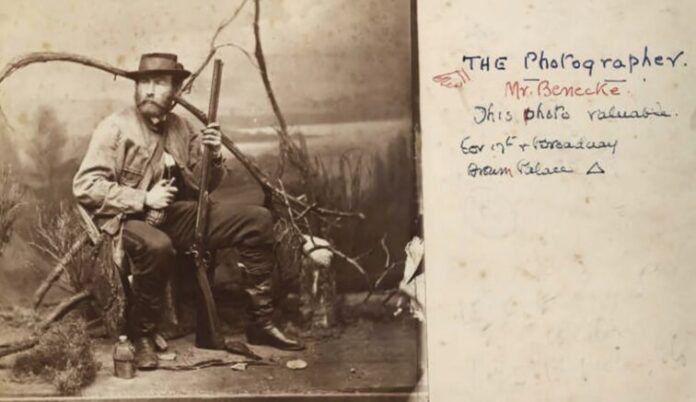
German-born photographer Robert Benecke, shown here in an undated self-portrait, traveled across Kansas taking scenic photographs at nearly every major stop in 1873 for the Kansas Pacific Railway. KU ecology and biology professor Town Peterson followed Benecke’s footsteps 150 years later to reveal startling changes to the prairie landscape.

Robert Benecke captured 19th-century western Kansas landscapes before massive European migrations to the area transformed them. In the intervening years, the dust bowl, mass extinction of bison, and expansion of mechanized agriculture have all led to a profusion of trees, ponds and lakes across the Sunflower State.

When railroad companies hired Robert Benecke to help advertise Kansas land for sale in the 1870s, the German-born photographer captured a unique window into life on the Great Plains at a very early time in the state’s history.

A century and a half later, University of Kansas professor of ecology and evolutionary biology Town Peterson sees Benecke’s images as a chance to investigate the impact of human settlement.

Peterson first became aware of a trove of Benecke’s images preserved in the digital collections of Southern Methodist University during the pandemic, and he set out to re-photograph the scenes and see what changed over the course of time.

It’s all part of the curiosity process in science, Peterson says.

“You go out there with a tingle in your right ear and you play around for a bit,” he explains. “You learn some lessons and that leads you to the next curiosity.”

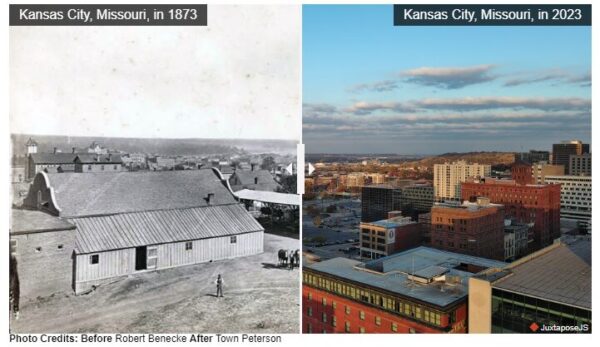
Peterson’s years-long effort has led to his new book, “One Hundred and Fifty Years of Change on the Great Plains,” available for free as a PDF or in hard-copy format on demand. It pairs Benecke’s historic landscapes with Peterson’s new photographs of the same views.

The juxtaposition, Peterson says, can show how the region has changed.

“I use these photo comparisons as a way of exploring and thinking about things,” the Ohio native says. “This particular set of photographs was really neat because it goes back to 1873, which is pretty much at the beginning of what I would call mobile photography.”

The 1873 Kansas Pacific Railway assignment took the St. Louis-based Benecke between Kansas City and Denver, taking photographs along the tracks all the way. Benecke would eventually travel all 600 miles of Kansas Pacific’s tracks, taking photographs at nearly every major stop and using a railcar darkroom to process his glass plate negatives.

Benecke captured a moment before the massive migrations into Western Kansas, when cities like Lawrence and Manhattan were just small European settlements. His images help chronicle the disappearance of the bison, the dust bowl, and the expansion of mechanized agriculture, ranching, irrigation, fire suppression and more.

Peterson’s modern images display what’s changed in the intervening years. They show a contemporary Kansas in color, sometimes from the ground and other times from a drone.

The project, which scientists call “repeat photography,” took Peterson across the state to find and photograph 50 different Benecke vantage points.

Each photograph presented its own challenges. While Benecke offered some detail about where each photo was taken, exact locations were often difficult to find.

“Locating the sites was months of work,” Peterson says, noting the hunt often left him spinning his wheels.

“Then it was two summers of driving back and forth between Denver and Kansas City getting into the fine details of where these sites were,” he says.

One of Peterson’s first observations was that many of the sites from 1873 are now covered by trees that have taken over the landscape. They often made the rephotographing process difficult and, when trees obscured the view, Peterson had to make compromises.

“If I can’t see anything because I’m in trees, then what do I do about this site?” Peterson says. “How do I take a photograph that’s meaningful in showing how this site is similar or different?”

Finding so many trees wasn’t exactly a surprise for the ecologist.

“I certainly have been aware of the afforestation process.” Peterson says. “If you look out my office window, it’s a forested landscape, and if you look at the depictions of Lawrence in the 1800s, it wasn’t, so I had some expectations.”

But he wasn’t entirely prepared for what he found either.

“West of Manhattan in the 1873 photos, you see essentially no trees,” Peterson says. “To me, the contrast is just astounding.”

Photography commissioned in the age of steam

Benecke’s 19th-century photographs were originally commissioned by railroad companies to lure white European settlers out west.

“The U.S. government incentivized building railroads that would connect, essentially, the east to the west of the country,” Peterson says.

Between 1850 and 1872 the federal government granted millions of acres of public lands to railroad companies in order to promote railroad construction, disregarding indigenous populations already living on the land in the process. Railroad companies commonly received 20 miles on either side of track that was built.

“It was very much in the Kansas Pacific railroad’s interest to get people to move out there,” Peterson says. “If they could depict the Great Plains as this wonderland where you can have land very cheap and prosper with your family, they could make tons of money.”

And they did. According to the Library of Congress, most western railroads had established as early as 1868 profitable land departments and European bureaus of immigration to sell land and promote foreign settlement in states like Kansas.

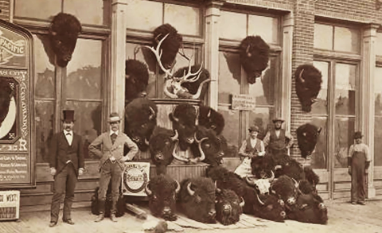
The No. 2. Taxidermist’s Department of the Kansas Pacific Railway, photographed by Benecke in 1873 to help advertise bison heads during the so-called “Great Slaughter,” from 1820 to 1880. The loss of the massive herds of grazing bison was one reason for the expansion of trees on the Great Plains.

Early steam locomotives ran on wood and water so there had to be a settlement every few miles, and refueling stations were built every 15 or 20 miles. On the often arid plains, a permanent source of water was also necessary, so the railroads built ponds and lakes along the lines to keep the engines running.

The new infrastructure encouraged development across the state, but also had an impact on the land in the form of new wetlands.

“Kansas didn’t have much in the way of wetlands in the 1800s,” Peterson says.

Environmental transformations like that substantiate the scientific merit in returning to these sites to track the changing land, he says, and ecological studies are often revisited at five, 10 and 20-year intervals.

“This is all an effort to get a longer term view of a landscape,” Peterson says. “And sure, some of it is just fun and some of it is that kind of pre-science curiosity that turns into neat questions down the line.”

Peterson has included in his book precise geographical coordinates of each image to help facilitate the next curious photographer.

“So much is going to change in the next 30 or 40 years,” Peterson says. “The idea is this is kind of our long term anchor point for being able to understand how the landscape changes here.”

Peterson also has some advice for that future photographer who may someday retrace his and Benecke’s journey.

“Get everything possible done between March and early June, and then October and November,” Peterson says. “Because, as much as I love Kansas landscapes, the ticks, the chiggers, the poison ivy, the mosquitoes, stinging nettles — you have to use early spring and late fall.”