
Tuesday, February 3, 2026
Home Blog Page 309

As Kansas farms grow bigger, more people leave and rural life gets lonelier

0
Kansas farms have expanded their operations and are now bigger than ever, which has led to an economic boom. But that also means fewer farmers, and that has contributed to depopulation in rural parts of the state that were socially isolated to begin with.

LARNED, Kansas — Tom Giessel vividly remembers growing up in the 1960s as a Kansas farm kid on the High Plains.

In his memories, this place that some refer to as “the middle of nowhere” was teeming with life. It was a place where nature and his family interacted directly.

He viewed farming as integrated. There were different kinds of livestock, siblings and grandparents and neighbors. There were native wildlife and other critters that also played a role on the farm.

“I always said the health of a farm is directly related to how many beating hearts are on that farm,” Giessel said. “That translates into creating community.”

But that’s not what a lot of Kansas farms look like today.

Kansas farms are more specialized, sticking to large-scale farming of one or two commodity crops. There are government incentives for these crops, and bigger farms get more federal dollars.

That economic efficiency might actually be hurting smaller towns, exacerbating some of the health challenges rural Kansans already face. Larger farms push out smaller farms and lead to less people staying in a community. With less people there’s less resources for them like hospitals and schools.

The changes have happened over years, a period that also saw death by suicide rates rise in rural areas

Mental health access is already hard to come by in western Kansas, but suicide rates are even higher if you work in agriculture.

Agriculture to Agribusiness

At Giessel’s secluded farmhouse, he and his wife Cheryl are miles from town, and without each other it could get lonely. Giessel walks down his narrow hallway where he has collected historical farming mementos.

After farming most of his life, Giessel is starting to ask himself and others why Kansans farm. He fears that the shifting answers have been detrimental to rural communities.

After taking over pieces of his parents’ land, and renting some land, Giessel and his brother formed a partnership and expanded their operation, wanting to see it grow. He remembers the feeling of competition, wanting to keep up with the changing environment around him.

But now, he is more concerned about the health of farmers, and sees them more as an exploited worker. Even down to the language used to refer to them as “producers.”

“That’s why my business card still just says ‘Tom Giessel, Farmer’ because now we just say producers, which is really impersonal,” Giessel said. “It desensitizes you to what you do.”

As Kansas has embraced grain production and beef production, the costly equipment needed to farm at such a large scale tends to make the distance between your neighbors further.

A study by the Journal of Agromedicine found that in Kansas, farm workers are three times more likely to die by suicide than other professions. The financial pressures, stress, and social isolation are driving factors.

Tim Davis, rural mental health expert at Fort Hays State University, said this is one of the aspects that has undermined mental health in rural communities.

“What we have today is not agriculture, what we have is agribusiness,” Davis said. “It’s a much different mindset, because it’s no longer kind of that ‘we’re in this together’ mentality.”

Davis also grew up on a farm in northwest Kansas. He thinks that outside of access to mental health services, the culture surrounding farming also stresses other rural mental health challenges.

“People are more focused on the individual. There’s good in that. There’s perseverance, but our communities have atrophied,” Davis said. “One of the reasons is because we have kind of lost the interdependence that we have on each other.”

Farm consolidation usually refers to the term “corporate farming” which is when ag corporations buy up farm land. But Kansas actually has had laws that prevent corporations owning land since 1931.

The law prohibited corporate farming for the purpose of growing various grains and the milking of cows. But today more small dairies are going out of business. So what changed?

The law has since seen heavy amendments. In the 1990s, “family farm corporations” and “family farm limited liability agricultural companies” could own and acquire farm land.

Before the dust bowl, there were over 166,000 farms across the state. Today, there are about 55,000.

The average size of a farm has increased by 40% since Giessel first started farming his own land.

This has allowed farms to focus on fewer things, going from raising multiple types of livestock and growing different crops, to growing mostly commodity crops at a large scale.

But large farms are more of a byproduct of the current farming system.

Mark Nelson is the director of commodities for the Kansas Farm Bureau, which represents small and large farms. From a business perspective, he said farmers operate on a margin, and it makes sense to get bigger.

“That farmer who can increase acres,” he said, “the ones who can better do that succeed.”

Farming in Kansas comes with huge costs. Nelson said there is some pressure to expand your farm operation to keep up with the costs of equipment like tractors and weed management.

Larger farms make more money, and if you want your business to succeed, you will need to produce more grain.

According to a report from the Economic Research Service, federal subsidies to farms are increasingly going to larger farms, thus supporting the cycle of the big getting bigger.

“The big get bigger, the small get smaller or they get pushed out,” executive director for the Kansas Farmers Union, Nick Levendofsky, said.

Levendofsky’s priority is supporting farmers, especially disadvantaged ones like small, new or minority farmers.

The average age for farmers in Kansas is almost 60, and as large farm operations pop up around aging farmers, the pressure to compete or sell your land can weigh heavy.

Levendofsky said giving up land that has been with you for multiple generations can feel like losing a member of your family.

What this means for rural Kansans

In western Kansas, counties with the largest farms are projected to see population losses in the next 70 years according to economists at Wichita State University.

Social isolation has been linked to serious health conditions like depression, dementia, and increased risk of heart failure.

Mary Hendrickson is a rural sociologist at the University of Missouri. She has spent the last 25 years studying the effects of food production consolidation on small towns.

Some of the other negative mental health impacts come from how workers engage in their operations today, sitting alone in a tractor or studying spreadsheets.

“It’s different now, when you have much more repetitive work,” Hendrickson said. “It has its roots in what happened with the consolidation of agriculture, with the structure of agriculture.”

Hendrickson said that the consolidation of food production leads to fewer choices for farmers.

According to a study she was a part of, just four companies control the market share of major aspects of the industry including beef production, seeds and fertilizer.

Hendrickson also thinks a loss of relationships is inevitable with this kind of consolidation.

“The economic relationships start to span larger distances, and so you start to also lose some of those social relationships,” Hendrickson said.

In order to slow the expansion of farms, both Hendrickson and Nelson agreed that communities need to be more present in dictating what their local agriculture looks like. Supporting local farmers, both with business and with providing health services would make a difference.

Especially since a lot of children are no longer inheriting the family farm. Kansas State University estimates that about half of Kansas farmland is rented. When land is rented, the health of that land usually comes second to its profit.

But Hendrickson and other policy analysts say that local communities can only make a limited amount of progress. Long-term changes would need to come at a federal level like the farm bill.

Those policies can change what is incentivized, and how smaller Kansas farms could thrive. It echoes the words that Farmer Giessel wrote.

Back at the kitchen table in Larned, Giessel’s wife, Cheryl, lovingly read from an essay he’d written years ago.

“We are not called to isolation, rather, we are called to be good neighbors and cultivate connections,” Cheryl said.

Calen Moore covers western Kansas for High Plains Public Radio and the Kansas News Service. You can email him at [email protected].

Courtesy of The Kansas News Service 
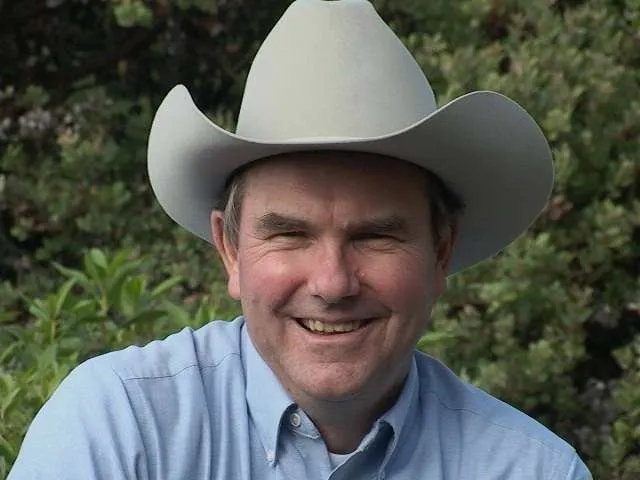
 

A Life Well Lived

0
lee pitts

I am just a humble human who never saw a Star Wars movie, never drove faster than 85 miles per hour, never rode a motorcycle, a D 9 Cat or a one ton bull for eight seconds. ( I never got on one either.) I’ve only owned one foreign car for a very brief time and I hate myself for my unpatriotic deed.

I’ve never been in jail other than that one time my Den Mother mom took all of us Cub Scouts to the police station and the cops locked us all in a jail cell to scare us straight. It left a lasting impression on me and I’ve never been back in jail again.

I’ve never been unfaithful to my wife of 50 years, never had a practice wife and never had the thrill of paying alimony or child support.

I’ve never called in sick when I really wasn’t and never caused a wreck, although I’ve been in three. The most memorable was after I picked up my wife from work at ten p.m. and we were stopped in our Chevy truck at the only stoplight in town at the time when WHAMO! Some young man who was high as a kite on dope plowed into our truck’s very substantial back bumper in his dinky Japanese car. It totaled his poor excuse for a vehicle and we got nary a scratch.

I’ve never hit a horse, dog or any other animal in anger although I have swatted my share of flies. I’ve never met a baby I didn’t immediately fall in love with even though they all had a tendency to burp, poop and pee on my shoulder.

I’ve never puffed on anything other than the candy cigarettes I “smoked” as a kid. I’ve never smoked a cigar, cigarette or marijuana and have always wondered what the allure was about cigarettes that made you smell like a bar, cost a fortune and killed you prematurely.

I never drank more than one sip of coffee in my life so I can spend my money at the Ace hardware store instead of Starbucks. I readily admit that I did drink copious amounts of tea the year we lived in Australia and when I traveled extensively in Texas I developed an ice tea habit that I continue to enjoy daily.

I’ve never been a registered Democrat and have not served in any political capacity since my college days. After several days of indoctrination as a 12 year old I did become a member of the Methodist church in town but I haven’t been back since our very married preacher ran off with our very married choir director and they took the Sunday collection with them.

Despite having a second home in Nevada for awhile I haven’t pulled on a slot machine or rolled any dice in many, many years. I never buy lottery tickets even when the jackpot exceeds a billion dollars because I have no idea what I’d do with the money and I think it could very well ruin the wonderful life I have now.

I’ve never owned a cell phone, played a video game on my computer and we’ve always paid off our credit card in full every month.

I’ve never deliberately cut a fence so my cattle could chow down on my neighbor’s abundant grass and I’ve never served chicken at my branding.

Despite writing a weekly column for 45 years along with thousands of feature stories I’ve never been accused of plagiarism nor have I been sued for libel or slander, although I did have to make a minor correction two times.

Despite having lived such a perfect life I do have some regrets. I’ve always wanted to go to James Herriott’s Yorkshire dales but I’ve never been to Europe. I never learned how to barbecue nor did I learn how to drive a team of horses. I’m sorry to say I never owned a team of Clydesdales or mules, much to my regret. I never got my pilot’s license, never bought a 1952 Chevy pickup, never sold my novel nor have I won a Pulitzer Prize. I’ve never owned a black cowboy hat or a black Lab and I’m sad to say we never could have kids, of the human or the goat variety.

All in all I’d say it’s been a life well lived.


How to keep invasive fish from jumping dam, infesting Kansas River near Topeka

0

Kansas wildlife officials have an idea for how to stop an invasive fish known for its jumping ability from leaping over a Lawrence dam and swimming upstream toward Topeka, further infesting the Kansas River.

This fish can jump. Social media has several videos, like one earlier this month that went viral on TikTok showing a carp jumping into a boat in Kentucky, hitting children.

Those invasive carp are also in Kansas, where their jumping ability enables them to pass dams, especially during floods. To prevent them from infesting more waterways, like the Kansas River around Topeka, experts are turning to a simple solution: grates.

Chris Steffen is the aquatic invasive species coordinator at the Emporia office of the Kansas Department of Wildlife and Parks. He gave the Wildlife and Parks Commission an update on invasive carp at a meeting last month.

Two carp species in particular, bighead and silver, have made it to the Kansas River. Those species are among the fish referred to as invasive carp that used to be referred to as Asian carp.

“The silver carp is the one you’ll see on YouTube or other places where people are riding around on skis or whatever behind a boat, and these carp are jumping,” Steffen said. “They’re able to jump up to maybe 10 feet in the air when spooked by a boat.”

The fish are filter feeders.

“They open their mouth, they swim around with their mouth open and eat all the small stuff in the water,” Steffen said. “The plankton, the zooplankton, phytoplankton. Surprisingly long lived, and they can grow to really incredible sizes, and they’re also capable of these really large, quick movements. Typically those are during high flow events.”

Native fish populations have declined in areas where invasive carp have moved in.

The Kansas River is infested with invasive carp between Lawrence and the Missouri River. Also infested are the Missouri River in northeast Kansas and part of the Neosho River in Labette County in southeast Kansas.

“Everything that doesn’t have a dam that’s attached to the Missouri River basin has these silver and bighead carp,” Steffen said.

But having a dam isn’t enough, as high water events have allowed the jumping carp to pass the barrier. That was the case with flooding in 1993, after which isolated fish were collected farther upstream from Lawrence, around Manhattan and Junction City.

Upstream 15 miles from the Missouri River is the WaterOne Dam in Wyandotte County, just east of the Interstate 435 Bridge.

“The carp, most of the time, cannot get over this barrier,” Steffen said.

However, Steffen referred to that dam as “semi-passable” because the fish can get over the barrier during high water events — which have happened occasionally in recent years.

Farther up the river is the Bowersock Dam in Lawrence — the only hydropower facility in the state.

Steffen called it “a much more formidable barrier to carp movement.”

Still, the carp can get past it during especially high water events, like in 1993, and KDWP has concerns about the dam’s north powerhouse. Installing bars, referred to as a headbanger, are a simple and low-tech solution.

“It’s just basically grates that hang out over the water that when those carp try to jump up into that structure, they literally just bounce off that grate,” Steffen said. “It’s really slick. It’s kind of self-cleaning. It’s got an angle to it, so any debris that comes in there just kind of pushes off the side.”

As of the Aug. 29 meeting, KDWP had already completed a structural analysis but was waiting on grant funds before getting to work on engineering and installation.

Invasive carp were the subject of a rebranding campaign intended to increase human consumption.

They’re also good bait for catfish, Steffen said.

Meanwhile, the infested 15-mile section of the river east of the WaterOne Dam is popular for fishing, according to a 2022 KDWP angler survey. That has the agency looking at a snagging opportunity.

Wildlife and Parks staff are proposing year-round snagging — but with harvest limited to only carp, and other fish would have to be released — in the Kansas River downstream from the WaterOne Dam. Steffen said carp are overly abundant there, but snagging them is technically illegal for now.

“Because they would be helping us out getting rid of carp that we don’t want in the river there, we’re not proposing any sort of special permit,” Steffen said. “This would be allowed on your standard fishing license.”

There’d be no possession limit, because, “The more carp we can get out, the better.”

Meanwhile, KDWP is going to use grant funding from the U.S. Fish and Wildlife Service to work on removing carp from the area between the WaterOne Dam at Edwardsville and the Bowersock Dam at Lawrence.

As reported in the Topeka Capital Journal

Want to avoid the DMV? Kansas government’s iKan platform adds another service

0

The state government is making it easier for Kansas drivers to update their vehicle’s address.

The Kansas Department of Revenue announced Wednesday that the digital platform iKan is getting a new feature allowing drivers to update their vehicle’s address online instead of going to a DMV office in-person.

“Our goal with iKan has always been to make vehicle and driver services readily available to all Kansans,” said David Harper, the KDOR vehicles division director, in a statement. “This new feature is a significant step towards that vision, allowing us to better serve Kansans and improving the customer experience by reducing the need for in-office visits.”

The Revenue Department encourages residents to create an iKan account, if they haven’t already, to speed up renewals and other processes.

The state introduced iKan in 2018 to consolidate routine services from multiple agencies into an online platform. The system can be used for renewing driver’s licenses and vehicle registrations, among other services. The Revenue Department said nearly half of Kansans have registered with iKan.

“The Kansas Department of Revenue is always looking for ways to improve their service offerings through iKan, and we are excited to continue our partnership,” said Katie Beth DeSchepper, general manager of DMV for PayIt. “The enhancements we’ve made to the user experience and the addition of vehicle address changes directly result from collaboration with Kansas and user feedback we’ve received. These updates also make it easier for us to deploy new services in the future, which will ultimately make the iKan experience even better.”

As reported in the Topeka Capital Jouranl