Tuesday, February 3, 2026
Home Blog Page 313

Test forages to prevent nitrate and prussic acid poisoning

0

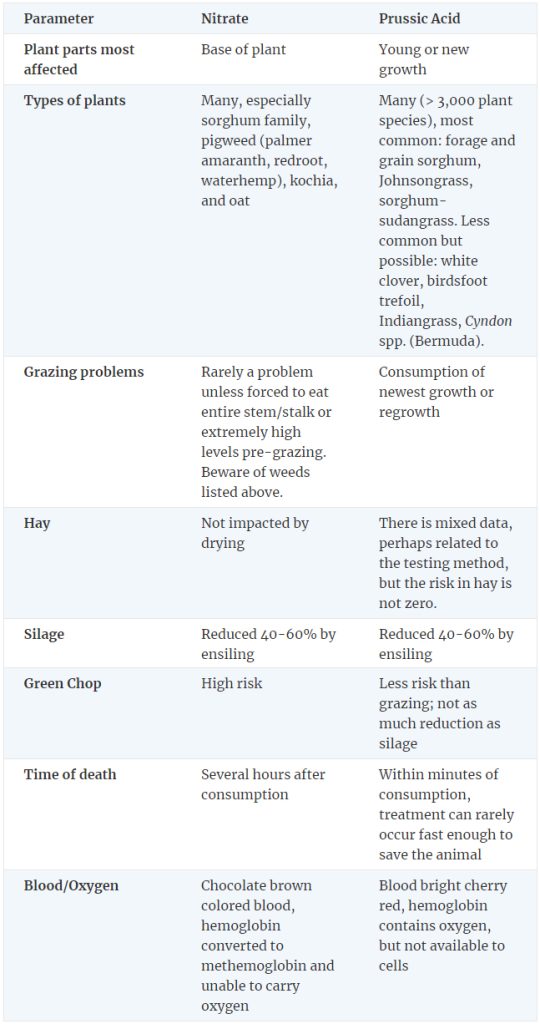
Many Kansas cattle operations rely on some type of harvested feed to use in the winter months, and common among those sources are forage sorghum, millets, sorghum-sudangrass, and sudan. Forages in the sorghum family are prone to two different problems when feeding cattle: nitrate poisoning and prussic acid (hydrocyanic acid, HCN) poisoning. Millet (proso and pearl) do not contain prussic acid but can have nitrates. Prussic acid and nitrate poisoning are easy to confuse because both result in a lack of oxygen availability to the animal and are more likely to occur when the plant is stressed (fertility, hail, drought).

Table 1. Key characteristics of nitrate and prussic acid poisoning.
In dry areas of the state, cattle may be removed from pasture early. Bringing hungry cattle into pens with weeds can be very dangerous as the nitrate concentration may be elevated throughout the plant and animal intake high. Manure in corrals can contribute to the elevation of nitrates in the weeds. Elevated nitrates may not result in death but could cause abortions. Be careful never to turn hungry cattle onto weeds, minimize consumption of weeds in corrals, and have other safe feed to consume besides weeds to reduce risk.

Prussic acid concentrations are greater in fresh forage than in silage or hay because HCN is volatile and dissipates as the forage dries or ensiles. Additionally, hay or silage that likely contained high cyanide concentrations at harvest should be analyzed before it is fed. This second statement is often forgotten, and it’s assumed that when the plant dries, all the cells are ruptured and any HCN is released. To confirm this, we measured dhurrin content in sorghum hay. The dhurrin content was stable from 1 week to 2 months of dry storage. In the plant, dhurrin (the precursor to HCN in sorghum species) and the enzyme that converts it to cyanide are stored in separate compartments within the cell. The compartments are ruptured when the plant is eaten, and the cyanide is formed and released. While the enzyme that converts dhurrin to cyanide is inactivated with drying, rumen enzymes can make the same conversion after consumption. If hay is made from forages in the sorghum family or other susceptible species, testing for prussic acid in forage that has suffered from drought, hail, or fertility issues is advised. The frequency of issues with prussic acid in harvested forages may be relatively low; however, testing is cheap compared to the cost of losing even one animal.

Management recommendations common to both prussic acid and nitrates include:

  • Test first, don’t gamble. Keep in mind that different labs use different tests that have different scales.
  • Feed animals with a known safe feedstuff(s) and have them full before introduction to potentially problematic feeds. Don’t turn in hungry.
  • Ensiling will reduce concentrations of either by 40-60% in well-made silage, but silage put up under less-than-optimal conditions could still contain very high levels. If extremely high before ensiling, a 50% reduction may not be enough to result in safe feed. Test ensiled feed before feeding.
  • Dhurrin concentrates in the newest growth and regrowth of the plant and with more plant growth (>24”), concentration levels may be diluted if measuring the whole plant.
  • Nitrate concentrates in the base of the plant and is least in head and leaves, grazing or cutting high can reduce nitrate levels in the forage.
  • Do not harvest drought stressed forage within 7 to 14 days after good rainfall to reduce the levels of accumulated nitrates.

If testing before grazing, samples should reflect what the animals are expected to consume, generally leaves and upper portion of the plant. Sample a minimum of 15 sites across a given field. One method is to sample from each corner and the center by walking diagonal lines and sample plants every 50-100 steps or as appropriate for field size.

We expect levels of nitrates and prussic acid to be variable across a field, so more samples are better than less. A rule of thumb is to sample 10 to 20% of the bales per field or cutting as a minimum. Be aware of areas of the field that exhibited more plant stress than others. If large enough areas, you may want to sample them separately. Your acreage size and feeding methods likely factor into this decision. Use a forage probe that cuts across all plant parts in a bale rather than a grab sample from individual bales or windrows. Most county extension offices can help with sampling procedures and equipment.

Prussic acid in sorghum following a freeze event

Frost causes plant cells to rupture and prussic acid gas forms in the process. Because the prussic acid is in a gaseous state, it will gradually dissipate as the frosted/frozen tissues dry. Thus, risks are highest when grazing frosted sorghums and sudangrasses that are still green. New growth of sorghum species following frost can be dangerously high in prussic acid due to its young stage of growth. It is recommended to wait ten days until after a killing freeze before grazing. Sorghum and sudangrass forage that has undergone silage fermentation is generally safe to feed.

For more complete information on these problems, see these publications: Nitrate ToxicityPrussic Acid Poisoning, and Managing the Prussic Acid Hazard in Sorghum. If you have samples with high prussic acid concentrations and are willing to share information on variety, growth, fertility, and harvest conditions, it will be helpful as we strive to understand this issue better.

Sandy Johnson, Extension Beef Specialist, Northwest Research-Extension Center
[email protected]

John Holman, Cropping Systems Agronomist, Southwest Research-Extension Center
[email protected]

Augustine Obour, Soil Scientist, Agricultural Research Center – Hays
[email protected]

Logan Simon, Area Agronomist – Southwest Research-Extension Center
[email protected]
Hay demand very light, movement picks up some

0

This past week, demand remained very light however, hay movement picked up a bit in the southwest region where some larger trades of grinding hay and ground and delivered were made, according to the Kansas Department of Agriculture-USDA Market News Service, Sept. 17.

Prices have continued to soften as producers are trying to get rid of last year’s hay which is in abundance, not only in Kansas but from Canada to Texas. The state remains dry and needs some precipitation but as harvest is ongoing, many are glad for the open weather. Prices are based on averages and given on a per-ton basis, unless otherwise noted.

Southwest—Demand light. Trade activity is slow. Dairy alfalfa prices are steady. Grinding alfalfa price $10-$15 lower and ground and delivered alfalfa price $5-$15 lower. Alfalfa: Dairy, $1.15-$1.25/point RFV. Fair/good, grinding alfalfa, large rounds, $100-$115, large squares, $100-115. Ground and delivered locally to feed lots and dairies, $135-$145. For the week ending Sept. 14, 9,292 tons of grinding alfalfa and no dairy alfalfa was reported bought or sold. The average paid by feedlots on Sept. 1 for alfalfa ground and delivered was $173.86, down $3.34 from the previous month. Usage was 584 tons per day, up 22% from last month and total usage was 18,100 tons.

South central—Demand light. Trade activity is slow. Dairy alfalfa prices steady. Grinding alfalfa steady and alfalfa pellet price $10 lower, Ground and delivered mostly steady. Alfalfa: Dairy $1.15-$1.25/point RFV. Fair/good grinding alfalfa, large rounds, $95–$105 delivered, 3×4 and 4×4 squares, $110-$120 delivered. Alfalfa ground and delivered, $145-$155. Sun-cured alfalfa pellets, 15% protein, $230-$240, 17% protein, $235-$245, 17% dehydrated, $365. For the week ending Sept. 14, 5,228 tons of grinding alfalfa and 975 tons of dairy alfalfa was reported bought or sold. The average paid by feedlots on Sept. 1 for alfalfa ground and delivered was $156.43, down $7.95 from the previous month. Usage was 212 tons per day, up 10% from last month and total usage was 6,562.5 tons.

Southeast—Demand light. Trade activity is slow. Bluestem and brome hay price remain steady. Dairy, $1.115-$1.25/point RFV. Bluestem grass hay, large rounds, $110-$120, 3×4 and 4×4 squares, $130-$140. Brome, 3×4 and 4×4 squares, $135-$145. Wheat straw, large squares, $70. For the week ending Sept. 14, 2,241 tons of grass hay was reported bought or sold.

Northwest—Little to no demand. Trade activity is slow. Horse alfalfa, $175-$185. Fair/good grinding alfalfa, large rounds, $100.

North central/northeast—Demand light. Trade activity is slow. Dairy alfalfa price is steady, grinding alfalfa steady to $10 lower, ground and delivered steady to $20 lower, and grass hay steady. Alfalfa: Dairy $1.15-$1.25/point RFV. Fair/good grinding alfalfa, large rounds, $90-$100. Alfalfa ground and delivered, $150-$160. Bluestem grass hay, small squares, $8-$9/bale, large rounds, $80-$110. Brome, small squares, $9-$10/bale, large rounds, $100-$120, large 3×4 and 4×4 squares, $130. For the week ending Sept. 14, 1,080 tons of grinding alfalfa and 125 tons of dairy alfalfa was reported bought or sold.

Hard Of Earring

0
lee pitts

I always wondered which would be worse, losing one’s eyesight or losing one’s hearing? I can now answer that question definitely because I’m gradually doing both and I can say that losing one’s eyesight is far worse as there can actually be some advantages to losing one’s hearing.

Suffice it to say, I’m NOT aging gracefully and I am not like the African heart-nosed bat that can hear the footsteps of a beetle walking in sand six feet away! While other species of animals can hear a rabbit sleeping I can’t even hear my wife’s snoring three feet away and believe me, that’s just one of the many advantages of being deaf as a dump truck.

I’m not making fun of deaf people and the difficulties they endure on a daily basis or belittling them as our society once did. I can remember in my childhood that deaf people used to be referred to as “deaf and dumb” because it was thought that deaf people were stupid. At one time they were even denied citizenship as a result of their handicap. On the contrary, I have found that deaf people are quite intelligent as shown by their ability to read lips and use sign language. Try it sometime and you’ll see what I mean.

I can pinpoint exactly when and why I’m losing my hearing and can barely speak above a whisper and I lay the blame at the feet of auctioneers. For nearly 50 years I worked ring at auctions of everything from A to Z, from automobiles to a zebra. My problem was that during those five decades of working ring and being the voice for Western Video Market and announcing video auctions every month that sometimes lasted four days, I was hardly ever further than twenty feet away from a speaker and 90% of the auctioneers I worked with had the volume turned up too high for the comfort of the crowd.

I know why the auctioneers do it and after auctioning a few charity sales myself I understand their reasoning. First of all, they want to be able to hear themselves and secondly, they don’t have to expel as much energy with their chant which always sounds better when the volume is higher.

Interestingly, when we lived in Australia 50 years ago at all the cattle sales I attended from the weekly town auctions to high dollar purebred sales the auctioneers didn’t use a microphone and it was so tiring for them they worked in teams which allowed them to take long breaks to rest up.

Not only did all the auctions damage my hearing but it also silenced my voice because for every animal, every car or every doo-dad I turned in the bids by yelling at the top of my lungs so the auctioneer could hear me above the din of the speakers. It finally caught up with me. I know there are things I could use to better my hearing but I think my voice is shot for good. I don’t want to buy a hearing aid because that makes people think you’re interested in what they have to say. I could also wear a big gold ring in one ear like NBA basketball players and pirates of old did who thought the gold ring improved their hearing and especially their eyesight.

At first my wife liked the fact that I couldn’t talk but she very much doesn’t like the fact I can’t hear as every time she tries to talk to me my response is always the same: “Huh?”

I’m considering getting a bunch of my road agent buddies together and filing a class action lawsuit against all auctioneers for damages and to buy hearing aids for all us poor ring men as auctioneers have the deepest pockets. Believe me, with what they are making now to sell a bull sale, real estate auction or exotic car sale the auctioneers can afford it.

If you don’t think us road agents have suffered damages just listen to this conversation I had about the potential for such a lawsuit with two of my ring man buddies:

Me: “Should we file a lawsuit against our windy friends?”

Second Road Agent: “No, it’s not Wednesday, it’s Thursday.”

Third Road Agent: “Yea, I’m thirsty too. Bartender, another round please.”


Bovine anaplasmosis vaccine developed

0

Cattle producers are one step closer to protecting their livestock from bovine anaplasmosis after the University of Missouri announced it has developed the first vaccine for the disease. Bovine anaplasmosis is a tick-borne disease of ruminants caused by intracellular bacteria that infect red blood cells.

Roman Ganta, a McKee-endowed professor in Mizzou’s College of Veterinary Medicine and a Bond Life Sciences Center researcher,spearheaded the study that led to the vaccine. He has studied molecular genetics and vector-borne diseases for more than 30 years and joined Mizzou in 2023.

“I often receive calls from cattle producers who are excited about our research and want to know how soon they can get the vaccine,” Ganta said. “There is currently no effective, widely available vaccine for the disease, and cattle farmers are very worried about the disease harming or killing their cattle. We want to help farmers in Missouri and around the world and are working hard to come up with a viable solution.”

The researchers developed the vaccine by genetically modifying the pathogen Anaplasma marginale—which causes bovine anaplasmosis. In this process, a specific gene within the pathogen was deleted to create the modified pathogen to be injected into cattle to protect them from the disease.

The vaccine is not available yet, but Ganta is working with industry partners to release the patented vaccine to cattle producers in the future. According to Mizzou, the new vaccine provides immunized cattle protection from anaplasmosis for at least a month. Ganta is conducting further research to determine if the modified pathogen can protect cattle for a longer interval.

More than 20 species of ticks—including the Rocky Mountain wood tick, American dog tick and Pacific Coast tick—can transmit bovine anaplasmosis. Other vectors of the disease include blood contamination, biting flies and blood-to-blood contact. There is no evidence bovine anaplasmosis can be transmitted to humans. Infected animals can be treated with tetracycline, but cattle remain carriers for the rest of their lives.

Symptoms of bovine anaplasmosis are anemia, jaundice, fever, weakness, weight loss, decreased milk production, constipation, increased aggression, difficulty breathing and abortion. Symptoms typically appear a month after infection, but can occur between seven and 60 days after infection. Diagnostic testing must be conducted to confirm an animal is infected with bovine anaplasmosis.

According to the U.S. Department of Agriculture, treating anaplasmosis can total more than $400 per animal and costs the U.S. beef industry more than $300 million every year.

“Missouri is a hotbed for tick-borne diseases, and bovine anaplasmosis causes massive economic losses both here in Missouri and around the world,” Ganta said.

KU News: KU Natural History Museum announces fall programming

0

From the Office of Public Affairs | http://www.news.ku.edu

Headlines

KU Natural History Museum announces fall programming

LAWRENCE — The KU Natural History Museum has a full lineup of science-themed public events this fall for both youth and adults. The programs will cover various topics, including STEM activities related to snakes and fossils, as well as public presentations about the evolutionary biology of jellyfish and the importance of caring for natural history collections. Events will include an all-ages program Sept. 7 for National Hummingbird Day, a series of scholarly talks at Free State Brewing Company for the Science On Tap series and Macabre at the Museum on Oct. 24.


Erik Scott named inaugural John P. Black Professor of History

LAWRENCE — The University of Kansas Department of History has announced Erik Scott as the inaugural John P. Black Professor of History. A KU faculty member since 2012, Scott is an award-winning scholar of modern Russia, the Soviet Union and the global Cold War. He is the author of “Defectors: How the Illicit Flight of Soviet Citizens Built the Borders of the Cold War World” (2023) and creator of the website Cold War in the Heartland. The Black Professorship was endowed through a gift by the Black-Cheslik family of Kansas City, Missouri.


Full stories below.


————————————————————————


Contact: Natalie Vondrak, Natural History Museum/Biodiversity Research Institute, [email protected]

KU Natural History Museum announces fall programming


LAWRENCE — The KU Natural History Museum has a full lineup of science-themed public events this fall for both youth and adults. The programs will cover various topics, including STEM activities related to snakes and fossils, as well as public presentations about the evolutionary biology of jellyfish and the importance of caring for natural history collections.


In honor of National Hummingbird Day on Sept. 7, the museum’s outreach team will host Pop-Up Science, a free program with hands-on science activities suitable for all ages, from 2-4 p.m. While exploring the museum, visitors can stop at various stations in the galleries to learn about hummingbirds and what makes them unique.


Other family-friendly events include a program series by the Kansas Postdoctoral Outreach Project, a group of KU postdoctoral researchers bringing science to life through experiments and activities. The series consists of Spectacular Snakes on Sept. 15, Six-Legged Science on Oct. 20 and Weather Science on Nov. 17. All events are 2-4 p.m. at the museum in Dyche Hall.


Science On Tap, a long-running public program in partnership with Free State Brewing Company, returns Sept.18 with “The World’s Mountains are Feeling the Heat,” presented by Sharon Billings, University Distinguished Professor of Ecology & Evolutionary Biology and senior scientist at the Kansas Biological Survey & Center for Ecological Research. The popular program series features an informal research presentation in the brewpub’s beer hall, followed by a Q&A session.


Late fall presenters will include Paulyn Cartwright, Baumgartner Professor of Biology, on Oct. 23 discussing “Invasion of the Freshwater Jellyfish.” On Nov. 20, Andy Bentley, collection manager of ichthyology at the KU Biodiversity Institute and Natural History Museum, will share “Natural History Collections as unique tools to highlight fauna and the complex interactions with their environment.” All Science On Tap events are held at Free State Brewing Company, 636 Massachusetts St., and begin at 7:30 p.m.


In October, the public is invited to celebrate fossils during the event Discovery Day: National Fossil Day from 11 a.m.-2 p.m. Oct. 12. Visitors can view paleontology specimens rarely seen by the public, learn about current KU paleontology research and participate in fun science activity stations. Then, just in time for Halloween, the public­ — especially KU students — will have the opportunity to explore the creepy side of natural science during the Macabre at the Museum event from 7-9 p.m. Oct. 24. From bats and deep-sea fishes to skeletons and more, students can participate in activities and enjoy snacks, music and raffle prizes.


Throughout the year, the museum also offers a variety of educational programs and resources for K-12 schools, Scout programs and collection tours for KU and other higher education institutions.


The KU Natural History Museum is part of the KU Biodiversity Institute, a KU-designated research center studying the biological diversity of life on Earth. The museum is in historic Dyche Hall, 1345 Jayhawk Blvd., and is open to the public 9 a.m.-5 p.m. Tuesday-Saturday and noon-4 p.m. Sunday. Suggested donations are $7 for adults and $4 for children. Members and KU students are free. Learn more at KU Biodiversity Institute and Natural History Museum.


-30-

————————————————————————

Don’t miss new episodes of “When Experts Attack!,”

a KU News Service podcast hosted by Kansas Public Radio.


https://kansaspublicradio.org/podcast/when-experts-attack

————————————————————————


Contact: Laura Mielke, Department of History, [email protected], @KUHistoryDept

Erik Scott named inaugural John P. Black Professor of History


LAWRENCE — The University of Kansas Department of History has announced Erik Scott as the inaugural John P. Black Professor of History.


A KU faculty member since 2012, Scott is a leading scholar of modern Russia, the Soviet Union and the global Cold War whose expertise has led to appearances on MSNBC, NPR and C-SPAN. He serves as the editor of “The Russian Review” and is the author of “Familiar Strangers: The Georgian Diaspora and the Evolution of Soviet Empire” (2016) and “Defectors: How the Illicit Flight of Soviet Citizens Built the Borders of the Cold War World” (2023). In 2023, Scott was recognized with a University Scholarly Achievement Award.


His book “Defectors” was awarded the Robert H. Ferrell Book Prize from the Society for Historians of American Foreign Relations, the Tonous & Warda Johns Family Book Award from the Pacific Coast Branch of the American Historical Association and an honorable mention for the Theodore Saloutos Book Award by the Immigration and Ethnic History Society.


In addition to producing award-winning scholarship, Scott is an esteemed teacher of graduate and undergraduate courses in Russian, Soviet and global history. He also serves as the primary researcher and co-researcher on multimillion-dollar grants and is the director of KU’s Center for Russian, East European & Eurasian Studies. Through the center, Scott created the digital humanities project Cold War in the Heartland.


“It is truly an honor to serve as the inaugural John P. Black Professor of History at KU,” Scott said. “The generous and timely gift of the Black-Cheslik family will enable me to pursue my research on the global legacies of the Cold War and offer classes that give students the historical skills and context needed to understand the world around them. As an author and teacher, I am a firm believer in the importance of history for making sense of complex issues such as migration, decolonization and international law.”


The Black Professorship was endowed through a generous gift by the Black-Cheslik family of Kansas City, Missouri. Julie Cheslik and Paul M. Black established the professorship in honor of the teaching excellence their son John P. Black, of Fairway, experienced while earning a bachelor’s degree in psychology and a minor in history in 2022. The professorship provides the opportunity for more students to be taught by inspiring historians and affirms the vital role of humanities courses and research at KU.


“The history department is lucky to have Erik as a teacher, researcher and campus leader,” said Laura Mielke, KU professor of English and interim chair of the Department of History. “We are delighted to draw on the generosity of the Black-Cheslik family to recognize an excellent scholar who gives so much to the KU community — and beyond.”


Arash Mafi, executive dean of the College of Liberal Arts & Sciences, expressed his appreciation as well.


“I deeply thank the Black-Cheslik family for their generous support of educational causes in Kansas and beyond,” he said. “We are truly appreciative of their commitment. I also want to praise Professor Scott for his exceptional scholarly work, which greatly enriches our academic community. The history department excels in fostering positive educational experiences, shaping the next generation of citizens and leaders. Their dedication is truly commendable.”


-30-

————————————————————————


KU News Service

1450 Jayhawk Blvd.

Lawrence KS 66045

[email protected]

http://www.news.ku.edu


Erinn Barcomb-Peterson, director of news and media relations, [email protected]


Today’s News is a free service from the Office of Public Affairs