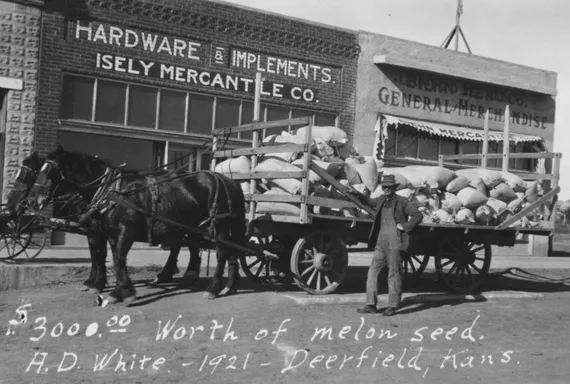
The fact that southwest Kansas farmers used to grow watermelons for decades in a place that almost solely relies on commodity grains today did not surprise McCombs. What did surprise her was why.
“What stood out to me most was that they weren’t necessarily growing the watermelons to eat it, but to harvest the seeds,” McCombs said.
The fertile Arkansas River Valley saw an influx of new homesteaders from the east, not accustomed to the dry and windy plains. They learned quickly that watermelons loved the hot temperatures and sun. With the two rivers, the Arkansas, and the Cimarron, flowing through the region, new farmers were able to irrigate and grow some of the best watermelons in the country.
They just needed a market. Trains built to population centers in the midwest helped small towns pop up in the rural plains, and gave farmers access to sell their produce. There were large seed companies in cities like Detroit and Chicago that loved southwest Kansas watermelon seeds.
These new southwest Kansans weren’t just growing watermelons, but sharing the ability to grow watermelons around the country. There was even a story from the Lakin Investigator in 1910 of a man from Grant County buying back the very seeds he harvested.
“When he was harvesting seed, he lost his glasses,” McCombs said. “Later to mix up his seed variety he ordered from the same company he sold seed to, and guess what he found? His glasses.”
This served as an advertisement in the area to buy more local seeds. The paper read: “Moral, buy your seed at home.”
While states like California and Washington eventually boomed with specialty crops including grapes and apples, Kansas couldn’t sustain its watermelon production.
The Arkansas and Cimarron rivers that used to be lifelines for southwest Kansas farmers are now just memories, and have been dry for decades.
Then, like today, what shaped western Kansas agriculture and its future was water. By the early 1900s, the Arkansas River that sustained watermelon farmers in the valley was getting smaller.
Colorado farmers were diverting water to irrigate their own crops, which led to less water flowing into Kansas. With less water moving across the plains, the water quality deteriorated and made flood irrigation harder.
And it even affected the water underneath the farmers, which would later save the region. Less river water meant that there was less water to recharge the aquifer underneath the surface.
Kansas sued Colorado in 1902, and that led to legal quarrels over the water for the past century.
By the 1950s, the Ogallala Aquifer was discovered underneath the High Plains, and farmers were able to drill wells and irrigate their thirsty crops once more, without the need for river irrigation. But this decision sucked up what was left of those rivers, which are now just dirt beds.
Kansas still faces significant water issues
Farmer Tom White, who’s only 62, still remembers when the rivers flowed. His great grandfather, A.D. White, was a prolific watermelon farmer in the area. His multigenerational farm has witnessed various water crises that caused the family to shift from watermelons to irrigated crops including corn and alfalfa.
White remembers when his father drilled water wells in the Arkansas river valley in the 1970s.
“I remember dad saying, ‘Well, how long will the water last?’ And the water driller says, ‘Oh, it’ll last forever’,” White said.
That was a common belief at the time. But today, the Ogallala aquifer has declined drastically, some counties already losing up to 80% of their water.
Irrigation uses 85% of the water consumed in the region, the same water these Kansans drink. But the economy is already so tied to irrigated crops that it’s hard to change.
“When I was a kid we had some wells that pumped water 2000 gallons per minute, but today those same wells can only muster about 600 gallons,” White said.
He was surprised to learn that the land he farms was initially focused on livestock and watermelons. It makes him wonder about the future of what his region will look like. He guesses the future holds either different crops or at least new varieties that grow better in the region.
“We are getting pretty good at breeding crops that are more drought tolerant,” White said.
Farms like his are an example of the dilemma most face in southwest Kansas. More dairies are popping up, giving life to rural economies, but the large demand for forage, or cattle feed, makes it hard to pivot away from these crops that require heavy irrigation.
Kansas agriculture is evolving with technology
Western Kansas has fertile soil, all it needs is water.
The region’s lack of rain actually contributed to watermelon’s success, producing higher quality fruits because they were at a lower risk of fungal and bacterial pathogens seen in regions with higher humidity.
Logan Simon, southwest Kansas agronomist for Kansas State University, is always surprised by people’s perception of southwest Kansas’ agricultural ability.
When European settlers arrived, they initially wrote off this part of the High Plains. Explorer Stephen H. Long dubbed the region as the “Great American Desert.” But the reason they thought this, Simon said, is because in their minds, trees were a direct indicator of soil health.
“The thought was that only the most fertile land could possibly be suitable for growing forests,” Simon said.
The soil turned out to be more fertile than settlers thought. It was perfect for vine crops and later broomcorn, a sorghum variety grown for its stiff stalks and made into brooms. And later the area was defined by sugar beets. Today it is known for sorghum, wheat and corn used for cattle feed.
Because of the success of the beef industry, which alone brings in $11 billion to Kansas each year, it’s hard to change what has brought so much success.
But crops like irrigated corn and alfalfa will soon be unsustainable if groundwater keeps running out. Just like when they abandoned watermelons, Kansas farmers will need to switch to another crop.
And farmers can’t return to specialty crops like watermelons or winter squash because the average number of farms have decreased, while the farm sizes have increased in Kansas. According to the ag census, Kansas counted 55,734 farms in 2022, a 5% decrease from the number of farms reported in the 2017 census. The average Kansas farm size has increased by an average of roughly 25 acres in that time.
With bigger farms, and fewer farmers, Kansas agriculture is dependent on mechanized farming. Crops like watermelons or winter squash require labor to harvest, which is labor that Kansas doesn’t currently have.
Some options for potential replacements are beans from Africa called cowpeas, very much like black eyed peas, or sorghum. But these switches would require changes to the current Farm Bill.
Crop insurance programs vital to Kansas farmers’ income
The current Farm Bill encourages farmers to stick to commodity grains by covering them with crop insurance programs. These programs are vital to Kansas farmers’ income, and protect them from crop failures caused by drought or natural disasters.
But the limited crops covered by those programs make it less profitable to grow alternative crops that would help farmers who have used up most of the water on their land.
That makes shifting crops difficult, even though it’s happened in the past.
“We think of ourselves as always having been a certain something, but in fact, we’ve always been changing from the very beginning,” Simon said.
Kansas News Service