Friday, February 6, 2026
Home Blog Page 352

Stuga Vodka creators find way back ‘home’ to make Kansas corn-based spirit

0

LINDSBORG — Meaning small house or cottage in Swedish, the word “Stuga” is all about home.

Now the word has taken on a new meaning, as a brand of homegrown and crafted, corn-based Kansas vodka.

The idea for a corn-based vodka came from husband and wife Hilary and Erin Condren after finding themselves back “home” to the family farm in Lindsborg during the height of the COVID pandemic.

“The world’s falling apart, we’re in California … and we decided to go home to Lindsborg, Kansas, embrace our roots and figure out what in the world is happening before we make any next decisions,” Erin Condren said.

Where do the roots of the Stuga Vodka brand come from?

Condren is the fifth-generation owner of the farm after her family left Sweden in 1869 and found themselves staking claim in Lindsborg under the Homestead Act.

The Condrens decided that if they were going to take over and steward the family farm, they wanted to find a unique way to make use of the crops that helped her ancestors flourish.

At the same time, the Condrens also partnered with Dani Greene to take over the Öl Stuga bar in Lindsborg, and things started aligning to begin this new adventure into distilling.

“It all sort of came together where we took over the bar, took over the farm, took over the crops,” Condren said, “and we thought let’s do something cool.”

Lovers of vodka, the Condrens realized that Tito’s was really the only brand that was using 100% corn, and decided it could be something they could do to add to the market, using Kansas ingredients.

“We knew we wanted to be Kansas-made,” Condren said. “We knew that we had Kansas corn (to use) and even if our farm didn’t produce enough Kansas corn we wanted to align ourselves with others who had Kansas corn.”

They also wanted to make sure Stuga would be made in Kansas, so they looked around the state and eventually partnered with Boot Hill Distillery in Dodge City to house the operations.

“We felt immediately a connection to Hayes Kelman and his team at Boot Hill,” Condren said. “We walked through, legally, how we were going to create an alternating proprietorship.”

She said the two are distinct companies, but Boot Hill and Stuga share facilities and teams.

“We worked through renditions and formulas until we came up with what we wanted to put out into the world that Kansas could be proud of,” she said.

After refining the product, she said they wanted to find a Kansas distributor to get their vodka on shelves and they found that with Lenexa-based Worldwide Beverage Group, and the product launched in May 2024.

Find Stuga Vodka in Kansas liquor stores now.

Though they have a distributor, Erin Condren said she and her husband still make the time for personal interactions, calling and walking into stores to pitch the vodka themselves, with the product now in 132 stores across the state.

“There has not been one store that has said no to the product,” she said.

In addition to the straight 80 proof, six-times distilled, corn vodka, Stuga also sells canned vodka soda cocktails, with five different cocktails; Rain, an unflavored vodka soda with sparkling water; Farm, which uses grapefruit juice; Harvest, which uses blood orange; Lake, lime flavored; and Sun, using lemon juice.

“We’re coming out with a sixth (canned cocktail) in fall called ‘Hunt’ that’s cranberry,” Erin said. “That’ll be out in October or November.”

For more information about the company, visit its website at www.stugaspirits.com. Stuga also regular posts information and updates on its Facebook and Instagram pages.
Grasshoppers

0

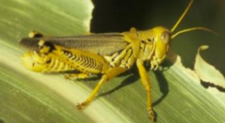
Raise your hand if you’re feeding grasshoppers in your garden right now. You’re not alone. You are likely hosting several grasshopper varieties which increase in size as they molt and
mature. Full-sized adults are the most problematic as they have wings and can cover more ground. They also have a tougher skin making insecticides less effective.

As with many problems in the garden, early action is important. Nets/floating row covers
can be effective protection for small areas, though grasshoppers have been known to
chew through netting. Gardeners who want to avoid synthetic treatments have to decide
the amount of damage they can tolerate. In suburban areas, it is important for
gardeners to work together to control grasshoppers and limit the destruction.

Insecticides are usually effective when the spray comes in direct contact with the
grasshopper. Most have to be reapplied to eliminate new arrivals. Immature
grasshoppers are limited in their range since they travel by foot. They are easiest to
control at this stage.

Gardeners who choose to use insecticides will likely select one of the following options
labeled for the widest variety of crops:

• permethrin (Hi-Yield Garden & Farm Insect Control, Eight Vegetable, Bonide
Eight Vegetable, Fruit & Flower Concentrate, Bonide Eight Garden Dust),
• cyfluthrin (BioAdvanced Tomato & Vegetable Insect Killer),
• gamma-cyhalothrin (Spectracide Triazicide.

Peonies

0

It’s the time of year when two fungal diseases may appear on peony plants. Preventative care each year is the best control against them.

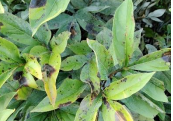
Peony measles, also referenced as red spot and leaf blotch, appears initially as purplish-brown circular spots on the top of the leaves. The spots on the undersides of the
leaves are brown. Over time, more spots develop and eventually merge creating large, irregularly shaped blotches. Spots can appear on the stems, flower buds,
petals and seed pods as the disease progresses.

Powdery mildew can infect a variety of plants. It presents as a white-grey powder on plant
material. Powdery mildew is quite common in Kansas due to the warm, humid conditions.

Fortunately, both diseases are primarily aesthetic problems unless they become severe. Promote good air flow by spacing peonies several feet apart when planting. Individual
plants can be pruned selectively during the growing season to improve circulation. Powdery mildew and measles overwinter in the soil on diseased plant material. At the end of the growing season cut peonies to the ground and throw out the plant material. Do not compost, especially if the plants are diseased. Use drip irrigation, if possible, to keep water from splashing on the leaves. When leaves are wet, avoid handling them.

Dividing Iris

0

Irises have a rhizome root system. Every year, each rhizome yields additional rhizomes creating a larger network of roots. After several years of this development, bloom production may slow down or halt altogether if the rhizomes become too crowded. This indicates it’s time to divide the rhizomes.

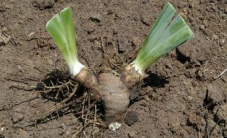
When the bloom season has ended dig the entire plant including all the rhizomes. Break the rhizomes apart by hand at the joints where they are connected. Healthy rhizomes should have roots extending below and a fan of leaf blades above.

The rhizome should be firm and at least the width of your thumb. Discard any rhizomes that are soft, have an odor or do not have leaves protruding.

Trim the fan blades to about eight-inches cutting each blade at an angle to keep water
from collecting in the thick, open leaves. Trimming the leaves prevents the plant from
falling over while the roots become established. Dig a hole just deep enough that the
top of the rhizome is slightly exposed when placed inside. Irises will tolerate poor soil
conditions but well-drained soil is best. Space plants 12 to 18 inches apart and do not mulch. Irises do not respond well to over-watering; however newly planted rhizomes need to be watered in thoroughly.

Fertilize according to soil test recommendations or by applying a complete fertilizer, such as a 10-10-10, at the rate of 1 pound per 100 square feet. Mix the fertilizer into the soil to a depth of 6 inches. If your soil test shows high phosphorus levels, use a fertilizer that has a much higher first number (nitrogen) than second (phosphorus). It is important to get
irises planted early enough in the season to allow roots to establish before the first hard frost.

Cut the cost of watering trees

0

Modifying soaker hoses can help reduce the cost of water, says K-State horticulture expert

As the temperatures climb into the 90s and above, most trees require more water, but more water means more costs. Kansas State horticulture expert Cynthia Domenghini says modifying soaker hoses can help homeowners save a few dollars.

“Soaker hoses are notorious for non-uniform watering,” Domenghini said. “In other words, you often receive too much water from one part of the hose and not enough from the other part.”

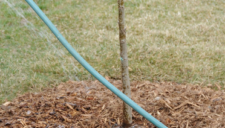
Patchy water application may not affect smaller trees, as the soaker will circle the tree several times, but can affect larger trees. For more uniform watering, Domenghini suggests hooking the beginning and end of the soaker hose to a y-adapter to equalize pressure and provide more uniform watering. The parts needed are just a y-adapter and a female-to-female connector.

“It is also helpful if the y-adapter has shut-off valves so the volume of flow can be controlled,” Domenghini said. “Too high a flow rate can allow water to run off rather than soak.”

The position of the hose can also make a difference. On larger trees, Domenghini said the soaker hose can circle the trunk at least half the distance to the drip line. On smaller trees, she said the hose can circle the tree several times so only the soil that contains tree roots will be watered.

To check if the watering is effective, Domenghini said the soil should be wet at least 12 inches deep. A metal rod or something similar can be used to check.

“Dry soil is much harder to push through than wet and your probe will stop when it hits dry soil,” she said. “How long it takes water to reach a 12 inch depth varies depending on the rate of water flow and soil.”

As a test when first watering the tree, record the amount of time it takes to reach a 12-inch depth of dampness. The tree can then be watered for that amount of time in subsequent watering.

Domenghini and her colleagues in K-State’s Department of Horticulture and Natural Resources produce a weekly Horticulture Newsletter with tips for maintaining home landscapes and gardens. The newsletter is available to view online or can be delivered by email each week.

Interested persons can subscribe to the weekly newsletter, or submit their garden and yard-related questions, by sending email to Domenghini at [email protected], More information also is available at your local K-State Research and Extension office.