Friday, February 6, 2026
Home Blog Page 353

Kansas artist completes 108-foot wheat mural on grain elevator

0

Talented Kansas-based mural artist Mindy Allen has recently finished her largest project to date — a 108-foot-tall mural on a grain elevator in rural Inman.

The mural project began nearly five weeks ago, timed to celebrate the 150th anniversary of turkey red winter wheat’s introduction to Kansas. Allen, whose business is called Mindy’s Murals, was determined to honor this milestone accurately. She even engaged the community by setting up a donation poll on Facebook, allowing locals to vote on the color of the combine featured in the mural.

Throughout the process, Mindy’s Murals actively shared updates and behind-the-scenes glimpses on its Facebook page. Followers were treated to a visual journey of the mural’s development, from initial sketches to final touches, giving the community an inside look at Allen’s meticulous work.

“I wanted to make sure every detail was perfect — the equipment, the colors — so that the people of Inman would be pleased and feel a connection to the mural,” Allen explained to local news outlet ksn.com.

Allen said that she finds joy not only in the painting process but also in seeing the finished project.

“It’s wonderful to feel a part of the community for a while, and while painting is fun, finishing and leaving knowing the project is done is always exciting,” she said.

Allen told reporters that feedback from the Inman community has been overwhelmingly positive.

“WOW!!! Soooo beautiful!!! Your work is ALWAYS amazing, but I think you’ve outdone yourself on this one. Incredible!!!” one comment on Facebook said.

“God has gifted you with such talent… I love seeing your work!” another said.

“It has been so fun to watch this project progress. You are truly talented. Thank you for the beautiful art,” yet another added.

Originally from a farming family near Scott City, Allen is based in Junction City but told the local media that she plans to return to her hometown for her next project.

“I loved this project!! Inman….you were great!” Allen said in one of her Facebook posts.

K-State food scientist outlines steps to canning frozen food safely

0

Frozen foods are best used in sauces, jams and jellies, Blakeslee says

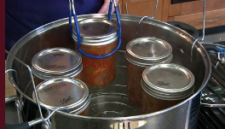
Freezing is often the quickest way to preserve fresh food from a garden or farmers market, but Kansas State University food scientist Karen Blakeslee said consumers should be cautious if thinking about canning that same food later on.

“Using frozen food in canning is not very cost-effective because of labor, time and energy to can the products,” said Blakeslee, who also is coordinator of K-State’s Rapid Response Center for food science. “Because of the time and labor spent freezing the food, it may be best for safety and quality to leave the food frozen, then thaw and use it later when cooking a meal.”

If canning the food is still preferred, Blakeslee suggests doing so in sauces, jams, jellies or fruit butters.

“The reason is that frozen food is much softer in texture when thawed,” she said. “Canning frozen foods in their original form – such as whole or cut pieces – can cause safety problems because the food will compact more and become more dense inside the jar. This can slow down how heat moves through the jar during canning, which affects food safety. The quality of these foods will be poor.”

Some examples of foods that could be frozen, then used later in a canned product, include:

  • Peaches – make into jam, peach butter or jelly.
  • Tomatoes – make into tomato juice, tomato sauce or spaghetti sauce.
  • Apples – make into applesauce, apple butter or jelly.
  • Berries – make into jam or jelly, or blend them to dehydrate fruit leather.

“Juice can be extracted from fruit to make jelly,” Blakeslee said. “There are stovetop juice extractors that steam the fruit to allow the juice to release from the fruit. Another option is to heat and crush the fruit, then pour into a jelly bag and suspend over a bowl to catch the juice.”

Additional guidance on preserving jams and jellies is available online.

Still, Blakeslee said, “for many foods, it is best to leave them frozen for best quality in the end.”

More information on food preservation is available online from K-State’s Rapid Response Center for food science.

Blakeslee publishes a monthly newsletter called You Asked It! that provides numerous tips on being safe and healthy. More information is also available from local extension offices in Kansas.

Cucumbers thrive in warm summer and produce a bounty of fresh food

0

Cucumbers are among the most popular garden vegetables, and growing them can be rewarding and delicious. Cucumbers thrive in Iowa’s warm summer and quickly produce a bounty of fresh, homegrown cucumbers perfect for salads, sandwiches and pickling. While relatively easy to grow, cucumbers can have some potential pitfalls. Horticulturists with Iowa State University Extension and Outreach answer questions to help solve some of the problems you may encounter when growing cucumbers.

My cucumber plants are blooming heavily but aren’t producing many fruit. Why?

Cucumbers and other vine crops are monoecious. Monoecious plants have separate male and female flowers on the same plant. Male and female flowers are similar in appearance. However, the female flowers have small, immature fruits at their base. Pollen is transferred from the male to the female flowers by bees and other pollinators. When properly pollinated and fertilized, the female flowers develop into fruit.

The first flowers to appear on cucumbers and other vine crops are predominantly male. As a result, fruit production is poor when the vines begin to flower. The cucumber vines should start producing a good crop within a few weeks as the number of female flowers increases.

Poor weather and the use of insecticides can also affect fruit set on cucumbers. Cold, rainy weather during bloom reduces bee activity. Fewer bees visiting the garden results in poor pollination and poor fruit set. Apply insecticides in the garden only when necessary to avoid harming bees and other pollinators.

Why are some of my cucumbers bitter?

The compound cucurbitacin produces the bitterness in cucumbers. Cucurbitacin is generally found in the leaves, stems and roots of cucumber plants. The cucurbitacins spread from the vegetative parts of the plant into the cucumber fruit when plants are under stress. Hot, dry weather is usually responsible for bitterness in cucumbers in Iowa.

Cucurbitacins tend to be concentrated in the stem end of the cucumber and just under the skin. To eliminate most of the bitterness, cut off the stem end of the fruit and peel the remaining portion of the cucumber. To avoid the problem, plant bitter-free cucumber cultivars, such as ‘Sweet Slice’ and ‘Sweet Success.’ Watering cucumber plants once a week during hot, dry weather may also be helpful.

Why are some of my cucumbers misshapen?

Poorly shaped fruit are usually the result of poor pollination. Poor pollination may be due to cool, wet weather and improperly applied insecticides that limit bee activity. When insecticides are necessary, select an insecticide with low toxicity to bees and apply it early in the morning or late in the evening to reduce the risk to bees.

Will cucumbers cross-pollinate with other vine crops?

While closely related, cucumbers will not cross-pollinate with squashes, pumpkins, muskmelons or watermelons as they are different species. Cucumber varieties can cross with one another. However, the quality of this year’s crop is not affected. An exception is the cross-pollination of parthenocarpic cucumber varieties with standard varieties. Parthenocarpic varieties develop fruit without pollination. As a result, the non-fertilized fruit do not contain seeds. Parthenocarpic varieties must be isolated from standard varieties to prevent cross-pollination and seed development.

How do I control cucumber beetles?

Striped and spotted cucumber beetles are common pests of cucumber and other vine crops in the Midwest. Both beetles are yellow-green and between 3/16 and 1/4 inches long. The striped cucumber beetle has three black stripes that run the length of its body. The spotted cucumber beetle, also known as the southern corn rootworm, has 12 black spots on its back. Both can be damaging, but the striped cucumber beetle is more problematic because of its ability to transmit the disease bacterial wilt.

Early in the season, feeding by larvae can stunt and even kill seedlings and small transplants. Adult beetles feed primarily on leaves but will feed on stems and cause cosmetic damage to fruits if populations become too high. Once cucumber plants have established and begin to mature, they can survive high levels of defoliation. However, striped cucumber beetles can still be very damaging to plants due to the transmission of bacterial wilt through feeding.

Covering young cucumber plants with row cover or frost fabric can protect them from cucumber beetles but remember to remove it when plants start to flower to allow for pollination. Keep an eye on your plants and act quickly if beetles cause damage. Scout also for bacterial wilt and remove any affected plants immediately. Planting a trap crop, like Hubbard squash, nearby, can lure beetles away. Once populations build up, treat the trap crop with pesticide to reduce beetle numbers without spraying your cucumbers. Use pesticides cautiously, as they can harm beneficial pollinators. Insecticide options include neem, pyrethrins, permethrin, bifenthrin and carbaryl.  Always apply only when necessary and according to label directions.

Looking for a summer trip before school? These 7 Kansas sites are a drive away.

0

Summer vacation is almost over, with Topeka-area schools resuming classes in mid-August. But there’s still time to take a quick trip to somewhere within driving distance in Kansas. Following are seven suggested Sunflower State vacation destinations, with each offering various things to do.

Atchison

Travelers looking for something new can visit the Amelia Earhart Hangar Museum, which opened last year near Atchison to celebrate the legacy of Atchison native and trailblazing female pilot Amelia Earhart. Tourists may also want to visit the city’s “Amelia Earhart Earthwork” portrait created by crop artist Stan Herd and tour the Amelia Earhart Birthplace Museum, located in the house where she grew up on a picturesque bluff overlooking the Missouri River.

About 11,000 people live in Atchison, a northeast Kansas city that also offers a historical museum, a railroad museumagritourism activities, a “river walk” along the Missouri River and chances to see houses that are said to be haunted.

Dodge City

Long after the days of cowboys and gunslingers came to an end, visitors can still enjoy the ambience of the Old West at Dodge City, once known as the “Queen of the Cowtowns.” Western-flavored attractions available in this southwest Kansas city of about 28,000 people include Boot Hill Museum, the Dodge City Trail of Fame and a Gunfighters Wax Museum.

Dodge City also offers Historic Trolley ToursBoot Hill Casino & Resort, the Kansas Teachers Hall of Fame and a former Santa Fe Railway Depot that has been turned into a theater.

Wichita

Wichita in south-central Kansas is the site of Exploration Place science museum; Botanica Wichita, featuring four gardens and a horticultural library; and the Sedgwick County Zoo, the seventh-largest zoo in the nation. Tanganyika Wildlife Park can be found in nearby Goddard and Field Station: Dinosaurs adventure park is in nearby Derby.

Almost 400,000 people live in Wichita. It’s also the site of the 44-foot-tall Keeper of the Plains sculpture, the Museum of World TreasuresOld Cowtown MuseumWichita-Sedgwick Country Historical Museum, the Mid-America All-Indian Museum, the Kansas African American Museum, the Old Town Wichita district and the Historic Delano District.

Hutchinson

The Cosmosphere, Hutchinson’s international science education center and space museum, houses the largest collection of Russian space artifacts outside of Moscow and a collection of U.S. space artifacts second to only the National Air and Space Museum in Washington, D.C.

A city of about 40,000 in south-central Kansas, Hutchinson is also the site of the Reno County Museum,; Dillon Nature Center, the Hutchinson ZooHedrick Exotic Animal Farm and Strataca, a salt mine museum where visitors may go as far as 650 feet beneath the Earth’s surface.

Abilene

The Eisenhower Presidential Library, Museum and Boyhood Home are among attractions at Abilene, a city of about 6,500 people in north-central Kansas that was the hometown of President Dwight D. Eisenhower. Tourists can get a taste of the Old West in that city by watching gunfights and can-can dancers on weekends at Old Abilene Town.

Visitors to Abilene may also ride the Abilene & Smoky Valley Railroad and the oldest known existing operational carousel; view the World’s Largest Belt Buckle and a 28-foot-tall Big Spur; visit Eisenhower Park & Rose Garden; and tour Seelye Mansion, which contains furnishings that were mostly bought at the 1904 World’s Fair in St. Louis.

Wilson State Park

Wilson State Park in Russell County in north-central Kansas is considered by many to be Kansas’ most beautiful state park, says the Kansas Department of Wildlife and Parks. Visitors may fish in the 9,040-acre Wilson Reservoir, view wildlife in Wilson Wildlife Area, hike on the one-mile Cedar Trail and ride on the 24.5-mile-long Switchgrass Bike Trail.

Wilson State Park is about 10 miles north of Wilson, population 859, where the Wilson After Harvest Czech Festival takes place Friday and Saturday, July 26 and 27. The park is about six miles south of Lucas, population 332, which is the site of S.P. Dinsmoor’s 117-year-old Garden of Eden, the oldest intact folk art environment in the U.S.

Wamego

OZ Museum at Wamego capitalizes on Kansas’ enduring fame as being the home of Dorothy, the central character in the 1900 book and 1939 movie “The Wizard of Oz.” The museum houses thousands of artifacts related to both.

A city of about 4,900 people in northeast Kansas, Wamego also offers an outdoor “Yellow Brick Road”; various statues of Dorothy’s dog, Toto, standing throughout the city; Wamego Historical Museum and Prairie VillageSwogger Art Gallery; the limestone Columbian Theatre, built in 1895 and renovated at a cost of $2.5 million in 1994; and a chance to see bison at ranches located 10 miles north and 10 miles south of town.

As reported in the Topeka Capital Journal

How deep are Kansas’ 24 large reservoirs? Here’s how they all stack up

0

The state of Kansas is home to 24 large, man-made reservoirs, all built by the federal government between 1940 and 1982.

Maximum depths range from 72 feet for Tuttle Creek Reservoir, the deepest of those lakes, to 20 feet for John Redmond Reservoir, the shallowest.

Here’s how deep each of them go.

Tuttle Creek Reservoir is deepest in Kansas

The state’s deepest lake is Tuttle Creek Reservoir in Pottawatomie and Riley counties, where operation project manager Brian McNulty told The Capital-Journal the maximum depth is 72 feet.

That lake encompasses 10,900 surface acres, according to the website of the Kansas Department of Wildlife and Parks.

The reservoir’s maximum depth is not expected to change appreciably as a result of a dredging project set to be carried out there next year, McNulty said.

Milford and Wilson lakes tie for second place in Kansas

Two lakes are tied for second deepest in Kansas, with each having a maximum depth of 65 feet.

One of those, Milford Lake in Clay and Geary counties in north-central Kansas, is also the state’s largest lake in terms of surface area. It encompasses 16,200 surface acres.

The other is Wilson Lake, located in Russell County in north-central Kansas. Wilson Lake encompasses 9,040 surface acres.

These lakes rank fourth through 11th in terms of depth

Three lakes are tied for fourth with a maximum depth of 60 feet.

They are as follows:

  • • Big Hill Lake in Labette County in southeast Kansas, which encompasses 1,240 surface acres.
  • • El Dorado Lake in Butler County in south-central Kansas, which encompasses 8,000 surface acres.
  • • Melvern Lake in Osage County in northeast Kansas, which encompasses 7,000 surface acres.
  • Cedar Bluff Reservoir in Trego County in northwest Kansas is in seventh place with a maximum depth of 58 feet. It encompasses 6,869 surface acres.
  • Hillsdale Lake in Miami County in east-central Kansas is eighth with a maximum depth of 57 feet. It encompasses 4,580 surface acres.
  • Council Grove Lake in Morris County in central Kansas is ninth with a maximum depth of 56 feet. It encompasses 3,280 surface acres.
  • Two lakes are tied for 10th with a maximum depth of 55 feet.
  • They are Clinton Lake in Douglas County in northeast Kansas, which encompasses 7,000 surface acres; and Glen Elder Reservoir in Mitchell County in north-central Kansas, which encompasses 12,586 surface acres.

    These lakes rank 12th through 17th in maximum depth

    • In 12th place with a maximum depth of 50 feet is Pomona Lake in Osage County in east-central Kansas, which encompasses 4,000 surface acres.
    • Perry Lake in Jefferson County in northeast Kansas is 13th with a maximum depth of 43 feet. It encompasses 11,630 surface acres.
    • Tied for 14th with a maximum depth of 42 feet are Cheney Reservoir in Kingman and Reno counties in south-central Kansas, which encompasses 9,550 surface acres, and Webster Reservoir in Rooks County in northwest Kansas, which encompasses 3740 surface acres.
    • Keith Sebelius Reservoir in Norton County in northwest Kansas is 16th with a maximum depth of 42 feet. It encompasses 2,300 surface acres. The reservoir is named after Keith Sebelius, of Norton, who represented the state’s First District in the U.S. House of Representatives from 1969 to 1981. Sebelius died at age 65 in 1982. He’s the father of retired U.S. Magistrate Judge Gary Sebelius and the father-in-law of former Kansas Gov. Kathleen Sebelius.
    • La Cygne Reservoir in Linn County in east-central Kansas is 17th with a maximum depth of 40 feet and encompasses 2,600 acres.

      These lakes rank 18th through 24th in maximum depth

      Two lakes are tied for 18th with a maximum depth of 35 feet.

      • One is Kanopolis Lake in Ellsworth County in central Kansas, which encompasses 3,550 surface acres.
      • The other is Lovewell Reservoir in Jewell County in northwest Kansas, which encompasses 2,986 surface acres.
      • Twentieth is Marion Lake in Marion County in central Kansas, which lake manager Brock DeLong told The Capital Journal has a maximum depth of 30.5 feet. That lake encompasses 6,160 surface acres.
      • Fall River Lake in Greenwood County in southeast Kansas is 21st with a maximum depth of 25.1 feet. It encompasses 2,500 surface acres.
      • Toronto Lake in Greenwood County in southeast Kansas is 22nd with a maximum depth of 24.2 feet. It encompasses 2,800 surface acres.
      • Elk City Reservoir in Montgomery County in southeast Kansas is 23rd with a maximum depth of 24 feet. It encompasses 4,450 surface acres.
      • John Redmond Reservoir in Coffey County in southeast Kansas is 24th with a maximum depth of 20 feet. It encompasses 9,400 surface acres. The reservoir is named after John Redmond, publisher of the Burlington Daily Republican, who died in 1953 at age 79.
      • As reported in the Topeka Capital Journal