Saturday, February 7, 2026
Home Blog Page 361

Protecting your home from wasps

0

K-State entomologist explains how to safely remove wasp nests

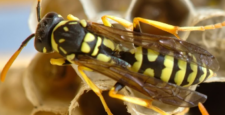
A common problem many homeowners face is wasps taking up residence outside their homes. Kansas State University entomologist Raymond Cloyd says, however, that not all wasps are harmful.

“Wasps are beneficial and they are part of the ecosystem,” Cloyd said. “They are predators of many caterpillar pests and are docile overall. They will usually only sting if disturbed or agitated.”

Mud daubers and paper wasps are commonly seen around homes and will generally not attack people. However, yellow jackets will actually attack people.

Despite the beneficial role of wasps, many people may want to remove wasp nests to avoid the possibility of getting stung when outdoors. When considering removing wasp nests, Cloyd advises determining whether the nest is new or mature.

“If the home has a history of wasps building nests, such as in late spring or early summer, physically remove the nest when you see the nest being initially built,” Cloyd said.

New nests can be removed with minimal risk of being stung because there are usually fewer wasps present inside the new nest. Wasps generally do not rebuild nests in the same location, so physically removing the nest will avoid having to deal with nests in the future.

Spraying nests with an insecticide should be done at night when the wasps are inside the nest, Cloyd said.

If the nest is large, mature, and has been around for some time, Cloyd recommends contacting a pest management professional.

“In order to avoid getting stung, it is best to contact a pest management professional,” he said.

Cloyd said that it is important to correctly identify the wasp that is creating the nest. He recommends contacting your local K-State Research and Extension office and either describing the insect over the phone or sending pictures via email.

Is rained-on hay still good?

0

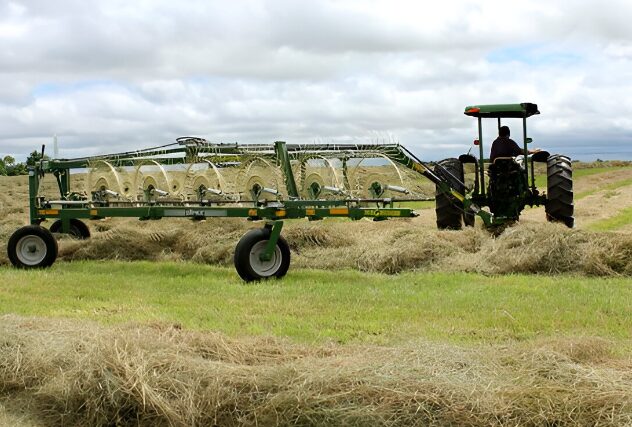
Rain is always a wild card when deciding the right time to mow hay.

“Pop-up showers and storms are a risk this time of the year,” says University of Missouri Extension agronomist Hunter Lovewell. This unpredictability makes it important to keep an eye on weather forecasts and understand how rainfall affects forage that is drying down but not yet baled, he says.

And not all rains are created equal, says Lovewell. Quick, short rains cause less damage than prolonged, slow rains.

Rained-on hay likely is less digestible with lower yields, respiration and microbial breakdown of the plant tissue.

Lower yields and lower digestibility

Wet hay requires more mechanical handling to dry, which results in leaf shatter. This reduces digestibility when leaves fall and tougher stems remain. Fewer leaves also mean less mass and lower yields, according to research from several universities. When this happens, livestock owners should consider supplementing hay with nutrients, says Lovewell.

Since rain affects grasses and legumes differently, growers should also consider what type of hay they have. Forage legumes such as bird’s-foot trefoil and red clover do not lose as much dry matter as alfalfa does. Most studies agree that crude protein in alfalfa is not greatly affected by rainfall on a mowed crop.

Leaching and respiration

Leaching is the movement and loss of soluble components of the mowed plant. A large portion of the leached out dry matter is soluble carbohydrates, along with lipids, minerals and soluble nitrogen.

Rained-on hay also allows microorganisms such as fungi and molds to develop. Respiration is the process of plant enzymes breaking down soluble carbohydrates. This process occurs whether the forage is rained on or not. It is normal for a small percentage of the total dry matter to be lost through respiration until moisture dries down to around 30%.

Rainfall intensity, length matters

If the total amount of rain is the same, a lower-intensity rain will result in worse quality and lower yield compared to higher-intensity rainfall.

Some research shows that leaching of carbohydrates, vitamins and minerals is usually highest when hay has partially dried and then there is a prolonged rain. Rainfall right after cutting usually results in less leaching of nutrients.

Lovewell says rained-on hay will be better in quality if:

  • Rainfall occurs soon after mowing.
  • Rainfall is higher in intensity, assuming the rainfall amount is the same.
  • Forage is rewetted only once rather than multiple times.

To know the true quality of rained-on hay, or hay in general, submit a forage sample to a lab for testing. “A hay test is the only way to truly know the quality of hay,” says Lovewell.

The analysis from the lab will help in the development of a supplementation program to replace nutrients in the hay.

Lovewell recommends these resources:

Much of Kansas is at ‘high risk’ of West Nile virus. Here’s why and how to stay safe

0

Keep your distance from mosquitoes if you’re in Kansas in the near future.

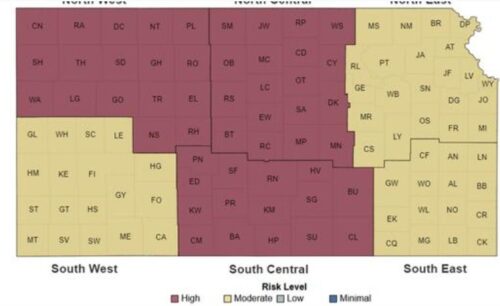
The Kansas Department of Health and Environment has issued high-risk and moderate warnings for West Nile virus across the state. Johnson and Wyandotte counties, located in the northeast region, are in moderate-risk areas, while Wichita, found in the south-central region, is in a high-risk area.

About half of Kansas is considered high-risk areas because there are a high number of mosquitoes in those regions, and that increases the chances of residents being bitten by a mosquito carrying the virus, according to the state health department. A moderate risk area means there is a moderate possibility of being bitten by a mosquito carrying the virus.

There have only been two reported cases of West Nile virus in Kansas in 2024 so far. There were 66 total cases and four deaths reported in 2023.

No matter what region you live in, here’s what to know about West Nile virus and mosquitoes.

What is West Nile virus?

The West Nile virus causes an illness with flu-like symptoms. Those can include fever, headache, muscle and joint aches, nausea and fatigue.

It’s the most common mosquito-borne disease in the United States. The virus does not spread from person to person, according to the U.S. Centers for Disease Control and Prevention , just from mosquito to humans and other mammals.

Around 1 in 5 people who are infected develop a fever and other fever-related symptoms, and about 1 out of 150 infected people develop swelling of the brain or brain tissue. In extreme cases, the virus can be fatal.

There is no vaccine or specific medication to treat the virus, but if you’ve had it before, you’re immune to it.

When are mosquitoes the most active?

You are more likely to see a mosquito in the day time through July and September, according to KDHE. They’re most active from dusk to dawn.

Mosquitoes are attracted to water, so remember to empty any standing water that may be sitting there from any rainfall. Clear out water from buckets, old tires, tarps, garden beds, kiddie pools or other spots with rainwater. The KDHE recommends to use larvicide in low-lying areas where water cannot be removed.

How does Kansas determine the risk of West Nile virus?

The Kansas health department determines the risk level based on:

  • The temperature, because mosquitoes breed more in hot weather
  • The number of mosquitoes in the area
  • The number of people infected with West Nile virus historically.

How do I stay safe from mosquitoes and West Nile virus?

The Kansas health department recommends the following prevention measures:

  • If you go outside, use insect repellent. Officials recommend using a repellent with an EPA-registered active ingredient on skin and clothing, which includes DEET, picaridin or lemon or eucalyptus oil.
  • Mosquitoes are most active at dusk and dawn hours, so keep the insect repellent on you during these hours. People with weakened immune systems should consider limiting how long they’re outside during these times.
  • Make sure you have good screens on your windows and doors to keep mosquitoes out.
  • Get rid of mosquito breeding sites by emptying standing water from flower pots, buckets, barrels and pet dishes that are left outside. You should also replace the water in your bird baths once a week if you have one.
  • Keep the water out of swinging tire holes by drilling holes in them.
  • If they’re not in use, keep kiddie pools empty and on their sides.

    Check the Kansas Department of Health and Environment’s West Nile virus tracker to learn about your community’s current risk level.

Lovina Enjoys Summer Days with Family

0

Today daughter Loretta and sons Denzel and Byron came here after my husband Joe and sons left for work. Daughter Verena left last night; she went to daughter Susan and Ervin’s house. She will stay with their five oldest children today while Susan will go help prepare for Ervin’s brother Steven’s wedding, which is Thursday. 

I’m still trying to get used to not having daughter Lovina home in the mornings. We miss her here, but I am happy for her and Daniel. It seems different seeing her sit with the women in church instead of with the young girls. 

Denzel is snuggled up with Loretta on the loveseat. He looks tired but is looking over here watching me pen this column. Byron is in the pack and play crib, talking to himself. He will probably talk himself to sleep. Denzel will be two years old tomorrow (July 10). He is a busybody, and he’s started his terrible twos early. Ha ha! He’s a sweetie, though, and can act so innocent when he does something wrong.

Yesterday son Benjamin came home from work and buttered some bread to make himself a grilled cheese sandwich. He walked away to go do something else, and when he came back, his one piece of bread was gone. Denzel had spotted the buttered bread and figured it would be a good snack. He loves bread with butter (and sometimes jelly). We had to laugh about Benjamin’s disappearing bread. 

Sunday church services were held at our neighbors’ house. Our family, along with sister Emma and son Jacob, nephew Benjamin and Crystal and son, came here after lunch. They all ended up staying for supper. The men grilled chicken, and along with that we had mashed potatoes, noodles, corn, cheese, homemade bread, butter and strawberry jam, ice cream, and cookies. It was an enjoyable afternoon and evening spent together. Everyone ate outside on our big L-shaped porch. Many meals have been eaten on this porch. I love my porch!

Our zucchini is really doing well out in the garden. Last night I fried sliced zucchini, green beans, onions, and peppers together in olive oil. It was delicious!

Our banana peppers are doing well, too, and we had our first meal of them stuffed with cream cheese and shredded cheese, then wrapped with bacon. We put them on the grill to cook. Our sweet corn should be ready to eat soon. Green beans, peas, and all those garden goodies make meal planning much easier. 

Last week, on July 3, Ervin and Susan invited our family and Mose’s family to gather at the graveyard when they put a gravestone on Mose’s grave. Our whole family, Mose’s parents, and three of his brothers and families attended. It brought back many memories of that sad day in December 2020 when Mose lost his life due to injuries from a traffic accident on his way to work. Rest in peace, Mose! You will always have great memories in our hearts.  

I invited everyone here for hot dog sandwiches and snacks afterwards, but Mose’s family couldn’t come. Our family all came, and once again that big porch was used to eat on. I have been leaving the extra tables and chairs on there, so when they all come home everyone has enough room to sit and eat. On warm summer days it’s also nice to feel the breeze on the porch. 

On the evening of July 4, Joe and I went out on the lake with Dustin, Loretta, and sons. They took their pontoon. It was so enjoyable, and the little boys loved it, too. Joe helped Denzel fish, but he seemed too scared to hold the fish. We grilled ribs and bacon-wrapped peppers, along with other picnic food. It was so relaxing, and before we knew it, it was 11:30 p.m. already. We could sleep in the next morning, though. Joe had off three days last week for the holiday. I have not been doing much extra work beside gardening and the daily chores since the wedding. It felt good to get extra rest after a busy few months.

God’s blessings to all!

Here is a recipe for the pudding we served at Lovina’s wedding.

Caramel Pudding

6 ounces Nestlé La Lechera milk-based caramel

2 (16-ounce) containers whipped topping

Caramel baking chips

Caramel sundae syrup

Whip together the milk-based caramel and whipped topping. Garnish with caramel baking chips and caramel sundae syrup. Leftover pudding will freeze well. The amount of milk-based caramel can be adjusted to your preference. 


Lovina’s Amish Kitchen is written by Lovina Eicher, Old Order Amish writer, cook, wife, and mother of eight. Her three cookbooks, The Cherished Table, The Essential Amish Cookbook, and Amish Family Recipes, are available wherever books are sold. Readers can write to Eicher at Lovina’s Amish Kitchen, PO Box 234, Sturgis, MI 49091 (please include a self-addressed stamped envelope for a reply); or email [email protected] and your message will be passed on to her to read. She does not personally respond to emails.