Thursday, February 12, 2026
Home Blog Page 415

Rabbits in the garden?

0

K-State horticulture expert gives methods for effective protection.

Rabbits are a common invader of home gardens, especially when plants flower in spring. Kansas State University horticulture expert Cynthia Domenghini said there are many common-sense ways to keep the hungry critters out.

“This time of year, rabbits gravitate to young vegetables and flowers,” Domenghini said. “But there are some vegetables that are rarely bothered, including potatoes, tomatoes, corn, squash, cucumbers and some peppers.”

Cynthia Domenghini said some methods for keeping rabbits away include:

Fencing

Fencing is often the quickest and easiest method of control. Domenghini recommended the fence be at least two feet tall with a fine mesh of one inch or less. Fencing support can be provided by a variety of products, including electric fence posts. However, fencing may not be a viable choice based on the desired appearance of the garden.

Floating Row Cover

Floating row cover is a light woven material that can be placed over plants yet still allows light, water and air to come through.

“Though most often used to promote early growth by keeping plants warmer than normal, it can also help protect young plants from insects and wildlife,” Domenghini said.

Repellants

Although commonly suggested for rabbit control, repellants must be re-applied frequently. Some can also be poisonous and cannot be used on plants intended for human consumption, Domenghini warned.

Trapping

Domenghini said live traps are usually recommended when the rabbit can be moved to a rural area several miles away from where they were initially caught.

“A number of baits can be used to entice the rabbit to enter the trap, including a tightly rolled cabbage leaf held together by a toothpick. However, rabbits often avoid baits if other attractive food is available.”

Sprinkler

A motion-activated sprinkler can be attached to a garden hose, releasing a short burst of water upon motion. Domenghini suggests picking a product that advertises it can protect at least 1000 square feet: “Such products are available from Contech, Orbit and Havahart,” she said.

Domenghini and her colleagues in K-State’s Department of Horticulture and Natural Resources produce a weekly Horticulture Newsletter with tips for maintaining home landscapes and gardens. The newsletter is available to view online or can be delivered by email each week.

Interested persons can also send their garden and yard-related questions to Domenghini at [email protected], or contact your local K-State Research and Extension office.

Brand names mentioned in this article are for identification purposes only and are not intended to be an endorsement of any product.

Symphony at Sunset Concert D-Day+80 Years Commemoration Week

0

Abilene, Kan. – The D-Day 80th Anniversary Commemoration Week at the Eisenhower Presidential Library in Abilene, Kan., is set to be a truly memorable experience. Starting with the Symphony at Sunset Annual D-Day Concert on June 1, the week progresses with the World War II Emerging Scholars Symposium culminating in the Remembrance Ceremony and Veterans Panel on June 6.
The Salina Symphony is tuning up for an unforgettable Symphony at Sunset concert on Saturday, June 1. The schedule is packed with activities starting at 1 p.m. with various Hands-on History Carts in the museum, food vendors, Mounted Color Guard Demonstrations, a flight simulator and additional displays. Performances by the Flint Hills Children’s Choir, Everyday Lights, and Fort Riley’s 1st Infantry Division Band lead up to the 8:30 p.m. patriotic orchestral performance featuring the Salina Symphony, conducted by Yaniv Segal.
Join us in honoring our veterans and celebrating the spirit of togetherness at this patriotic event. While admission is free, your generous donations to the Eisenhower Foundation will ensure the continuity of programming for future years. Don’t forget, museum admission is complimentary for the entire day, offering you a chance to explore and to learn. Be sure to visit the D-Day Remembered—Photographs by Fabrice Bourge photo exhibition. The Symphony at Sunset Concert is generously sponsored by the Community Foundation of Dickinson County, Marshall Motors of Salina, and the Friends of the Eisenhower Foundation. Additional support is also provided by Kansas Gas Service and Vyve Broadband.
June 4-6, the Eisenhower, Roosevelt, and Truman Presidential Libraries host the annual WWII Emerging Scholars Symposium dedicated to honoring the significance of D-Day. This virtual event delves into specialized topics surrounding the Allied endeavors in World War II, offering a platform for budding scholars to showcase their expertise. This year participants will explore different ways in which the United States attempted to attain and maintain peace. Each presentation is allocated a one-hour slot, followed by a Scholar Spotlight segment that provides a glimpse into the promising futures of these historians.
The week-long commemoration of the D-Day 80th Anniversary concludes on June 6. Immerse yourself in the stories of heroes at the Meet a World War II Veteran Reception at 9 a.m, followed by a Remembrance Ceremony at 11 a.m. and the Veterans Panel at 2 p.m. Enjoy complimentary museum admission, engage with reenactors and delve into history with the Hands-On History Carts. The June 6 veterans spotlight events are generously sponsored by Tim and Brenda Holm, Nancy Gugler in honor of Wendell Gugler, 10th Mountain Division, and the You Were Worth It Foundation.
This commemoration week is not just an event; it is a chance to honor, learn and connect with the remarkable legacy of Dwight Eisenhower and our nation’s greatest generation. Complete schedule details can be found on the Eisenhower Presidential Library’s website at eisenhowerlibrary.gov/public-programs/commemorate-d-day.

Cabbage Worms

0

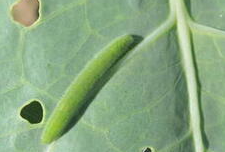
Description: Velvet-green larvae are 1-1/4 inches long at maturity. The chrysalis is light green, tan or yellowish and about one inch long. The adult is a white butterfly with black spots on the wings. Spherical eggs are yellow to cream in color.

Life Cycle: Adult butterflies emerge in spring and begin laying eggs on the underside of leaves of host plants. The resulting caterpillars reach maturity within 10-14 days and feed on hosts of broccoli and cabbage typically. Chrysalises attach to the food source with silken threads. There can be multiple generations of cabbage worms each year.

Damage: No damage is caused by the adults but the larvae feed on their host plant and can defoliate entire plants sometimes preventing the formation of heads. Boring into the heads can also cause them to be inedible due to their presence along with the fecal pellets.

Control: Monitor plants for signs of cabbage worms regularly. White butterflies near cole crops are an indicator of cabbage worms. Larvae are camouflaged against plant leaves so look for irregular-shaped holes and dark green fecal pellets on the plant or ground nearby.

Prevent cabbage worms by removing debris after the growing season to reduce overwintering habitats. Use row covers to prevent butterflies from laying eggs. Choose cultivars that mature faster to shorten the season. Remove larvae by hand. Bt (Bacillus thuringiensis) is effective on young caterpillars as are Spinosad, neem and pyrethrum. Always follow label instructions and practice safe application. A spreader sticker will increase efficacy due to the slick leaves of the host plants.

0

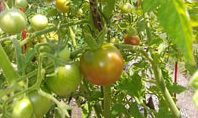
Tomatoes need support to remain upright. If left to grow on the ground there is less air flow and greater risk of disease. Support keeps the fruit off the ground which helps reduce contamination from contact with soil. Is there a right or wrong way to support your tomato plants? Maybe…

Traditional, store-bought cages can be effective especially for small, container varieties of tomatoes. Though these cages sometimes come in fun colors, they tend to be more expensive than building your own. The support they provide is minimal and often insufficient for most tomato varieties.

You can build your own tomato cage using concrete reinforcing mesh. With a roll 150 feet long and 5 feet tall you can create multiple tomato cages and trellises to support climbing plants. The openings between the wires are large enough to fit your hand through for harvesting and allow even large slicing tomatoes to slide through. Cut the wire at the desired length and create a cylinder that will wrap around the tomato plant. If you cut the wire at a length of six feet, the diameter of the cage will be almost two feet. Wrap the cut wires around the other end of the panel to secure the cylindrical shape. To keep the cage in place you will need at least one or two wooden stakes. Hammer them into the soil several inches and attach the cage to them using wire or garden tape.

Another support method is called the “basketweave” or “stake and weave” which is a trellising system. Plants should be grown in a row with a t-post in the ground between every few plants. Install a t-post at the start and end of the row as well. When plants are about one-foot-tall tie a strand of twine to the t-post at one end of the row. Walk the length of the row holding the twine and wrapping it around each t-post as you pass. At the opposite end of the row, wrap the twine around the t-post and then return to the start while again wrapping the twine around each post. As you come upon plants, they should be carefully placed between the strings for support. When you reach the starting point, cut the twine and secure it to the t-post. As the plants grow add twine higher up on the posts in this same pattern. Twine should be added every 8-12 inches or at least before the plants begin to droop.

K-State food scientist shares tips for buying, cleaning fruits and vegetables

0

Blakeslee touts the benefits of storing fresh produce.

In most locales, the changing of seasons from spring to summer translates into an abundance of fruits and vegetables.

That’s good news for health, but if the wealth of fresh foods is allowed to spoil before they’re eaten, it could cause a pinch in the pocketbook.

“Fruits and vegetables are so important for health and they provide lots of good nutrition,” said Karen Blakeslee, a food scientist at Kansas State University. “But there are some general guidelines when it comes to purchasing those foods, and the first is to look it over – whether you’re purchasing at the grocery store or at a farmer’s market – to make sure you buy good quality produce.”

Blakeslee said most fruits and vegetables should be cleaned before eating, as well as before they’re put into storage. Lettuce, leafy greens and fresh herbs, for example, may contain a small amount of dirt or even a stray bug crawling on the leaves.

“If you leave dirt and other visible contamination on the produce, that can reduce quality, so clean them up before you store them,” Blakeslee said. “If it needs to be rinsed before you put it into the refrigerator, do so. With some foods, it’s better to wait until you’re ready to use them before rinsing them with water.”

Rinsing, she said, should be “with plain water. There is no need to use produce washes or other cleaning products. Use a vegetable brush with water on produce that grows on or in the ground to remove visible dirt.”

“When you’re getting ready to prepare those foods, keep the fresh produce that is ready to eat away from raw meats,” Blakeslee said. “You don’t want raw meat juices to cross-contaminate those foods. Be mindful to wash your hands, use clean equipment and keep foods cold, if necessary.”

If food spoils, throw it out, or compost it, Blakeslee says. Clean storage bins, dishes or counters that may have been in contact with the spoiled product.

“There are some categories of foods that should be stored in the refrigerator, such as fresh berries, cherries, grapes, fresh herbs, lettuce and fresh vegetables, such as carrots,” Blakeslee said. “Once you start cutting produce, you have to store them in the refrigerator because they are going to deteriorate quickly.

Some foods – peaches and pears, for example – can be left on a counter to ripen. Then they should be used or refrigerated. Potatoes, onions, tomatoes and bananas can be left at room temperature until ready to use. Keep potatoes and onions separated because onions can cause potatoes to grow sprouts.

Blakeslee said K-State Research and Extension has a publication titled, Storing Fresh Produce, to help consumers care for many fruits and vegetables. The publication is available to purchase or view online from the K-State Research and Extension bookstore.

“There’s a lot of food waste that ends up in the landfill, and it creates environmental problems,” Blakeslee said. “A better choice is to re-purpose foods that may be spoiled, such as a compost pile or maybe you’ve got animals that can eat those foods.”

Food preparation scraps, such as produce peels, can also be composted or fed to animals.

Blakeslee said decreasing the amount of spoiled foods often begins at the time of purchase.

“Be a smart shopper,” she said. “Plan your meals and make a shopping list so you buy the right amount of food for the week. Plan around how much you can store to help avoid food waste.”

More information on food safety, including food preservation and canning, is available at local extension offices in Kansas.