
Wednesday, January 28, 2026
Home Blog Page 4543

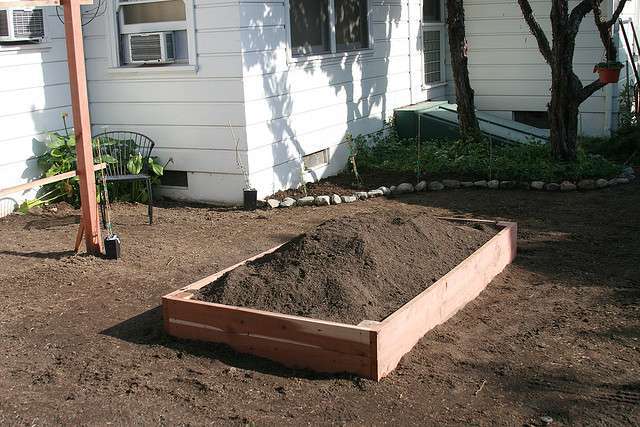
Raised Bed Gardening

0
Photo credit: Amanda Wray

By: Scott Eckert, County Extension Agent, Horticulture

I grew up in the sand hills a little bit West of here where the soil is SANDY. In sand you can dig by had all day long. Sand has its good points in that water drains or permeates well after heavy rains so plants don?t sit in excess water very long. The only thing we did to improve sand was add organic matter to actually help hold moisture longer and add nutrients.


Now I live in Newton and learned many years ago that this clay soil is vastly different than sand. Besides the fact that clay soil holds moisture it can also make tilling and growing vegetable plants difficult because it is heavy, tight and so hard to work. I recommend adding lots of organic matter (leaves, compost, manure, peat moss, etc.) to help make

this soil easier to work with. Another gardening practice I recommend is using raised beds.


Advantages of raised-bed gardening.

Better drainage – Growing plants in raised beds is a logical choice for gardeners with

heavy, poorly drained soils. Raised beds permit plant roots to develop in soil held above water-logged or compacted zones. This soil environment is much better for root growth. As beds are built up, compost or other forms of organic matter may be incorporated, further improving soil structure, drainage and nutrient-holding capacity.


Higher yields – Better root growth from improved soils leads to higher yields for food crops and lusher growth of ornamental plantings. Also, intensive planting in raised beds means more plants can be grown in a smaller area than with conventional row-cropping techniques. No space is wasted between rows.


Expanded growing season – Better drainage speeds soil warming and allows earlier spring planting. In wet seasons, soil dries faster, so planting can proceed between rains.


Easy maintenance – Because plants grow above the level of walkways, less stooping is required for weeding, watering and other chores. Intensively planted raised beds provide dense foliage cover, shading out much weed growth.


Using difficult sites – Raised beds make gardening possible on sites where growing plants would otherwise be impossible. Rooftop gardens and raised beds on top of solid rock are

examples. Terraced raised beds turn hillsides into productive growing areas while reducing soil erosion potential.


Types of raised beds

Temporary raised beds work well for many backyard vegetable gardeners. As the soil is tilled, it is loosened. If tillage equipment and foot traffic are kept off tilled beds, the loosened soil remains slightly raised above surrounding pathways. Adding compost or other organic matter to the bed raises it even higher.


The main advantage of temporary raised beds is their simplicity. No expense is involved in

constructing framework to contain the soil. Temporary beds are less labor intensive to make than permanent beds. However, temporary beds flatten over the course of a growing season and require reconstruction the next year. Also, because a temporary bed has no wall, the soil may erode from the top of the bed into walkways or down hillsides.


Permanent raised beds are more satisfactory for most situations. In the landscape, planting

berms may be constructed by hauling in topsoil to create traffic barriers as well as visual interest. When planted and mulched, berms need no edging to keep the soil in place. Walled raised beds may be used in the landscape or for vegetable gardens. Besides controlling erosion better than temporary beds, walled beds permit deep soil amendment.


Although constructing walls for raised beds takes labor and has an initial cost, the finished product should last for many years.


Think Spring … and Rabbit-Resistant Flowers

0
K-State Research and Extension

Kansas State University specialist says there are flowers that rabbits don’t like.

MANHATTAN, Kan. – It happens way too often – we tuck those tender flowers into our landscapes and wake up to find they’ve turned into rabbit food overnight. Something to keep in mind as we’re planning for spring planting, however, is that there are certain flowers that rabbits typically don’t eat.

Rabbit-proof fencing can be an effective control, but may be too unattractive for some uses, said Ward Upham, horticulture rapid response coordinator at Kansas State University.  In such cases, using plants that are less likely to be attractive to rabbits can be helpful.

“These plants are resistant, but not immune to attack,” said Upham, who is also the coordinator of the K-State Research and Extension Master Gardener program.  Young plants or those that are succulent due to overfertilization are more likely to be damaged, he said. A lack of other food sources also can result in rabbits feeding on plants that are normally rejected.

One good source of information is a University of Arizona publication, Upham said, which has a list of flowers considered resistant to feeding damage by rabbits, including: artmesia, aster, bee balm, begonia, blanket flower, bleeding heart, candytuft, columbine coreopsis, crocus, daffodil, dahlia, daylily, ferns, gloriosa daisy, herbs (except basil), iris, lamb’s ears, pincushion flower, red hot poker, surprise lily, sweet violet, verbena and yarrow.

The Arizona publication, “Deer and Rabbit Resistant Plants,”, also includes trees, shrubs, groundcovers and vines.

WSU graduate, undergraduate students present research in Topeka, Feb. 11-12

0

On Feb. 11-12, five undergraduate and 10 graduate students from Wichita State University will travel to the state capitol to present a wide range of research studies, covering topics from advances in health care to drilling efficiency.

Undergraduate students will present from 11 a.m.-1 p.m. Wednesday, Feb. 11, on the first floor of the Rotunda in the Capitol Building in Topeka. Master’s and doctorate students will present from 10 a.m.-noon Thursday, Feb. 12, on the second floor of the Rotunda. The event is free and open to the public.

“This year, WSU is facilitating events that bring together students from across Kansas,” said Kimberly Engber, dean of the WSU Honors College. “We are proud to carry on a tradition of supporting excellent undergraduate research and creative activities and sharing students’ enthusiasm with legislators.”

The WSU students will share their findings not only with legislators, but with the Kansas Board of Regents, industry representatives and other attendees. Students from other Board of Regents institutions in Kansas will also participate at the summit.

“The Graduate School is proud to be a part of this summit which showcases WSU graduate students’ innovative research that is important to the economic advancement of the state and the well-being of Kansans,” said Kerry Wilks, associate dean of the Graduate School.

Undergraduate students presenting at the event, with their respective faculty mentors, are: Lydia Ibarra and Jodie Hertzog, associate professor of sociology; Maha Madi and Joseph Keebler, assistant professor of psychology; Tyler McGinnis-Extine and Wilfredo Moscoso-Kingsley, assistant professor of industrial and manufacturing engineering; Spencer Sinclair and Humberto Saenz, assistant professor of printmaking; and Colton Turner and Alex Chaparro, professor of psychology.

Graduate students presenting at the event, with their respective faculty mentors, are: Telakapalli Abhignan and Geethalakshmi Shivanapura-Lakshmikanth, lecturer, General Aviation Flight Lab; Emmanuel des-Bordes and Esra Buyuktahtakin, assistant professor of industrial and manufacturing engineering; Nithyanandhi Duraisamy and Kim Cluff, assistant professor of biomedical engineering; Parisa Eimanzadeh and Ehsan Salari, assistant professor of industrial and manufacturing engineering; Alexander Foster and Atri Dutta, assistant professor of aerospace engineering; Elham Kookhahi and Mehmet Yildirim, professor of industrial and manufacturing engineering; Crystal Miller and Jodie Hertzog, associate professor of sociology; Senaratnelage Senaratne and David Eichhorn, professor of chemistry; Kiley Schmidt and Kathy Strattman, associate professor of communication sciences and disorders; Dustin Smith and Joseph Keebler, assistant professor of psychology.

Show Off Your Sweet Side This Valentine’s Day

0

valentines2(Family Features) Treat family, friends and co-workers to something they will all love this Valentine’s Day by making easy and impressive cookies. Start with your favorite roll-out cookie recipe or simply dress up store-bought ones by adding some simple details with icing.


From the cupids at Wilton, here are three ways to leave them smitten with sweets this Valentine’s Day:


  • Desserts with dimension. Triple your treats by stacking three decorated cookies in different sizes together and attach them with icing.
  • Complement with color. A simple piping technique looks stunning when piped in different colors on your cookies.
  • Get to gifting. Wrap your finished treats in a Valentine’s Day treat bag or box.


For more fun and delicious Valentine’s Day recipes, baking tips and inspiration, visit www.wilton.com.


Stackable Ombre Heart Cookies

Each stacked cookie serves 1.


Favorite roll-out cookie recipe

Royal icing (recipe on wilton.com)

Rose Icing Color

Heart Micro Mini Icing Decorations


Prepare and roll out cookie dough following recipe directions. Use 3 smallest cutters from 4-piece heart nesting cookie cutter set to cut out shapes. Bake and cool cookies.


Divide royal icing into three equal portions, and tint 3 shades of rose. Thin a portion of each shade following recipe directions. Use tip 3 and full-strength tinted icing to outline cookies. Use thinned tinted icing in cut decorating bag to fill in cookies; gently tap to smooth icing. Let dry overnight.


Use icing to attach cookies, stacking largest to smallest; place icing decoration on top.


Scalloped Heart Cookies

Each cookie serves 1.


Favorite roll-out cookie recipe

Ready-To-Use White Creamy Decorator Icing

Icing Colors: Burgundy, Red-Red and Christmas Red


Prepare and roll out dough following recipe directions. Use largest cutter from the 4-piece heart nesting cookie cutter set to cut out shape. Bake and cool cookies.


Divide icing into four equal portions. Tint one of each portion light burgundy, dark burgundy and combination of red-red/Christmas red. Reserve last portion white.


Starting from top edge of heart, use tip 102 and icing in dark burgundy, light burgundy, red and white to pipe V-shaped groups of two petals, one piped from left and one from right, to create row of petals in alternating colors. Repeat with second row between petals in first row. Continue to repeat pattern until cookies are covered.

Source: Wilton


Contest Winners Learn How To Save Lives Going Against The Grain

0

(NAPS)—High crop yields, low temperatures and wet weather can mean farmers, grain elevator operators and other grain handlers dealing with high-moisture corn and beans are at risk for dangerous, even deadly, grain engulfment—but there are ways to save them and you can help.

Seconds Count

Grain-handling entrapments happen very quickly. Flowing grain is like quicksand and it can draw in a person in seconds.

A grain surface may appear solid, but it is not. A small opening in the unloading gate gives the entire surface the quality of quicksand. When a single kernel is removed from the bottom of a wagon, kernels directly above it rush to fill the void, creating a fluid motion. Flowing grain is like a fluid; objects on the surface sink, and heavy objects sink faster than light ones.

Even if grain has stopped flowing, submerged objects or people are difficult to extract.

The force required to remove someone buried below the surface of grain can easily exceed 2,000 pounds, about the same as lifting a small car.

How To Prevent Entrapments

The easiest way to reduce risk is to eliminate the situation.

  • Always lock all access doors to grain storage structures.
  • Lock out power to all types of grain-handling equipment. Disconnect power and place locks over operating switches. This also helps discourage grain theft.
  • Never enter a bin when grain is caked or spoiled. Grain that is wet or moldy clumps together, and as it is unloaded, a large air pocket may form just below the surface.
  • When you must enter a bin, use the buddy system—have a properly equipped second person available and in a place where he or she can see you in the bin and be in constant communication with you. These observers should be able to get more help if necessary and know not to enter the bin to assist themselves.

Rescue Tubes and Training

Additionally, lives can be saved by first responders who have the specialized rescue training and equipment required to secure someone trapped in a grain bin. Volunteer firefighters are often a rural area’s first and only line of defense when a farmer or grain elevator worker becomes helplessly trapped in a grain bin.

The only way to safely remove someone trapped in a bin is to remove the grain around the person’s body. And the best way to do that is to arm emergency personnel with the proper tools and training.

The chances of surviving a grain bin engulfment are greatly increased if a rescue tube is available to nearby fire departments. Unfortunately, many fire departments lack the equipment and specialized rescue training needed for a successful rescue.

Rescuers’ Contest

That’s one reason the National Education Center for Agricultural Safety (NECAS), Grain Systems, Inc., KC Supply Co. and the Nationwide insurance company decided to award fire departments the grain bin rescue tubes and the specialized training that can save lives when farmers and other workers become entrapped in grain bins.

This is where you can help. Any rural community fire department can be nominated before May 31, 2015.

Nominations can be sent in online to www.grainbinsafetyweek.com/participate-with-us/nominate-your-fire-dept; via e-mail to [email protected]; or by mail to NECAS, Grain Bin Safety Ag Contest, 8342 NICC Dr., Peosta, IA 52068.

To get your first responders in the running, describe how the fire department or emergency rescue team and community would benefit from grain entrapment training and a rescue tube. Include your name, occupation, phone number, and mailing and e-mail address, as well as the name, address and phone number of the fire department or emergency rescue team being nominated.

A state-of-the-art grain entrapment simulator and rescue tube will travel to the winning locations for a one-day, six-hour training session. Loaded on a 20-foot trailer and able to hold approximately 100 bushels of grain, the simulator is an excellent training ground.

More information and the official rules are at www.grainbinsafetyweek.com.

Expert Opinion

“Every year, we see people needlessly injured and tragically killed in grain bin accidents that could have been avoided,” explains Doug Becker, Director, Nationwide. “It’s more important than ever for farm families, rural communities and industry leaders to come together to help prevent these tragic accidents from occurring.”

The No. 1 farm insurer in the country, Nationwide is a leading insurer of commercial agribusiness and related businesses in the food, fuel and fiber chain. It’s also one of the largest and strongest diversified insurance and financial services organizations in the U.S. It provides a full range of insurance and financial services, including auto, commercial, homeowners and life insurance; public and private sector retirement plans, annuities and mutual funds; banking and mortgages; specialty health; pet, motorcycle and boat.

Learn More

For more information, visit www.grainbinsafetyweek.com.


You can win lifesaving equipment for your favorite fire and rescue department.


!


Note to Editors: Grain Bin Safety Week is February 22 to 28 and the contest runs through May 2015.