Tuesday, January 27, 2026
Home Blog Page 4559

Natural resources conservation service helps fund pheasant, grassland initiatives

0

USDA launches new regional program, aiding KDWPT in two projects

PRATT ­– Out of more than 600 pre-proposals and 200 full proposals submitted, two Kansas initiatives have been awarded state-level grant funding as part of the U.S. Department of Agriculture’s new Regional Conservation Partnership Program (RCPP). The regional program, which focuses heavily on public-private partnerships, aims to provide private companies, local communities, and other non-government partners a way to invest in efforts relating to land, water, agriculture, construction, tourism, and outdoor recreation. Both the Kansas Pheasant Initiative and the Regional Grassland Bird and Grazing Land Enhancement Initiative, a multi-state effort that also includes Missouri, Iowa and Nebraska, will receive funding from RCPP.

PHEASANT INITIATIVE

The Kansas Department of Wildlife, Parks, and Tourism (KDWPT), alongside the Natural Resource Conservation Service (NRCS), Pheasants Forever, Star Seed Inc., National Wild Turkey Federation, Quail and Upland Wildlife Federation, The Kansas Wildlife Federation, and Safari Club International, have developed a program geared at managing habitat for pheasants. This initiative uses a focus-area approach, providing cost-share and incentives for practices that create and maintain pheasant habitat. Because widespread, isolated efforts have proved less effective, the Pheasant Initiative will direct resources into focus areas to promote connectivity of projects and facilitate landscape-level population increases.

The initiative will use several traditional management practices to meet this goal, including the Conservation Reserve Program, but will also incorporate agricultural practices that have the potential to provide habitat.

“It seems that there is a widespread misconception that modern production agriculture and wildlife management are not compatible,” KDWPT small game specialist, Jeff Prendergast said.
“The funds from the RCPP program will give us the opportunity to promote modern production practices that are beneficial to wildlife, while being economically favorable to producers.”

The two focus areas include portions of Norton County and Mitchell/Osborne counties and both feature public wildlife areas. The RCPP funds will be utilized to implement cover crops and related practices to increase the availability of nesting and brood rearing cover while partners’ funds will be used to incentivize enrollment in other practices with the same goal.

REGIONAL GRASSLAND BIRD AND GRAZING LAND ENHANCEMENT INITIATIVE

The Regional Grassland Bird and Grazing Land Enhancement Initiative is a five-year project that will aid ranchers in enhancing and protecting the Flint Hills and Smoky Hill native prairies. Opportunities will be offered through key USDA conservation programs, including the Environmental Quality Incentives Program, the Conservation Stewardship Program and the Agricultural Conservation Easement Program (ACEP). Eligible landowners will be able to utilize practices such as prescribed burning, brush management and prescribed grazing to meet their management objectives. Through ACEP, producers can enter into easements that protect the agricultural use and conservation values of their eligible land.

KDWPT partners involved in the project include the NRCS, The Nature Conservancy of Kansas, Ranchland Trust of Kansas, and the Kansas Grazing Lands Coalition. KDWPT’s primary role will be providing technical assistance to landowners interested in participating in the program.

“The goals of this project are to implement management strategies that promote biodiversity and enhance grassland ecosystem functions, as well as address smoke management issues,” said KDWPT Farm Bill coordinator, Matt Smith. “By focusing additional resources on our native grasslands, it creates a win-win situation for our wildlife and the land stewards who manage these critical landscapes.”

For more information on these Kansas RCPP projects, and others, visit www.ks.nrcs.usda.gov.

Source: Kansas Department of Wildlife, Parks, and Tourism
New fish attractors for Kansas lakes

0
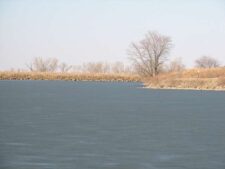
McPherson State fishing lake by: Steven Rodriguez

Synthetic structures are forty-eight cubic feet and can last more than 10 years

PRATT ­– Kansas Department of Wildlife, Parks and Tourism (KDWPT) fisheries staff will be launching a new program to increase the amount of fish-attracting structures in Kansas lakes. Traditionally, biologists have used cut trees to create brush piles to attract and hold fish, providing angling hotspots. However, attaching concrete blocks to trees can be labor intensive and time consuming and the trees don’t last very long once submerged in the water. The new specially-designed PVC structures are in the shape of a cubes three feet tall, four feet wide, and four feet deep. Cost-effective, easy to place and proven in other states, the new structures not only last more than three times longer than natural brush piles, but they also have been shown to hold as many fish as the natural counterpart without affecting water quality. Anglers can expect to see the implementation of these structures as soon as early February.

“Our goal is to produce 150-300 of these PVC cubes each year,” said Bryan Sowards, KDWPT fisheries programs specialist. “For 2015, structures will go in Milford, Wilson, Melvern, El Dorado, and Cedar Bluff, as well as a variety of other community and state fishing.” Sowards added the structures will immediately attract fish for angler harvest, but the overall goal is to accumulate enough structures to improve fish populations.

Known as “Georgia Cubes,” the structures were originally designed by the Georgia Department of Natural Resources (DNR). Stacking more than 50 feet of corrugated pipe on the PVC frame, Georgia DNR staff have been able to create optimum surface area to attract fish while still maintaining an open design. They have also found that the structures quickly accumulate periphyton, a complex mix of algae, fungi, and bacteria, which further attracts insects and fish – an ideal result for both fisheries staff and anglers.

Thanks to the involvement and commitment of Kansas B.A.S.S. Nation (KBN) clubs, KDWPT staff will have assistance in constructing and placing these cubes in select Kansas waters.

“These cubes will not only provide habitat for adult fish of all species, but also provide critical nursery habitat.” said Jeff Nolte, Conservation Director for KBN. “We at KBN are very excited and encouraged by the fisheries staff’s commitment to improving Kansas fisheries in general. We have had a great relationship with KDWPT in the past and this cooperative effort bodes well for a continued relationship that will benefit all fisheries, not just bass.”

Source: Kansas Department of Wildlife, Parks and Tourism

Roger’s View From The Hills: Oh That Early Spring Day

0
 “SUNSHINE ON MY SHOULDER
MAKES ME HAPPY”.
                                              John Denver
     There is such a nice thing that happens now and then in the late winter that really makes me happy.  It is that odd day or two that the cold, blowy, cloudy, winter days seem to be getting longer as I get longer in the tooth.  With the blood sugar that is always giving me problems I seem to be cold all the time.  Setting on the porch on summer days are a pure pleasure now instead of hibernating under the air conditioner of earlier years.
       Well this week I was able to take the dog out on the porch and I have gotten the same pleasure of a warm sunbeam that she does.  It is a great feeling to thaw out clear to the bones including my toes.
      Now part of the pure pleasure besides the sunshine is the TV turned off and the continual drivel of News is off and the quiet is so nice. I have the CD player on with silly stories by Andy Nelson.  As I am writing this the sun is starting to warm up one last time for now.  And I am handed a 21st century staple gun that needs loading.  After an hour of ruining my attitude it goes in the trash and the perfected design from the 1950’s is dug out and put back into service.
      Oh I can feel that sunshine now.  Soak up a batch of that vitamin D and snooze with the dog at my feet.  The Blizzard from Hell did not happen back east and the climate change people are trying to figure out how the fact that they can’t predict 12 hours that they can convince us that they can predict 50 years ahead.
      Sunshine on my shoulder makes me happy!!!!!

Rural Poll: Self-employment becoming more common in rural Nebraska

0

Lincoln, Neb., Jan. 29, 2015 — Many rural Nebraska households utilize self-employment and multiple job-holding to piece together their incomes, according to the Nebraska Rural Poll.

The 19th annual University of Nebraska-Lincoln poll was sent to 6,813 households in 86 Nebraska counties last spring. Results are based on 1,943 responses.

Data from the Bureau of Economic Analysis in 2012 show self-employment to be the fastest growing employment segment in Nebraska’s non-metropolitan counties. While the most recent recession may not have actually led to overall job losses in Nebraska, it may have accelerated the trend toward greater self-employment, especially in rural portions of the state, said Randy Cantrell, rural sociologist with the Nebraska Rural Futures Institute.

The 2014 poll backs up those findings in a series of questions about employment. The poll found that 75 percent of rural Nebraska households had at least one full-time job. Of the rural households with at least one person working, 43 percent derived part of their income from self-employment last year.

Self-employment is especially prevalent in or near smaller communities. Fifty-eight percent of respondents in or near towns with populations under 500 have at least one person in their household who is self-employed, compared to 31 percent of those in or near communities of 10,000 or more. Sixty-one percent of the self-employed households in or near the smallest communities have a farm or ranch, 48 percent have a farm-related business, 41 percent have a nonfarm business and 11 percent provide a contract service to a company.

“The increased prevalence of self-employment in more rural areas of Nebraska confirms the smaller role of large employers and the increased importance of small businesses and sole proprietorships in a diversified, entrepreneurial rural economy,” said Brad Lubben, assistant professor of agricultural economics.

Almost three in 10 self-employed households get at least 76 percent of their income from self-employment. Fifty-four percent get less than half their total household income from self-employment.

“Most of the self-employed households are relying on other sources of income. Self-employment is only one piece of their income,” said Cheryl Burkhart-Kriesel, associate professor and Nebraska Extension community vitality specialist.

This is demonstrated in the number of rural Nebraska households with multiple job-holding (having more jobs than adult members in their household). Just more than four in 10 employed rural Nebraska households have multiple job-holding by members of the household.

Multiple job-holding is also more common in smaller communities. Fifty-one percent of people living in or near towns with populations ranging from 500 to 999 have multiple job-holding in their household, compared to 37 percent of those living in or near cities with more than 10,000.

Other findings:


> 18 percent of employed rural Nebraska households have at least one member who telecommutes for at least one job.

> 28 percent of employed households report at least one member is overqualified for their job (has settled for a job they are overqualified for because nothing better is available).

> At least nine in 10 rural Nebraskans rate income for basic needs and being able to do work they enjoy as important or very important reasons in their decision to be employed.


The Rural Poll is the largest annual poll of rural Nebraskans’ perceptions on quality of life and policy issues. This year’s response rate was about 29 percent. The margin of error is plus or minus 2 percent. Complete results are available online at http://ruralpoll.unl.edu/report14.

With its 19-year history, the poll has a collection of data about rural trends and perceptions that is unmatched in the country, said Becky Vogt, survey research manager has worked on the Rural Poll since its second year.

Although the Grand Island area — Hall, Hamilton, Howard and Merrick counties — was designated a metropolitan area by the U.S. Census Bureau in 2013, the Rural Poll continues to include those counties in its sample. Dixon and Dakota counties were added to the poll this year.

UNL’s Department of Agricultural Economics conducts the poll in cooperation with the Nebraska Rural Futures Institute with funding from UNL Extension and the Agricultural Research Division in the Institute of Agriculture and Natural Resources.

Kansas Farmer Veteran Coalition Formation Exploration Forum to be Held February 10

0
kfu

Exploration forum to determine and hopefully create the groundwork for a Kansas chapter of the Farmer Veteran Coalition


MCPHERSON, KS Jan. 29, 2015 – On Tuesday, Feb 10th at 3:00 p.m. the Kansas Farmers Union, the Kansas Farm Bureau, and the Farm Credit Associations of Kansas will host a forum to explore the possibility and interest of forming a Kansas chapter of the National Farmer Veteran Coalition.


We feel that there is a need and an opportunity for veterans interested in entering agriculture to form a Kansas chapter and we have set up this forum to help jump-start the process.


Any entities interested in becoming a part of the Kansas Farmer Veteran Coalition chapter are encouraged to participate. Veterans, organizations, anyone who wants to become involved are welcome.


It is expected there will be a representative from the National Farmer Veteran Coalition in attendance to help start the process.


The meeting will be held in Manhattan Kansas at the Frontier Farm Credit building at 2009 Vanesta Place, Manhattan KS 66503. View on Google Maps.


Please RSVP to Donn Teske.